Lecture 18 Logistics HW7 is due on Monday (and topic included in - - PDF document

lecture 18
SMART_READER_LITE
LIVE PREVIEW

Lecture 18 Logistics HW7 is due on Monday (and topic included in - - PDF document

Lecture 18 Logistics HW7 is due on Monday (and topic included in midterm 2) Midterm 2 on Wednesday in lecture slot Midterm 2 on Wednesday in lecture slot cover materials up to todays lecture Review session Tuesday 4:15pm


slide-1
SLIDE 1

Lecture 18

Logistics

HW7 is due on Monday (and topic included in midterm 2) Midterm 2 on Wednesday in lecture slot Midterm 2 on Wednesday in lecture slot

cover materials up to today’s lecture

Review session Tuesday 4:15pm in EEB125

Last lecture

Finish counter design More complex finite-state machines

Today

1

CSE370, Lecture 19, 20

Today

More and Mealy machines 18

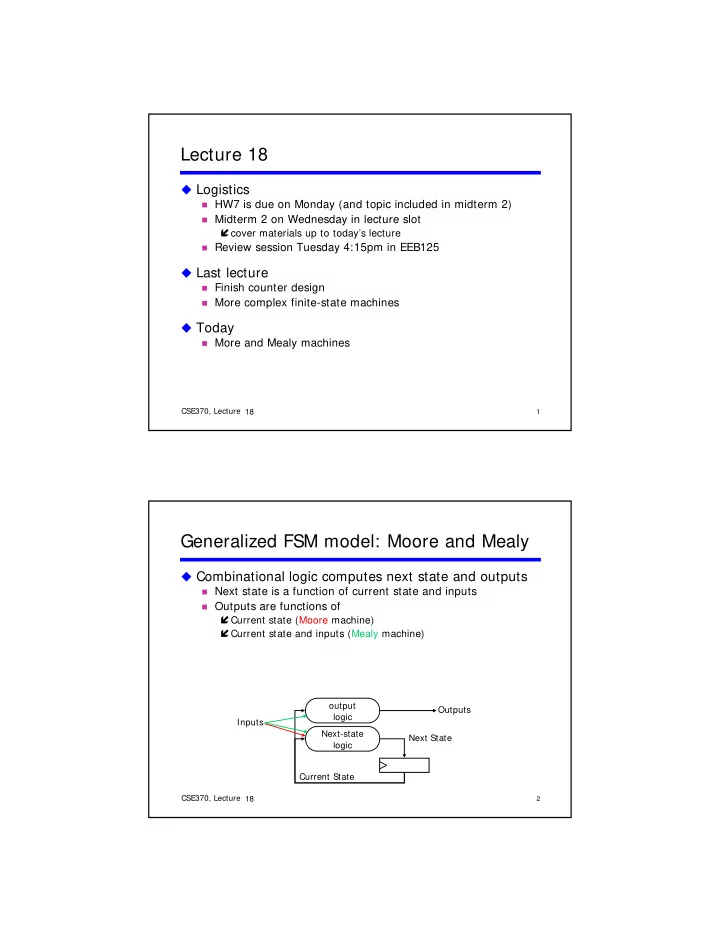
Generalized FSM model: Moore and Mealy

Combinational logic computes next state and outputs

Next state is a function of current state and inputs Outputs are functions of

Outputs

  • utput

Outputs are functions of

Current state (Moore machine) Current state and inputs (Mealy machine)

2

CSE370, Lecture 19, 20

Inputs Outputs Next State Current State logic Next-state logic

18

slide-2
SLIDE 2

Moore versus Mealy machines

inputs combinational l i f

Moore machine

Outputs are a function f t t t

  • utputs

state feedback reg logic for next state logic for

  • utputs
  • f current state

Outputs change synchronously with state changes

Mealy machine

Outputs depend on state

inputs

  • utputs

logic for

  • utputs

3

CSE370, Lecture 19, 20

Outputs depend on state and on inputs Input changes can cause immediate output changes

(asynchronous)

state feedback reg combinational logic for next state

  • utputs

18

Example 10 -> 01: Moore or Mealy?

Circuits recognize AB= 10 followed by AB= 01

What kinds of machines are they?

D Q Q D Q Q D Q Q D Q Q A B clock

  • ut
  • ut

4

CSE370, Lecture 19, 20

D Q Q D Q Q A B clock

Moore Mealy

18

slide-3
SLIDE 3

Example 01/10 detector: a Moore machine

Output is a function of state only

Specify output in the state bubble

D/1 B/0 A/0 1 1 reset current next current reset input state state

  • utput

1 – – A A B 1 A C B B 1 B D

5

CSE370, Lecture 19, 20

E/1 C/0 1 1 1 C E 1 C C D E 1 1 D C 1 E B 1 1 E D 1

18

Example 01/10 detector: a Mealy machine

Output is a function of state and inputs

Specify outputs on transition arcs

current next current reset input state state

  • utput

B A 0/1 0/0 0/0 1/1 reset/0 1 – – A A B 1 A C B B

6

CSE370, Lecture 19, 20

C 1/0 1/0 B B 1 B C 1 C B 1 1 C C

18

slide-4
SLIDE 4

Comparing Moore and Mealy machines

Moore machines

+ Safer to use because outputs change at clock edge – May take additional logic to decode state into outputs – May take additional logic to decode state into outputs

Mealy machines

+ Typically have fewer states + React faster to inputs — don't wait for clock – Asynchronous outputs can be dangerous

We often design synchronous Mealy machines

D i M l hi

7

CSE370, Lecture 19, 20 Design a Mealy machine Then register the outputs 18

Synchronous (registered) Mealy machine

Registered state and registered outputs

No glitches on outputs No race conditions between communicating machines No race conditions between communicating machines

inputs

  • utputs

reg combinational logic for next state logic for

  • utputs

reg

8

CSE370, Lecture 19, 20

state feedback

18

slide-5
SLIDE 5

Example 0 -> 1: Moore or Mealy?

Recognize A,B = 0,1

Mealy or Moore?

D Q Q B A clock

  • ut

D Q

  • ut

A

Registered Mealy (actually Moore)

9

CSE370, Lecture 19, 20

9

Q D Q Q clock B

Moore

18

FSM design procedure reminder

Counter-design procedure

  • 1. State diagram
  • 2. State-transition table
  • 3. Next-state logic minimization
  • 4. Implement the design

FSM-design procedure

  • 1. State diagram
  • 2. state-transition table
  • 3. State minimization

4 State encoding

10

CSE370, Lecture 19, 20

  • 4. State encoding
  • 5. Next-state logic minimization
  • 6. Implement the design

17 18

slide-6
SLIDE 6

Example: A parity checker

Serial input string

OUT= 1 if odd # of 1s in input OUT= 0 if even # of 1s in input

Let’s do this for Moore and Mealy

11

CSE370, Lecture 19, 20 18

Example: A parity checker

1.

State diagram Moore Mealy

Even [0] 1 1

  • a y

Even [0] 1 1

0/0 1/1 1/0

12

CSE370, Lecture 19, 20 Odd [1] Odd [1]

0/1

18

slide-7
SLIDE 7

Example: A parity checker

  • 1. State-transition table

Moore Present Input Next Present State State Output

Even Even Even 1 Odd Odd Odd 1 Odd 1 Even 1 Present Input Next Present

State State Output Mealy

13

CSE370, Lecture 19, 20

State State Output

Even Even Even 1 Odd 1 Odd Odd 1 Odd 1 Even

18

  • 3. State minimization: Already minimized

Need both states (even and odd) Use one flip flop

Example: A parity checker

Use one flip-flop

14

CSE370, Lecture 19, 20 18

slide-8
SLIDE 8
  • 4. State encoding

Assignment Even 0 Odd 1

Moore

Example: A parity checker

Present Input Next Present State State Output

1 1 1 1 1 1 1 0 1

P t I t N t P t Mealy

15

CSE370, Lecture 19, 20

Present Input Next Present State State Output

1 1 1 1 1 1 1 1 0

18

Example: A parity checker

  • 5. Next-state logic minimization

Assume D flip-flops Next state = (present state) XOR (present input) Next state = (present state) XOR (present input)

  • 6. Implement the design

D Q D Q Output

Moore Mealy

16

CSE370, Lecture 19, 20

D Q Q CLK Input Output D Q Q CLK Input Current State

18

slide-9
SLIDE 9

Example: A vending machine

15 cents for a cup of coffee Doesn’t take pennies or quarters

Reset

Doesn t take pennies or quarters Doesn’t provide any change

Last lecture We had mix of

Vending Machine FSM N D Open Coin Sensor Release Mechanism

17

CSE370, Lecture 19, 20

Moore and Mealy

17

Clock

18

A vending machine: Moore machine

present inputs next

  • utput

state D N state

  • pen

Reset state D N state

  • pen

0¢ 0¢ 1 5¢ 1 10¢ 1 1 – – 5¢ 5¢ 1 10¢ 1 15¢ 1 1 – – 10¢ 10¢ 1 15¢ 0¢ 5¢ N N D

18

CSE370, Lecture 19, 20 17

symbolic state table 1 15¢ 1 1 – – 15¢ – – 15¢ 1 N + D 10¢ 15¢ [open] D

18

slide-10
SLIDE 10

A vending machine: Mealy machine

present inputs next

  • utput

state D N state

  • pen

Reset state D N state

  • pen

0¢ 0¢ 1 5¢ 1 10¢ 1 1 – – 5¢ 5¢ 1 10¢ 1 15¢ 1 1 1 – – 10¢ 10¢ 1 15¢ 1 0¢ 5¢ N/0 N/0 D/0

19

CSE370, Lecture 19, 20 17

symbolic state table 1 15¢ 1 1 1 – – 15¢ – – 15¢ 1 N + D/1 10¢ 15¢ D/1

18

A vending machine: State encoding

Moore Mealy

present state inputs next state

  • utput

Q1 Q0 D N D1 D0

  • pen

1 1 1 1 1 1 – – – 1 1 1 1 1 1 1 1 1 – – – present state inputs next state

  • utput

Q1 Q0 D N D1 D0

  • pen

1 1 1 1 1 1 – – – 1 1 1 1 1 1 1 1 1 1 – – – 1 1

20

CSE370, Lecture 19, 20 17

1 1 1 1 1 1 1 1 1 1 – – – 1 1 – – 1 1 1 1 1 1 1 1 1 1 1 1 1 1 1 – – – 1 1 – – 1 1 1

18

slide-11
SLIDE 11

A vending machine: Logic minimization

1 1 1 1 1 Q1 D1 1 1 Q1 D0 1 0 Q1 Open

Moore

1 1 1 X X X X 1 1 1 1 Q0 N D 1 1 1 X X X X 1 1 1 Q0 N D 1 X X 1 X 1 Q0 N D 1 1 Q1 D1 Q1 D0 Q1 Open

Mealy

21

CSE370, Lecture 19, 20 17

1 1 1 1 1 X X X X 1 1 1 1 Q0 N D 1 1 1 1 1 X X X X 1 1 1 Q0 N D 1 0 1 1 X X 1 X 1 1 1 Q0 N D

18

A vending machine: Implementation

Moore Mealy

22

CSE370, Lecture 19, 20 18