Using CMB data to study Dark Matter-Photon Interactions DM DM - - PowerPoint PPT Presentation

using cmb data to study dark matter photon interactions
SMART_READER_LITE
LIVE PREVIEW

Using CMB data to study Dark Matter-Photon Interactions DM DM - - PowerPoint PPT Presentation

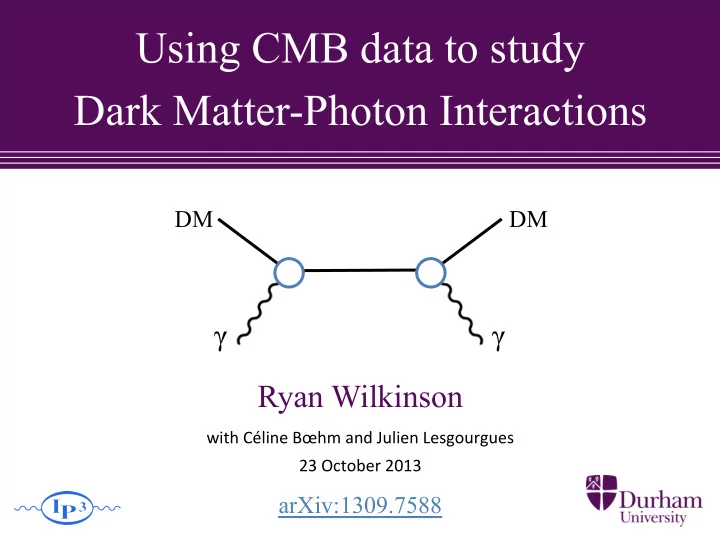
Using CMB data to study Dark Matter-Photon Interactions DM DM Ryan Wilkinson with Cline Bhm and Julien Lesgourgues 23 October 2013 arXiv:1309.7588 Motivation 2 We dont yet


slide-1
SLIDE 1

Using CMB data to study Dark Matter-Photon Interactions

with ¡Céline ¡Bœhm ¡and ¡Julien ¡Lesgourgues ¡

¡

23 ¡October ¡2013 ¡
Ryan Wilkinson

arXiv:1309.7588 DM

γ γ

DM

slide-2
SLIDE 2

Ryan Wilkinson 23 October 2013 arXiv:1309.7588

2

  • We ¡don’t ¡yet ¡know ¡the ¡nature ¡of ¡DM. ¡
  • DetecFon ¡methods ¡generally ¡assume: ¡
  • ­‑ ¡ ¡Late-­‑Fme ¡annihilaFons ¡in ¡our ¡galaxy ¡

¡-­‑ ¡ ¡InteracFons ¡with ¡quarks ¡

  • DM-­‑SM ¡interacFons ¡dampen ¡maNer ¡fluctuaFons, ¡erasing ¡all ¡structure ¡

smaller ¡than ¡the ¡induced ¡damping ¡scale: ¡

  • Can ¡constrain ¡the ¡cross ¡secFon ¡using ¡CMB ¡data, ¡independent ¡of ¡the ¡

vanilla ¡DM ¡assumpFons. ¡

  • DM-­‑γ ¡interacFons ¡can ¡occur ¡through ¡processes ¡involving ¡SM ¡parFcles ¡or ¡

magneFc ¡and ¡dipole ¡moments. ¡

  • Preliminary ¡result ¡(pre-­‑WMAP): ¡ ¡

Motivation

}

not ¡always ¡appropriate! ¡

¡

lid ~ π H Γi " # $ % & '

1/2 vit

a

dec(DM−i)

Bœhm ¡et ¡al. ¡(2004) ¡

Largest ¡for ¡ relaFvisFc ¡parFcles ¡

σ DM−γ ≤ 7×10⁻³⁰(mDM / GeV) cm2

Bœhm ¡et ¡al. ¡(2002) ¡

slide-3
SLIDE 3

Ryan Wilkinson 23 October 2013 arXiv:1309.7588

3

  • Add ¡DM-­‑γ ¡interacFon ¡to ¡Euler ¡equaFons: ¡ ¡
  • Also ¡need ¡to ¡modify ¡photon ¡temperature ¡and ¡polarisaFon ¡equaFons. ¡
¡
  • To ¡quanFfy ¡the ¡effect ¡on ¡the ¡CMB, ¡we ¡introduce: ¡
¡
  • We ¡consider ¡σDM-­‑γ ¡const. ¡and ¡prop. ¡T2. ¡
  • Made ¡use ¡of: ¡
¡

¡-­‑ ¡ ¡Boltzmann ¡code ¡CLASS ¡ ¡-­‑ ¡ ¡Line-­‑of-­‑sight ¡integraFon ¡approach ¡

¡

Implementation

 θb = k2ψ − Hθb +cs

2k2δb − R−1 

κ θb −θγ

( )

 θγ = k2ψ + k2 δγ / 4−σ γ

( )− 

κ θγ −θb

( )− 

µ θγ −θDM

( )

 θDM = k2ψ − HθDM − S−1  µ θDM −θγ

( )

DM-­‑γ ¡InteracFon ¡Rate ¡

 µ ≡ aσ DM−γcnDM

S ≡ (3/ 4)(ρDM / ργ ) u ≡ σ DM−γ σ Th # $ % & ' ( mDM 100 GeV # $ % & ' (

−1

[class-­‑code.net] ¡Lesgourgues ¡(2011) ¡ Seljak ¡& ¡Zaldarriaga ¡(1996) ¡

Ensures ¡energy ¡conservaFon ¡

slide-4
SLIDE 4

Ryan Wilkinson 23 October 2013 arXiv:1309.7588

4

Effects on the CMB

101 102 103 104 500 1000 1500 2000 2500 3000 [l(l+1) Cl

TT / 2] (µK2)

l u = 10-2 u = 5×10⁻³ u = 10-3 u = 10-4 u = 0

u ≡ σ DM−γ σ Th # $ % & ' ( mDM 100 GeV # $ % & ' (

−1

Suppression ¡of ¡ small-­‑scale ¡power ¡ Shi] ¡in ¡peaks ¡to ¡ larger ¡mulFpoles ¡

DM-­‑γ

cross ¡secFon ¡

slide-5
SLIDE 5

Ryan Wilkinson 23 October 2013 arXiv:1309.7588

5

Constraints from Planck

}

2.13 2.23 2.33

100 Ωbh2 = 2.21+0.0288

−0.0319

0.111 0.12 0.13

ΩDMh2 = 0.12+0.00275

−0.00284

0.111 0.12 0.13 64 68 72

100 h = 67.6+1.23

−1.23

64 68 72 2.05 2.23 2.41

10+9 As = 2.2+0.0532

−0.0594

2.05 2.23 2.41 0.938 0.962 0.987

ns = 0.963+0.00744

−0.00792

0.938 0.962 0.987 7.12 11 15

zreio = 11.2+1.14

−1.13

7.12 11 15 3.44 6.19

10+4 u = 1.01+0.16

−1.01

2.13 2.23 2.33 3.44 6.19 0.111 0.12 0.13 64 68 72 2.05 2.23 2.41 0.938 0.962 0.987 7.12 11 15

  • To ¡fit ¡our ¡model ¡to ¡the ¡data, ¡we ¡varied: ¡
  • Assumed ¡three ¡acFve ¡neutrinos ¡(Σmν ¡= ¡0.06 ¡eV). ¡
  • Made ¡use ¡of: ¡

¡-­‑ ¡ ¡‘Planck+WP’ ¡data ¡

¡-­‑ ¡ ¡Monte ¡Python ¡

Ωbh2 ΩDMh2 ns As H0 zreio u

Planck ¡CollaboraMon ¡(2013) ¡ [montepython.net] ¡Audren ¡et ¡al. ¡(2013) ¡

New ¡constraints ¡

σ DM−γ ≤ 8×10⁻³¹(mDM / GeV) cm2

Constant ¡σ ¡: ¡ σ ¡prop. ¡T2 ¡: ¡

σ DM−γ,0 ≤ 6×10−40(mDM / GeV) cm2

(at ¡68% ¡CL) ¡

u ≤10−4

slide-6
SLIDE 6

Ryan Wilkinson 23 October 2013 arXiv:1309.7588

6

10-2 10-1 100 101 102 2500 3000 3500 4000 4500 5000 5500 6000 [l(l+1) Cl

TT / 2] (µK2)

l u = 10-4 WMAP-9 Planck SPT ACT

Prospects for future experiments

100 101 102 103 104 500 1000 1500 2000 2500 3000 3500 4000 4500 [l(l+1) Cl

TT / 2] (µK2)

l u = 10-4 WMAP-9 Planck SPT ACT

20 40 2750 3000 3250

u ≡ σ DM−γ σ Th # $ % & ' ( mDM 100 GeV # $ % & ' (

−1

  • Large ¡deviaFon ¡from ¡ΛCDM ¡for ¡l ¡> ¡3000. ¡
  • At ¡l ¡= ¡6000, ¡power ¡is ¡suppressed ¡by ¡a ¡factor ¡4 ¡-­‑> ¡SPT, ¡ACT. ¡
  • However, ¡foregrounds ¡are ¡dominant ¡in ¡this ¡region. ¡
  • Need ¡to ¡ensure ¡accurate ¡foreground ¡modelling ¡and ¡removal. ¡
slide-7
SLIDE 7

Ryan Wilkinson 23 October 2013 arXiv:1309.7588

7

10-8 10-6 10-4 10-2 100 102 104 10-2 10-1 100 P(k) (h-1 Mpc)3 k (h Mpc-1) u = 10-2 u = 10-3 u = 10-4 u = 10-5 u = 0

Prospects for future experiments

10-3 10-2 10-1 1000 2000 3000 4000 5000 6000 [l(l+1) Cl

BB / 2] (µK2)

l u = 5×10⁻³ u = 10-3 u = 10-4 u = 10-5 u = 0 SPTpol 3 SPTpol 2 SPTpol 1

u ≡ σ DM−γ σ Th # $ % & ' ( mDM 100 GeV # $ % & ' (

−1

  • Large ¡suppression ¡of ¡B-­‑modes. ¡
  • First-­‑season ¡data ¡from ¡SPT ¡can ¡

already ¡rule ¡out ¡u ¡> ¡5 ¡× ¡10-­‑3. ¡

  • Future ¡data ¡from ¡SPT, ¡

POLARBEAR, ¡SPIDER ¡etc. ¡could ¡ disFnguish ¡u ¡= ¡10-­‑5 ¡from ¡ΛCDM. ¡

  • Damped ¡oscillaFons ¡in ¡the ¡P(k). ¡
  • DeviaFon ¡from ¡ΛCDM ¡restricted ¡

to ¡non-­‑linear ¡regime. ¡

  • Expect ¡intermediate ¡between ¡

CDM ¡and ¡WDM. ¡

  • LSS ¡surveys: ¡SDSS-­‑III, ¡Euclid ¡etc. ¡
slide-8
SLIDE 8

Ryan Wilkinson 23 October 2013 arXiv:1309.7588

8

Conclusions

  • We ¡have ¡studied ¡the ¡effects ¡of ¡DM-­‑photon ¡interacFons ¡on ¡the ¡CMB. ¡
  • By ¡comparing ¡the ¡spectra ¡with ¡Planck ¡data, ¡we ¡have ¡set ¡stringent ¡

limits ¡on ¡the ¡scaNering ¡cross ¡secFon: ¡

  • For ¡heavy ¡DM ¡(TeV), ¡large ¡constant ¡cross ¡secFons ¡with ¡photons ¡are ¡
  • allowed. ¡
  • For ¡light ¡DM ¡(MeV), ¡the ¡cross ¡secFon ¡is ¡of ¡the ¡order ¡typically ¡expected ¡

for ¡(SM) ¡weak ¡interacFons. ¡

  • A ¡stronger ¡result ¡could ¡be ¡achieved ¡using ¡future ¡Cl ¡data ¡from ¡

polarisaFon ¡experiments ¡and ¡Planck, ¡and ¡informaFon ¡on ¡the ¡P(k). ¡

  • Importantly, ¡one ¡can ¡use ¡cosmological ¡data ¡to ¡study ¡DM ¡interacFons, ¡

independently ¡of ¡any ¡theoreFcal ¡prejudice. ¡

σ DM−γ ≤ 8×10⁻³¹(mDM / GeV) cm2

Constant ¡σ ¡: ¡ σ ¡prop. ¡T2 ¡: ¡

σ DM−γ,0 ≤ 6×10−40(mDM / GeV) cm2