LCS 11: Cognitive Science GQ 4.1 group discussion Language - - PowerPoint PPT Presentation

lcs 11 cognitive science
SMART_READER_LITE
LIVE PREVIEW

LCS 11: Cognitive Science GQ 4.1 group discussion Language - - PowerPoint PPT Presentation

Agenda Pomona College The mapping problem LCS 11: Cognitive Science GQ 4.1 group discussion Language acquisition 3 Constraints on word learning 0.1 Whole object 0.2 Taxonomic Jesse A. Harris 0.3 Mutual exclusivity 0.4 Fast mapping


slide-1
SLIDE 1

Pomona College

LCS 11: Cognitive Science

Language acquisition 3

Jesse A. Harris April 1, 2013

Jesse A. Harris: LCS 11: Cognitive Science, Language acquisition 3 1

Agenda

֠ The mapping problem ֠ GQ 4.1 group discussion ֠ Constraints on word learning

0.1 Whole object 0.2 Taxonomic 0.3 Mutual exclusivity 0.4 Fast mapping 0.5 Syntax

Jesse A. Harris: LCS 11: Cognitive Science, Language acquisition 3 2

The mapping problem

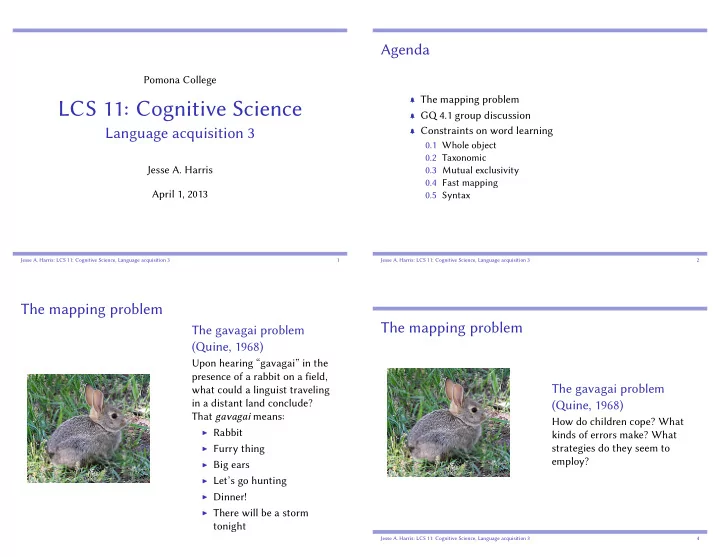
The gavagai problem (Quine, 1968)

Upon hearing “gavagai” in the presence of a rabbit on a field, what could a linguist traveling in a distant land conclude? That gavagai means:

◮ Rabbit ◮ Furry thing ◮ Big ears ◮ Let’s go hunting ◮ Dinner! ◮ There will be a storm

tonight

The mapping problem

The gavagai problem (Quine, 1968)

How do children cope? What kinds of errors make? What strategies do they seem to employ?

Jesse A. Harris: LCS 11: Cognitive Science, Language acquisition 3 4

slide-2
SLIDE 2

GQ 4.1

The language learner faces a great many challenges in learning a word’s meaning. Children often overgeneralize

  • r overextend the meaning of a word. A famous case in the

literature is a child who learned the word for "moon" and then applied it to cakes, round marks, postmarks, and the letter "O". What is the child doing in these cases? What might the specific overgeneralizations that a child uses reveal about his or her strategy for word learning? How might such a strategy by efficient in terms of word learning? Group leaders: Ally, Thomas, Jun, Paul, Becca, Sam, Ryan, Daniel, Stephen

Jesse A. Harris: LCS 11: Cognitive Science, Language acquisition 3 5

The mapping problem

Errors

◮ Overextensions: moon applies to any round object ◮ Underextensions: puppy means only the child’s puppy

Questions

What do these errors reveal about strategies employed by children?

Jesse A. Harris: LCS 11: Cognitive Science, Language acquisition 3 6

Assumptions

Assumptions

  • 1. Whole object assumption – word labels refer to whole
  • ver parts
  • 2. Taxonomic assumption – word labels extended to kinds

rather than those that are thematic related

  • 3. Mutual exclusivity – one word label per object

Jesse A. Harris: LCS 11: Cognitive Science, Language acquisition 3 7

Whole object assumption

Whole object

Children (and adults) immediately take a new word to refer to the whole object, rather than a part or a property of that

  • bject.

(Soja, Carey, & Spelke, 1991 )

Jesse A. Harris: LCS 11: Cognitive Science, Language acquisition 3 8

slide-3
SLIDE 3

Taxonomic assumption

Taxonomic assumption

Children assume that a word label should be extended to an

  • bject of the same kind (rather than one with a similar role).

Markman & Hitchinson (1984) tested how children use taxonomic vs. thematic relations with and without word labels.

Jesse A. Harris: LCS 11: Cognitive Science, Language acquisition 3 10

Taxonomic assumption

‘Find another one’ Thematic associate Taxonomic associate

Jesse A. Harris: LCS 11: Cognitive Science, Language acquisition 3 11

Taxonomic assumption

‘This is a fep. Find another fep.’ Thematic associate Taxonomic associate

Jesse A. Harris: LCS 11: Cognitive Science, Language acquisition 3 12

slide-4
SLIDE 4

Mutual exclusivity assumption

Mutual exclusivity

Children assume that one word cannot refer to two different kinds of things. Where is the dax?

Jesse A. Harris: LCS 11: Cognitive Science, Language acquisition 3 13

Fast mapping

Fast mapping

Associating a word with its referent after a single exposure: single trial learning, typically framed in terms of a deductive hypothesis about what word is likely to mean, given what learner already knows.

◮ Children show incredible fast-mapping abilities from age

2 on

◮ But can animals also show fast-mapping like behavior?

Jesse A. Harris: LCS 11: Cognitive Science, Language acquisition 3 14

Fast mapping

Rico, the border collie http://www.hulu.com/watch/87813

Jesse A. Harris: LCS 11: Cognitive Science, Language acquisition 3 15

Fast mapping

Jesse A. Harris: LCS 11: Cognitive Science, Language acquisition 3 16

slide-5
SLIDE 5

Differences

Rico

  • 1. Rico is likely exceptional
  • 2. Vocabulary limited even

by age 9

  • 3. Complexity limited
  • 4. Context for learning

limited to fetching

A child

  • 1. Nearly all children learn

words

  • 2. At 9, children know 10s
  • f thousands of words
  • 3. Complexity unbounded
  • 4. Context for learning

varies

Jesse A. Harris: LCS 11: Cognitive Science, Language acquisition 3 17

Fast mapping

Fast mapping specific to words?

◮ Adults and Children (3–4 yrs) given 10 objects to play

with as part of a game.

◮ Names were casually introduced in two conditions and a

control: Name “Let’s use the koba to measure which is

  • longer. We can put the koba away now. “

Description “We can use the thing my uncle gave me to measure which is longer. We can put the thing my uncle gave me away now.” Control “The sticker goes here ...” (Placing sticker

  • n an object.)

◮ Retention high for both name and description, but did not

extend to control.

Word learning

Vocabulary explosion 10 –15 mo First words 16–18 mo Approx 8 – 12 words per month > 18 mo Approx 10 words per day Explosion may depend on a variety of devices: The ability to learn the meaning of words depends on a number of capacities, some of which are specific to language and unique to humans, others of which are potentially shared with other species. (Bloom & Markman, 1998)

Jesse A. Harris: LCS 11: Cognitive Science, Language acquisition 3 20

slide-6
SLIDE 6

Linguistic capacities

Use knowledge of syntax to determine the basic ontological categories of words (1) This is ...

  • a. Stella

a name

  • b. a doll

a kind (2)

  • a. Do you know what a sib is? In this picture, you can

see a sib. Count noun syntax

  • b. Have you seen sibbing? In this picture, you can see

sibbing. Verb syntax

Jesse A. Harris: LCS 11: Cognitive Science, Language acquisition 3 21

Sensitivity

Open questions

  • 1. How might children become sensitive to these cues?
  • 2. When might we expect that these cues become active in

development?

  • 3. What would we learn about these sorts of mechanisms if

dogs like Rico could use syntactic cues in fast mapping? Is it likely that they can?

Jesse A. Harris: LCS 11: Cognitive Science, Language acquisition 3 22