LCS 11: Cognitive Science Nature vs. nuture divide Poverty of the - - PowerPoint PPT Presentation

lcs 11 cognitive science
SMART_READER_LITE
LIVE PREVIEW

LCS 11: Cognitive Science Nature vs. nuture divide Poverty of the - - PowerPoint PPT Presentation

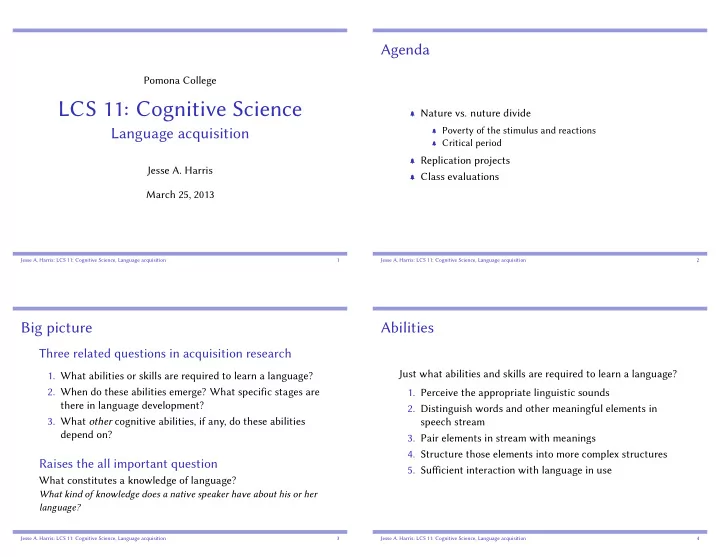
Agenda Pomona College LCS 11: Cognitive Science Nature vs. nuture divide Poverty of the stimulus and reactions Language acquisition Critical period Replication projects Jesse A. Harris Class evaluations March 25, 2013 Jesse A.


slide-1
SLIDE 1

Pomona College

LCS 11: Cognitive Science

Language acquisition

Jesse A. Harris March 25, 2013

Jesse A. Harris: LCS 11: Cognitive Science, Language acquisition 1

Agenda

֠ Nature vs. nuture divide

֠ Poverty of the stimulus and reactions ֠ Critical period

֠ Replication projects ֠ Class evaluations

Jesse A. Harris: LCS 11: Cognitive Science, Language acquisition 2

Big picture

Three related questions in acquisition research

  • 1. What abilities or skills are required to learn a language?
  • 2. When do these abilities emerge? What specific stages are

there in language development?

  • 3. What other cognitive abilities, if any, do these abilities

depend on?

Raises the all important question

What constitutes a knowledge of language?

What kind of knowledge does a native speaker have about his or her language?

Jesse A. Harris: LCS 11: Cognitive Science, Language acquisition 3

Abilities

Just what abilities and skills are required to learn a language?

  • 1. Perceive the appropriate linguistic sounds
  • 2. Distinguish words and other meaningful elements in

speech stream

  • 3. Pair elements in stream with meanings
  • 4. Structure those elements into more complex structures
  • 5. Sufficient interaction with language in use

Jesse A. Harris: LCS 11: Cognitive Science, Language acquisition 4

slide-2
SLIDE 2

Segmentation problem

(1) Thisisanaverageexampleofaspeechstream.

Segmentation problem

There are rarely definitive pauses between words in a speech

  • stream. How can the child learn how to recognize word

boundaries?

Jesse A. Harris: LCS 11: Cognitive Science, Language acquisition 5

Segmentation problem

This an average example of a speech stream

Segmentation problem

Time (s) 2.194

  • 0.1477

0.2003

Segmentation problem

slide-3
SLIDE 3

Segmentation problem

(2)

  • a. Two dults

(Uttered)

  • b. Two adults

(Target) (3)

  • a. I don’t want to go to your ami

(Uttered)

  • b. I don’t want to go to your Miami

(Target) (4)

  • a. I am being have!

(Uttered)

  • b. I am behaving!

(Target)

Jesse A. Harris: LCS 11: Cognitive Science, Language acquisition 9

Segmentation problem

Phonological bootstrapping

Children use statistical regularities to determine likely word boundaries.

◮ Infants can’t use top-down knowledge to infer words ◮ Must make the most of the input ◮ Saffran et al (1996) proposed that infants use transitional

probability measures to infer boundaries.

Jesse A. Harris: LCS 11: Cognitive Science, Language acquisition 10

Segmentation problem

Transitional probabilities

The probability of one sound X given another Y: P(Y|X) = P(XY) P(X) ≈ freq(XY) freq(X)

◮ Languages regulate what sounds can go together within a

word, but not so much at a word boundary. Within word High transitional probabilities Between word Low transitional probabilities (5) pretty# baby pre + ty is high within word; ty + ba is low.

Jesse A. Harris: LCS 11: Cognitive Science, Language acquisition 11

Nature vs. Nuture

Nature

Child’s acquisition of language is acheived primarily through innate knowledge.

◮ Universality in grammar ◮ Specialized learning

device

◮ Inborn biases and

defaults

◮ Similiar development

Nuture

Child’s acquisition of language is acheived primarily through exposure.

◮ Statistical regularities ◮ Model learning with

limited memory

◮ Child directed speech

Plausibly elements of both!

Jesse A. Harris: LCS 11: Cognitive Science, Language acquisition 12

slide-4
SLIDE 4

Nuture

B.F. Skinner

The extreme case of behaviorism: Simple set of reward-based general learning principles that child uses to learn language. No previous knowledge or expectations.

Question

Does this view seem reasonable? What might be some intuitive concerns about such a view?

Jesse A. Harris: LCS 11: Cognitive Science, Language acquisition 13

Nature

Noam Chomsky

Impossible!

  • 1. Too many possible responses

given stimuli

  • 2. Ignores complexity and

creativity of language structures

  • 3. Too little exposure to develop

rich knowledge through imitation.

Jesse A. Harris: LCS 11: Cognitive Science, Language acquisition 14

Nature

Noam Chomsky

Instead, children acquire language by using an innate knowledge of language, along with very powerful language specific learning biases. Innate knowledge of language is abstract, and known as Universal Grammar (UG).

Jesse A. Harris: LCS 11: Cognitive Science, Language acquisition 15

Nature vs. Nuture

Poverty of the stimulus argument

The language that children acquire goes beyond the input that they receive. Language is unlearnable from exposure alone.

In support

◮ Limited negative

evidence

◮ Children seem

unresponsive to correction

◮ Grammatical judgments

for novel forms

◮ Relative uniformity in

development

slide-5
SLIDE 5

Child My teacher holded the rabbits and we patted them. Adult Did you say the teacher held the baby rabbits? Child Yes. Adult What did you say she did? Child She holded the baby rabbits and we patted them. Adult Did you say she held them tightly? Child No, she holded them loosely. Jean Berko

http://www.onbeing.org/program/unfolding-language-unfolding-life/256

Nature vs. Nuture

Poverty of the stimulus argument

The language that children acquire goes beyond the input that they receive. Language is unlearnable from exposure alone.

In support

◮ Limited negative

evidence

◮ Children seem

unresponsive to correction

◮ Grammatical judgments

for novel forms

◮ Relative uniformity in

development

Wug test Wug test

slide-6
SLIDE 6

Wug test Wug test

◮ Full Wug test materials:

http://childes.psy.cmu.edu/topics/

◮ Video of Berko Gleason

describing her work:

http://video.pbs.org/video/1608569948/

Nature vs. Nuture

Poverty of the stimulus argument

The language that children acquire goes beyond the input that they receive. Language is unlearnable from exposure alone.

In support

◮ Limited negative

evidence

◮ Children seem

unresponsive to correction

◮ Grammatical judgments

for novel forms

◮ Relative uniformity in

development

Counterclaims

◮ Underestimates negative

evidence

◮ Children learn language

piecemeal according to cognitive limitations

◮ Unclear how a rich UG

would be innately encoded

Critical period

Developmental limitations

Acquiring a language requires that the child be exposed to sufficient language input within a developmental time window.

◮ Estimates vary: 5 years – puberty ◮ Period of neural plasticity ◮ Bilingualism ◮ Profeciency ◮ Failure to develop language ◮ Critical period observed in other species

Jesse A. Harris: LCS 11: Cognitive Science, Language acquisition 24

slide-7
SLIDE 7

Critical period

◮ Severely abused and isolated ◮ Discovered at age 13 without

having acquired speech

◮ Eventually able to acquire a

limited vocabulary, but never a fully complex linguistic system.

  • 1. Few grammatical words
  • 2. No auxiliaries
  • 3. Improper verbal and nominal

inflection

  • 4. No passives
  • 5. Negation limited