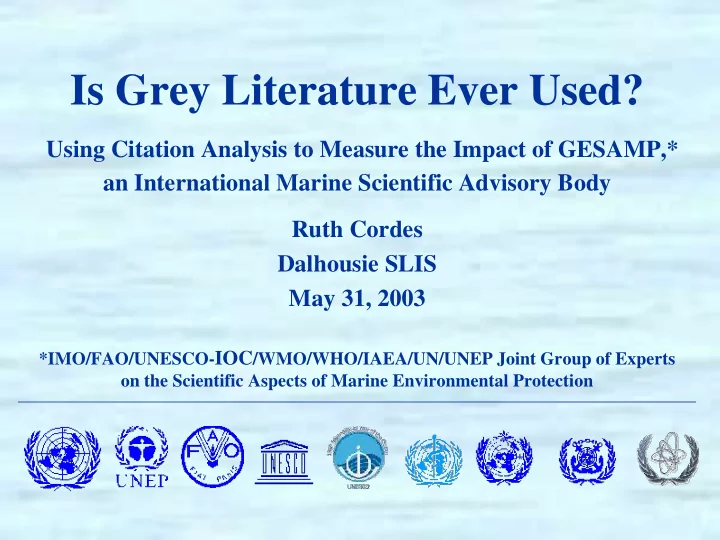
Is Grey Literature Ever Used? Using Citation Analysis to Measure the - - PowerPoint PPT Presentation

is grey literature ever used
SMART_READER_LITE
LIVE PREVIEW

Is Grey Literature Ever Used? Using Citation Analysis to Measure the - - PowerPoint PPT Presentation

Is Grey Literature Ever Used? Using Citation Analysis to Measure the Impact of GESAMP,* an International Marine Scientific Advisory Body Ruth Cordes Dalhousie SLIS May 31, 2003 *IMO/FAO/UNESCO- IOC /WMO/WHO/IAEA/UN/UNEP Joint Group of Experts


slide-1
SLIDE 1

Is Grey Literature Ever Used?

Using Citation Analysis to Measure the Impact of GESAMP,* an International Marine Scientific Advisory Body Ruth Cordes Dalhousie SLIS May 31, 2003

*IMO/FAO/UNESCO-IOC/WMO/WHO/IAEA/UN/UNEP Joint Group of Experts

  • n the Scientific Aspects of Marine Environmental Protection
slide-2
SLIDE 2

Presentation Outline

  • Background on GESAMP
  • Reasons for doing this study
  • Broader relevance
  • Discussion of Grey Literature and GESAMP

publications

  • Locating GESAMP citations
  • Analysis of the results
  • Impact of the study
slide-3
SLIDE 3

GESAMP

  • IMO/FAO/UNESCO-IOC/WMO/WHO/IAEA/UN/UNEP

Joint Group of Experts on the Scientific Aspects of Marine Environmental Protection – sponsored by the UN and seven of its agencies – active since 1969

  • is a committee of volunteer scientific experts

– working groups address specific questions

  • internal and external peer review of reports
  • gives advice on marine environmental protection

– to the agencies – through them, to their member governments – to scientists, managers, other organizations

slide-4
SLIDE 4

Why was this study done?

  • GESAMP was being reviewed

– needed evidence that its work is used

  • Citation indexes are an available tool

– locate references in journal articles

  • Citation analysis used elsewhere for

measuring impact of organizations

slide-5
SLIDE 5

Broader Relevance

  • GL is a large but undervalued genre
  • Citation studies can show that GL is used

– Few have been published

  • Developed strategies for locating citations of

a complex body of GL

slide-6
SLIDE 6

Grey Literature is…

“that which is produced on all levels of government,

academics, business and industry in print and electronic formats, but which is not controlled by commercial publishers”

(Fourth International Conference on Grey Literature, October 1999)

“literature which is not readily available through normal book selling channels, and therefore difficult to identify and obtain”

(C. P. Auger, 1998, Information Sources in Grey Literature, p. 3.)

also called “report literature”

slide-7
SLIDE 7

Grey Literature (GL) Spectrum

White Commercially published books and journals. Light grey Theses, standards, patents Technical reports in numbered series Electronic documents on the Internet Government documents Medium grey Corporate annual reports, directories Product information, catalogues Newsletters, conference proceedings, pre-prints Consultants’ reports, bibliographies Dark grey Brochures, non-commercial translations Background documents, drafts of technical reports Black Internal documents of organizations, other inaccessible items

slide-8
SLIDE 8

Grey Literature Features of GESAMP Reports and Studies

  • Inconsistencies in

– Corporate author name, series title, report title – Inclusion of ISSN, ISBN, date – Indexing

  • Eight publishing agencies

– Two “Report # 11”s – Some reports reprinted in other series

  • Difficult to locate in catalogues and indexes
slide-9
SLIDE 9

Locating GESAMP Citations

  • Web of Science

– an interdisciplinary citation index – compact format for representing citations – no standard way of entering GL citations

  • Multiple searches required

– searches based on GESAMP, sponsoring agencies, report series, titles – searches for books and papers

slide-10
SLIDE 10

IMO*FAO* in Cited Work

slide-11
SLIDE 11

“J*GR*EX” in Cited Author

slide-12
SLIDE 12

Search Results

  • 1436 citations in 1178 papers
  • 88.2% of papers contain a single citation
  • Maximum 17 citations in one papers
  • 928 (64.6%) to Grey Literature items
  • 1381 (96.2%) to thematic report versions
slide-13
SLIDE 13

Annual Citations & Cumulative Publications vs Time

(1969 – July 2002)

13 2 2 4 7 8 17 40 1113141914211418 39 105 6968 9196 112 123 127 8 9 170 134 68 20 40 60 80 100 120 140 160 180 1969 1972 1975 1978 1981 1984 1987 1990 1993 1996 1999 2002 Year # Citations 20 40 60 80 100 120 1969 1972 1975 1978 1981 1984 1987 1990 1993 1996 1999 2002 Year Cumulative # publications

slide-14
SLIDE 14

Most Highly Cited Reports

Title

Year

# citations GESAMP version # citations UNEP version # citations book / journal # citations draft version Total # citations Total # citing papers

The Atmospheric Input of Trace Species to the World Ocean

1989

1990 1991

76 3 324 7 410 394

The State of the Marine Environment

1990

1990 1991

54 85 26 165 164

Technical Annexes to the Report on the State of the Marine Environment

1990

11 67 78 78

Land/Sea Boundary Flux of Contaminants: Contribution from Rivers

1987

57 3 60 60

The Review of the Health of the Oceans

1982

1982

20 27 47 47

Impact of Oil on the Marine Environment

1977

44 44 44

Review of Potentially Harmful Substances: Arsenic, Mercury and Selenium

1986

1988

36 7 43 43

slide-15
SLIDE 15

Citations of Versions of

The Atmospheric Input of Trace Species to the World Ocean

3 56 57 37 22 29 41 39 36 26 30 22 12 10 20 30 40 50 60 1989 1990 1991 1992 1993 1994 1995 1996 1997 1998 1999 2000 2001 2002 Year # Citations Total citations [n = 410] GESAMP # 38 (1989) [n = 76] Regional Seas # 119 (1990) [n = 3] Duce et al. (1991) [n = 324] Report draft (1989) [n = 7]

slide-16
SLIDE 16

Citations of Versions of

The State of the Marine Environment

1 4 13 10 12 4 19 5 8 24 21 23 21 10 20 30 1990 1991 1992 1993 1994 1995 1996 1997 1998 1999 2000 2001 2002 Year # Citations Total citations [n = 165] GESAMP # 39 (1990) [n = 54] Regional Seas # 115 (1990) [n = 85] Book: GESAMP (1991) [n = 26]

slide-17
SLIDE 17

People who Cite GESAMP Most Often

Name Role

# Citations # Papers # Items

  • P. G. Wells

GESAMP chair 1999 - 2000, Working group chair 48 11 28

  • T. Hofer

Working group member 40 7 20

  • R. A. Duce

GESAMP chair 2001 - 2002, Working group chair 32 15 19

  • J. M. Bewers

GESAMP member, Working group member 23 9 14

  • J. S. Gray

GESAMP chair 1993 - 1994, Working group chair 23 12 14

  • S. Boehmer

Christianse n No GESAMP connection 21 5 18

  • T. D. Jickells

Working group member 21 18 4

  • R. Arimoto

Working group member 20 17 2

slide-18
SLIDE 18

Self-citation within GESAMP

  • Identified 690 people connected to GESAMP

– members, administrators, observers at sessions – working group members, reviewers (6 reports) – year when they joined GESAMP

  • 146 of them (21.2%) cite GESAMP
  • In 363 citing papers (30.8% of 1178)
slide-19
SLIDE 19

Core Journals (containing 477 citations in 360 papers)

# citations # papers Marine Pollution Bulletin 185 135 Science of the Total Environment 56 37 Marine Chemistry 46 39 Marine Policy 42 22 Journal of Geophysical Research – Atmospheres 40 40 Atmospheric Environment 39 38 Ocean & Coastal Management 38 19 Marine Ecology – Progress Series 31 30

slide-20
SLIDE 20

Categories from Journal Citation Reports

Top Science Categories # citations # journals

  • Environmental Sciences

641 58

  • Marine & Freshwater Biology

385 43

  • Oceanography

223 27

  • Geosciences, Interdisciplinary

135 28

  • Meteorology & Atmospheric Sciences

115 11

Top Social Science Categories

  • International Relations

64 8

  • Environmental Studies

52 5

  • Law

26 7

Other Diverse Science Categories

  • Engineering, Environmental

78 8

  • Fisheries

51 14

  • Public, Environmental & Occupational Health 17

7

  • Food Science & Technology

10 6

slide-21
SLIDE 21

Impact of this Study

  • Shows that Web of Science can be used to trace

citations of a complex body of Grey Literature

  • GESAMP publications are influential, cited

– over many years after publication – mostly by people not directly connected to GESAMP – in environmental science journals – also in a variety of other disciplines

  • Contributed to the review process

– GESAMP to continue with revised structure

slide-22
SLIDE 22
slide-23
SLIDE 23

Links

Web of Science http://www.library.dal.ca/databases/dbalpha.ht m#W GESAMP www.imo.org

slide-24
SLIDE 24

GESAMP Publications

Format Session reports Thematic reports Total Grey Literature

Reports and Studies

25 48 99

Reprints in other series

1 14

Only in another series

1

Early documents

6 2

Histories

2

Working documents, drafts, translations

White Lit.

Books, Journal articles

7 8 15

slide-25
SLIDE 25

Search Strategies

Cited Author

  • GESAMP*
  • GR* EX*

SCI*

  • IMCO*FAO*
  • IMO*FAO*
  • J* GR* EX*
  • UN GR* EXP*

Cited Work - Report Titles

  • atm* inp* t*
  • sta* mar* env*
  • sea* mic*
  • land*sea* b* OR cont* riv*
  • rev* h* oc* OR hlth oc*
  • imp* oil mar*
  • imp* oil rel*
slide-26
SLIDE 26

Search Strategies – Cited Work

  • FAO* REP*

n*FAO* REP* (n=0,9)

  • GESAMP*

i*GESAMP* (i=0,9 and A-Z)

  • G* REP* STUD*

n*G* REP* STUD* (n=0,9)

  • GR* EX* SC*

n*GR* EX* SC* (n=0,9)

  • IMCO*FAO* or IMCO* REP*

n*IMCO* (n=0,9)

  • IMO*FAO* or IMO* REP*

n* IMO* (n=0,9)

  • J* GR* EX*

n*J* GR* EX* (n=0,9)

  • REG* SEA*

n*REG* SEA* (n=0,9)

  • REP STUD*
  • REPORTS STUDIES*

n*REP* STUD* (n=0,9)

  • UN ENV* PR*

n*UN ENV* PR* (n=0,9)

  • UN REP* ST*

n*UN REP* ST* (n=0,9)

  • UNEP* REG*

n*UNEP* (n=0,9)

  • UNESCO* REP* ST*

n*UNESCO* REP* ST* (n=0,9)

  • UNEP* REP* ST*

n*UNEP* REP* ST* (n=0,9)

  • WHO* REP* ST*

n*WHO* REP* ST* (n=0,9)

  • WMO* REP* ST*

n*WMO* REP* ST* (n=0,9)

slide-27
SLIDE 27

3*gesamp* in cited work