Impact of food quality, nutritional status, birth rate and hunting - - PowerPoint PPT Presentation

impact of food quality nutritional
SMART_READER_LITE
LIVE PREVIEW

Impact of food quality, nutritional status, birth rate and hunting - - PowerPoint PPT Presentation

Impact of food quality, nutritional status, birth rate and hunting pressure on Baltic grey seals Kaarina Kauhala, Markus P. Ahola, Britt- Marie Bcklin, Marja Isomursu, Jari Raitaniemi & Karin C. Harding Baltic grey seal ( Halichoerus


slide-1
SLIDE 1

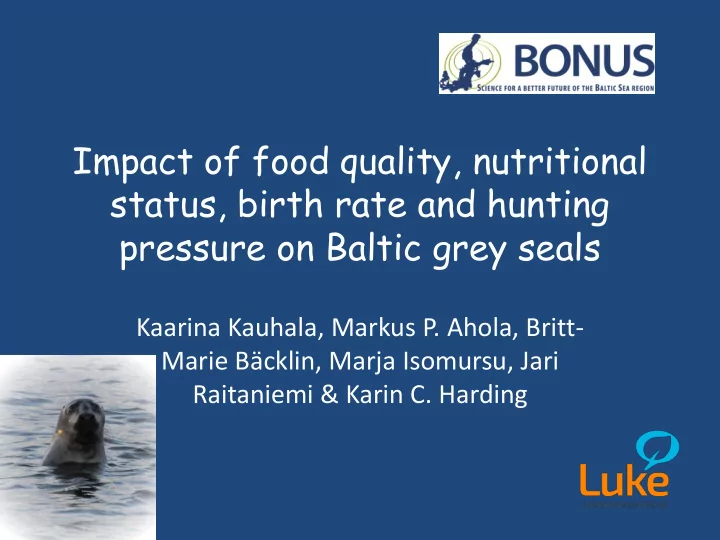
Impact of food quality, nutritional status, birth rate and hunting pressure on Baltic grey seals

Kaarina Kauhala, Markus P. Ahola, Britt- Marie Bäcklin, Marja Isomursu, Jari Raitaniemi & Karin C. Harding

slide-2
SLIDE 2

Baltic grey seal (Halichoerus grypus)

  • The population crashed in

the 1970s to only 2000- 3000 due to hunting and environmental pollution which caused reproductive failure in females.

  • After the grey seal was

protected from hunting and DDT and PCB consentrations declined, population started to increase.

  • At present, reproductive

health of females is good and birth rate normal.

  • Hunting was started again in

1998 in Finland and 2001 in Sweden.

  • Grey seal is the top

predator in the Baltic Sea.

  • The most common prey fish
  • f grey seals is the herring

(Clupea harengus), especially in the northern parts of the Baltic Sea.

slide-3
SLIDE 3

Aims of the study

  • We studied:
  • 1) the possible impacts of

food quality/quantity and ice conditions on the nutritional status of grey seals

  • 2) the effect of food quality

and nutritional status on birth rate

  • 3) the impact of birth rate and

hunting pressure on population abundance in the Finnish sea area.

Study area included ICES sub- divsions 27 and 29-32. Birth rate and hunting pressure only from the Finnish sea area.

slide-4
SLIDE 4

Methods

  • Seal samples were collected from

hunters and fishermen from Finland and Sweden since 2001.

  • Sex, age, reproductive status of

females and subcutaneous blubber thickness (an index of nutritional status) of seals were determined.

  • Annual variation and trends in blubber

thickness were tested with GLM. Variables which were included in the models as covariates (when significant) were: month, age, sex, sea region and cause of death (hunted vs. by-caught).

  • Model predicted values (mean ± SE) for

blubber thickness are given.

slide-5
SLIDE 5

1) Impacts of food resources and ice conditions on the blubber thickness of grey seals (Kauhala et al. 2017) 1.1. Pooled data for all age groups

  • Blubber thickness in the

pooled data for Finnish and Swedish grey seals of all age groups (n = 2144) varied between years (year: p < 0.001, all independent variables as covariates).

  • A significant declining

trend in blubber thickness until 2010 (slope = -0.44, F = 7.2, p = 0.007).

slide-6
SLIDE 6
  • Herring weight (mean for 5-6

years old) explained well the decline in blubber thickness of grey seals from 2003 to 2010 (r2 = 0.79, F = 23.0, p = 0.003).

  • A negative relationship

between herring catch size (an index of herring abundance) and blubber thickness (r = - 0.86, p = 0.006).

  • A negative correlation also

between herring weight and herring catch size (r = -0.93, p = 0.001).

slide-7
SLIDE 7

1.2. Pups (< one year old seals)

  • Also blubber thickness of pups

varied between years (year: p 0.001, sea region and cause of death as covariates) and declined until 2010 (slope -1.13, F = 18.7, p < 0.001).

  • The weight of 5-6-year-old

herring explained well the decline, especially in Baltic Proper (largest data for pups; r2 = 0.88, F = 42.2, p = 0.001).

  • A negative correlation between

herring catch size and blubber thickness of pups (r = -0.77, p = 0.026).

slide-8
SLIDE 8
  • In recent years in the Gulf of

Finland, blubber thickness of grey seal pups decreased with decreasing ice cover during the breeding season in late winter (r2 = 0.85, F = 16.8, p = 0.026).

  • In other areas, blubber

thickness of pups increased in recent years with increasing weight of 5-6- year-old herring (r2 = 0.78, F = 14.0, p = 0.020).

slide-9
SLIDE 9

1.3.Sub-adults (1-3 years old) and adults

  • Sub-adults: blubber thickness

varied between years (year: p = 0.028 with all independent variables as covariates), and was partly explained by herring weight (r2 = 0.66, F = 9.8, p = 0.026).

  • In recent years, the blubber

thickness of sub-adults in Baltic Proper increased (slope = 2.02, F = 6.7, p = 0.012).

  • Total data of adults: year was not

significant.

  • Blubber thickness of adult

females in the Bothnian Bay increased in recent years (slope = 1.28, F = 10.1, p = 0.002).

Sub-adults Adult females in BB

slide-10
SLIDE 10
  • In recent years, the increase in

blubber thickness of sub- adults in Baltic Proper and that

  • f adult females in the Botnian

Bay were explained by increasing herring weight (ages 6+ and 7 years).

  • Sub-adults: r2 = 0.88, F = 21.0,

p = 0.019.

  • Adult females: r2 = 0.62, F =

9.6, p = 0.021.

Adult females in BB

slide-11
SLIDE 11

2) Impact of food quality and blubber thickness on the birth rate of grey seals (Kauhala et al. 2016)

  • Abundance index, birth rate

and herring weight of grey seals in the Finnish sea area in the 2000s.

  • Birth rate = % adult females

giving birth each year

  • Herring weight: mean

weight of age 5+ herring

  • Abundance index = grey

seals seen during aerial monitoring

slide-12
SLIDE 12
  • Herring weight affected

blubber thickness of adult females.

  • There was a positive

relationship between the blubber thickness and birth rate in BB (r2 = 0.53, F = 8.9, p = 0.024; Kauhala et al. 2017).

  • Herring weight thus explained

well the variation in the birth rate of 7-25-year-old grey seal females mainly killed in the Bothnian Bay in the 2000s (r2 = 0.71, F = 14.8, p = 0.008 ).

slide-13
SLIDE 13

3) Impact of birth rate and hunting pressure on the grey seal abundance index (Kauhala et al. 2016)

Hunting pressure: 100*hunting bag/abundance index

slide-14
SLIDE 14

Proportion of pups increased and that of adults decreased in the hunting bag. Adult mortality rate is more important in long-living mammals.

slide-15
SLIDE 15
  • Hunting pressure partly

explained the change in abundance index of grey seals in the Finnish sea area in the 2000s (r2 = 0.76, F = 31.3, p < 0.001).

  • In recent years, birth rate

increased, and birth rate alone explaned 86% of the variation in abundance index (F = 38.0, p = 0.001).

slide-16
SLIDE 16

Conclusions

  • Herring weight affected the nutritional status of grey

seals in all age groups including adult females and thus it affected also their birth rate.

  • Herring abundance did not have an effect on the

blubber thickness, indicating that the herring quality, not the quantity, is important for Baltic grey seals.

  • A negative correlation between herring abundance

and herring weight indicated that in a dense herring population herring are slim and vice versa.

  • When herring are slim seals have to use more energy

for foraging than when herring are fatty.

slide-17
SLIDE 17
  • Ice cover in late winter had an impact on the

nutritional status of pups in the Gulf of Finland.

  • Pups born on land are lighter at the time of weaning

than those born on ice (Jüssi et al. 2008).

  • Climate change may thus affect the nutritional status
  • f seal pups and thus their mortality rate during their

first year.

  • It may also affect their future reproduction because

bad start may be seen later in their lifes.

slide-18
SLIDE 18
  • Hunting pressure had a negative impact on grey seal

abundance.

  • It increased after the mid-2000s probably inhibiting

population growth.

  • In recent years, hunting pressure, especially towards

adult seals, decreased.

  • The decreasing hunting pressure and increasing birth

rate resulted in a new phase of population growth since 2010.

  • Both human-induced mortality and the quality of the

main prey fish have an impact on the population growth rate of Baltic grey seals.

slide-19
SLIDE 19

Acknowledgements to:

  • BONUS BaltHealth that has received funding from BONUS (Art.

185), funded jointly by the EU, Innovation Fund Denmark (grants 6180-00001B and 6180-00002B), Forschungszentrum Jülich GmbH, German Federal Ministry of Education and Research (grant FKZ 03F0767A), Academy of Finland (grant 311966) and Swedish Foundation for Strategic Environmental Research (MISTRA).

  • Mervi Kunnasranta
  • Hunters and fishermen
  • All assistants in the laboratory