
SLIDE 1
OIB – class of 2020
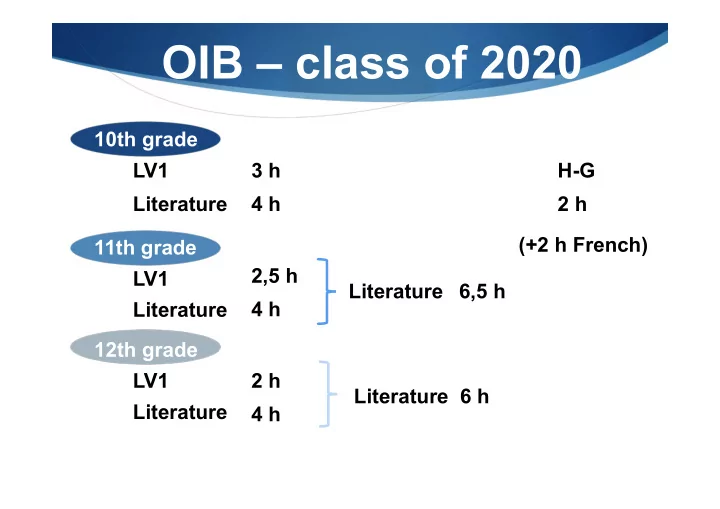
10th grade 11th grade 12th grade LV1 LV1 LV1 Literature Literature Literature 3 h 4 h 2,5 h 4 h 2 h 4 h Literature Literature 6,5 h 6 h H-G 2 h (+2 h French)
OIB class of 2020 10th grade LV1 3 h H-G Literature 4 h 2 h - - PowerPoint PPT Presentation
OIB class of 2020 10th grade LV1 3 h H-G Literature 4 h 2 h (+2 h French) 11th grade 2,5 h LV1 Literature 6,5 h Literature 4 h 12th grade LV1 2 h Literature 6 h Literature 4 h L ES S OIB-Literature- written 6 5 5
10th grade 11th grade 12th grade LV1 LV1 LV1 Literature Literature Literature 3 h 4 h 2,5 h 4 h 2 h 4 h Literature Literature 6,5 h 6 h H-G 2 h (+2 h French)
L ES S OIB-Literature- written 6 5 5 OIB-Literature- oral 5 4 4 OIB-H-G-written 4 5 4 OIB-H-G- oral 3 4 3 Total 18 18 16 French 3+2 2+2 2+2 TPE (>10) 2 2 2 Science 11th grade 2 2 x Maths 2 5 (+2) 7 (+2) Physics x x 6 (+2) Biology x x 6 (+2) Philosophy 7 4 3 Literature 4 x x Foreign language 2 4+1 3 2 Social Studies x 7 (+2) X P.E 2 2 2
Develop your critical thinking and develop a sense of iniative. Encourage collaborative work. Make you acquire the basic tools for literary analysis. Make you become autonomous and engaged readers who can interact with the text. Encourage you to participate actively in class and be creative in your thinking and writing. Give you depth and breadth of knowledge in the literature and culture of English- speaking countries (the USA in particular), as well as the features of the English language itself. Encourage critical and personal responses to literary works by developing your skills of active reading, close-reading, literary analysis and interpretation of texts. Make you progress in your ability to express your ideas and views effectively, with nuance and clarity, in both written and oral assignments.
One Shakespeare play Three 19th/20th/21st-century English-speaking novelists Two 19th/20th/21st-century English-speaking playwrights Two 19th/20th/21st-century English-speaking poets Three works of world literature Two English-language non-fiction works CORE FREE CHOICE
The Scarlet Letter
Nathaniel Hawthorne
The Tempest Intimate Apparel
Lynn Nottage A selection of 8 poems from: Langston Hughes, Rita Dove, Niki Giovanni and Martin Espada
Interpreter of Maladies
Jhumpa Lahiri
Stranger in the Village
James Baldwin
The syllabus includes 13 works to be studied
JUNE 2017
Part I – Essays
Discuss how two authors explore the balance between fear and courage on your OIB program.
OIB syllabus?
your OIB syallbus.
another character. How does this statement apply to two works on your OIB syllabus? Part II – Creative writing Write about a place that the narrator misses, but to which he or she may not return. Part III – – Prose or poetry commentary Poetry: Widows by Louise Glück Prose: Extract from The Goldfinch by Donna Tartt.
Part I – Essays
Discuss how two authors explore the balance between fear and courage on your OIB program.
OIB syllabus?
your OIB syallbus.
another character. How does this statement apply to two works on your OIB syllabus? Part II – Creative writing Write about a place that the narrator misses, but to which he or she may not return. Part III – – Prose or poetry commentary Poetry: Widows by Louise Glück Prose: Extract from The Goldfinch by Donna Tartt.
CHOICE 1: Two essay questions comparing two literary works
Part I – Essays
Discuss how two authors explore the balance between fear and courage on your OIB program.
OIB syllabus?
your OIB syallbus.
another character. How does this statement apply to two works on your OIB syllabus? Part II – Creative writing Write about a place that the narrator misses, but to which he or she may not return. Part III – Prose or poetry commentary Poetry: Widows by Louise Glück Prose: Extract from The Goldfinch by Donna Tartt.
CHOICE 2: One essay question comparing two literary works and
Part I – Essays
Discuss how two authors explore the balance between fear and courage on your OIB program.
OIB syllabus?
your OIB syallbus.
another character. How does this statement apply to two works on your OIB syllabus? Part II – Creative writing Write about a place that the narrator misses, but to which he or she may not return. Part III – Prose or poetry commentary Poetry: Widows by Louise Glück Prose: Extract from The Goldfinch by Donna Tartt.
CHOICE 3: One essay question comparing two literary works and a never before seen piece of prose or poetry for commentary
ASSESSMENT RUBRIC FOR OIB AMERICAN OPTION WRITTEN EXAMINATION: ESSAY
N.B. A short response may require assessment to be lowered.
Category Below Level
Level 0 Level 1 + 0.5 Level 2 + 1.0 Level 3 +1.5 Level 4 +2.0
Knowledge & Understanding No true understanding or first-hand knowledge
inaccuracies void argument. Some understanding but
response replaces first-hand knowledge. Factual inaccuracies affect argument. Satisfactory understanding and knowledge. Development may be limited with some inadvertent or minor factual inaccuracies. Good overall understanding. Knowledge is full and developed. Very good and thorough understanding, including some
meaning are apparent. Excellent understanding, including some subtlety. Levels of meaning are
pertinent knowledge. Response to the Question Off-subject or no clear response discernible. Observation, commentary
but no attempt to form an argument. Response is partial or
directed at the question but may be confused or superficial. A satisfactory response to the main implications of the
the question may be ignored. A good response. Argument addresses the question but may need more development. A very good response. Argument is complete and well-targeted, and the question is well-understood. An excellent response. Argument demonstrates
addresses the question with clarity and depth. Analysis & Depth
(Includes discussion of style at Level 2 and above)
Plot summary or generalizations dominate. No successful attempt at analysis. Plot summary or generalizations frequent. Little or unsuccessful analysis. Inconsistent analysis that does not always address important elements. Analysis may be uneven or lacking in depth. Good analysis that appropriately addresses important elements. Generally appropriate analysis of style illustrated by relevant examples. Very good analysis. Thoughtful, pertinent analysis of style. Excellent analysis and argumentation. Insightful, sophisticated and coherent analysis of style. Organization
& Integration
No logical sequence of
is so inadequate that clarity is in danger of dissolving completely. Weak or mechanical
is barely adequate and examples are either impertinent or lack clear connection to the argument. Satisfactory structure and
ideas generally logical. Examples not always pertinent and integration may be awkward. Good structure with some
ideas logical. Examples are generally pertinent and most often integrated appropriately. Very good essay structure with solid
development throughout and good integration of supporting evidence. Excellent essay structure with clear transitions. Carefully planned, persuasive development
integration of supporting evidence. Expression Meaning often cannot be
very difficult to read. Prose can be read and its meaning surmised even if hampered by weak control (or French interference). Prose conveys the writer’s ideas adequately. Vocabulary is sufficient and notions of good English usage are evident if sometimes inconsistently applied. Prose shows evidence of good writing skills. Lapses are minor and do not impede understanding. Some care is shown in word choice and register. Prose is clear and
does not mar ideas or
vocabulary and register. Prose is articulate, fluid, and displays an excellent command of written language. Sophisticated use of vocabulary and register. Totals
Adopted Nov 2015 OIB
ASSESSMENT RUBRIC FOR OIB AMERICAN OPTION WRITTEN EXAMINATION: CREATIVE WRITING
Category Below Level
discretion of the examiner
Level 0 Level 1 + 0.5 Level 2 + 1.0 Level 3 +1.5 Level 4 +2.0
Response to Task & Strength
Inadequate response. Superficial treatment
Adequate response to prompt. Idea has potential but needs development. Appropriate response to prompt. Idea shows evidence of risk-taking, imagination or complexity. Some inconsistency in approach. Thoughtful response to
evidence of risk-taking, imagination or complexity. Approach is mostly consistent. Strong response that often surprises, delights or
evidence of risk-taking, imagination and complexity. Any inconsistency is minor. Highly effective response to prompt. Consistently surprises, delights or provokes reader. Often compelling, imaginative and complex. Voice and Sense
Inadequate or no clear
audience. Adequate but not always consistent
Appropriate and mostly consistent voice. Some sense of audience. Clear voice with
sense of audience. Strong voice with only minor lapses in consistency. Effective sense of audience. Confident and persuasive use of voice. Highly effective sense of audience Use of Literary Technique (Style) and Genre Elements No significant use
appears flat and is often limited to a simple, literal level of meaning. Contains limited attempts to include style or address genre. Connection to task may be unclear. Some evidence of style to enhance meaning. Contains some literary or genre elements appropriate to task. Use of style and genre elements is focused and coherent with meaning. Strong and subtle use of style and genre. Choice of literary elements often enhances meaning. Sophisticated and persuasive use of style and genre. Displays a cohesive array of literary elements that enhance meaning. Use of Structural Elements No evident structure. Structure is present but lacks coherence, purpose or flow. Clear attempt to use structural elements to reinforce meaning Effective and focused use
Writing is coherent, purposeful and flows well. Strong and subtle use of structural elements to enhance or add to meaning. Sophisticated and cohesive integration of structural elements to develop meaning. Expression Difficult to understand. No or limited control of register. Most language can be understood, but register is very inconsistent. Simple vocabulary choices. Adequate use of language and register. Some creative word choice, even if awkward
Careful word choice, some judicious use of language and register. May have minor lapses. Strong word choice. Effective use of language and register. May contain an occasional lapse. Highly articulate. Sophisticated use of language evident. Totals
Adopted Nov 2015 OIB
ASSESSMENT RUBRIC FOR OIB AMERICAN OPTION WRITTEN EXAMINATION: THE COMMENTARY
N.B. A short response may require assessment to be lowered.
Category Below Level
discretion of the examiner
Level 0 Level 1 + 0.5 Level 2 + 1.0 Level 3 +1.5 Level 4 +2.0
Understanding the Text Flawed to seriously flawed understanding. No awareness of levels
effect of voice or tone. Basic denotative
find meaning on another level. Fair but awkward understanding of much of the text. Plausible sense of deeper meaning. Some sense of voice/tone. Fair understanding with coherent sense of some deeper meaning in much of the text. Accurate sense of voice/tone. Good understanding of whole text, including the use of voice, tone and levels of meaning. Excellent interpretation. Shows understanding
subtleties implied by text. Analysis & Use of the Text A paraphrase or superficial commentary with little to no textual
analysis. Superficial commentary with some textual basis. Little or fuzzy analysis. May summarize rather than analyze, or struggle to prove anything. Satisfactory analysis of some textual features. Relevant but limited use
relevant and irrelevant. Satisfactory analysis of several important textual
evidence of deeper meaning. Good analysis supports commentary throughout. Quotes well chosen and
meaning of the text. Insightful analysis. Textual usage full and
digs far beyond the
Appreciation
Literary Features Appreciation of literary features absent or
use of literary terminology. Some notion of voice or
comments are inaccurate
ability to relate these to meaning. Limited sense of literary
devices may be accurately identified, but discussion is often superficial or relation to meaning very hit and miss. Good sense of some literary
devices are identified and
may be awkward or inconsistent. Good sense of text as
discussion of style with varied use of
ability to relate style to meaning. Excellent appreciation
Comments grounded in style with use of precise, detailed terminology. Discussion always directed at meaning. Organization No development of any
strictly linear, or simply rambling paragraphs. Weak structure. Little development or too short. Some ordering of ideas but logical flow or focus is broken. Some evidence of good structure, but overall development remains unfocused, mechanical or clumsy. Mostly coherent structure. Paragraphs have clear focus, but the whole lacks some development. Coherent, well developed
commentary structure. Flowing and persuasive paragraphs. Elegant and effective use of commentary structure. Expression Meaning often cannot be surmised. Commentary difficult to read due to consistent mistakes. Prose can be read and meaning surmised, but expression frequently shows weak control (or French interference). Prose mostly conveys the writer’s ideas, but language can be clumsy, heavy or marred by errors amidst a sometimes clear expression. Prose mostly clear and
if frequent, do not impede
and consistency shown in word choice and register. Much evidence of strong writing skills. Lapses easily corrected. Often careful and effective use
register. Articulate and fluid. Excellent and effective use of vocabulary and register. A pleasure to read. Totals
Adopted Nov 2015 OIB
On an excerpt from a work-in-depth on the English OIB syllabus 10 min presentation of your analysis of the extract 5 min presentation of the links between the passage and the rest of the program. 15 min exchange between the examiner and the candidate to test their knowledge
and its relation to the examination text.) Shakespeare Poetry Novel
N.B. A commentary that is too short or too long may require assessment to be lowered. Commentary on text given (10 minutes) Context: Links (5 min) and General discussion of the program (15 minutes) Expression A clear lack of knowledge or a misinterpretation of the text. 0-1 pt Inability to make links to other works. No acquaintance with works and background. 0-1 pt (Below OIB level) Expression is inaccurate making meaning unclear. Student struggles to communicate clearly or is uncommunicative. 0-1 pt Basic or superficial understanding
An attempt at analysis is made but the arguments are not developed. 2 pts Little or no ability to make links. Scant familiarity with the program. 2 pts (Below OIB level) Expression is inaccurate, but ideas do come across. Ideas expressed simply. Difficulty in interacting, leaning heavily on examiner intervention. 2 pts Acceptable level of understanding
An argument is defined but not sustained. Student shows some ability to analyze the text. 4 pts Can make some links but does not develop them. Some familiarity with the program, but ideas only partially developed. 4 pts Clear and satisfactory communication of ideas. Ability to engage with the examiner. 4 pts Good understanding of the text. Student sets out clear arguments. Good attention paid to style in relation to meaning. 5 pts Interesting links made with some development. Good knowledge of program. Student shows some understanding of stylistic features. 5 pts The expression effectively communicates the student’s ideas in a fluent and accurate way. Confident exchange with the examiner. 5 pts Excellent understanding of the text. Arguments are sophisticated. Student shows an excellent ability to explore how style informs meaning. 6 pts Excellent links made that are fully developed. Excellent knowledge of the program. Student confidently addresses stylistic features. 7 pts Effective, nuanced, and articulate communication. Makes use of a wide range of literary terminology. 7 pts Mark A out of 6 /6 Mark B out of 7 /7 Mark C out of 7 /7
Adopted November 2015 OIB
Student’s total mark (A+B+C) = /20
« In order to be awarded the ‘international option’ of the baccalaureate, the candidate must have an average of at least 10/20 in all specific and non-specific papers. As such the OIB is an integral part of the pupil’s baccalaureate or, in other words, once enrolled for the OIB the candidate cannot be awarded their diploma without the specific papers. The relatively high coefficients of these papers also play a significant role in the diploma or top grades being awarded. » https://cache.media.eduscol.education.fr
If you get a 9 in OIB Lit > 1 x 9 = 9 points to catch up If you get an 8 in OIB Lit > 2 x 9 = 18 points to catch up If you get a 7 in OIB Lit > 3 x 9 = 27 points to catch up The weight of your OIB (32% in S, 35% in ES and 37% in L) makes it very hard if you don’t get good grades in literature and history geography.