3/14/16 Review Class/Object Type Class Keyword class - - PDF document

3 14 16
SMART_READER_LITE
LIVE PREVIEW

3/14/16 Review Class/Object Type Class Keyword class - - PDF document

3/14/16 Review Class/Object Type Class Keyword class class Point { // Fields int x; Object Declares a new type int y; color c; Data fields ( class variables)


slide-1
SLIDE 1

3/14/16 1

Review ¡

  • Class ¡
  • Object ¡

Class/Object ¡Type ¡

  • Keyword ¡class
  • Declares ¡a ¡new ¡type ¡
  • Data ¡fields ¡( ¡class ¡variables) ¡
  • Constructor ¡
  • Methods ¡(class ¡func>ons) ¡

– update/move ¡ – display/draw ¡

class Point { // Fields int x; int y; color c; // Constructor Point() { x = 0; y = 0; c = color(255, 255, 255); } // Methods void update() { } void display() { noStroke(); fill(c); ellipse(x, y, 10, 10); } }

this ¡Keyword ¡

  • Within ¡an ¡instance ¡method, ¡this ¡is ¡a ¡reference ¡to ¡

the ¡current ¡object ¡– ¡the ¡object ¡whose ¡method ¡is ¡ being ¡called ¡

class Ball { // Fields int w; int h; // width and height of ball float x; // x position float y; // y position // ... // Constructor Ball(int x, int y) { w = h = 20; this.x = x; this.y = y; } // ... } Ball b1 = new Ball(0, 0); Ball b2 = new Ball(20, 20);

Crea8ng ¡a ¡set ¡of ¡Graphic ¡Object ¡Classes ¡

  • All ¡have… ¡
  • X, ¡Y ¡loca>on ¡
  • width ¡and ¡height ¡fields ¡
  • fill ¡and ¡stroke ¡colors ¡
  • A ¡display() ¡method ¡
  • An ¡update() ¡method ¡defining ¡how ¡they ¡move ¡
  • Implementa>on ¡varies ¡from ¡class ¡to ¡class ¡

Crea8ng ¡a ¡set ¡of ¡Graphic ¡Object ¡Classes ¡

  • Problems ¡

How ¡would ¡you ¡hold ¡all ¡your ¡objects? ¡ – Array? ¡ What ¡if ¡one ¡class ¡had ¡extra ¡methods ¡or ¡special ¡arguments? ¡

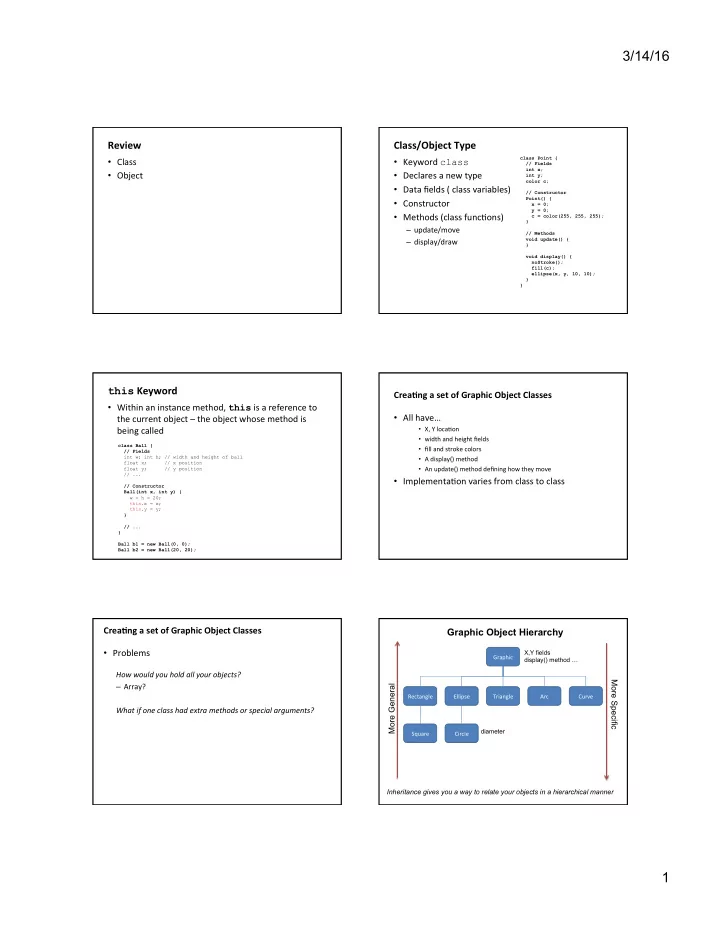
Graphic ¡ Ellipse ¡ Rectangle ¡ Triangle ¡ Arc ¡ Curve ¡ Circle ¡ Square ¡

More General More Specific

Graphic Object Hierarchy

X,Y fields display() method … diameter

Inheritance gives you a way to relate your objects in a hierarchical manner

slide-2
SLIDE 2

3/14/16 2

Inheritance ¡

  • Superclass ¡(parent ¡class) ¡– ¡higher ¡in ¡the ¡hierarchy ¡
  • Subclass ¡(child ¡class) ¡– ¡lower ¡in ¡the ¡hierarchy ¡
  • A ¡subclass ¡is ¡derived ¡from ¡from ¡a ¡superclass ¡
  • Subclasses ¡inherit ¡the ¡fields ¡and ¡methods ¡of ¡their ¡
  • superclass. ¡

– I.e. ¡subclasses ¡automa>cally ¡"get" ¡stuff ¡in ¡superclasses ¡

  • Subclasses ¡can ¡override ¡a ¡superclass ¡method ¡by ¡

redefining ¡it. ¡

– They ¡can ¡replace ¡anything ¡by ¡redefining ¡locally ¡

// Ellipse base class class Ellipse { float X; float Y; float W; float H; // Ellipses are always red color fillColor = color(255,0,0); Ellipse(float X, float Y, float W, float H){ this.X = X; this.Y = Y; this.W = W; this.H = H; } void display() { ellipseMode(CENTER); fill(fillColor); ellipse(X, Y, W, H); } } // Circle derived class class Circle extends Ellipse { Circle(float X, float Y, float D) { super(X, Y, D, D); // Circles are always green fillColor = color(0,255,0); } }

  • The ¡extends ¡keyword ¡creates ¡

hierarchical ¡rela>onship ¡between ¡

  • classes. ¡
  • The ¡Circle ¡class ¡gets ¡all ¡fields ¡and ¡

methods ¡of ¡the ¡Ellipse ¡class, ¡ automa>cally. ¡

  • The ¡super ¡keyword ¡refers ¡to ¡the ¡base ¡

class ¡in ¡the ¡rela>onship. ¡

  • The ¡this ¡keyword ¡refers ¡to ¡the ¡object ¡
  • itself. ¡

Graphics.pde Graphics.pde

// Graphics Ellipse e = new Ellipse(150, 250, 150, 50); Circle c = new Circle(350, 250, 75); void setup() { size(500, 500); } void draw() { e.display(); c.display(); }

// Graphics2 Ellipse[] es = new Ellipse[20]; void setup() { size(500, 500); for (int i=0; i< es.length; i++) { float X = random(0, width); float Y = random(0, height); float W = random(10, 100); float H = random(10, 100); // Ellipses and Circles are // stored in the same array if (random(1.0) < 0.5) es[i] = new Ellipse(X,Y,W,H); else es[i] = new Circle(X,Y,W); } } void draw() { for (int i=0; i<es.length; i++) es[i].display(); }

Ellipses and Circles in the same array! Graphics2.pde

Graphics3.pde

// Ellipse base class class Ellipse { float X; float Y; float W; float H; // Ellipses are always red color fillColor = color(255,0,0); Ellipse(float X, float Y, float W, float H){ this.X = X; this.Y = Y; this.W = W; this.H = H; } void display() { ellipseMode(CENTER); fill(fillColor); ellipse(X, Y, W, H); } // Do nothing void mousePressed() {} } // Circle derived class class Circle extends Ellipse { Circle(float X, float Y, float D) { super(X, Y, D, D); // Circles are always green fillColor = color(0,255,0); } // Change color of circle when clicked void mousePressed() { if (dist(mouseX, mouseY, X, Y) < 0.5*W) fillColor = color(0,0,255); } }

  • The ¡mousePressed ¡behavior ¡of ¡the ¡

Circle ¡class ¡overrides ¡the ¡default ¡ behavior ¡of ¡the ¡Ellipse ¡class. ¡

Graphics3.pde

// Graphics3 Ellipse[] es = new Ellipse[20]; void setup() { size(500, 500); //code now shown … } void draw() { for (int i=0; i<es.length; i++) es[i].display(); } void mousePressed() { for (int i=0; i<es.length; i++) es[i].mousePressed(); }

slide-3
SLIDE 3

3/14/16 3

A ¡few ¡more ¡rules ¡about ¡inheritance ¡… ¡

  • A ¡child’s ¡constructor ¡is ¡responsible ¡for ¡calling ¡the ¡

parent’s ¡constructor ¡

  • The ¡first ¡line ¡of ¡a ¡child’s ¡constructor ¡should ¡use ¡the ¡

super ¡reference ¡to ¡call ¡the ¡parent’s ¡constructor ¡

  • The ¡super ¡reference ¡can ¡also ¡be ¡used ¡to ¡reference ¡
  • ther ¡variables ¡and ¡methods ¡defined ¡in ¡the ¡parent’s ¡

class ¡

Example ¡

  • ballDropInheritance ¡