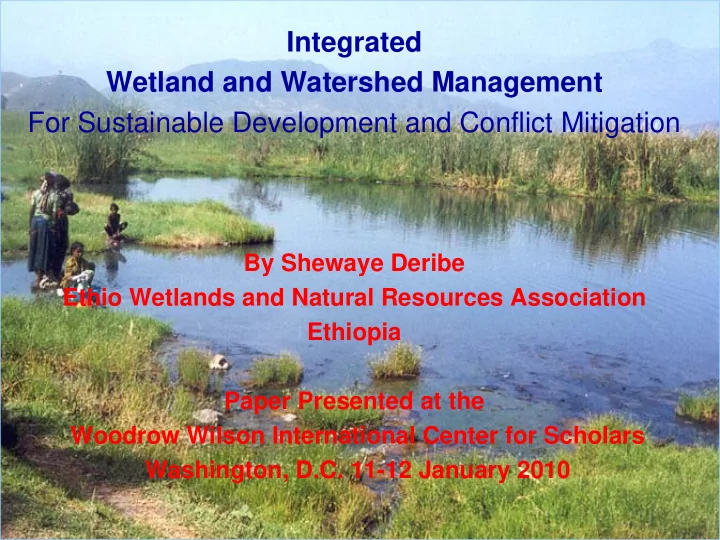
SLIDE 1
Integrated Wetland and Watershed Management For Sustainable Development and Conflict Mitigation
By Shewaye Deribe Ethio Wetlands and Natural Resources Association Ethiopia Paper Presented at the Woodrow Wilson International Center for Scholars Washington, D.C. 11-12 January 2010
SLIDE 2 CONTENT
– Environment – People – Conflict sources
- 2. Practices to sustainability
SLIDE 3 Population Growth and Environmental Change Crop-Forest continuum Conflict of ideas, interests and benefits
Water and Biodiversity Conservation/ Climate change Landless community members Investors Government, economy, food security
SLIDE 4 Environment and Conflicts
- Rapid population growth and poverty
- Environmental degradation and livelihood
insecurity
- Despair , migration and conflicts
SLIDE 5
Then ?
SLIDE 6
Land Degradation & Climate Change
Loss of assets- livestock and crop failure- unpredictable future- creates fertile ground for conflicts
SLIDE 7 Shortage of fish and severe competition
Increasing competition for dwindling resources
Burden on women
SLIDE 8
Pollution and Health
SLIDE 9
Ecosystem wellbeing improves quantity and quality of resources
Blue Nile -Flourishing
Resource availability hampers conflicts
SLIDE 10
Ecosystem degradation leads to resource shortage both in quality and quantity Blue Nile-shrinking Resource shortage stimulates grievance and conflicts
SLIDE 11 Harmonize linkages between people and environment
- Build local capacity and encourage participation
- Partnership (government-private-CBOs; upstream-down stream )
- Balance population growth and carrying capacity
- Realize fair benefit sharing (ownership, sustainability)
SLIDE 12 Biosphere ( Biodiversity, w ater, land, energy ,air)
Hum an
Com m unities
Harm onize People- Biosphere interaction
SLIDE 13 The Experience of Ethio Wetlands and Natural Resources Association Integrated Watershed Management
- to protect the environment and
- mitigate associated conflicts
SLIDE 14 The Experience of EWNRA
- Capacity building (Awareness and Training)
- Wetland-Watershed Rehabilitation
- Livelihood diversification
- Water and Sanitation
- Reproductive Health –FP
- Energy Efficient Technology
- Environmental Policy Advocacy
SLIDE 15
Improve Watershed Productivity by Vetiver grass and compost
SLIDE 16 Environment, Livelihood, Food, etc
.
ALTERNATIVE LIVELIHOOD: Employment and Revolving fund
SLIDE 17
Environment, Livelihood, Food, etc Bee keeping and fattening
SLIDE 18
Environment, Livelihood, Food, etc Afforestation and Agro-forestry
SLIDE 19
- Safe guard community health
- Reduce burden of women
SLIDE 20
- Reduce biomass consumption for fuel
- Protect women’s health
- Save their time and energy
SLIDE 21 Awareness Community/ stakeholders Environment
Consensus and trust-building
- Sensitization, discussions on
problems and solutions
Planning Expert visit and learning Community-decision makers field day Community-Donor Interaction Expert training
SLIDE 22 PROJECT ACHIEVEMENTS
Livelihood-Dependence on Natural resources decreasing Health-Nutritional, Family Planning and water born infections Environmental- better function and services Behavioural- community stewardship growing Institutional-Watershed committees with bylaws General- Secured trust from the community & other stakeholders
SLIDE 23
Rehabilitated Wetland of Wichi
SLIDE 24 Integrated approach is advantageous to
- Improve the environment, livelihood and resilience of
poor communities with minimum cost
- Block opportunities to migration, unrest and conflicts
Scale up programmes that integrate
- Population,
- Health
- Livelihood and
- Environment issues at watershed level
CONCLUSION
SLIDE 25