Livelihood options preferred by communities and threats to Red - - PowerPoint PPT Presentation

livelihood options preferred by communities and threats
SMART_READER_LITE
LIVE PREVIEW

Livelihood options preferred by communities and threats to Red - - PowerPoint PPT Presentation

Livelihood options preferred by communities and threats to Red Colobus in Itwara and Matiri forests, Uganda Moses Chemurot , Makerere University International Primatological Society Nairobi, August 2018 Meet our team Moses Chemurot 1 , Jennifer


slide-1
SLIDE 1

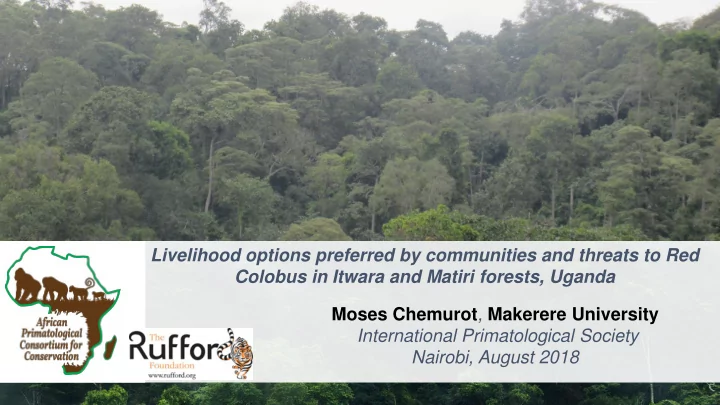
Livelihood options preferred by communities and threats to Red Colobus in Itwara and Matiri forests, Uganda Moses Chemurot, Makerere University International Primatological Society Nairobi, August 2018

slide-2
SLIDE 2

Meet our team

1Department of Zoology, Entomology and Fisheries Sciences, School of Biosciences, College of Natural

Sciences, Makerere University, P.O. Box 7062 Kampala, Uganda

2Department of Wildlife, University of Eldoret, Kenya 3Kabarole District Local Government, P.O. Box 38, Fort Portal, Uganda 4Biology Department, Faculty of Science, Mbarara University of Science and Technology, P. O. Box

1410 Mbarara, Uganda

5African Institute for Capacity Development (AICAD), Uganda Country Office 6Primate Research Institute, Kyoto University, Japan

Moses Chemurot1, Jennifer Wanyingi2, Sam Mugume3, Gilbert Isabirye-Basuta1, Ubaldo Rutazaana1, Chris Bakuneeta1, Grace Karogo4, Deborah Baranga1, Adalbert Aine-Omucunguzi5, Furuichi Takeshi6

slide-3
SLIDE 3

Introduction

Red colobus: Procolobus rufomitratus tephrosceles

  • Threatened primate species
slide-4
SLIDE 4

Distribution of Red colobus across north central Africa (black shading; Ting 2008), with the black star highlighting Kibale National Park (KNP). (b) Uganda with the location of major conservation areas in yellow circle (c) Location of the two conservation areas and other major conservation areas

slide-5
SLIDE 5
  • Red colobus distribution in Uganda
  • Kibale National Park
  • Matiri and Itwara Central Forest Reserves (Mugume et al. 2015)
  • Semliki National Park and Wildlife Reserve?
  • Red colobus threats
  • Human activities
  • Chimpanzee hunting

Need to protect isolated populations of Red colobus

Introduction

slide-6
SLIDE 6

Chimpanzee eating a monkey

slide-7
SLIDE 7

Promote Red Colobus conservation in Matiri and Itwara Central Forest Reserves in Uganda

  • Population monitoring and habitat quality assessment
  • Promoting environmentally friendly IGAs e.g. beekeeping

Introduction: Project Goal

slide-8
SLIDE 8

Bees are a key component of agriculture worldover

  • About 80% of Uganda’s population is

involved in agriculture

  • Beekeeping: source of household

incomes, food & employment

Annual pollination value: $ 0.49 billion from crops valued at $ 1.16 billion

8

Introduction: Why beekeeping

slide-9
SLIDE 9

Economics of beekeeping

  • Economically, beekeeping is ranked 2nd or 3rd among livestock world wide

Livestock Economic importance ($) CATTLE (meat, milk, skin) 331,407,538,000 Honeybees (products, pollination) 180,990,944,120 Pigs (meat) 173,423,160,000 Poultry (meat, eggs) 144,241,789,000 Sheep (meat,milk, wool, skin) 41,319,473,000 Goat (meat, milk, skin) 25,331,724,000

Source: Jacobs et al. 2005

Introduction

slide-10
SLIDE 10

Relatively low-cost & low labour intensive enterprise that does not require a lot of land

10

Beekeeping can be practiced in unproductive lands

Viable for people like women & youth who are least likely to have access to resources

Introduction: Beekeeping in Uganda

slide-11
SLIDE 11
  • Pollination of wild plants: food for wildlife
  • Controlling elephant crop raiding
  • Earnings from tourism: $ 979 million in 2013; largest foreign exchange earner

11

Beekeeping and Red colobus: Beekeeping at the edge of Red colobus habitat can help protect the habitat for this threatened species: economic incentive  Beekeeping important for sustainable development

Introduction: Beekeeping and conservation

slide-12
SLIDE 12

What we have done

Field work

Questionnaire administration Field surveys

 Data analyses  Sharing the findings with stakeholders

12

slide-13
SLIDE 13

Income generating activities (IGAs) as adaptation strategies to conservation challenges

Findings

Communities prefer Goat farming

Livelihood activities

slide-14
SLIDE 14

Factors considered by households when selecting livelihood adaptation strategies

Communities consider most effectiveness, cost and profit of IGA

Considerations for livelihood activities

slide-15
SLIDE 15

Cooperation of local authorities with communities in supporting adaptations to conservation challenges Communities say local authorities are not cooperative in supporting their adaptation to conservation challenges

slide-16
SLIDE 16

Relative abundance (no. per km transect) of primates during the survey

Forest Chimps Red Colobus Blue Monkey Black & White Red- tailed Baboons Itwara 8.6 4.2 27.2 21.7 1.3 Matiri 3.7

No record of Red colobus yet in the last 5 months; are they locally extinct?

Itwara 2015: 0.0034.75/km Matiri 2015: 0.0023.5/km

slide-17
SLIDE 17

Frequency of anthropogenic activities per km transect

 Relatively higher frequency of trapping sites for wildlife in Itwara;  Matiri trapped out?  Increased frequencies of anthropogenic activities between 2015 & 2018 Human population pressure

Anthropogenic activities Matiri 2015 Matiri 2018 Itwara 2015 Itwara 2018 Traps 0.025 1.7 0.038 3.3 Fuel wood sites 0.025 1.5 0.013 0.3 Pit-sawing sites 0.041 8.7 0.008 6.2

Source of 2015 data: Mugume et al. 2015

slide-18
SLIDE 18

Fresh pit-sawing site in Itwara CFR

slide-19
SLIDE 19

Blue dyker trapped in Itwara CFR

slide-20
SLIDE 20
slide-21
SLIDE 21
slide-22
SLIDE 22
slide-23
SLIDE 23

Red colobus vulnerability to changes in the environment: Conceptual diagram, showing the range of variability of ‘‘Current Red colobus environment’’ parameters for anthropogenic pressures, climate change, pathogen intensity and chimpanzee hunting with a small portion of the environment situation ‘‘space’’ currently in the low mortality for Red

  • colobus. ‘‘Future colobus environment’’ shows increases in extreme anthropogenic pressure, increased pathogen

intensities, effects of climate change and chimpanzee hunting events associated with foreseen environmental changes, indicating increased risks of die-off for current populations.

Synthesis

slide-24
SLIDE 24
  • 1. Identification of livelihood options for interventions to address conservation

challenges MUST involve local communities for ownership

  • 2. Develop effective forest patrolling systems to control illegal activities
  • 3. Regular monitoring of threatened wildlife populations to guide responses to threats

and inform adaptive management

  • 4. Survey un-surveyed protected areas for Red Colobus
  • 5. Community awareness on Red Colobus is required

24

Recommendations

slide-25
SLIDE 25

Acknowledgements

slide-26
SLIDE 26

26

Am not t sur ure! ! Well ll, how do do we e fin find out ut? Our homes are getting destroyed! Are we still safe?

Ugandan primate conversation

Thank you for listening