IE1206 Embedded Electronics PIC-block Documentation, Seriecom Pulse - - PowerPoint PPT Presentation

ie1206 embedded electronics
SMART_READER_LITE
LIVE PREVIEW

IE1206 Embedded Electronics PIC-block Documentation, Seriecom Pulse - - PowerPoint PPT Presentation

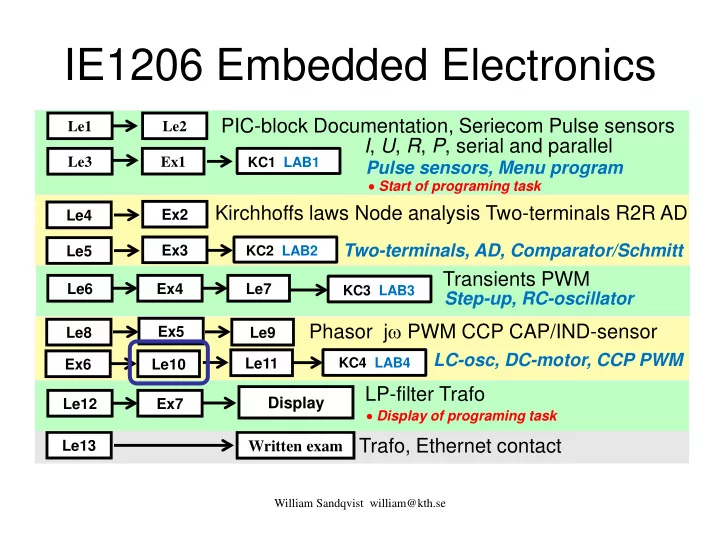
IE1206 Embedded Electronics PIC-block Documentation, Seriecom Pulse sensors Le1 Le2 I , U , R , P , serial and parallel Le3 Ex1 KC1 LAB1 Pulse sensors, Menu program Start of programing task Kirchhoffs laws Node analysis Two-terminals


slide-1
SLIDE 1

IE1206 Embedded Electronics

Transients PWM Phasor jω PWM CCP CAP/IND-sensor

Le1 Le3 Le6 Le8 Le2 Ex1 Le9 Ex4 Le7

Written exam

William Sandqvist william@kth.se

PIC-block Documentation, Seriecom Pulse sensors I, U, R, P, serial and parallel

Ex2 Ex5

Kirchhoffs laws Node analysis Two-terminals R2R AD Trafo, Ethernet contact

Le13

Pulse sensors, Menu program

Le4

KC1 LAB1 KC3 LAB3 KC4 LAB4

Ex3 Le5

KC2 LAB2 Two-terminals, AD, Comparator/Schmitt

Step-up, RC-oscillator

Le10 Ex6

LC-osc, DC-motor, CCP PWM

LP-filter Trafo

Le12 Ex7

Display

Le11

  • Start of programing task
  • Display of programing task
slide-2
SLIDE 2

William Sandqvist william@kth.se

How to measure pulses?

To measure various digital pulses is one of the PIC processor main tasks

?

slide-3
SLIDE 3

William Sandqvist william@kth.se

slide-4
SLIDE 4

William Sandqvist william@kth.se

  • Pulses from numerous sensors

Numerous sensors have their output in the form of digital pulses: number, time, period time, frequency, duty cycle … Here are some examples : With the stream flow meter. The flow-ball followes the fluid and pass the photodiode each lap. The sensor is used as fuel gauge, the number of pulses from the photo- diode are summarized as fuel consumed.

Flow-ball

  • utlet

inlet Window

slide-5
SLIDE 5

William Sandqvist william@kth.se

  • eg. Number

Gear meter. Fluid moves in "tooth gaps". No leaks, can measure very small amounts of liquid (the resolution is the volume of a tooth gap). Used as a fuel gauge on gasoline

  • stations. The number of turns is a measure of liquid quantity.
slide-6
SLIDE 6
slide-7
SLIDE 7

Propeller and turbine Meter

William Sandqvist william@kth.se

Pulse frequency is proportional to the flow rate.

slide-8
SLIDE 8

William Sandqvist william@kth.se

  • eg. Pulse time

Torque meter.

When a torque is transferred with a rotating shaft, it will be sheared so that the gear wheels rotate relative to each other. It will be an a measurable time difference between the pulses from the sensor elements, which detects teeth peaks passage. The torque can be calculated from this time difference with knowledge of the shaft torsional stiffness. t ∆

slide-9
SLIDE 9

William Sandqvist william@kth.se

  • eg. Pulse time

t t

D t ∝ ∆

U U ?

∆t

Laser Scan Micrometer. Measured object diameter shades the laser light. A resolution of 1 µm is possible.

t D ∆ ∝

t ∆

slide-10
SLIDE 10

Sales man's dream: Computerized Measuring System.

William Sandqvist william@kth.se

This is how to check camshaft tolerances in

  • ne turn!

They have succeeded selling 6 units!

slide-11
SLIDE 11

Inductive pulse sensor

William Sandqvist william@kth.se

Fe S N S N Fe There are some requirements on the magnetic properties. t e ∆ ∆Φ ∝ e e

slide-12
SLIDE 12

Control of the internal combustion engine

William Sandqvist william@kth.se

Inductive pulse sensor Inductive pulse sensor

slide-13
SLIDE 13

William Sandqvist william@kth.se

  • eg. Pulse time, number

Speed and angle are measured against a gear ("starting ring gear") with an inductive pick up. The sensor produces a pulse for each tooth top. The speed. RPM, is calculated from the pulse duration between two peaks. An "index mark" denotes the angle 0°. (Alternatively, a cog can be "missing" at 0°). Passenger cars combustion engines:

index

Inductive pulse sensor

RPM Position

Coil Core

slide-14
SLIDE 14

William Sandqvist william@kth.se

  • eg. Low pulse frequency

ABS brakes. When the wheel "locks up", it releases the grip to the ground. This the ABS system detects and then "reduces" the brake pressure. An pulse sensor is integrated in the wheel bearing and gives a pulse frequency proportional to the wheel speed. "Locked" wheel is signified by low pulse rate.

Control monitoring warning

Break pressure

slide-15
SLIDE 15

William Sandqvist william@kth.se

Sensors are nowadays often integrated in pure machine products

Hub bearing unit with integrated ABS sensor. SKF.

slide-16
SLIDE 16

William Sandqvist william@kth.se

Inductive ABS-sensor (coil)

The toothed metal wheel is embodied in the ball bearing plastic seal! (eg. SKF)

slide-17
SLIDE 17

William Sandqvist william@kth.se

slide-18
SLIDE 18

f Capacitive pressure sensor

William Sandqvist william@kth.se

Differential capacitor for pressure difference P1 P2

1

C

2

C

1

C

2

C

slide-19
SLIDE 19

Simple measurement equipment?

William Sandqvist william@kth.se

74HC14 Six CMOS Schmitt- trigger inverter

2 1

f f

f1 f2 Two oscillators are constructed close to the differential capacitor. The frequencies f1 and f2 are measured. By forming the ratio between the frequencies then everything that affected both frequencies equally is suppressed (= can be shortend away).

1

C

2

C

1

C

2

C

slide-20
SLIDE 20

William Sandqvist william@kth.se

slide-21
SLIDE 21

William Sandqvist william@kth.se

Accurate measurement of f

Measurement of frequency can be done very

  • accurate. More accurate than other

measurements. The pulse sensors emit pulses of highly variable appearance and frequencies - there is not a single measurement method that can cover all the measuring case. PIC processor has three different Timer's and a CCP device for this. The processor clock can be generated with eight different methods.

slide-22
SLIDE 22

William Sandqvist william@kth.se

Frequency Measurement

CLK REF

) 1 ( 1 f p f T p f ⋅ ± = ± =

  • Direct frequency measurement

the Number of positive edges p under one period of TREF is counted (TREF=1/fCLK). High measured frequency fMÄT together with long measure time TREF minimizes the impact of the quantization error. Quantization. The counter onlu counts complete pulses.

High frequency

CLK MÄT

f f >

Counter

slide-23
SLIDE 23

William Sandqvist william@kth.se

Frequency Measurement

4 ) 1 ( 1 4 1

CLK REF 4 1 REF

f p T p f f f T

CLK CLK

⋅ ± = ± = = ⋅ =

To measure lower frequencies requires that the measurement time is extended by dividing down the reference frequency fCLK with a prescaler.

  • Prescale

Lower frequency 4 1

CLK 4 1 MÄT

f f >

Counter

slide-24
SLIDE 24

William Sandqvist william@kth.se

Period time measurement

) 1 (

CLK

± = n f f Alternatively, when measuring low frequencies one can do this indirectly by measuring the period time. The measurement frequency is obtained by mathematically invert the count. During a period of the signal n clock pulses are counted.

Low frequency

CLK MÄT

f f <

Counter

slide-25
SLIDE 25

William Sandqvist william@kth.se

Multiperiod time measurement

Higher frequencies can be measured with multiperiod time measurement. The measured signal frequency is then divided down by a factor k before measurement (register only every 4 or every 16 of the edges). ) 1 (

CLK

± ⋅ = n f k f

Higher frequency

CLK MÄT 4 1

f f <

  • PIC processor is prepared for all these different

measurement methods. (And many more … )

Counter

slide-26
SLIDE 26

William Sandqvist william@kth.se

slide-27
SLIDE 27

William Sandqvist william@kth.se

Clock frequency accuracy

In addition to quantization, ie counting only the whole pulses,

  • ne will always have a relative error which is equal to the

reference frequency error.

  • Eg. Wrist watch requires crystal. Crystals have typical error ∆f

± 20 ppM (parts per million). f = 4 MHz ± 80 Hz. Wishes: clock may not lose more than 10 sek/month. 10s/(30[days]·24[hr]·60[min]·60[sec]) = 25 ppM.

slide-28
SLIDE 28

William Sandqvist william@kth.se

Clock frequency accuracy

  • Eg. Stopwatch to use at a 800m race.

(2 minutes total measurement time is probably enough) Wishes: resolution 0.01 sec. 1/(2[min]·60[sek]·100) = 1 ‰. A RC-oscillator has typical a 5% error, if untrimmed. ( R 1%, but C seldom better than 5% ) PIC16F690-processor internal RC-oscillator is factory trimmed to ±1%. Dthis is not enough … but perhaps we can finetune!

slide-29
SLIDE 29

William Sandqvist william@kth.se

PIC-processor clock module

slide-30
SLIDE 30

William Sandqvist william@kth.se

PIC-processor clock module

10000(min) – 00000 (fabrikstrim) – 01111(max)

  • At lab we use the default setting,

4 MHz – that makes it easy to calculate the execution time.

  • If you are able to "tune yourself" so can the factory tuned frequency be

adjusted in ±16 small steps to ≈ ±0,5‰ . Now enough for the stopwatch!

slide-31
SLIDE 31

William Sandqvist william@kth.se

External crystal

PIC processors can use external crystal. C1 and C2 can be

  • mitted on the breadboard, but they are necessary on a PCB.

Same kind of circuit as in the course LC-oscillator lab.

slide-32
SLIDE 32

William Sandqvist william@kth.se

Piezoelectric crystal

Add current (charge) to a "quartz crystal" and it is compressed, then when it "springs" back it will suply the current.

  • Electric, a crystal can be compared to

a resonant circuit - with extremely high Q value.

slide-33
SLIDE 33

William Sandqvist william@kth.se

Piezoelectric crystal

Extremt högt Q-värde!

slide-34
SLIDE 34

William Sandqvist william@kth.se

External clock signal

PIC processors can use the external clock frequency signal. If you have access to an exact frequency then the PIC processor to can be as accurate. (The picture shows such an external clock module, oscillator and crystal "all in one").

slide-35
SLIDE 35

William Sandqvist william@kth.se

Atomic clock?

Radio Controlled Watches, from

  • eg. Claes Ohlsson & co, are

locked to an atomic standard in germany. So it can actually be possible to get extremely accurate reference frequency to low price! Such a clock module gives a pulse per second (excluding sec No 60). A so-called PPS signal.

slide-36
SLIDE 36

Low clock frequency RC

William Sandqvist william@kth.se

  • The lower the clock speed, the lower current

consumption, and less risk that the PIC processor emits interferences.

When the frequency accuracy is not that important – external RC-circuit.

Data acquisition of one measurement per day does not require high clock

  • frequencies. You can then

change/increase the clock frequency of the program when the processor will report back!

Schmitt-trigger

slide-37
SLIDE 37

William Sandqvist william@kth.se

slide-38
SLIDE 38

William Sandqvist william@kth.se

PIC 16F690 Timer1

32768 Hz

  • Own oscillator for watch crystals!
slide-39
SLIDE 39

William Sandqvist william@kth.se

PIC 16F690 Timer1

Processor clock Number Gate

  • Numgers or fosc/4
  • Gate → Count enable
slide-40
SLIDE 40

William Sandqvist william@kth.se

PIC 16F690 Timer1

Timer 1 is a 16-bit timer/counter. You reach it through two 8-bit registers TMR1H and TMR1L. A flag TMR1IF will be set if the timer overflows. Must be reset if you want to know if this happens again. Timer1 can use its own oscillator – for a 32768 Hz watch crystal, or it could use the processor cloch. Timer 1 has then a Prescaler for {1:1,1:2,1:4,1:8}.

prescaler

1 1

Settings at our frequency measurment lab.

slide-41
SLIDE 41

William Sandqvist william@kth.se

How to read from a 16-bit "Freerunning" Timer1?

Timer 1 is a 16-bit counter. It must be read as two 8-bit numbers, the 8 most significant bits TMR1H and the 8 last significant bits TMR1L. This can be a problem because the timer can "turn around" between the readings

  • f 8-bit numbers. The following code shows the safe way:

long unsigned int time; char TEMPH; char TEMPL; TEMPH = TMR1H; TEMPL = TMR1L; if (TEMPH == TMR1H) // Timer1 not rolled over = good value { time = TEMPH*256; time += TEMPL; } else // Timer1 rolled over - no new rollover for some time // lots of time to read new good values { time = TMR1H*256; time += TMR1L; }

OK direct OK now

slide-42
SLIDE 42

William Sandqvist william@kth.se

How to write to a 16-bit "Freerunning" Timer1?

It can also be problematic to write to a 16-bit counter as it must be done as two 8-bit number. This is the safe way :

TMR1L = 0; // clear low byte = no rollover for some time TMR1H = 12345/256; // high byte of constant 12345 TMR1L = 12345%256; // low byte of constant 12345

The number 12345 fits in 16 bits. With integer division / and the och modulo operator % a constant can be split into two 8-bit parts 8at compilation time). One other way is to use hexadecimal constants: 1234510 = 303916

TMR1H=0x30 TMR1L=0x39

slide-43
SLIDE 43

William Sandqvist william@kth.se

CCP synchronized registers

ECCP-unit, Enhenced Capture/Compare/(PWM)

  • One can avoid writing to and reading from Timer1 registers - there is

synchronized registers in the ECCP unit for this!

  • CCPR1H and CCPR1L
slide-44
SLIDE 44

William Sandqvist william@kth.se

ECCP Capture modes

  • MÄT

f

When the Capture event occurs Timer1 is directly copied to the CCPR1H and CCPR1L registers where they can be read where they can be read in "peace ". Bit CCP1IF signals when this

  • happens. We must then reset this bit

1 1

Periodtime measurement Multiperiodtime measurement

slide-45
SLIDE 45

William Sandqvist william@kth.se

slide-46
SLIDE 46

William Sandqvist william@kth.se

Setup Timer1

Timer1, as fast as possible:

// Setup TIMER1 /* 0.x.xx.x.x.x.x TMR1 gate not invert x.0.xx.x.x.x.x TMR1 gate not enable x.x.00.x.x.x.x Prescale 1:1 x.x.xx.0.x.x.x TMR1-oscillator is shut off x.x.xx.x.1.x.x no input clock-synchronization x.x.xx.x.x.0.x Use internal clock f_osc/4 x.x.xx.x.x.x.1 TIMER1 is ON */ T1CON = 0b0.0.00.0.1.0.1 ;

Clear comment that shows how the T1CON value is developed.

slide-47
SLIDE 47

William Sandqvist william@kth.se

Setup ECCP

CCP1, capture time for positive edges :

// Setup CCP1 /* 00.00.xxxx -- -- xx.xx.0101 Capture each positive edge */ CCP1CON = 0b00.00.0101 ;

slide-48
SLIDE 48

William Sandqvist william@kth.se

Wait for the edges

CCP1IF = 0 ; // reset the flag while (CCP1IF == 0 ) ; // wait for capture t1 = CCPR1H*256; t1 += CCPR1L; CCP1IF = 0 ; // reset the flag while (CCP1IF == 0 ) ; // wait for next capture t2 = CCPR1H*256; t2 += CCPR1L; T = t2 - t1; // calculate period f = 1000000U/T; // calculate frequency

unsigned long T, f, t1, t2;

t1 t2

T f t t T 1

1 2

= − = 16-bit numbers

slide-49
SLIDE 49

William Sandqvist william@kth.se

t2 – t1

unsigned long T, f, t1, t2;

  • What will happen if t1 > t2 (100-65636)?

The difference t2-t1 is taken modulo 216 so the number of counts between t1 and t2 will always be the correct value ”around the circle”! 2000 ) 2 ( mod ) 63636 100 (

16 =

Start Stopp It’s a good idea to check your thoughts with CodePad C compiler online

slide-50
SLIDE 50

William Sandqvist william@kth.se

(Codepad Online C-compilator)

It is convenient to try your formulas with a standard C

  • compiler. One must then take into account that the PIC

processor has different variable sizes than what is the usually

  • standard. You must print the results with the "module" the

PIC processor uses.

// int in Codepad is 32 bit // int in Cc5x PIC is 8 bit // long int in Cc5x PIC is 16 bit int a= -25; printf(”PIC int a=%d”, a%256); printf(”PIC long int a=%d”, a%pow(2,16)); Cc5x-compiler does not follow the C-standard (this of performance reasons). You need to read the manual, and you need to "test drive" computational part

  • f your program with the hardware to make sure that you understood

everything correctly.

slide-51
SLIDE 51

William Sandqvist william@kth.se

f=1000000U/T

unsigned long T, f, t1, t2; /* long is max 65535 */ f = 1000000U/T;

  • Scalefactor between f and T is 1000000. Timer1 is clocked with 1 MHz.
  • If T=1 (T=1±1) the measured frquency is 1 MHz. f > 65535, to big for 16 bit.
  • If T=10 (T=10±1) the measured frequency is 100 kHz. f > 65535, to big.
  • If T=100 (T=100±1) the measured frequency is 10 kHz. f < 65535, ok.
  • If T=1000 (T=1000±1) the measured frequency is 1 kHz. f < 65535, ok.
  • If T=10000 (T=10000±1) measured frequency is 100 Hz. f < 65535, ok.
  • If T > 65535 TMR1 overflows can be anything f = ?
slide-52
SLIDE 52

William Sandqvist william@kth.se

slide-53
SLIDE 53

William Sandqvist william@kth.se

Frequence measurement lab

PIC16F690 can distribute the processor clock fOSC /4 = 1 MHz to the pin CLKOUT. Wit the cheap frequency divider chip 74HC4040 we will get 12 different frequencies for for measuring purposes!

slide-54
SLIDE 54

William Sandqvist william@kth.se

Frequence measurement lab

?

Why is the readings so incredibly precise ? Have you got hold of a super PIC16F690?

488 976 3906 Something seems fishy …

slide-55
SLIDE 55

William Sandqvist william@kth.se