IE1206 Embedded Electronics PIC-block Documentation, Seriecom Pulse - - PowerPoint PPT Presentation

ie1206 embedded electronics
SMART_READER_LITE
LIVE PREVIEW

IE1206 Embedded Electronics PIC-block Documentation, Seriecom Pulse - - PowerPoint PPT Presentation

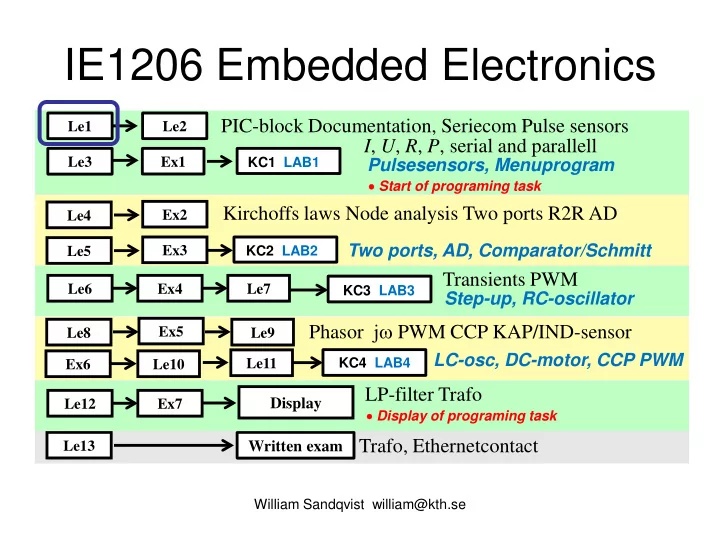
IE1206 Embedded Electronics PIC-block Documentation, Seriecom Pulse sensors Le1 Le2 I , U , R , P , serial and parallell Le3 Ex1 KC1 LAB1 Pulsesensors, Menuprogram Start of programing task Kirchoffs laws Node analysis Two ports R2R AD


slide-1
SLIDE 1

IE1206 Embedded Electronics

Transients PWM Phasor jω PWM CCP KAP/IND-sensor

Le1 Le3 Le6 Le8 Le2 Ex1 Le9 Ex4 Le7

Written exam

William Sandqvist william@kth.se

PIC-block Documentation, Seriecom Pulse sensors I, U, R, P, serial and parallell

Ex2 Ex5

Kirchoffs laws Node analysis Two ports R2R AD Trafo, Ethernetcontact

Le13

Pulsesensors, Menuprogram

Le4

KC1 LAB1 KC3 LAB3 KC4 LAB4

Ex3 Le5

KC2 LAB2

Two ports, AD, Comparator/Schmitt Step-up, RC-oscillator

Le10 Ex6

LC-osc, DC-motor, CCP PWM

LP-filter Trafo

Le12 Ex7

Display

Le11

  • Start of programing task
  • Display of programing task
slide-2
SLIDE 2

Need a computer engineer to know anything about the reality that the data reflects?

William Sandqvist william@kth.se

?

slide-3
SLIDE 3

Not only general databases…

More than 98% of the world's processors today sits in embedded systems. Embedded systems are used everywhere, in satellites, robots, cars, planes and phones, down to the smallest radio, elevator, laundry or dishwashing machine.

William Sandqvist william@kth.se

slide-4
SLIDE 4

Inbyggda system – computer programs in products

In order to write a good program, you simply has to understand the product.

Often a development team of employees with different skills are needed.

William Sandqvist william@kth.se

Husqvarna robot vacuum cleaner - An example of an embedded system

slide-5
SLIDE 5

You as a programmer …

In the development team the programmer often interacts with mechanical hardware and electronics technicians.

The programmer of the embedded system is usually the one who gives the product the most of the function.

William Sandqvist william@kth.se

slide-6
SLIDE 6

William Sandqvist william@kth.se

slide-7
SLIDE 7

Course Embedded Electronics

The course Embedded Electronics provides a practical foundation for future project courses and your thesis. The course will familiarize you with electro technician's terminology and reasoning, so that you can actively interact, as a valuable member of a development team for products with embedded processors.

William Sandqvist william@kth.se

Embedded Electronics

slide-8
SLIDE 8

William Sandqvist william@kth.se

Laborations – hands on

The laboratory course teaches both the programming of a PIC processor and electricity-electronics circuits!

slide-9
SLIDE 9

We learn electronics with the school's smallest processor!

William Sandqvist william@kth.se

slide-10
SLIDE 10

Simple development system!

William Sandqvist william@kth.se

PIC 16F690 8-bit microcontroller

slide-11
SLIDE 11

William Sandqvist william@kth.se

Texteditor Notpad++

slide-12
SLIDE 12

William Sandqvist william@kth.se

Compiler Cc5x

  • the compiler is invoked from inside the texteditor Notepad++.

A script starts the compiler

slide-13
SLIDE 13

William Sandqvist william@kth.se

Chip programmer PICKit 2

PICKit2 Stand alone program for the chip programmer To download code to chip

Fast download

  • f code to chip!
slide-14
SLIDE 14

William Sandqvist william@kth.se

slide-15
SLIDE 15

William Sandqvist william@kth.se

Programing task in groups of two-three …

Programming assignment should give you a practical experience of basic electronic circuit work. This is useful knowledge for project courses and thesis. Programming assignment is presented with a demonstration/presentation and a written "mini report".

slide-16
SLIDE 16

William Sandqvist william@kth.se

Technical report?

slide-17
SLIDE 17

Report on software for an embedded system

You document:

  • System structure
  • The scope of the program
  • Program structure
  • How application/function is to be tested

Technical reports contains "figures" and text interaction. The figures are often different types of charts.

William Sandqvist william@kth.se

slide-18
SLIDE 18
  • Assembly Image

An embedded processor is built into a product. It is hardly possible to describe the processor computer program without first at least briefly explain the product! An assembly image defines what the different parts are called - you then use these exact names consistently throughout the report when you need to refer to the product.

William Sandqvist william@kth.se

slide-19
SLIDE 19
  • Block diagram

It requires no advanced skills or tools for drawing a block diagram. This is a block diagram of the product components. Other chart types are used to describe the program structure. A block diagram is a diagram

  • f a system in which the

principal components, or functions, are represented by block interconnected with arrows showing the relationships of the blocks.

William Sandqvist william@kth.se

slide-20
SLIDE 20

Illustrated block diagram

If you turn to readers outside the group of technicians, it often happens that the blocks are colored and illustrated …

William Sandqvist william@kth.se

slide-21
SLIDE 21

Chart types for program code?

William Sandqvist william@kth.se

How to describe your program as a picture?

slide-22
SLIDE 22

(There is a standard, UML )

Unified Modeling Language (UML) is an

  • bject-oriented general

language for modeling all types of systems. The language used primarily in software design, but is also useful in other fields such as business process modeling and more. By creating a model of the system to be constructed it will be easier to understand and build it.

UML - contains a variety of chart types.

But … UML is too extensive for this course…

William Sandqvist william@kth.se

slide-23
SLIDE 23

Chart types for software

Three common chart types:

  • Flowchart - how the

processor executes

  • Structural diagram -

program structure

  • State Diagram - state

machines

The arrows show how several different chart types interact and may be required to provide a holistic picture.

slide-24
SLIDE 24

Good chart properties

A good chart should be small, simple, clear, contain few abstract symbols, and follow formal rules. A good chart is helpful when to explain the system to others.

William Sandqvist william@kth.se

slide-25
SLIDE 25

Example of a chart that breaks all the rules!

Good chart properties

William Sandqvist william@kth.se

slide-26
SLIDE 26

So, the diagrams are only helpful if you make an effort when drawing them …

William Sandqvist william@kth.se

slide-27
SLIDE 27

We will use …

State chart – for statemachines Structure chart – program structure Flow chart – how the processor executes

William Sandqvist william@kth.se

  • See exercise 1!
  • See Digital Design!
  • See Datorteknik!
slide-28
SLIDE 28

William Sandqvist william@kth.se

  • Flow chart

Tool to draw flow charts could be found in Word and PowerPoint. Flow chart is used when it is important to show exactly how the processor executes code. For example, when analyzing assembly code to ensure that different paths through the program takes the exact same time. But the program structure is better described with a Structure chart.

Programflow

!

Same time …

slide-29
SLIDE 29
  • Structure chart

William Sandqvist william@kth.se

Structure diagram is an easy to draw (just three symbols) two dimensional chart (dimensions: time, and resolution).

slide-30
SLIDE 30

Structure chart editor

William Sandqvist william@kth.se

Take the help of the JSP editor when you plot structure charts!

slide-31
SLIDE 31
  • C-code shell from the chart

William Sandqvist william@kth.se

From the structure chart, one can directly

  • btain a C code shell -

a good beginner's tool!

slide-32
SLIDE 32

Knowledge control before Lab1

William Sandqvist william@kth.se

slide-33
SLIDE 33

William Sandqvist william@kth.se

Knowledge control before Lab1

slide-34
SLIDE 34

William Sandqvist william@kth.se

  • Publishing software code

Program code are written with a font that has a fixed width ("typewriter style"). Normally fonts have variable width: ”i” is more narrow than”W”. Courier New, is one such "fixed" font. Have you used 80 characters per line in the text editor, when publishing size should be set to 8 points if one line is to fit on A4. If the lines are broken it makes your code difficult to read. Please note! Tab characters may need to be replaced with a number of spaces.

slide-35
SLIDE 35

William Sandqvist william@kth.se

Comments

If you write all comments in English you can take advantage

  • f that there are millions of talented PIC programmers around

the world. You can expect to easily find someone who understands your program and who is willing to further develop your code. If you publish code with English comments it is available to the whole world.

comments // or /* */ in english.

slide-36
SLIDE 36

William Sandqvist william@kth.se

  • ASCII graphics

Important information can be embedded in the application code as ASCII graphics. It will then be available to all regardless of the system.

All the course program examples has ASCII-graphics to show how to ”connect” the chip.

slide-37
SLIDE 37

William Sandqvist william@kth.se

Exemple of ASCII-graphics

With ASCII-grafics inside your code, you will have hardware information in reach all the time while you are coding.

slide-38
SLIDE 38

William Sandqvist william@kth.se

slide-39
SLIDE 39

William Sandqvist william@kth.se

Prototyping

slide-40
SLIDE 40

William Sandqvist william@kth.se

Functional prototype - Product

The meaning of a function prototype is to convince

  • thers that you have solved the technical/software

problems that may exist with the design. One has deliberately refrained from a variety of properties that a finished product must have. This has been done to save costs and development time.

  • Functional prototype (working prototype)

What you do in a project course or in thesis work is probably a function prototype of this type.

slide-41
SLIDE 41

William Sandqvist william@kth.se

One must be clear about what is included and what is excluded. Things that are excluded must be perceived as uncontroversial. For example, one can show a functional prototype with a "big" breadboard, while it is "estimated" that the product would fit on a 5×5 mm PCB. Everyone knows that electronic products can be miniaturized.

Functional prototype - Product

What you do in a project course or in thesis work is probably a function prototype of this type.

slide-42
SLIDE 42

Functional prototype

William Sandqvist william@kth.se

Prototyping means building an actual circuit for your

  • design. To verify the function, or to create a platform for

troubleshooting, if it turns out that it does not work. One should always build and test a prototype step by step, there is nothing worse than to troubleshoot and correct the symptoms that have more than one cause. It is always easier to find errors one at a time!

slide-43
SLIDE 43

Everything starts with trying out the the function with a breadboard

William Sandqvist william@kth.se

A breadboard is used to make temporary connections to test

  • r examine an idea. No soldering is required so it is easy to

change the connections and positioning of components. You can practice with: Virtual Breadboard program!

slide-44
SLIDE 44

Components that do not use standard electronics module 0.1“ ?

William Sandqvist william@kth.se

Today's electronics consist of complex PCB with surface mount components that do not use 0.1 "leg distance ".

How can a non-expert then Do anything at all?

slide-45
SLIDE 45

Breakoutboards!

William Sandqvist william@kth.se

For prototype work there are "breakoutboards" to facilitate the connection

  • f all types of special components to 0.1“ pin

standard.

slide-46
SLIDE 46

When solution is complete?

William Sandqvist william@kth.se

To project courses and thesis projects, you often need a more stable circuit design than the breadboard can provide.

slide-47
SLIDE 47
  • You can move the function to a stripboard

William Sandqvist william@kth.se

One can assemble and solder components on a stripboard. It is a PCB with 0.1” (2.54mm) pitch pattern of holes and parallel line strips. Transverse connections are done with wires (jumper wires), and disruption of conduction strips are done, where needed, with a milling tool.

http://www.zen22142.zen.co.uk/Prac/vero_circ/vero.htm http://www.printedcircuitsboards.com/software/88/veroboard-stripboard- software.html

slide-48
SLIDE 48
  • You can move to a "Breadboard PCB"

William Sandqvist william@kth.se

There are ready-made circuit boards which have exactly the same layout as a breadboard! First try it out the circuit on a breadboard, and then when you have a final layout, solder to the components on the same way on a PCB! PCB = Printed Circuit Board

slide-49
SLIDE 49

William Sandqvist william@kth.se

How can an electronics engineer keep track of all wires?

slide-50
SLIDE 50

Simple and useful tool?

William Sandqvist william@kth.se

  • PAD Pencil Aided Design
  • ASCII-graphics
  • But electronics engineers often require more
slide-51
SLIDE 51

The ultimate tool is an electronic CAD software

William Sandqvist william@kth.se

  • Board view • Schematic view

http://www.cadsoftusa.com/ Popular electronik-cad: EAGLE-CAD

slide-52
SLIDE 52

Schematic and Board view

William Sandqvist william@kth.se

Every electronic component has a schematic representation and a PCB representation (the component's foot footprint). The two views are linked. If you select a signal line in the diagram, then the corresponding “pin" in the printed circuit representation is also marked! Easy to orient the components.

slide-53
SLIDE 53

Board view

William Sandqvist william@kth.se

Electronics CAD is the main tool for an electro engineer when it comes to organizing the wiring of a circuit! But one need not produce a circuit board in order to take advantage of all the information on the component pin numbers, footprints, position and orientation, that one can get from a "board view"! CAD software is the natural place to gather information about your circuit and your components! It will often be confusion about component orientation: up, down, left, right, pin number, and so on - but everything can be described in the CAD file in a precise and unambiguous way!

slide-54
SLIDE 54

A tried and tested circuit board is evidence

William Sandqvist william@kth.se

If you you consistently used an Electronics CAD, then a tested circuit board can be seen as a proof that the circuit diagram presented in a report and the real circuit you have made your measurements on are the same!

  • Who else dares to promise that all is connected right?

? !

slide-55
SLIDE 55

You can buy PCP on internet

William Sandqvist william@kth.se

If you buy three cards will cost the same as when buying one (!)

Buy on internet!

Electronic-CAD can generate all files needed …

slide-56
SLIDE 56

William Sandqvist william@kth.se

So now you know the secret of how an electronics engineer can keep track of all the wires?

slide-57
SLIDE 57

William Sandqvist william@kth.se

slide-58
SLIDE 58

What is a Mockup?

William Sandqvist william@kth.se

Mockups are non-functional PCB's that are used to show the physical format of a circuit board which is not yet available. A mockup is just some few components to try out where the contacts should be placed, and to show how large the most bulky components are. The components are soldered to a PCB with 0.1“ pitch pattern of holes that only has solder pads.

slide-59
SLIDE 59

Virtual Mockup

William Sandqvist william@kth.se

There are programs that can convert a CAD file into a 3D image! This can be used to show the size, appearance, component placement long before the actual product is exists!

http://www.matwei.de/doku.php?id=en:eagle3d:eagle3d

slide-60
SLIDE 60

Virtual Mockup

William Sandqvist william@kth.se

http://www.matwei.de/doku.php?id=en:eagle3d:eagle3d

There are programs that can convert a CAD file into a 3D image! This can be used to show the size, appearance, component placement long before the actual product is exists!

slide-61
SLIDE 61

Mockup of a product

3D-CAD LEGO-mill A common Mockup material is OASIS foam http://www.youtube.com/watch?v=Cf6mWQ8QreA A mockup showing how it will look like - but in a material that lacks strength.

slide-62
SLIDE 62

Function Prototype + Mockup

William Sandqvist william@kth.se

A function prototype together with a mockup eliminates the need to directly produce a finished product. This is often enough to convince others (technicians/funders) that you have sustainable idea.

slide-63
SLIDE 63

William Sandqvist william@kth.se