How to run a campaign some recommendations and examples Overall - - PDF document

how to run a campaign some recommendations and examples
SMART_READER_LITE
LIVE PREVIEW

How to run a campaign some recommendations and examples Overall - - PDF document

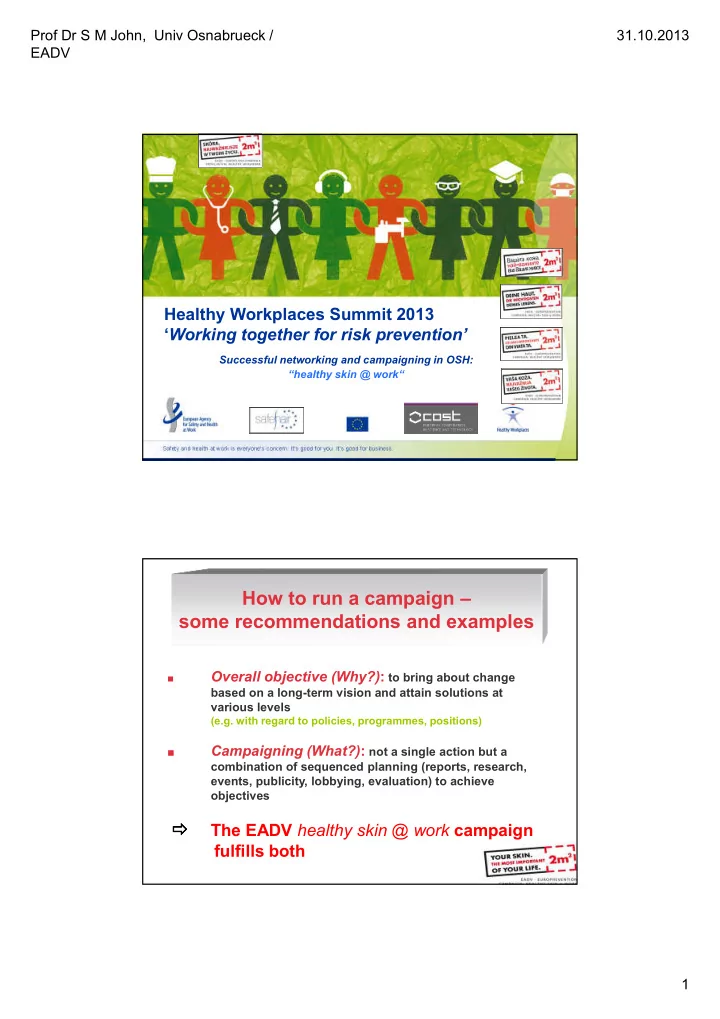
Prof Dr S M John, Univ Osnabrueck / 31.10.2013 EADV Healthy Workplaces Summit 2013 Working together for risk prevention Successful networking and campaigning in OSH: healthy skin @ work Safety and health at work is everyones


slide-1
SLIDE 1

Prof Dr S M John, Univ Osnabrueck / EADV 31.10.2013 1

Safety and health at work is everyone’s concern. It’s good for you. It’s good for business.

Healthy Workplaces Summit 2013 ‘Working together for risk prevention’

Successful networking and campaigning in OSH: “healthy skin @ work“

How to run a campaign – some recommendations and examples

Overall objective (Why?): to bring about change

based on a long-term vision and attain solutions at various levels

(e.g. with regard to policies, programmes, positions)

Campaigning (What?): not a single action but a

combination of sequenced planning (reports, research, events, publicity, lobbying, evaluation) to achieve

  • bjectives
  • The EADV healthy skin @ work campaign

fulfills both

slide-2
SLIDE 2

Prof Dr S M John, Univ Osnabrueck / EADV 31.10.2013 2

Most Frequent Occupational Diseases: Skin

Metallarbeiter, 25 Jahre Irritatives Kontaktekzem

22-yrs

Sick @ work: 90% of all occupational diseases in the age 15 – 25 yrs: skin (2.400 cases p.a. in Germany)

Contact dermatitis

slide-3
SLIDE 3

Prof Dr S M John, Univ Osnabrueck / EADV 31.10.2013 3

Socio-economic Burden

  • f Occupational Skin Diseases

(OSD)

  • “Skin diseases of occupational origin outnumber all other work-incurred illnesses in the

US.” (National Institute for Occupational Safety and Health [NIOSH], Cincinnati, Ohio, USA; www.cdc.gov/niosh).

  • “Skin diseases are one of the most important emerging risks related to exposure to …

chemicals.” (EU-25 report 2008, European Agency for Safety and Health at Work [EU-OSHA], Bilbao) Annual loss of productivity by OSD :

– Netherlands: 99.1 million € (van Gils, Boot et al. 2011) – Germany : > 1.5 billion € (Batzdorfer, Schwanitz 2005) – Denmark: 800 million DKK (J. Duus-Johansen 2011) – UK: > 200 million £ (English 2004) – EU: >> 5 billion € (Wulfhorst et al. 2011) – US: > 11 billion $ (Blanciforti 2010)

OSD1-3:

– Point prevalence: ca. 20 % in risk professions, e.g. hairdressers, health care, metal etc. – 15% of all occupational diseases in USA, up to 35 % in Europe, particularly in SME – 30-72 % of OSD-sufferers loose job

1Saary et al. 2005 JAAD 53:845; 2 Thyssen et al. 2010 Contact Derm 62:75, 3 Wulfhorst et al 2011 Contact Dermatitis, Springer, p 985

EPOS

113 members from 30 countries

European members 109 experts from 26 EU-countries Overseas members 4 experts from 4 international countries (Australia, Canada, India, Indonesia) Thanks to everyone who has joined EPOS and made it what it is today!

slide-4
SLIDE 4

Prof Dr S M John, Univ Osnabrueck / EADV 31.10.2013 4

EADV Campaign „Healthy Skin@Work“: Campaign strategy

National Level

  • Austria
  • Bulgaria
  • Croatia
  • Czech Republic
  • Denmark
  • Germany
  • Romania

European Level

  • Framework Agreement

Hairdressers

  • SafeHair 2.0
  • COST TD1206

Lobbying

  • EU Parliament
  • EU Forum Accident Insurances
  • EU Administration DG EMPL
  • EU OSHA

Improved prevention of OSD at all levels

International Level

  • WHO Global Workshop
  • WHO-ICD Advisory

Group for 11th revision of ICD list

  • XIX World Congress on

Safety and Health a Work

  • ILO Experts Workshop on

Review of List of OSD

  • ICOH

„healthy skin@work“

kick-off Nov. 18 th, 2009 EU Parliament, Brussels Campaign Milestones: Nov. 30th, 2011, EU Parliament, Brussels

EADV Healthy Skin @ Work Campaign

slide-5
SLIDE 5

Prof Dr S M John, Univ Osnabrueck / EADV 31.10.2013 5

Hairdressers in Northern Bavaria Dickel et al. 2002

> 60% reduction of incidence

Effects of preventive efforts, including workers' education Tertiary Tertiary Tertiary Tertiary Individual Individual Individual Individual Prevention Prevention Prevention Prevention (TIP) (TIP) (TIP) (TIP) (3 (3 (3 (3 weeks weeks weeks weeks in in in in-

  • pt

pt pt pt. . . . R R R Rx

x x x)

) ) )

Dermatologist‘s Dermatologist‘s Dermatologist‘s Dermatologist‘s procedure procedure procedure procedure (out (out (out (out-

  • pt

pt pt pt. . . . treatment treatment treatment treatment by by by by local local local local dermatologist dermatologist dermatologist dermatologist for for for for 6 6 6 6 months months months months) ) ) ) + + + + Health Health Health Health education education education education / / / / Skin Skin Skin Skin protection protection protection protection seminars seminars seminars seminars

EUROPEAN SOCIAL PARTNERS' FRAMEWORK AGREEMENT ON THE PROTECTION OF OCCUPATIONAL HEALTH AND SAFETY IN THE HAIRDRESSING SECTOR & Declaration of Dresden

Health Health Health Health education education education education

Healthy Healthy Healthy Healthy skin skin skin skin @ @ @ @ work work work work campaign campaign campaign campaign

tertiary tertiary tertiary tertiary

(severe cases)

secondary secondary secondary secondary

(initial/moderate cases)

primary primary primary primary

( ( ( (prophylaxis prophylaxis prophylaxis prophylaxis) ) ) )

Systematic approach to OSD prevention:

slide-6
SLIDE 6

Prof Dr S M John, Univ Osnabrueck / EADV 31.10.2013 6

2008

2008

EADV EADV EADV EADV Healthy Healthy Healthy Healthy skin skin skin skin @ @ @ @ work work work work / / / / europrevention europrevention europrevention europrevention campaign campaign campaign campaign EU-Commission SOCIAL DIALOGUE PERSONAL SERVICE

uni EU / Coiffeur EU (Employers/Employees; hairdressing in Europe)

EU-Research project

SafeHair:

Development of a common health and safety standard for prevention

  • f occupational skin diseases in the

hairdressing trade

www.SafeHair.eu

slide-7
SLIDE 7

Prof Dr S M John, Univ Osnabrueck / EADV 31.10.2013 7

EU Commissioner Mr. L. Andor & The Social Dialogue, WHO, ILO Official Ceremony in Brussels April 26, 2012

slide-8
SLIDE 8

Prof Dr S M John, Univ Osnabrueck / EADV 31.10.2013 8

www.bgw-online.de

Expenditure on professional skin protection in everyday working life

Hair salon with 1 owner-operator / 3 employees 6 colourations per employee – Consumption per employee / day Material Application frequency Amount Cost/€ Hand protection cream 6 x 1ml 6 ml 0.23 Gloves Colouration 6 x 2 pairs; No colouration 6 x 1 pair 18 2.40 Liquid soap 6 x 1 ml 6 ml 0.16 Paper tissues 2 per wash 20 units 0.10 Moisturiser 3 x 1ml 3 ml 0.44 2.99

Source: CLIPS Chef-Info April 2010, EVA-Studie WELLA

  • ca. 1% of the total turnover in the salon

Framework agreement of social partners in professional hairdressing

Every Cent on prevention is a Cent well spent !

slide-9
SLIDE 9

Prof Dr S M John, Univ Osnabrueck / EADV 31.10.2013 9

gutter press

“…we are waging war against the excessive health and safety culture that has become an albatros around the neck

  • f British business.

So this coalition has a clear New Years' resolution: to kill off the Health and Safety culture for good.“

UK Prime Minister Mr. David Cameron. Jan 5th, 2012

slide-10
SLIDE 10

Prof Dr S M John, Univ Osnabrueck / EADV 31.10.2013 10

OFFICIAL PARTNER EU OSHA

  • Modular SafeHair Skin & Beauty Toolbox
  • Easy access multilingual web platform

(English, German, French, Danish, Dutch, Slovenian, Maltese)

  • Multiplier model (educational authorities, teachers,

tutors, masters)

  • Medical reference document
  • Didactical information at all levels
  • Educational games e.g. puzzle, quizI
  • Learning certificate

www.safehair.eu

slide-11
SLIDE 11

Prof Dr S M John, Univ Osnabrueck / EADV 31.10.2013 11

Teachers:

Educational game description for teachers, Module A “Quizmaster“

short description In this game a so-called “Quizmaster“ reads a question with four possible answers. goal of procedure The goal is to answer as many as possible of a total of four question cards correctly . There is no time limit. learning objectives The students should D I communicate and work cooperatively. I accept the opinions of others. I justify their opinions. I involve all team members. I assign roles within the team. I remain fair and on-topic. I take responsibility for the work results of the group. materials “Quizmaster“ quiz question cards, Solution Guide creative alternatives All students receive the same informational materials on the subject. The entire class is divided into two

  • teams. Each team creates questions based on the materials, which are posed to the opposing team. One

student from each team competes, and may consult with his/her teammates. After each question, both teams appoint a new player. Wrong answers result in lost points. The teacher keeps score for both teams. The teacher can also assume the role of Quizmaster. She/he divides the class into two teams and poses a Quizmaster question to each team in rotation. The groups consult among themselves and give an answer. The team with the most correct answers wins. additional materials needed: informational and learning materials, Quizmaster cards, small prizes if desired

Employees

1) Practice example "critical customer!" Sara works as a hairdresser may now shampoo a new customer. She accompanies the customer to the sink and puts on her gloves. Suddenly the female customer says: “Why are you wearing gloves? Because you don’t want to touch me? My hair is not that dirty and besides, gloves pull on my hair!” How can you react in this situation? BRIEF COUNTERARGUMENT “I’m sorry you have that impression. I’m not wearing gloves because of you, but rather for myself, because I have to protect my skin from so much contact with moisture. Hairdressers often suffer from contact dermatitises of the skin. “Besides, we use single-use gloves that don’t pull on the hair. We’ll try it out and you let me know if it is uncomfortable.”

slide-12
SLIDE 12

Prof Dr S M John, Univ Osnabrueck / EADV 31.10.2013 12

■ draw attention to a problem and have a simple message EADV/national campaign(s) focus: OSD (healthy skin@work) ■ communicate facts – do not overload, avoid complexity

  • EADV campaign: data from the 2008 European Risk

Observatory report on Occupational skin diseases (OSD) and dermal exposure in the EU (EU-25)

  • German campaign: data resulting from OSD-registry,

research (e.g. intervention studies) and other sources

What should a campaign do?

slide-13
SLIDE 13

Prof Dr S M John, Univ Osnabrueck / EADV 31.10.2013 13

What should a campaign do?

■ build support for action

www.epos2010.eu

■ build support for action

  • EU-funded SAFEHAIR 1.0 & 2.0 projects: together with

workers´ and employers´ associations of hairdressers

  • EU-funded COST Action "Development and Implementation of

European Standards on Prevention of Occupational Skin Diseases (StanDerm)"(TD1206)

  • EADV Project #18 : Scientific Evaluation of "Healthy Skin@ work"

What should a campaigner do?

slide-14
SLIDE 14

Prof Dr S M John, Univ Osnabrueck / EADV 31.10.2013 14

http://www.cost.eu/TD1206 COST Mission Statement COST enables break-through scientific developments leading to new concepts and products and thereby contributes to strengthen Europe’s research and innovation capacities. COST key features are:

  • building capacity by connecting high-quality scientific communities

throughout Europe and worldwide;

  • increasing the impact of research on policy makers, regulatory bodies and

national decision makers…(www.cost.eu)

  • EU Commission (Employment, Social Affairs, Inclusion)

– EU Sectoral Social Dialogue (41 branches)

  • Social partners from skin risk professions

– EU Agency for Safety & Health at Work (EU-OSHA)?

  • incl. OiRA
  • National Authorities (Employment, Health)
  • Social Insurances (e.g. European Forum, ISSA etc.)
  • International Labor Office (ILO), Geneva
  • World Health Organisation (WHO), Geneva
  • Producers of e. g. personal protective equipment, pre-

/after work emollients, cosmetics, industrial chemicals

WHO Global Workshop on OSD, Geneva 2011 Hairdressers‘ Social Partners, Brussels 2012

ESF COST Action TD 1206:

StanDerm

“Development and Implementation of European Standards

  • n Prevention of Occupational Skin Diseases (OSD)”

Aims

  • Evidence-based standards of OSD prevention and EU-regulations
  • Safer work environments and easier access to early intervention
  • Improved health and quality of life of workers
  • Diminished socio-economic consequences of OSD
  • Increased competitiveness of small & medium sized enterprises
  • Sustainable process of implementation across Europe, with all stakeholders

http://www.cost.eu/TD1206

slide-15
SLIDE 15

Prof Dr S M John, Univ Osnabrueck / EADV 31.10.2013 15

How to run a campaign – an example

and an unexpected outcomeD

Concerted action. National Press-Conference kick off

  • 20.-24. September 2010 „Week Of Occupational Skin Diseases (WOOD)“
  • 05.-09. December 2011 „Week Of Occupational Skin Diseases (WOOD)”
  • 05.-09. November 2012 „Week Of Occupational Skin Diseases (WOOD)”
  • 04.-08. November 2013 „Week Of Occupational Skin Diseases (WOOD)”
  • Free service by dermatologists, free information by occup. physicians,

statutory accident insurances, vocational schools…

  • www.hautgesund-im-Beruf.de
  • Occupat. Physicians‘ Soc.,

Social insurances, Federal and state authorities

  • U. von der Leyen, MD

Minister of Labour

slide-16
SLIDE 16

Prof Dr S M John, Univ Osnabrueck / EADV 31.10.2013 16

PK der ABD, DDG, DKG, BVDD, DGUV, BGW, BMAS in der Bundespressekonferenz, Berlin am 8.9.2010

Prof. Tschachler, EADV

  • Dr. Brauksiepe,

Ministry of Labour

slide-17
SLIDE 17

Prof Dr S M John, Univ Osnabrueck / EADV 31.10.2013 17

BUKH Hamburg 2010, 2011

Action days

slide-18
SLIDE 18

Prof Dr S M John, Univ Osnabrueck / EADV 31.10.2013 18

Occupational skin diseases in Germany: Notifications (total)/ accepted as occupational/ recognized cases

Quelle: DGUV 2013

5000 10000 15000 20000 25000 2007 2008 2009 2010 2011 2012

Verdachtsanzeigen Bestätigte Fälle Anerkannte Fälle (in Bestätigte Fälle enthalten)

56,4 % 54,8 % 50,1 % 67 % 77,4 % 80 %

Source: DGUV; German Accident Insurance

recognized cases

  • Occup. origin

"Crude" notifications

Effects of "healthy skin@ work" awareness campaign in Germany: Melting down underreporting 30% 27%

slide-19
SLIDE 19

Prof Dr S M John, Univ Osnabrueck / EADV 31.10.2013 19

Underreporting

(ca. 80 fold)

Diepgen TL, Schmidt A (2002) Werden Inzidenz und Prävalenz berufsbedingter Hauterkrankungen unterschätzt? Arbeitsmed.Sozialmed.Umweltmed. 37: 477-480 Meding B, Järvholm B (2002) Hand Eczema in Swedish adults - Changes in prevalence between 1983 and 1996. J Invest Dermatol 118: 719-723. Meding B, Wrangsjo K, et al. (2005) Fifteen-year follow-up of hand eczema: persistence and consequences. Br J Dermatol 152: 975-80 Kütting B, Diepgen TL, Drexler H et al. (2005) Überlegungen zu notwendigen Konsequenzen für arbeitsmedizinische Vorsorgeuntersuchungen durch die Novellierung der Gefahrstoffverordnung... Arbeitsmed Sozialmed Umweltmed 40: 308-312.

25.056 p.a.

> 2.000.000

(Prevalence)

9,628; 50% 8,996; 47% 586; 3%

Notifications of occupational skin diseases 2009 vs. 2012

Occupational origin accepted Notifications unconfirmed Recognized Occupational Disease (Job resignation)

Ntotal2009= 19,210 Skin (Ntotal=19,210): 29% of all notifications of occup. Diseases 2009 (66,951); Skin (Ntotal=24,384): 35% of all notifications of occup. Diseases 2012 (70,566); Source: DGUV (German statutory accident insurance)

slide-20
SLIDE 20

Prof Dr S M John, Univ Osnabrueck / EADV 31.10.2013 20

9,628; 50% 8,996; 47% 586; 3%

Notifications of occupational skin diseases 2009 vs. 2012

Occupational origin accepted Notifications unconfirmed Recognized Occupational Disease (Job resignation)

Ntotal2009= 19,210

581; 2% 19.447; 80% 4,357; 18%

Ntotal2012=24,384 Skin (Ntotal=19,210): 29% of all notifications of occup. Diseases 2009 (66,951); Skin (Ntotal=24,384): 35% of all notifications of occup. Diseases 2012 (70,566); Source: DGUV (German statutory accident insurance)

Costs of occupational skin diseases

German Accident Insurance 2006 vs. 2011 2006 2011

  • Nr. of cases

Costs per case (€) Total Costs (€)

  • Nr. of cases

Costs per case (€) Total Costs (€) Difference

Medical Costs

26,246 656 17,214 € 43,368 560 24,292 € + 41%

Job retraining

4,739 9,074 43,003 € 3,710 7,009 26,003 €

  • 40%

DGUV-Veranstaltung VERFAHREN HAUT Seite 41

  • Cost reduction 2011 vs. 2006: ~10 million €

(not adjusted for inflation)

  • Increase of dermatology-treated cases by 65%

Source: German Accident Insurance (DGUV), 2013

Cases: Costs:

slide-21
SLIDE 21

Prof Dr S M John, Univ Osnabrueck / EADV 31.10.2013 21

cost reduction for employers (who pay the statutory accident insurance fees) by preventive measu

slide-22
SLIDE 22

Prof Dr S M John, Univ Osnabrueck / EADV 31.10.2013 22

Promoting and Developing Social Security Worldwide. www.issa.int

  • Dr. Walter Eichendorf, German Social Accident

Insurance

Results for 15 participating countries

Quantitative effects of OSH

Prevention costs (for companies) Prevention benefits (for companies)

Value in € per employee per year Value in € per employee per year Personal protective equipment 168 Cost savings through prevention of disruptions 566 Guidance on safety technology and company medical support 278 Cost savings through prevention of wastage and reduction of time spent for catching up after disruptions 414 Specific prevention training measures 141 Added value generated by increased employee motivation and satisfaction 632 Preventive medical check-ups 58 Added value generated by sustained focus on quality and better quality of products 441 Organizational costs 293 Added value generated by product innovations 254 Investment costs 274 Added value generated by better corporate image 632 Start-up costs 123 Total costs 1.334 Total benefits 2.940

RoP = 2.2

Participating 15 countries (April 2011): Australia, Austria, Azerbaijan, Canada, Czech Republic, Germany, Hong Kong (China), Romania, Russian Federation, Singapore, Sweden, Switzerland, Turkey, United States, Viet Nam Walter Eichendorf, German Social Accident Insurance; RoP= Return on Prevention

How to run a campaign – some recommendations and examples

involve your parliamentarians D

Antigoni Papadopoulou

SUBJECT: (please specify)

Improving the regulatory framework to develop specific prevention standards for

  • ccupations

susceptible

  • f

acquiring occupational skin diseases (OSD)

TEXT: Occupational skin diseases (OSD) are to date the second most common work-related health problem and cause extensive suffering for the affected workers1. (…) In its 2008 report, the European Agency for Safety and Health at Work confirms that (…)

The European Commission is asked:

  • Which actions does the Commission propose to undertake in order to improve preventive

standards for occupational skin diseases?

  • What can the Commission do to pursue the recommendations made in the 2008 report of

the European Agency for Safety and Health at Work concerning better recognition

  • f
  • ccupational diseases, awareness raising and training of professional staff?

EUROPEAN PARLIAMENT

FORM FOR TABLING PARLIAMENTARY QUESTIONS To the: COUNCIL COMMISSION
slide-23
SLIDE 23

Prof Dr S M John, Univ Osnabrueck / EADV 31.10.2013 23

How to run a campaign – some recommendations and examples

However, before starting it is important to

✔ ✔ ✔ ✔ identify the stakeholders

  • potential key players, allies, opponents

■ who can provide support? ■ who should be influenced? (specific organizations, policy makers, society, etc).

  • they may D support the campaign

D be adversely affected D may have the power to bring about changes or D be responsible for the problem identified

for instance

  • D.

(I)

How to run a campaign – some recommendations and examples

slide-24
SLIDE 24

Prof Dr S M John, Univ Osnabrueck / EADV 31.10.2013 24

`

With glamour, style and beautiful hands

Live your dream

Skin protection becomes a second nature3

Line of argument that goes beyond ‘protection’ and ‘risk’

Topmodel contest

slide-25
SLIDE 25

Prof Dr S M John, Univ Osnabrueck / EADV 31.10.2013 25

prevention goes sexy3

slide-26
SLIDE 26

Prof Dr S M John, Univ Osnabrueck / EADV 31.10.2013 26

Who is going to be the heir of Safeh(e)air ?

SafeHair Skin & Beauty Toolbox (webplatform)

Who is going to be the heir of Safeh(e)air ?

  • Future Generations of Hairdressers !

SafeHair Skin & Beauty Toolbox (webplatform)

slide-27
SLIDE 27

Prof Dr S M John, Univ Osnabrueck / EADV 31.10.2013 27

This takes too long ! I.Good night !

KISS www.safehair.eu

Social networks ? Facebook ?

slide-28
SLIDE 28

Prof Dr S M John, Univ Osnabrueck / EADV 31.10.2013 28 http://www.who.int/occupational_health/en/index.html

How to run a campaign – some recommendations and examples

Also, before starting

✔ ✔ ✔ ✔ analzye in-house resources available

skills/ financial/ existing partnerships/ others ✔ ✔ ✔ ✔ identify the resources needed human resources ? fund-raising ? sponsorship ? specific material ?

slide-29
SLIDE 29

Prof Dr S M John, Univ Osnabrueck / EADV 31.10.2013 29

How to run a campaign – some recommendations and examples

Then D

✔ ✔ ✔ ✔ create a resource pool

✔ ✔ ✔ ✔ get commitment and support for the campaign through partnerships ✔ ✔ ✔ ✔ analyse economical/political conditions: ■ is it the right moment? ■ important events coming up, which may help to gain momentum?

✔ work effectively with the media (e.g. press conferences,

interviews, publish regularly articles)

Czech campaign

How to run a campaign – some recommendations and examples

German campaign

slide-30
SLIDE 30

Prof Dr S M John, Univ Osnabrueck / EADV 31.10.2013 30

How to run a campaign – some recommendations and examples

✔ ✔ ✔ ✔ have one campaign logo

How to run a campaign – some recommendations and examples

✔ ✔ ✔ ✔ develop publicity material and website

www.dermanet.cz

www.hautgesund-im-beruf.de

www.healthyhairdresser.nl

slide-31
SLIDE 31

Prof Dr S M John, Univ Osnabrueck / EADV 31.10.2013 31

  • Dr. C. Wirtz, VMBG

Greatest risk in risk-professions:

Lack of information

„Crime scene“: work place

slide-32
SLIDE 32

Prof Dr S M John, Univ Osnabrueck / EADV 31.10.2013 32

How to run a campaign – some recommendations and examples

Important ingredients for a successful campaign are

Good planning from the start Sound skills and arguments Communicating a message Using local government, media, the public,

social insurances, social partners

Publicity, leaflets, publications, meetings

Time and money

  • e. g. research projects EU COST Action TD 1206,

EADV Research Project #18 , supporting your campaign and evaluation !!

Safety and health at work is everyone’s concern. It’s good for you. It’s good for business.

Healthy Workplaces Summit 2013 ‘Working together for risk prevention’

Successful networking and campaigning in OSH: “healthy skin @ work“

slide-33
SLIDE 33

Prof Dr S M John, Univ Osnabrueck / EADV 31.10.2013 33

Safety and health at work is everyone’s concern. It’s good for you. It’s good for business.

Get comfy with campaigning, BILBAO !