
SLIDE 1
3RD PARTY CAMPAIGN: HOW AND WHY REGULATE?
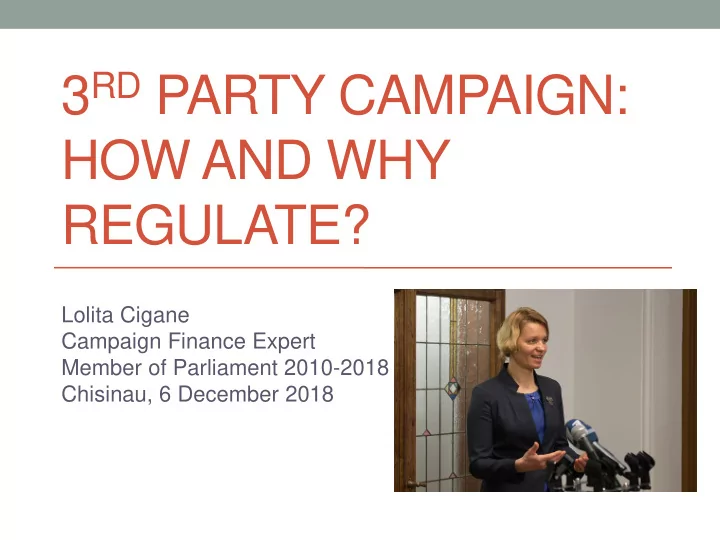
Lolita Cigane Campaign Finance Expert Member of Parliament 2010-2018 Chisinau, 6 December 2018
3 RD PARTY CAMPAIGN: HOW AND WHY REGULATE? Lolita Cigane Campaign - - PowerPoint PPT Presentation
3 RD PARTY CAMPAIGN: HOW AND WHY REGULATE? Lolita Cigane Campaign Finance Expert Member of Parliament 2010-2018 Chisinau, 6 December 2018 Campaign finance: a long personal journey of 18 yrs Latvia a former communist state, now EU
Lolita Cigane Campaign Finance Expert Member of Parliament 2010-2018 Chisinau, 6 December 2018
publicity purposes = grey zone
Is charity charity? Is there such thing as “political” charity? UK Corrupt and Illegal Practices Act of 1883: bribery, such as buying food and drink for potential supporters, was banned.
regulated
and legal entities for campaign purposes
candidate, this opens a possibility to circumvent the campaign expenditure ceiling, and the regulation in general
Detailed disclosure: income/expenditure Enforcement Ceiling on expenditures Defined campaign period Definition of “hidden advertising” Caps on donations, bans for legal entities to donate Ban on paid TV advertising Declaration of prices by media outlets Regulated 3rd party campaigning
https://www.osce.org/odihr/elections/latvia/387665?download=true
I.
Enforcement The KNAB [Anti-corruption agency] supervises campaign finance provisions, exercising investigative and enforcement powers. Donors are obliged to provide information on their income, savings, and property upon the request of the KNAB, as well as documents proving the legality of the sources of donations given.
Political parties are required to submit general financial reports for the previous calendar year by 31 March. By law, the deadline for declaration of campaign income and expenditures is 30 days after election day. KNAB also requests additional party income reports, which must disclose all donations within 15 days of receipt, and which are published on an ongoing basis on the KNAB website.
If an election contestant exceeds the campaign expenditure ceiling, the KNAB is empowered to prohibit further campaign activities.
Despite noting some gaps in existing provisions, most ODIHR NAM interlocutors expressed confidence in the party and campaign finance rules, including the oversight role of the KNAB.
From “wild jungle” in 2001 to a well regulated system in 2018
2001
BUT: Activities of non-governmental organizations, individuals or companies during the campaign through, e.g. placement of paid advertisements on behalf of - or with an aim to promote - a political party or a candidate in the campaign context - high. ➔ Campaign finance ceiling has lost its meaning.
groups not contesting an election can spend on election advertising. Such entities must register with Elections Canada if they incur or intend to incur election advertising expenses of more than US$376. A base limit of $3,000 can be incurred to promote or oppose the election
➔ Transparency and comparatively low spending
call for the election of a candidate and are sponsored by Political Action Committees or individuals, also have to be disclosed to the Federal Election Commission. Additionally, all these groups must disclose their expenditures to any individual who requests this. ➔ Only disclosure
➔ Issues, not a party or a candidate
participate in the pre-election campaign
associations or candidates. Can be an individual, a legal person or a registered association
with the respective political organization, association or candidate.
local government or another public person is prohibited to conduct pre-election campaign.
Expenditure by individual candidates is not 3rd party spending, it has to be counted in political party expenditure. Parties should not be allowed to create other legal bodies.
(1) Unrelated person has the right to conduct pre-election campaign in accordance with the procedure laid down in this Law. (2) Pre-election campaign conducted by an unrelated person shall not be considered a campaign conducted (3) Financial resources or property that is used for pre- election campaign conducted by unrelated persons shall not be considered as a gift (donation) to a political party (4) State authorities and authorities of derived public persons and capital companies are prohibited from conduct of pre-election campaign.
(2) Unrelated person for pre-election campaign may use resources not exceeding 15 minimum monthly wages - 6450 (3) The amount shall consist of the expenses by the relevant person during the period of pre-election campaign regardless of the date on which a document confirming a transaction (bill, contract or other document) was written out, or payment was received or made for: 1) placement of an advertisement: a) in the television programmes and broadcasts of the public electronic mass medium, b) in the radio programmes and broadcasts of the public electronic mass medium, c) in the television programmes and broadcasts of the commercial electronic mass medium, d) in the radio programmes and broadcasts of the commercial electronic mass medium, e) in newspapers, magazines, bulletins and other periodicals registered in accordance with the procedures laid down in the law, produced by print technology and widely circulated throughout the whole territory of the State, f) in newspapers, magazines, bulletins and other periodicals registered in accordance with the procedure laid down in the law, produced by print technology and mostly circulated within the territory
g) on the Internet, except website of an unrelated person, h) in premises and public places (in squares, streets, on bridges and in other similar places) regardless of the ownership; 2) utilisation of postal services (also electronic mail) in order to send the pre-election campaign materials with the help of it; 3) financing, sponsoring charity events, disbursing benefits and making gifts (donations) if they are of the nature of a pre-election campaign.
(4) All financial resources, which are used for pre-election campaign conducted by unrelated persons and exceed one minimum monthly wage, shall be transferred into the bank account of the recipient directly and without mediators. (5) If the total payment would exceed the amount of the expenses set out in Paragraph two of this Section, the relevant electronic mass medium, publication, person, who agrees with the campaigner on the placement of materials of pre-election campaign on the Internet, as well as the person or authority, which allocates premises and public places for payment for conducting the pre-election campaign (regardless of ownership),
materials of pre-election campaign, shall refuse entering into a contract for the unrelated person.
limits
newspaper stopped Success=clear provisions+enforcement
Neutral Administrative
Strong:
stigative Potentially biased