SLIDE 1
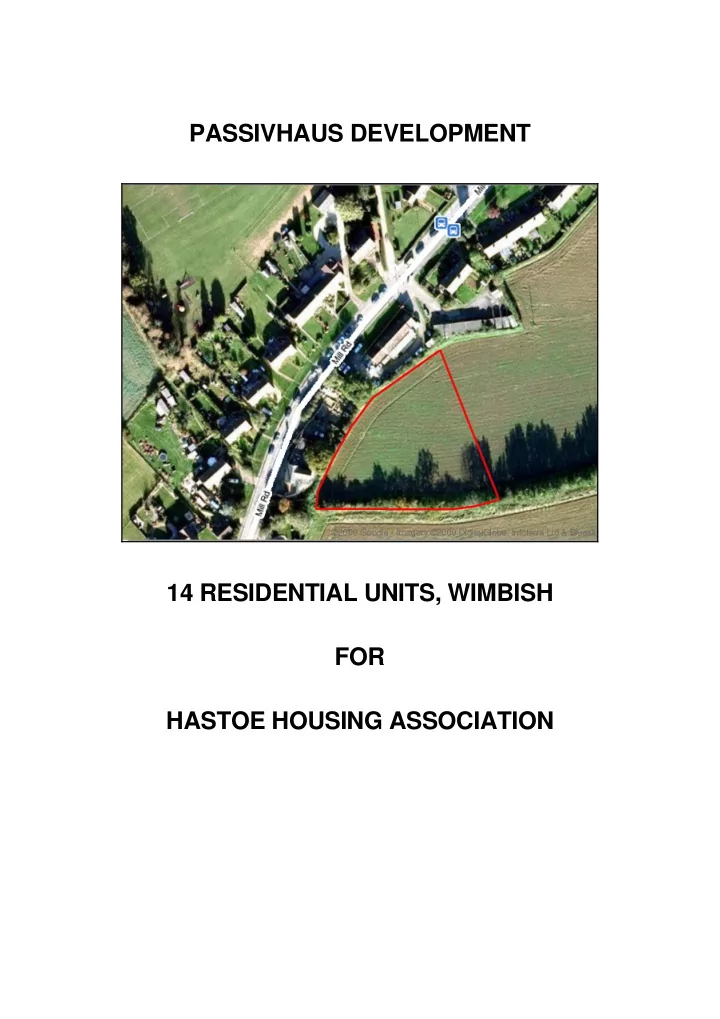
PASSIVHAUS DEVELOPMENT 14 RESIDENTIAL UNITS, WIMBISH FOR HASTOE HOUSING ASSOCIATION
SLIDE 2 Passivhaus Development
INTRODUCTION
Deejak Builders and Passivhaus Design Solutions Ltd (PDS) are pleased to present this response to the proposal to construct 14 residential units to certified Passivhaus standards at Wimbish. We believe our combined proposal demonstrates a hallmark standard of thinking, development and implementation of energy efficiency within the construction industry. Deejak has a track record of long-term relationships with clients over more than 35 years and a strong leaning towards innovation in methods of construction, sustainability and environmental management. PDS is an international alliance of two UK and German leading edge architectural practices - Chambers Goodwin and Partners of Rickmansworth, Herts and r-m-p, architects and engineers, of Mannheim,
- Germany. Both long established firms have extensive expertise in Passivhaus development and design.
This document demonstrates our professional expertise and familiarity with aspects of design for Passivhaus, identifies the critical cultural and management issues involved. It also contains a case study
- f Deejak’s development of low-energy homes at Wixams New Village, a new flagship development in
Bedfordshire, a profile of the parties involved in this proposal and a description of our supply chain partners. Deejak Builders
SLIDE 3 Passivhaus Development
PASSIVHAUS DESIGN AT WIMBISH
When considering a Passivhaus project, the architectural design needs to incorporate specific and unique features from the earliest stage. This is particularly so when a development site is limited for space or its shape restricts building footprint and layout. It is necessary for an appointed design and build contractor and his professional advisers to have input into the initial scheme design to ensure the final detailed proposals will meet the specification and brief and adhere to Passivhaus standards. In this case, the exact nature of the two-stage process is not clearly defined and the contractual relationship and apportionment of risk is difficult to establish from the documents provided. In the case of Mill Road the detail of construction required for a Passivhaus building will not be a governing factor as the site appears to have enough room to accommodate the varied external envelope
- solutions. Consideration will need to be given to the building form, orientation and fenestration, and this
will need to be taken into account at the planning design stage. The current scheme has the right
- rientation, but some work will be required to ensure the balance is provided to regulate solar gain.
Window sizes will need to be calculated against the notional envelope construction and details. A preliminary Passivhaus software PHPP2007 calculation tool will be required to verify the design. In conjunction with a site appraisal shading from natural features such as trees and bushes will need to be considered as solar gains for the new buildings during winter months should be optimised to reduce the heating load requirement. This evaluation will directly impact on the size of glazed areas and in particular those facing generally south. A dwelling designed to Passivhaus principles is intended to generate as much of the heating/cooling of the building as possible minimising the input of imported energy. Deejak Builders
SLIDE 4 Passivhaus Development
THE PASSIVHAUS BRIEF
The invitation identifies the following as essential in Passivhaus construction:-
- Mechanical ventilation and heat recovery
- Air tightness
- Thermal bridging
- Component, build system and subcontractor selection
- Quality control and management
In addition we would identify the following specific requirements for Passivhaus design, which must be addressed holistically, while contained within the 5 principles above:-
- Total energy demand for space heating/cooling less than 15kWh/m3/yr
- Total primary energy use of all appliances, domestic hot water and space heating/cooling is to be
less than 120kWh/m3/yr
- Air permeability level 1m/h/m3 or less
- Windows with combined U-Value of 0.80 W/ m3/K or less
- External building fabric (Floor, walls and roof) U-Value of 0.15 W/ m3/K or less
As part of a value engineering exercise carried out in conjunction with the Passivhaus software, compatible off site panellised frames and more traditional construction will be evaluated for the project. These various systems might include:-
- Open frame timber with added insulation
- Close panel timber frame with added insulation
- Solid wood frame with external insulation
- SiPs close panel systems with added insulation or doubled panels
- Stotherm mineral on lightweight block
- Modcell straw with added insulation
- Beco Wallform (or similar) hollow polystyrene interlocking block with concrete core
- Formworks ICF (Styroframe) EPC/light gauge steel/ concrete core(VIP) system vacuum
insulated panel with concrete or masonry structure
- Brick and aircrete block cavity wall with full fill cavity insulation
Deejak Builders
SLIDE 5 Passivhaus Development
CONSTRUCTION
Other constructional systems and materials are available to use in combination with the above or as
- alternatives. Each will have benefits and drawbacks.
The most likely structural panel system to suit the project would be either a SiPs system or a solid wood
- frame. The use of solid wood on the continent has proven to be highly successful in achieving high levels
- f air tightness with reduced thermal bridging. r-m-p currently favour this form of construction on projects
they are developing to meet the Passivhaus standard. The best means of achieving high levels of air tightness are when the on site components for the external envelope are kept to a minimum. If the design of the houses can achieve whole elevation/storey panels, the number of joints between the panels can be reduced removing the risk of onsite failure to seal joints
- correctly. Reduced joint numbers also makes it easier to check works to ensure the highest standards
are achieved at joints. The use of off site manufacture gives an opportunity for the quality to be closely monitored in clean and controlled environments. If taped seals are required, it will be easier to carry this work out in a factory rather than on a dusty site. As part of his responsibility, the manufacturer will be required to deliver panels which meet the highest standards of air tightness, leaving only the jointing of subsequent components at a site level. Some panelised systems can even be delivered from the factory with windows fitted and glazed, thus ensuring the quality of air tightness for the whole panel. Panels can be interlocking and service wire ways can also be incorporated reducing the risks associated with random site cutting. While desirable in terms
- f quality these systems preclude late client changes such as additional power points.
It will be important for the appointed contractor to work closely with his supply chain to ensure they are fully aware of the requirements to meet the high levels of air tightness. This can be reinforced through training and education of all the parties from the client to the operative at site level. The need to adhere to the design details, the self-checking of work and the close supervision by the contractor’s management staff both on site and through the supply chain is vital. A change of technique or method for a ‘good idea’ at site level could lead to failure to meet the requirement of a detail that has exhaustively been developed to meet a specific need in an individual location. As the buildings thermal resistance values increase, coupled with greater air tightness, then thermal bridging becomes more relevant and important. The ideal situation is the removal of all thermal bridges, but this is almost impossible to achieve economically. The important issue is to control thermal bridging, calculate the effect and compensate. Examples of detail can be provided to show how thermal bridging is reduced or mitigated. The designer will need to consider each of the thermal bridging situations as individual, and only use a common detail were this is appropriate, each of the individual thermal bridges will be calculated and inputted into the Passivhaus software. This coupled with the other data will be submitted to the Passivhaus Institute to obtain the Certification. Deejak Builders
SLIDE 6
Passivhaus Development On-site standards of workmanship will need to be high in relation to the envelope of the buildings, through close monitoring and attention to detail this can be achieved. The monitoring process will require the positive input of the construction stage designer, who will need to advise the concept designers at the planning and specification stages. Working with the design and build contractor they will be able to advise on the cost effective solutions that will meet the brief. Chambers Goodwin and Partners, through their close ties with r-m-p in Germany, can call upon the experience of over 200 Passivhaus projects throughout mainland Europe. Roland Matzig is a foremost exponent of Passivhaus design and would provide the means to provide the full certification required for the project. The knowledge base of r-m-p coupled with the experience that Chambers Goodwin has in the UK of working within the social housing sector, provides a combination to deliver a Passivhaus construction design that will be cost effective. PDS can provide training for both designers and supply chain partners so the principles of Passivhaus can be fully understood in the context of the UK. For more details see www.r-m-p.de and www.cgparchitects.com also www.passivhaus-design-solutions.com for examples of work. Deejak Builders
SLIDE 7 Passivhaus Development
PROCEDURE FOR THE PASSIVHAUS DESIGNER
- Carry out a basic assessment of the site, orientation and layout
- Agree a base construction method for the envelope and fenestration
- Agree a base design for ventilation and other service solutions
- Use baseline thermal bridging values and quantify thermal bridges
- Test the basic design against the PHPP2007 software using minimum standards
- Advise any adjustments to the planning stage design (In particular fenestration and space for
ventilation equipment and servicing)
- Develop a detailed construction design based on the preferred building envelop (in conjunction
with system/frame supplier where appropriate)
- Develop in conjunction with services designer/specialist services design sub contractor technical
solutions and coordinate with building design (interior and exterior)
- Recalculate design against actual design PHPP2007 software (this would form the basis for initial
certification by PHI)
- Check as appropriate supply chain partners detailed design to ensure compliance with design
- Assist contractor with on site training and training of supply chain partners
- Assist contractor with checking of installed frame and components and provision of installation
reports verifying installation compliance
- Receiving air tightness reports and updating PHPP2007 software calculation to generate final
report for certification by PHI (this would also include the as built information relating to the issues covered by certification, i.e. envelope design including all details associated with envelop, U value calculations, thermal bridge calculations, component specifications, product certificates, site photographs and reports)
- Submission of project to PHI for certification (this could be direct or through BRE, AECB,
depending on registration route) This intricate process means that the professional input into the design and supervision of the detailed construction of a Passivhaus is far higher than in a conventional project. This is one of the factors contributing to the higher cost of Passivhaus buildings (see below). Deejak Builders
SLIDE 8
Passivhaus Development
OTHER ISSUES
In addition to the above procedures for Passivhaus certification, Code of Sustainable Homes certification will also be required. If BRE would accept the PHPP2007 tool calculations as satisfying ENE 1 and 2 of the Code some duplication of energy calculations could only be avoided.. Otherwise duplicate calculations will be required using the SAP2009 tool. All other aspects of the Code would be dealt with as normal. The basic specification for a Passivhaus provides a building at or about Code Level 4 for Ene 1 and 2. It may also be a requirement to run calculations using the SAP2009 tool to satisfy Building Regulations approval (Part L1) and to generate EPC’s at completion. Deejak Builders
SLIDE 9 Passivhaus Development
COSTS
As far as we are aware, there are no definitive published figures relating to the costs of Passivhaus in the
- UK. Additional costs ranging from a 5% to a 30% increase above a “normal” house design have been put
into the public domain, although much more modest figures than the latter are normally quoted. In order to arrive at a comparable figure, a “base cost” building has to be clearly defined and differing unique site conditions have to be eliminated between the examples cited. Some of the extra costs can be identified as follows:
- The cost of the structural frame will increase against the normal to provide greater air tightness,
but this extra should be small.
- It will require effort to be made to seal joints, but most timber frames are provided with an internal
vapour check and this will provide good air tightness if correctly installed.
- Windows will be more expensive as triple glazing will be needed.
- There will be more insulation added to the existing, but EPS is not a high value material and if
integrated into the structural panel system again will only add a small percentage to the overall frame cost.
- Solar shading by means of external shutters or blinds to control summer heat gain will be
essential
- If the houses/flats are heated via an efficient heat recovery ventilation system topped up either
electric or heat from a heat pump with hot water generated from the same heat pump with electric backup/rapid recovery, then there would be no need for a gas boiler and gas infrastructure. The savings from the non-provision of gas would probably more than offset the cost of the ventilation and heat pump system.
- Greater professional input for the calculations of thermal bridges and a greater degree of site
supervision to achieve air tight construction will both add cost
- All other fixtures and finishes would generally remain the same for a non-Passivhaus.
It is our view that the likely cost increase would be much lower than one would think and would be in a range of between 5% and 10%. On the following page we have included a basic indicative cost plan for the development based upon recent tender experience. Clearly this will vary according to site conditions and availability of services etc. in the vicinity and should not be taken as a definitive cost. Deejak Builders
SLIDE 10
Passivhaus Development Deejak Builders
SLIDE 11 Passivhaus Development
COMPONENT BUILD SYSTEM AND SUB-CONTRACTOR SELECTION
Aside from the proposed collaboration with PDS for this project, Deejak has worked with various supply chain members to achieve high levels of energy efficiency. For example the £1.9 million development at Westfield Care Home at Dallington in Northampton which utilised cross-laminated solid timber panels as the basis of a modular construction system on an in-situ reinforced concrete floor slab. The pre-fabricated panelling system was supplied by Austrian based timber specialist KLH. The company has worked with numerous architects and engineers to develop sustainable and cost effective structural solutions – seeking to optimise design and buildability. KLH focuses on sustainable construction and promotes the use of timber in lieu of concrete and steel – all timber used is certified, as is the production process, which works to a zero waste system. We are using a Taylor Lane timber frame solution provided by Excel Structures for the construction of new homes at The Brambles at Easton on the Hill in Northamptonshire. Excel Structures (www.excelstructures.co.uk) is a new player in the field of energy efficient component systems but the company principal has more than 25 years experience in the industry – including knowledge of the UK’s First Code Level 6 Sustainable Home the Lighthouse Project. The company are Sustainable Homes Assessors and through its personnel have enjoyed a ten–year working relationship with Deejak Builders. The company offers a single point of contact and responsibility throughout the project. Services include pre-contract design, detailed design, manufacturing, installation and sign-off. Using leading specialist UK supply chain partners, Excel
- ffer the commercial benefits of component selection and a range of fabric solutions.
Deejak Builders
SLIDE 12
Passivhaus Development When complete, this project will be accredited to Level 3 Code for Sustainable Homes. On this project we will be using doors and windows provided by Munster Joinery (www.munsterjoinery.co.uk), one of Europe’s largest door and window manufacturers. The company provides a range of innovative glazing solutions in various opening styles with highly efficient thermal values. In line with the performance requirements set down by the Passivhaus Institute and the upper levels of the Code for Sustainable Homes, Munster Joinery products provide U-values of 0.8W/m2K for the glass and frame combined (not just the centre pane), with solar heat gains of more than 50%. The properties at The Brambles will be built off concrete strip foundations with cavity brickwork. The internal skin will be 140mm wide supporting pre-cast polystyrene insulated floor beams with a 75 mm Deejak Builders
SLIDE 13 Passivhaus Development thick reinforced easyflow concreted slab. The inner shells of these units are of a modular timber frame construction including the roof trusses and all internal walls, externally faced with brickwork. The roofs are tiled with concrete interlocking tiles, windows are double glazed UPVC whilst doors are composite steel the storm porches are made off site from moulded GRP and require no on site attention after installation. All properties have been designed to achieve very good insulation values: 140mm-wide external walls to a value of 0.26, roofs insulated to 0.13, floors to 0.17 with doors and windows to 1.8 with the whole building permeability to achieve a score 5.0m³/h/m² or better with the heating provided from Ideal air source heat pumps connected to a traditional wet radiator system. Our experience of achieving high levels of energy efficiency is not solely limited to new build properties using modern modular methods of construction. For example we worked on a housing project at Rothwell in Northamptonshire that was part new build of traditional materials and part refurbishment of an old
- factory. This £3.5 million project entailed the demolition of the existing factory and the design and
construction of 42 houses and flats of two and three storeys within three blocks. Part of the existing factory was retained for conversion purposes. As well as high levels of energy efficiency (the project was rated as Eco Homes Very Good) it benefitted from high levels of sound insulation. Other construction details included a mixture of thin joint blockwork, traditional brickwork with groundfloors constructed of beam and block, with timber upper floors. The homes have slate tiled roofs and PVC double glazed sealed window units. All properties achieved an air permeability of less than 5.0 m³/h/m² with our best result being 1.89m³/h/m² as shown below. Deejak Builders
SLIDE 14
Passivhaus Development
WIXAMS VILLAGE, ELSTOW – CASE STUDY
Deejak’s recent work at Wixams New Village in Bedfordshire provides an interesting case study that highlights the practical realities of constructing homes to high levels of energy efficiency. The Wixams development is on a large former industrial site, with a mixture of brick coloured render and timber boarding has been designed to look like a traditional Bedfordshire market town. Roofs are constructed from a mixture of slate and interlocking plain tiles with false chimneys. When it is complete, Wixams will be one of the largest new communities to be built in the UK in recent times and will provide a significant contribution towards the region’s housing requirements. Deejak Builders
SLIDE 15 Passivhaus Development However, behind the wrought iron railings and the false chimneys, the 42 houses and flats that Deejak have built at Wixams have benefitted from the application of leading edge technologies and energy efficiencies to achieve Code for Sustainable Homes Level 3. We are proud of what we have achieved on this project and the knowledge gained will be used to improve work on future projects. The technical aspects of the construction are set out below. Frame: Timber-framed construction consisting of 140 mm stud insulated with 120mm of Kingspan Thermawall TW55 insulation, Glidevale Protect VC foil and plasterboard on 18mm plywood strips. U value: 0.18 W/m2k. The plywood strips were used to create a service void and ensure that electrical boxes could be fitted without penetrating the vapour barrier. Robust details from the DEFRA publication limiting thermal bridging and air leakage were used Flooring: Hansons Jetflloor system. This is a composite flooring system for ground floors that utilises expanded polystyrene blocks to provide high levels of thermal
- insulation. It is made up of an inverted concrete T beam with expanded
polystyrene (EPS) infill blocks with an additional 75mm of EPS laid over the floor and a 75mm structural topping giving a U value of 0.11 W/m2k Roof: Trussed rafters, covered with slate or concrete tiles, and a plasterboard ceiling with 400mm of mineral wool with an insulation U value of 0.11 W/m2k Windows: Double glazed UPVC with a U value of 1.8 W/m2k or 1.6 W/m2k, depending on the style of the windows that were to be installed. Heating and We employed two different systems: one for the flats and for the houses. Ventilation: The houses use gas central heating with temperature zone control and load
- compensation. There is a mechanical ventilation and heat recovery system
(using either Greenwoods Fusion HRV1 or HRV95, depending upon which would achieve the required SAP rating) The HRV 95 is an approved Passivhaus system. The flats have a gas combination boiler with load compensation with a Greenwoods Fusion mechanical ventilation and heat recovery system. Air leakage: We worked hard and took care to produce the best air leakage results (4m3/h/m2) that we could. Before we began first fix work, we held a meeting with Deejak Builders
SLIDE 16 Passivhaus Development Wintech Engineering Ltd, the air pressure testing company, to discuss details to ensure our target was achieved. Close supervision is important when it comes to achieving targets so two working carpenter foremen were given the responsibility
- f ensuring that the properties were correctly sealed for air leakage and sound.
In addition to a vapour barrier on the external walls, the party walls and the ceiling at roof level were lined with polythene. In the flats, polythene was laid across the subfloor of the upper floors (under the acoustic floor battens) to reduce air leakage from flat to flat. As shown on the following drawings. Deejak Builders
SLIDE 17 Passivhaus Development During the second fixing, skirtings were fixed to all elevations of bathrooms and kitchens, prior to installing kitchen units and baths, to ensure a good seal between floor and walls. Prior to air pressure testing, we also carried out smoke tests, which gave us a visual check on areas of leakage. Valuable lessons were learnt from the smoke tests and air leakage process. For example, we could have improved the air tightness by using higher specification windows and
- doors. The smoke tests gave us a visible indication of leakages at the doors and
- windows. Other efficiency improvements would have come from using a better loft hatch
and increasing the levels of supervision. There is a definite realisation on our part that there is need for a shift in attitudes when it comes to achieving high levels of energy
- efficiency. On a more mundane level, we simply omitted to seal between the vapour floor
DPM and the wall vapour barrier that would, in hindsight, have given us a higher level of airtightness. All properties tested achieved the design air leakage rate of less than 4m³/h/m² with our best result of 1.52m³/h/m² as shown below. Deejak Builders
SLIDE 18
Passivhaus Development The tick sheets below were used to assist our site staff in achieving our objective of a low air permeability rate. Deejak Builders
SLIDE 19 Passivhaus Development
ABOUT DEEJAK BUILDERS
Deejak Builders is a privately owned construction business that has delivered high quality projects on time and on budget to clients in the private and public sector for more than 35 years. The company prides itself on its ability to add value and develop lasting long-term relationships with clients. Deejak offer clients experience, size and the ability to undertake projects to meet the brief and
- specification. Deejak seek to deliver quality and value above and beyond the terms of the minimum
contract requirements and are able to embrace change. Our service is built around key elements that include flexibility to combine with a unique value-added
- service. The company’s roots are in the community it serves. Deejak has grown over 35 years to a
business with more than 120 directly employed tradesman and experienced management team with a turnover in excess of £25 million. Typical project values range from £500,000 to £10 million. We’ve grown the business by serving the region that we operate from, serving Local Authorities, Social Housing providers, local businesses, communities and organisations – through the service provided we have developed many long-term relationships in the process. The business is made up of four specialist skills providers, namely: Deejak Builders, the contracting division; Deejak Properties, a private development arm; RBM Joinery, a bespoke joinery operation, and Deecon Civils, our own earthmoving business. Deejak Builders works with clients across a wide range of industry sectors to deliver tailored leading-edge solutions to the residential housing, leisure, commercial, industrial, healthcare, education, office and retail sectors. Deejak Properties Ltd operates as a property developer in the residential and industrial and commercial sectors to develop high quality homes and state of the art commercial properties. As specialists in purpose-made joinery, RBM Joinery manufactures purpose-made and specialised joinery items. Deecon Civils is Deejak’s specialist earthmoving operation, offering a comprehensive range of services to clients and main contractors, as well as working on Deejak projects. Long before the idea of partnering and a non-adversarial approach became well accepted in the industry we had informally adopted these approaches. It’s a no-nonsense concept that is built around some very basic ideas that influence the way we work. We treat our people, our sub-contractors and our clients in the way that we like to be treated ourselves. This is all manifested by the way we retain and develop staff,
- ur high levels of safety including much work done on occupied sites, by the way we have long-term
relationships with all of our supply chain (20- to 30-year relationships are not uncommon) and the way in which we work again and again with the same clients. It’s an approach based on trust, honesty and fairness, characterised by a long-term view and the idea that we win only when everyone else wins too. Our approach is always to eliminate shocks and surprises. We make a point of appointing a named team, dedicated to the life of each project whose job it is to Deejak Builders
SLIDE 20 Passivhaus Development understand the client, their objectives, their project limitations and then to deliver a situation tailored to these criteria to the highest possible standard. STEPHEN J. TITMUSS – CONTRACT DIRECTOR F.I.O.D. Stephen Titmuss has worked for Deejak Builders for over 30 years. Upon leaving school, he began a career as a site carpenter, before taking on a succession of more demanding roles: working carpenter/foreman, assistant site manager, site manager, contracts manager and, finally, contracts director. Currently, he is responsible for a team comprising six contracts managers, three quantity surveyors, fifteen site managers and associated staff over a diverse range of contracts. Stephen recently led a multi-disciplinary team that succeeded in landing a framework agreement with the council for the nearby city of Milton Keynes. The agreement covers the provision of new school builds and refurbishment in one of the fastest growing areas of the UK. In the face of
- pposition from some of the biggest and most respected construction firms in the country, we
succeeded in becoming one of just three partners to the council in a programme that will be responsible for many tens of millions of pounds over the next few years. The successful conclusion of the bid process has marked a step change for Deejak which has had to embrace concepts such as partnering, industry standard benchmarking, environmental management and certification, high standards of health and safety, ISO accreditation, supply chain management and modern methods of construction to win a place at a table where it is taking on, and beating, major industry players. With an extensive knowledge of construction methods and detailing coupled with a keen interest in Modern Methods of Construction, Stephen is well placed to add the benefit of his 30 years experience to the Design team and help take this forward thinking development from the design stage through to completion. MARTIN WOODWARD – CONTRACTS MANAGER BSC HONS Martin Woodward has more than 30 years experience in the construction industry, 15 of those years have been with Deejak Builders. Martin started his career with Wimpey Construction UK Ltd as a Site Engineer before moving to Boon Building and Construction Ltd as Assistant Contract Manager involved with the construction of one off luxury houses.He moved to Glanville Projects a Project Management Company in Oxfordshire where he managed the construction of several warehouse and office units on the Milton Park Estate near to Abington Oxon. Deejak Builders
SLIDE 21
Passivhaus Development Since joining Deejak Builders Martin has specialised in Design and Build Social Housing projects being responsible for all aspects of the contract from design through to Practical Completion. He has experience of both Eco Homes (our project at Upton in Northampton achieved a rating of excellent) and the Code for Sustainable Homes (Wixams Village achieved a Code rating of 3). He is also a registered Code for Sustainable Homes Assessor. STACEY HOLGATE – CODE FOR SUSTAINABLE HOMES ASSESSOR / SECRETARY Stacey Holgate joined Deejak Builders in 2003 as an Administration Assistant. She worked closely within the contracts department undertaking all general office administration duties. Stacey took a CAD course in 2007 giving her the ability to create and edit architectural drawings. This helped develop her knowledge and understanding of the construction process. In 2008 Stacey passed her Code for Sustainable Homes Competent Persons examination and was registered as an Assessor for the company. As part of our on going training Stacey was given Quality Management training this year to assist her in working along side Martin Woodward to develop various site checklists. Deejak Builders
SLIDE 22 Passivhaus Development
ABOUT PASSIVHAUS DESIGN SOLUTIONS
Passivhaus Design Solutions (PDS) is a specialist international architectural consultancy that aspires to make the Passivhaus construction standard a mainstream method of achieving progression and raising the transitional standards towards the zero carbon construction targets in UK of 2016 and beyond, particularly but not exclusively in the social housing sector. The company also provides training in Passivhaus design and construction and act as agents and promoters for component suppliers that meet the exacting standards set by the Passivhaus Institute. The architectural partners of PDS are Roland Matzig, Peter Goodwin and Terry Haigh.
ROLAND MATZIG DIPL. ING. (FH) ARCHITECT
Born in 1956, Roland became an architectural draftsman at the age of 17. At 21 he studied architecture at the University of Karlsruhe/Germany and then founded R-M-P aArchitects and Engineers in 1981, which he developed into the foremost designer of Passivhaus in Germany. As a certified Passivhaus Designer, Roland teaches Passivhaus Planning to other Architects and is a major contributor to Architos a consortium of architects providing sustainable solutions– see Roland’s personal website www.roland-matzig.de
PETER GOODWIN B ARCH (EDIN), M SC (EDIN), RIBA, MRTPI – CHARTERED ARCHITECT AND TOWN PLANNER
Born in 1945, Peter read architecture and urban design at Edinburgh University, becoming a Member of RIBA in 1972 and RTPI in 1973. He worked as a town planner and architect in London local authorities and private practices before becoming a partner of Chambers Goodwin and Partners (CGP) in 1983, where he has been involved in the procurement and design development
- f many housing developments. Peter specialises in feasibility studies, master planning/concept and
urban design. He is registered as a RIBA Client Design Adviser and has been an Assessor for Civic Trust Awards since 1998 and RIBA East Awards since 2001.
TERRY HAIGH FFB - PROJECT MANAGER
Born in 1950, in 1966 Terry became an architectural technician working for GMW Architects. Over his years there he managed teams delivering technical packages and supervised contracts on large-scale commercial and public projects in London and the South East. In 1984 Terry joined Peter at CGP as an Associate, becoming a partner in 1986 and has supervised the technical packages and contract supervision of all major projects. Terry currently manages the application of IT, production information, specification, contract documentation, site supervision, party wall surveying, CDM coordination. He is also an Assessor for the Code of Sustainable Homes. Deejak Builders
SLIDE 23
Passivhaus Development
QUALITY CONTROL & MANAGEMENT
Deejak Builders and Passivhaus Design Solutions combined approach would be to focus on Quality Control and Management on this project. A dedicated full time Site Manager and Foreman with a proven track record in delivering high quality CSH Level 3 constructed houses and flats would be allocated to the project from the start. Their experience and expertise combined with the Design Team would provide them with a full understanding of the targets required and allow them to become completely familiar with the concept of Passivhaus. Training would also be a pre-requisite for all of the key players involved in the deliever of the Passivhaus construction, with pre construction sessions followed during construction with site team reviews and talks, to ensure standards required for a Passivhaus building are understood and delivered. We can clearly demonstrate from our results at Wixams Village, Bedford and Gordon Street, Rothwell, that we believe we have systems and control procedures in place to take the construction of the 14 units at Wimbish forward to Passivhaus Certification. We would expect to carry out smoke and air testing at 3 key stages during construction; these would be as follows:- 1) Completion of the air barrier 2) Completion of 2nd fix activities 3) Completion prior to snagging This level of inspection and control would further reinforce the need for high quality and control needed for this project, something which we at Deejak Builders believe already places us ahead of our fellow contractors in achieving. In working as a team to ensure that certification is achieved as cost effectively as possible, early consultation with key sub-contractors and suppliers is absolutely vital as their input to the key elements i.e. frame construction, windows and doors and electrical and mechanical systems has a major effect. Early discussions with planners is also a key element in the process to allows orientation and layout to be fully taken advantage of. We believe that Passivhaus Construction can eventually become a “Gold” standard and a measure of quality in construction and a realistic benchmark in the UK as we move towards the Zero Carbon future. Clearly early examples will have cost more in both delivery times and construction costs due to the construction learning curve and the development of a supply chain to consistently deliver what is needed. This will apply to the construction industry as a whole and equally to any new building of the future that seeks to achieve higher energy standards. However once these hurdles have been overcome and this or any other comparable standard required is achieved, then Deejak will be in a position to offer Passivhaus construction as a viable, cost effective “Green” solution, offering a Forward Approach to Energy and Design. Deejak Builders
SLIDE 24
Passivhaus Development Deejak Builders
CONCLUSION
The outlook in the UK for Passivhaus is enormous but it will require a higher quality of design and construction than has ever been seen in the housing market. The Government and its energy policy agencies are setting this standard. Social housing providers are already looking at Passivhaus developments. The partnership of Deejak and PDS is uniquely placed to offer a huge depth of experience together with expert knowledge of the requirements of the UK social housing sector to deliver the new solutions that will meet the lower energy dwellings needed now and beyond 2016.