SLIDE 1 Jon Bootland Passivhaus Trust
Passivhaus Trust The Foundry, 5 Baldwin Terrace, London N1 7RU Tel: 0207 704 3502 Email: info@passivhaustrust.org.uk Web: www.passivhaustrust.org.uk
Why Choose Passivhaus?
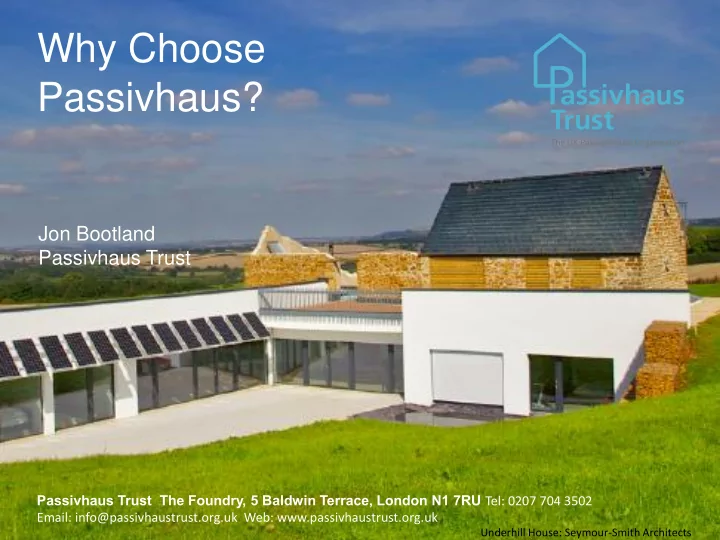
Underhill House: Seymour-Smith Architects
SLIDE 2
Alaska's Glacier Bay, 1941
SLIDE 3
Alaska's Glacier Bay, 2004
SLIDE 4
Built environment impacts
How much of the UK’s CO2 emissions are caused by buildings in use? 10% 25% 50% 75% 100%
43%
SLIDE 5
Housing impacts
How much of the UK’s CO2 emissions are caused by homes in use? 10% 25% 50% 75% 100% 25%
SLIDE 6
Official figures (UKCCC)
SLIDE 7 Simmonds.Mills / Thermal Inspections Ltd.
What is Passivhaus?
Energy Savings and Improved Comfort & Health
Passivhaus is the leading international low energy, design standard.
SLIDE 8
What is Passivhaus?
SLIDE 9 What is Passivhaus?
A quality assured process with Certification for:
Buildings
- Through UK based certifiers
Products / Components
- Through Passive House Institute
- Is a demonstration of performance but not
required (except for MVHR systems)
Designers / Consultants
- Through CEPH courses
- List of CEPH designers / consultants on the
PH Trust website
Tradesmen / Installers
- Through Certified Tradesman courses
SLIDE 10
- Developed by Dr. Wolfgang Feist and Prof. Bo Adamson in the 1980s
- Over 50,000 Passivhaus projects have been completed world-wide.
- Passivhaus is now the leading international low-energy standard.
- It is a building concept that can be adopted by anyone
International Standard
SLIDE 11 Passivhaus Timeline
The world’s first Passivhaus is built in Darmstadt
1991 1996 2009 2010
The Passivhaus Institut is founded by Dr. Wolfgang Feist The first Passivhaus in the UK is built in Machynlleth The Passivhaus Trust is founded to promote PH in the UK
SLIDE 12 In the UK:
certified
certified
underway
400 units (apartments)
- Largest complete site so far
is 51 units (Rainham, Essex)
UK Passivhaus 2017
>500 complete, >1000 underway
SLIDE 13 Not just housing
The Passivhaus standard is not confined to residential properties and has been achieved in several office buildings, schools, supermarkets etc around Europe.
SLIDE 14 Also refurbishment
“Quality-Approved Energy Retrofit with Passive House Components”
The goal was to create a standard for an economically and ecologically optimal energy retrofit, for old buildings that cannot achieve Passive House Standard with reasonable effort. (PHI) Lena Gardens
SLIDE 15 Why choose Passivhaus?
Futureproof: Passivhaus as a route to Near Zero Better Energy Performance Greater Occupant Comfort Comparable Capital cost Lower running costs Quality now: Passivhaus as a low risk approach
SLIDE 16 Why choose Passivhaus?
There are three major quality challenges presently facing the UK house- building industry:
Many conventional buildings designed and built in the past few years are demonstrating a performance gap in terms of: a.energy use b.ventilation and indoor air quality c.thermal comfort and overheating
Denby Dale – Photo: Green Building Store
SLIDE 17
Performance gap for energy use in new homes
How much more energy does a typical new home use for heating, compared to its design target? +10% + 25% +50% +75% +100%
SLIDE 18 Better energy performance
Figures show that for Passivhaus the average heat energy use is 15kWhr/m2/yr
SLIDE 19 2011 Measured performance Primary Energy: 100.19 kWh/(m².yr) (Everything, including space/water heating) Space Heating: 8.86 kWh/(m².yr) Y Foel, the first Certified PH project in the UK North Wales (2006/7)
SLIDE 20 Measured performance: Primary energy demand: 80 kWh/m²/yr Space heating demand 14.8 kWh/m²/yr (£130/yr gas bill) Internal temperatures never below 20°C or over 26°C Canolfan Hyddgen, the first Non-domestic PH project in the UK North Wales (2008)
SLIDE 21
Better energy performance
UK Measured Data (Rachel Mitchell)
SLIDE 22 Greater occupant comfort
Y Foel: Constant indoor temp, Consistent relative humidity between 40 and 60%.
SLIDE 23
SLIDE 24
Ventilation & healthy indoor air
In new homes tested for DCLG in 2010, how many ventilation systems delivered the required air change rate? 10% 25% 50% 100%
22%
SLIDE 25
Ventilation & healthy indoor air
In equivalent tests on Passivhaus new homes, how many ventilation systems delivered the required air changes? 10% 25% 50% 100%
>80%
SLIDE 26 Overheating
What the hell is going on?
SLIDE 27
Summer comfort
What temperature do regulators consider to be dangerous to vulnerable occupants (elderly, sick, young)? 20oC 25oC 30oC 35oC
25- 26oC
SLIDE 28 Overheating
1. Single-aspect apartments 2. Solar gains from West and South facades 3. Heat gains from uninsulated pipework & equipment 4. Night-time ventilation difficulties (noise, security, midges!) 5. Occupancy levels………………… Passivhaus already addresses the first three items in its calculation software; we encourage practitioners to design the others out! We want to ensure that overheating is almost impossible in Passivhaus homes in the UK We know the problems:
SLIDE 29 Why invest in Passivhaus?
Extra capital costs can typically be between 3-8%, offset by lower running costs. However, experienced designers have managed to build at no extra cost. Extra capital costs:
Insulation, high performance triple glazed windows, ventilation with heat recovery.
But operational cost savings:
Reduced cost of heating systems, heating bills typically reduced by 90%
Plus extra value:
High build quality; health and comfort benefits
and LOWER RISK:
No performance gap, good ventilation, avoid serious overheating risks.
Bushbury Hills Primary School: Architype
SLIDE 30
Comparable capital costs
From 2012-2015 there was an extra capital cost for new-build housing of 12 to 20%, depending on size, orientation etc. Exeter City Council schemes 2-3 onwards: no additional cost.... ….but you have to aim for that from the start. And added value, lower voids, lower arrears
SLIDE 31 Future costs
Recent figures show the additional cost coming down, as people become more experienced with using Passivhaus. By 2020, the costs should be comparable with other approaches. Any move to Zero Carbon would elevate costs above the Passivhaus standard, PH would be a low-risk route to achieving Zero CO2!
TBC
Vol 2
2018
SLIDE 32
Lower running costs
How much does it cost to heat a typical new home (2-3 bedroom terrace, 2010 building regs) for one year? £100 £200 £300 £400 £500
SLIDE 33 Passivhaus running costs
How much does it cost to heat a typical Passivhaus home (2-3 bedroom terrace) for
£100 £200 £300 £400 £500
SLIDE 34 What next?
Passivhaus project!
- 2. The Trust will help you. We are:
- A not-for-profit organisation
- The UK affiliate of the PassivHaus Institute
- 3. Join in and learn from others
SLIDE 35 Exeter City Council 9 schemes >100 units
Knights Place, Exeter City Council (Gale & Snowden)
SLIDE 36
Cameron Close, Isle of Wight
16 new Passivhaus homes
Hastoe Homes 11 schemes >100 units
SLIDE 37
6 sites across the city
e.g. 105 new Passivhaus homes
Norwich City Council 6 sites >200 units
SLIDE 38
Agar Grove, Camden
Existing: 249 homes Proposed: 493 homes
Camden Council 2nd Project
SLIDE 39 Images top (l-r): Wimbish (Hastoe), Dormont (CCG), Bushbury (Architype), Interserve (Interserve) Images bottom (l-r): Sampson Close (Orbit), Montgomery School (BAM), Viking House (Van Developments)