SLIDE 1
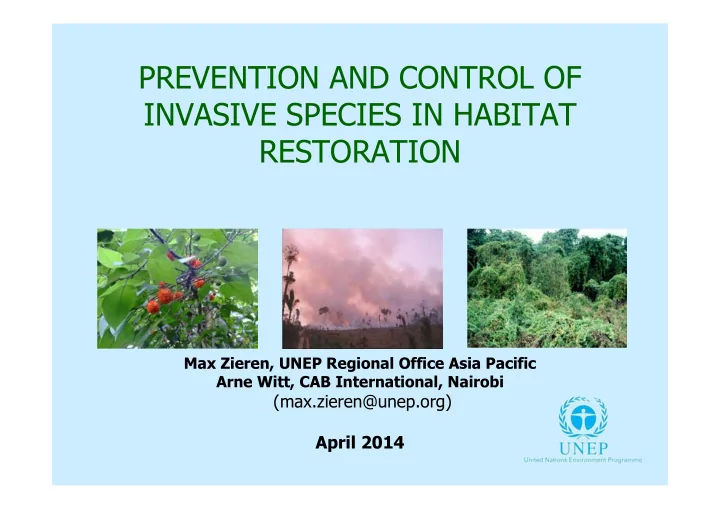
PREVENTION AND CONTROL OF INVASIVE SPECIES IN HABITAT RESTORATION
Max Zieren, UNEP Regional Office Asia Pacific Arne Witt, CAB International, Nairobi
(max.zieren@unep.org) April 2014
SLIDE 2 Beauty of invasive species is deceitful…..and costly…
- IPCC - 2 degree rise in temperatures could cost the global economy anything
from 0.2-2% of global GDP (April 2014)
- BUT - Invasive species costing the global economy 5% of global GDP (2011,
USD 1.4 Trillion)
Yet invasive species grossly ignored in economic development, restoration and core conservation programs Water Hyacinth
SLIDE 3 Invasive Alien Species (IAS) and habitat restoration
- Role and impact of IAS on restoration
underestimated
- Many fast growing species used for reforestation
are invasive
- Habitat degradation invites IAS
- Much degraded, logged over and fallow land has
IAS
- Challenge to rehabilitate ground vegetation
cover, whilst removing IAS
Merremia peltata, Bukit Barisan NP
SLIDE 4 Invasive Alien Species – the basics
- Invasive Alien Species (IAS) are “introduced
species that become established in a new environment, then spread in ways that are destructive to human interests and natural systems”
- Intentional and non-intentional
introductions
- Key entry points or pathways: economic
development, logging & major habitat degradation, increased trade & transport
- Invasive species more than a pest -> IAS
change ecosystems functioning!
- Prevention better and cheaper than control
afterwards
SLIDE 5 Scope of the Problem
- IAS are everywhere - and still being introduced or promoted due to
carelessness or ignorance - e.g. as ‘solution’ to land degradation!
- Prosopis juliflora – e.g. invaded c. 800 000 Ha in Ethiopia, c. 600,000
Ha in Kenya, 1.8 mill. Ha in South Africa & 5.6 mill. Ha India
- Cost invasives in EU (Euro 12 billion/yr) – an ‘Act’ in the making to
blacklist ‘possession, transport, selling or growing species deemed as
- f Union concern’
- Cornerstone of BD conservation – the Protected Areas sytems, are
increasingly infested, impacted or being lost
- Key wildlife such as One-horned Rhinoceros (Chitwan National Park),
Banteng (Baluran NP), or Asian Elephant affected by changes in available fodder
- Reduced agriculture production: USD 21.6 million p.a in SE Asia;
Coffee plantations East Java loose 83% production
- Natural forest regeneration severely affected
SLIDE 6 Impacts of invasive species
Types:
- 1. Economic
- 2. Production & food
- 3. Human health
- 4. Biodiversity &
ecosystems
SLIDE 7 (i) Economic impacts
Australia
- 2681 alien species have become established
- Annual cost of invasive weeds to crops – USD 1.2 billion;
pasture – USD 462 million; horticulture USD 199 million.
- Cost of introduced invertebrates like mosquitoes, honeybees
and wasps, fire ants, cattle tick, screw-worm, earth mite, wood wasp – USD 4.7-7.5 billion p.a. USA
- Economic costs of invasive plants and animals are estimated at
US$ 137 billion p.a.
Total costs AUS + USA over USD 140 billion per year
SLIDE 8 (ii) Food security
Witchweed (Striga hermonthica)
Africa – maize losses
impacts on the lives of more than 300 million Africans
SLIDE 9
Depressed and weak
(ii) Food security - Impacts on crop and pasture production
Lantana camara poisoning !
Has invaded majority of pasturelands India (13.2 million ha.) – damage estimated USD 924 million per year Pastoral losses Queensland (AUS) USD 7.2 million, 1,500 animal deaths, reduction in productivity, loss of pasture, and control costs
Exposed flesh where skin has died – photosensitive!
SLIDE 10 (iii) Human & Animal Health - Parthenium impacts
Prolonged skin contact gives allergenic eczematous contact dermatitis. Inhalation
- f pollen causes allergenic rhinitis which can
become bronchitis or asthma. 1 to 10 years exposure to the weed, 10 – 20%
- f the population will develop severe allergenic
reactions (McFadyen 1995) Labial dermatitis in Goat
SLIDE 11 (iv) Habitat & biodiversity impacts – Kafue Flats, Zambia, Impacts Mimosa pigra on bird diversity and numbers
5 10 15 20 25 30 35 40 45 50
Uninvaded Invaded
5000 10000 15000 20000 25000
Uninvaded Invaded
SLIDE 12
(iv) Habitat & biodiversity – Baluran NP, Indonesia Acacia nilotica
Introduced as firebreak in late 1970s Spread to 60% of savanna ‘Protected’ Banteng population dropped from hundreds to just 26
SLIDE 13 CBD and where are we now
- IAS in most NBSAPs & 55% have
national legislation, yet not enough ‘on-the-ground’ follow up
- Focus T9 on ‘pathways’ yet the
problem already there & extensive
- IAS cross-cutting to most Aichi
Targets!
- Lack of baseline data on scale of
infestations and costs impacts
- Many still unaware or ignorant how
serious this issue is As a result countries and donors not motivated to invest in IAS
SLIDE 14 CBD targets – threats IAS to Protected Areas in SE Asia (selected only)
Indonesian Protected Areas (incl. WHS, MAB) infested :
- Wasur NP; Lembah Anai NR; Rawa Aopa Watomohae NP;
- Gunung Gede Pangrango NP; Ujung Kulon NP; Meru Betiri NP;
- Alas Purwo NP; Baluran NP; Merapi NP; Pulau Mojo GR;
- Kamojang NR; Bogani Nani Wartabone NP, and many more...
What is at stake?:
- Degradation by IAS leads to additional degradation – e.g. fire risks
- Their core conservation values, species and services may be lost;
- Natural habitat regeneration affected – seedlings of keystone species
can not establish anymore
- Income from tourism down?
- Loss of support/motivation with local government and general public?
SLIDE 15
CBD - change needed !
1. National inventories – what and where, anticipated spread (climate models) 2. Full national costs benefit analysis (CBA) of both the monetary and non-monetary impacts of invasives on production systems, human health and ecosystem services; plus PA networks 3. Extensive global & national communications campaigns : (i) impacts, (ii) control measures, (iii) stop promoting IAS (national pride/indigenous species campaign) 4. Getting countries, donor agencies and others such as CBD, FAO, UNDP, UNEP, IUCN, CABI etc to work together under a kind of ‘International Protocol’(?) 5. Control is possible IF combined with habitat rehabilitation 6. Adopt and promote bio-control, as safest and most cost efficient
SLIDE 16 Challenges habitat restoration
1. Many exotic species suitable are invasive
- E.g: Austroeupatorium inufolium (South America) –
introduced Indonesia for control Alang Alang grass – now invasive Sumatra
- Prosopis juliflora – introduced many sites for firewood and
desert control, now noxious weed with extreme impacts and human costs
- Mimosa pigra – soil improvement Wonogiri watershed,
Central Java, severe invasive in wetlands
- Acacia nilotica – firebreak Baluran NP, now leading to
destruction grass savanna & Banteng population
- Acacia mangium is now an invasive in Borneo
Lessons:
- Ideally go for native species
- Conduct full Risk Analysis (RA) of any introduced species – build
upon existing RA/quarantine systems in countries
SLIDE 17 2. Degraded habitat often already with or susceptible to IAS
- E.g logged over Dipterocarp forests or former agriculture
land – e.g. Merremia peltata (Indonesia); Acacia diplotricha (Vietnam); Piper aduncum (Philippines); Mikania or Chromoleana on plantations – East Java or Timor Leste
- Lesson: We can not rehabilitate without dealing with
invasives!
SLIDE 18 3. IAS control - cost & time considerations key!
- Choice of chemical, mechanical and bio-control
- Chemical/mechanical removal of Acacia in Baluran NP - takes tens
- f years, IF without further infestations. Winning this battle will be
costly and long!
- Cost Zambia approximately USD 450,000 to clear 900 Ha Mimosa
pigra infestation on the Kafue Flats (USD 500/ha)
- Mechanical control costs range USD 500 - 20,000/ha/yr
- Fifteen years of mechanical plus chemical control in South Africa
cost USD 457 million, yet invasions still increasing! Chemical and mechanical control useful for containment, yet very expensive, and - on their own, can never treat the millions of Hectares already invaded!
SLIDE 19
- 4. IAS control must go hand in hand with habitat
restoration
- Stimulate native vegetation recovery –
e.g. good canopy cover can suppress IAS
- Remove competition by IAS for light,
nutrients and toxic effects
- Prevent re-growth or new IAS
- Restoration of water quality or
hydrology (e.g. lakes, swamps) helps suppressing IAS
- FORIS project: integrated habitat
management – combined w. IAS control (see video); various treatments: manual-versus- chemical & support to adopt bio-control
SLIDE 20
- Multi-facetted (it’s certainly not just # seedlings planted)
- Clarifying land-titles & providing income for local communities
- Make economic case with corporate and government on benefits
large scale restoration: think about - (i) ecosystem services value; (ii) reduction of disasters, (iii) reducing financial risk for businesses of degraded natural capital like water
- Integrated habitat management plans include IAS & restoration
- IAS control – can be mix of chem./mech. & bio-control
- Species selection – non invasives!
- Assisted natural regeneration
- Artificial restoration, re-forestation, re-vegetation
- Benefit sharing of improved local environment (monetary and
non-monetary)
- 5. Elements for successful restoration
SLIDE 21 ‘The Big Push’ – Case for stepping up Bio-Control
Background:
- Biological control - the use of host-specific natural enemies (pathogens,
mites, and insects) to control invasives
- The control agent can and will not attack other plant species
- Been practiced for many decades by especially USA, Australia, South
Africa, Canada, New Zealand, but also some in Indonesia, Vietnam, Philippines.
- Compared to chemical and mechanical control – being the most cost
efficient – at medium to long term (only start-up investment)
- Entirely safe for environment – following extensive tests and safety
regulations
- Unfortunately mixed up with vertebrate introductions for bio-control -
such as cane toads and Indian mongoose – today no generalists agents will ever be considered for release!
SLIDE 22 Bio-control - continued
- Very good cost-benefit ratio
- Self-perpetuating
populations and often establish throughout the range of the target weed
- Suppresses in natural ways
the IAS targeted – avoids fallow land
nothing’! Bukit Barisan National Park
SLIDE 23
Successful biocontrol does not eradicate the target weed
time population size Economic threshold level Target weed Biocontrol agent
SLIDE 24
Prickly pear
(Opuntia ficus- indica) Cochineal Cactus moth
Some examples of successful biocontrol
SLIDE 25
Red water fern (Azolla filiculoides)
Stenopelmus rufinasus
SLIDE 26
How effective has biocontrol of invasive plants been in South Africa ?
Substantial 30% (14 spp.) Completely 17% (8 spp.) Negligible 8% (4 spp.) Unknown 45% (21 spp.)
SLIDE 27 Economic benefits and costs of biocontrol
‘between the initiation of research until the estimated date at which weed populations would cover all available habitat’
- B. W. van Wilgen et al., (2002)
Species Benefit : Cost ratio Jointed cactus 1 154 : 1 Red sesbania 45 : 1 Lantana 34 : 1 Long-leaved wattle 1 465 : 1 Golden wattle 4 333 : 1 Silky hakea 611 : 1
SLIDE 28
Poisoning: Worldwide > 3 million metric tons of pesticides applied/year - 26 million cases of non-fatal pesticide poisonings, 220,000 fatalities & 750,000 chronic illnesses/year
The alternative ?…pesticides and human health
Pesticide resistance:
About 520 insect and mite species, nearly 150 plant pathogens and about 273 weed species are now resistant to pesticides