
SLIDE 1
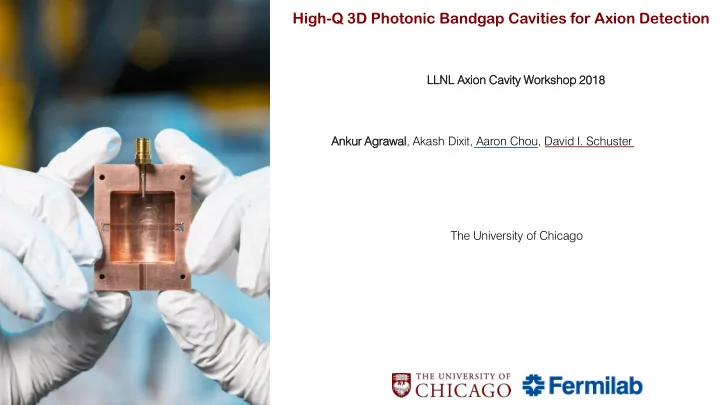
High-Q 3D Photonic Bandgap Cavities for Axion Detection
LLNL Axion n Cavit ity Worksho hop p 2018 18 The University of Chicago Ankur ur Agrawa wal, Akash Dixit, Aaron Chou, David I. Schuster
High-Q 3D Photonic Bandgap Cavities for Axion Detection LLNL Axion - - PowerPoint PPT Presentation
High-Q 3D Photonic Bandgap Cavities for Axion Detection LLNL Axion n Cavit ity Worksho hop p 2018 18 Ankur ur Agrawa wal, Akash Dixit, Aaron Chou, David I. Schuster The University of Chicago Outline Introduction to Photonic Band-gap
High-Q 3D Photonic Bandgap Cavities for Axion Detection
LLNL Axion n Cavit ity Worksho hop p 2018 18 The University of Chicago Ankur ur Agrawa wal, Akash Dixit, Aaron Chou, David I. Schuster
2
Ankur Agrawal | LLNL Cavity Workshop 2018
3
Δ𝜕 𝜕𝑛 ~ Δ𝜁 𝜁
Ankur Agrawal | LLNL Cavity Workshop 2018
𝜁 𝜁 = 13 = 1
The width of the 𝜁 = 13 layer is 0.2a, and the width of 𝜁 = 1 layer is 0.8a
Joannopoulos, John D., et al. Photonic crystals: molding the flow of light. Princeton university press, 2011.
4
Ankur Agrawal | LLNL Cavity Workshop 2018
Defect
The red curve is the electric field strength of the defect state associated with this structure ൗ 𝜇 2
5 Ankur Agrawal | LLNL Cavity Workshop 2018
Microwave rowave Cavit ity 8-Tes esla la Magne gnet SQUID ID Amplifie plifier
2𝑅𝑑𝑏𝑤𝑊 ∝ 𝑔−11 3
stimulated emission
6 Ankur Agrawal | LLNL Cavity Workshop 2018
Johnson, S. G., & Joannopoulos, J. D. (2000). Applied Physics Letters, 77(22), 3490-3492.
7 Ankur Agrawal | LLNL Cavity Workshop 2018
Δ𝜕 𝜕𝑛~ 31%
MIT MPB simulation package For band-center @ 10GHz, a ~ 4.11 mm r ~ 0.293a ~ 1.26 mm and h ~ 0.93a ~ 4.0 mm Dielectric constant (𝜁): Rutile ~ 225 and Sapphire ~ 10 Rutile rods arranged in a trigonal pattern in Sapphire slab 4-5 periods on each side would be sufficient to exponentially suppress the losses at copper walls
8 Ankur Agrawal | LLNL Cavity Workshop 2018
A B C ANSYS HFSS package Defec fect Air rods in Sapphire substrate Defec efect
Future ure Work: ▪ Test powdered form
dielectric materials to estimate the enhancement in Q ▪ Simulate a woodpile structure (Rutile-Sapphire) to get an idea of Q
9 Ankur Agrawal | LLNL Cavity Workshop 2018
▪ PBG Cavities made out of low-loss dielectric material may achieve high Q-values ▪ High contrast dielectric materials allows compact structure to fit in small magnet bores ▪ Cavity Q in excess of axion Q will further help in QND measurement using Qubits