Axion Dark Matter searches @ IAXO Javier Redondo LMU,MPP, Munich - - PowerPoint PPT Presentation

axion dark matter searches iaxo
SMART_READER_LITE
LIVE PREVIEW

Axion Dark Matter searches @ IAXO Javier Redondo LMU,MPP, Munich - - PowerPoint PPT Presentation

Axion Dark Matter searches @ IAXO Javier Redondo LMU,MPP, Munich Axion Dark Matter a ( ) - Axion, a(x) : 0 - fi eld associated with QCD a ( x ) /f a substructure? BE? transients? 1 m a = 0 . 006 eV10 9 GeV virialized DM mass,


slide-1
SLIDE 1

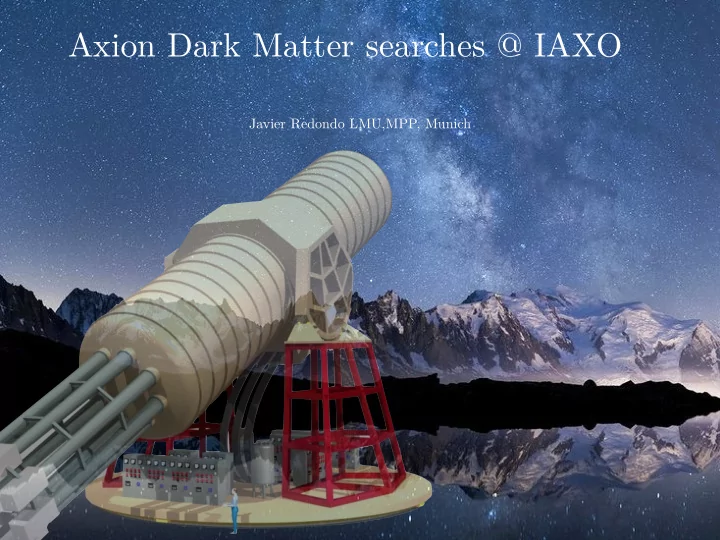
Axion Dark Matter searches @ IAXO

Javier Redondo LMU,MPP, Munich
slide-2
SLIDE 2
  • Axion, a(x): 0- field associated with

θQCD → a(x)/fa

  • Cold Dark Matter as a classical field a(t) ∼ a0 cos(mat)
  • Local DM density: ρCDM ⌘ 1

2m2

aa2 0 ' 0.3GeV

cm3 ! θ(t) ⇠ O(10−19)

  • Predictions:

Effects depend on couplings cγ α 2π E · B θ(t)

  • pol. & freq. changes

cosmic rays

¯ ψγ5γνψ ∂µθ(t)

Spin precession

  • freq. dep. forces

αs 8π G e Gθ(t)

  • scillating neutron EDM

dn ∼ O(10−34e cm) × cos(mat)

cγ α 2π E · Bext θ(t)

Electric (magnetic) fields

B ∼ O(10−20T)|Bext| 10 T cγ × cos(mat)

E ∼ O(10−12V/m)|Bext| 10 T cγ × cos(mat)

ω

ma

δω ω ∼ 10−6

substructure? BE? transients? virialized DM

˜ a(ω)

10-4 10-3 10-2 10-1 1 1010 109 108 107

Observed relic density?

10-11 10-10 10-9 10-8 10-7 10-6 10-5 10-4 10-3 10-2 1017 1016 1015 1014 1013 1012 1011 1010 109

ma[eV]

fa[GeV]

Scenario II

Scenario I

10-4 10-3 10-2 10-1 1 1010 109 108 107

10-5 10-4 10-3 10-2 10-1 1 10 102 103

ν[GHz] couplings, mass,

∝ 1 fa

ma = 0.006 eV109GeV fa

Axion Dark Matter

slide-3
SLIDE 3

Detecting EM fields from Axion Dark Matter

Pout = κ ρCDM ✓ cγα|B| 2πfama ◆2 [V ma] G Q

(on resonance) |Ea|2 ∝ c2

γB2

  • Past experiments Florida U., RBF, ADMX, CARRACK
  • Future endeavors: ADMX, ADMX-HF, YMCE, CAPP

10-7 10-6 10-5 10-4 10-3 10-1 1 10 102 103 10-1 1 10 102 10-1 1 10 102 103

KSVZ DFSZ ADMX RBF UF ADMX ADMX2 ADMX-HF CARRACK?

ma[µeV] ν[GHz]

IAXO

  • Haloscope (Sikivie 83)

“Amplify resonantly the EM fields created by axionDM in a B-field in a cavity”

  • Parameters unexplored at low and high masses: WHY?

Scenario I

Scenario II

Cylindrical cavity (h/r=b) like ADMX but scaled

  • Signal/noise in of time, t,

∆νa S N = Pout Pnoise p ∆νat

Very easy, but needs large magnet volume! IAXO!!!!!!!!!!!!!!!!!!!!! Very complicated, needs new ideas...

  • Signal

(V ∝ m−3

a )

Pout ∝ V ma ∼ 1 m2

a

  • Noise

Pnoise = Tsys∆νa ∝ m2

a

  • Scanning rate

1 ma d∆ma dt ∝ c4

γ

m9

a

slide-4
SLIDE 4
  • 2
  • 1

1 2

  • 2
  • 1

1 2

IAXO magnet

  • Length = 20 m
  • Magnetised radius ~ 1 m
  • Peak value ~ 5.4 T
  • Average in bore 2.5 T
  • Available T ~ 4.5 K

(but warm bores in design)

x[m]

field map of transverse cut

ADMX ADMX-HF IAXO CAST B [T] Dimensions [cm] V [L] 8 9 2.5 * 9 h,R=100,21 h,R=25,5 h,R*=2000,30 h,R=920,2.2 140 2 8 x 1700 2 x 14 9000 160 8 x 35000 2 x 1100

Pout ∝ |B|2V [T2L]

  • Comparison B2V with other haloscope magnets is promising

(Shilon et al JINST 9 (2014) T05002

slide-5
SLIDE 5

IAXO (3 years)

  • 2
  • 1

1 2

  • 2
  • 1

1 2

x[m]

Low mass axion DM search in IAXO

  • Geometry is not optimal for cylindrical cavity
  • Use a big rectangular cavity (Baker et al, PRD D85 035018)
  • w =1 m, h =0.5 m, L = 20 m

ω2

nml =

⇣nπ w ⌘2 + ⇣mπ h ⌘2 + ✓lπ L ◆2

w

h

L

TE101

  • Searching in the fundamental mode TE101

ω101 ∼ π w ∼ 0.6 µeV1 m w

G = 64 π4 = 0.66

Q(w, h ⌧ L) ⇠ 2π ω101δ h 2w + 4h

10-7 10-6 10-5 10-4 10-3 10-1 1 10 102 103 10-1 1 10 102 10- 1 10 102 103

KSVZ DFSZ ADMX RBF UF ADMX ADMX2 ADMX-HF CARRACK?

ν[GHz]

IAXO

ma[eV]

  • Possible (cryo. to 1+ K, best magnet position)

S N = 2 c2

γ

✓ B 2.5T ◆2 ✓5.5 K Tsys ◆ G 0.65 ✓ Q 3.5 × 10⁵/√m6 ◆ r t 1min

  • Very preliminary/rough and conservative estimates

dma dt

  • S/N=3

∼ 4 c4

γ

µeV year

slide-6
SLIDE 6

0.5 1.0 1.5 2.0 2.5

  • 1.0
  • 0.5

0.0 0.5 1.0

x0 x0

0.6 0.8 1.0 1.2 1.4 0.2 0.4 0.6 0.8

G

w=1m, h=0.5m

more...

  • Optimise the location and compare with in-coil configuration
  • Tunning; dielectric rods, other ideas
  • High Q cavity requires good stability of temperature, mechanical vibrations, etc...
  • Not compatible with solar tracking (?)
  • After IAXO solar run
  • Up to 8 cavities!

Baker et al, PRD D85 035018

slide-7
SLIDE 7

high mass axion DM searches ... ideas

  • develop Q-limited amplifies beyond 10 GHz (SQUIDs, JPAs: Shokair et al 1405.3685)
  • bolometers (CARRACK, Lamoreaux 1306.3591)
  • superconducting films to boost Q (Shokair et al 1405.3685)
  • multirod cavities

+ Rectangular cavities (Baker et al, PRD D85 035018) + Dish antenna (Horns et al JCAP04(2013)016)

  • Open resonators (Hong et al, 1403.1576)
  • Fabry-Perot resonators (Rybka, 1403.3121)
  • Boost all ADMX-like parameters (with ADMX-HF), CAPP
  • Dielectric resonators (Jaeckel Ringwald, PLB659 509)

+ combine cavities (Kinion, UMI-30-19020)

+ Dielectric mirrors (Jaeckel PRD 88 (2013))

slide-8
SLIDE 8

Rectangular cavities

w

h

L

TE101

  • fixed ma, maximise power?

maximise transverse area! tune

TE101

ma = ωn01 ∼ nπ w Crossings with TE0ml (avoided?, coupling?) not the fundamental! R+D in progress (B. Gimeno Valencia U., J.D. Gallego, Yebes O.)

  • cavity(s) to reach SCENARIO-II ?

(independent of n...)

P ∝ [V ma]GQ ∼ [whLma] 64 π4n2 1 ωδ h 4h + 2w → hL 1 ma

slide-9
SLIDE 9

Flat rectangular cavities

  • h=1 m, L=20 m, w tuned to ma, ~40 cavities (15% tuning), 1 year
  • 2
  • 1

1 2

  • 2
  • 1

1 2

x[m]

10-6 10-5 10-4 10-3 10-1 1 10 102 103 1 10 102 10-1 1 10 102 103 10-6 10 5 10-4 10-1 1 10 102 10

Tsis (4.5 + HEMT) K (4.5 + QL) K (1.3 + HEMT) K (1.3 + QL)

ma[eV]

y[m] prospects ranging 1-100 (# with increasing mass), (Q=3000 to 500)

10-6 10 5 10-4 10-1 1 10

trade part of the Q for a large number

  • Boost the power even more by combining N equal cavities coherently (high Q?)

Kinion, UMI-30-19020

1 ma dma dt ∝ 1 Q ✓Pout Tsis ◆2 ∝ c4

γ Q V 2 × N 2

slide-10
SLIDE 10

Dish Antenna

(Horns et al JCAP1304016, Jaeckel & JR JCAP1311016, PRD 88, 2013)

  • Trade cavity’s Q for volume (well... area...)

Pout ' ρCDM ✓ cγα|B| 2πfama ◆2 A

[V ma]GQ ↔ A

  • Broadband (cavity has to tuned to get Q),

here the band is limited by amplifier noise and gain (1 octave)

10-6 10-5 10-4 10-3 10-1 1 10 102 103 1 10 102 10-1 1 10 102 103

  • IAXO (B~ 2.5 T, A ~ 1 m2, t=year, Tsis=QL)

is NOT enough for ρCDM = 0.3GeV/cm3

ma[eV] 8-Dish IAXOQL

+ back production and all reflexions ...

  • Dielectric layers enhance the emission (in phase)

Alternating N layers of low/high, turn your “dielectric mirror” into a resonator, (+narrows the band) Enhancements Q~ N2 are feasible in small bands

P × N 2

∆ma ∼ ma/N 2

λ/2

slide-11
SLIDE 11

10-6 10-5 10-4 10-3 10-1 1 10 102 103 1 10 102 10-1 1 10 102 103

8-Dish IAXOSYS

  • 0.1-1 meV range is most interesting in Scenario-II

Scenario II

10-6 10-5 10-4 10-3 10-1 1 10 102 103 1 10 102 10-1 1 10 102 103

  • IAXO (B~ 2.5 T, A ~ 1 m2, t=year, Tsis=QL)

is NOT enough for ρCDM = 0.3GeV/cm3

ma[eV] 8-Dish IAXOQL

  • Encounter with the Earth (every 104 years)

ρCDM × 106, Qa ∼ 109, t ∼ 3days

  • IAXO would see a huge signal, even with a realistic detector!!!!
  • S-II predicts miniclusters of axion CDM

Zurek et al 07, See also Kolb & Tkachev 94

Mmc ∼ 1012M Ωmc/ΩaCDM ∼ O(1)

Dish Antenna

(Horns et al JCAP1304016, Jaeckel & JR JCAP1311016, PRD 88, 2013)

slide-12
SLIDE 12

Conclusions

IAXO flat # IAXO big-box (3 years)

CARRACK?

10-7 10-6 10-5 10-4 10-3 10-1 1 10 102 103 10-1 1 10 102 10-1 1 10 102 103

KSVZ DFSZ ADMX RBF UF ADMX ADMX2 ADMX-HF

ma[µeV] ν[GHz]

IAXO

IAXO 8 DISH (SC-II) minicluster

  • IAXO huge magnetic volume

can have extraordinary applications in Axion Dark Matter

  • Low mass, rectangular cavities plum
  • Intermediate mass, combine

flat rectangular cavities (R+D needed!) and QL detectors up to 20 GHz (JPAs?)

  • High mass is difficult

But mostly interesting for SC-II which implies miniclusters 8 Dish in IAXO can cover the 0.01-1 meV range continuously (1 encounter/104 years...?)

  • Other possibilities under scrutiny!
slide-13
SLIDE 13

Thanks!