Axionic dark matter searches with Josephson junctions and SQUIDS - - PowerPoint PPT Presentation

axionic dark matter searches with josephson junctions and
SMART_READER_LITE
LIVE PREVIEW

Axionic dark matter searches with Josephson junctions and SQUIDS - - PowerPoint PPT Presentation

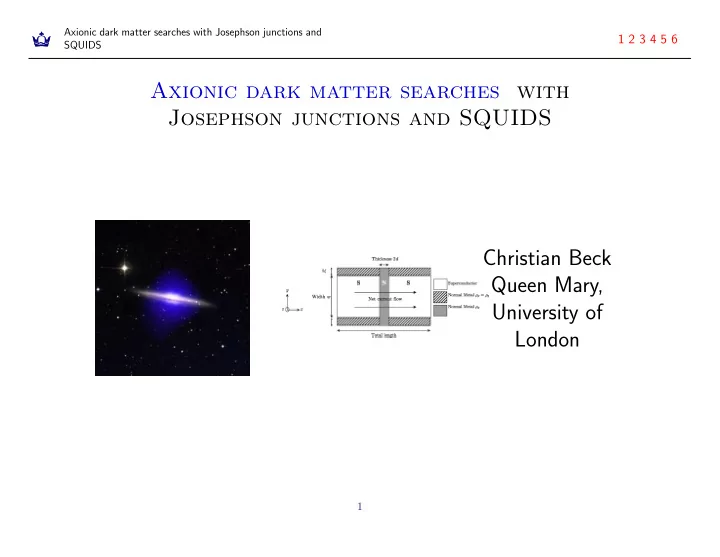
Axionic dark matter searches with Josephson junctions and 1 2 3 4 5 6 SQUIDS Axionic dark matter searches with Josephson junctions and SQUIDS Christian Beck Queen Mary, University of London 1 Axionic dark matter searches with Josephson

slide-1
SLIDE 1

Axionic dark matter searches with Josephson junctions and SQUIDS

1 2 3 4 5 6

Axionic dark matter searches with Josephson junctions and SQUIDS Christian Beck Queen Mary, University of London

1

slide-2
SLIDE 2

Axionic dark matter searches with Josephson junctions and SQUIDS

1 2 3 4 5 6

Axionic dark matter searches with Josephson junctions and SQUIDS Christian Beck Queen Mary, University of London

1

slide-3
SLIDE 3

Contents

1 Introduction: Astrophysical evidence for dark matter 2 Two main candidates for dark matter particles: WIMPS and axions 3 Searching for axions and axion-like particles in the lab 4 Josephson junctions as axion detectors 5 An observed axion candidate signal in S/N/S Josephson junctions

  • C. Beck, Phys. Rev. Lett. 111, 231801 (2013)

6 Recent developments and Summary

2

slide-4
SLIDE 4

Axionic dark matter searches with Josephson junctions and SQUIDS

1 2 3 4 5 6

1 Introduction: Astrophysical evidence for dark matter

  • bservational evidence for dark matter from galaxy rotation curves, grav-

itational lensing, CMB, structure formation, ...

3

slide-5
SLIDE 5

Axionic dark matter searches with Josephson junctions and SQUIDS

1 2 3 4 5 6

2 Two main candidates for dark matter particles: WIMPS and axions

  • WIMPS (weakly interacting particles): mass ∼ 100GeV

motivated by supersymmetry (lightest supersymmetric particle should be stable)

  • axions: mass ∼ 100µeV

motivated by Standard Model of Particle Physics, no supersymmetry needed (solution of strong CP problem)

  • Both are cold dark dark matter (CDM) but with subtle differences for

halo physics. Axions most likely to form a very cold quantum liquid, a Bose-Einstein condensate (Sikivie et al 2009)

4

slide-6
SLIDE 6

Axionic dark matter searches with Josephson junctions and SQUIDS

1 2 3 4 5 6

2 Two main candidates for dark matter particles: WIMPS and axions

  • WIMPS (weakly interacting particles): mass ∼ 100GeV

motivated by supersymmetry (lightest supersymmetric particle should be stable)

  • axions: mass ∼ 100µeV

motivated by Standard Model of Particle Physics, no supersymmetry needed (solution of strong CP problem)

  • Both are cold dark dark matter (CDM) but with subtle differences for

halo physics. Axions most likely to form a very cold quantum liquid, a Bose-Einstein condensate (Sikivie et al 2009) Original motivation for axions: QCD (Peccei Quinn 1977).

4

slide-7
SLIDE 7
  • 5
slide-8
SLIDE 8
  • 6
slide-9
SLIDE 9
  • Pictures courtesy of Y. Wong, Aachen

7

slide-10
SLIDE 10

Axionic dark matter searches with Josephson junctions and SQUIDS

1 2 3 4 5 6

8

slide-11
SLIDE 11

9

slide-12
SLIDE 12

3 Searching for axions and axion-like particles in the lab

  • 10
slide-13
SLIDE 13
  • 11
slide-14
SLIDE 14
  • 12
slide-15
SLIDE 15
  • 13
slide-16
SLIDE 16

Very recently (2013-14), four completely new ideas to detect dark matter axions in the lab have been suggested. All have in common that they search for coherent axion oscillations, i.e. a small electric signal that oscillates with the axion mass ¯ hω = mac2 (this frequency is in the GHz region). Still the details of these proposals, of course, are very different.

  • P.W. Graham, S.Rajendran, Phys. Rev. D 88, 035023 (2013): Use NMR

(nuclear magnetic resonance) setup

  • C. Beck, Phys. Rev. Lett. 111, 231801 (2013): Use S/N/S Josephson

junctions

  • P. Sikivie, N. Sullivan, D.B. Tanner, Phys. Rev. Lett. 112, 131301

(2014): Use LC circuit cooled down to mK temperatures

  • B.M. Roberts et al., Phys. Rev. Lett. 113, 081601 (2014): Use parity

non-conserving transitions in heavy atoms

14

slide-17
SLIDE 17

Axionic dark matter searches with Josephson junctions and SQUIDS

1 2 3 4 5 6

4 Josephson junctions as axion detectors

  • Josephson junction (JJ) consists of two superconductors separated by a weak-link region

(yellow)

  • weak link-region is an insulator for tunnel junctions and a normal metal for S/N/S

junctions

  • distance between superconducting plates: d ∼ 1nm for tunnel junctions, d ∼ 1µm

for S/N/S junctions

  • If voltage V is applied then JJ emits Josephson radiation of frequency ¯

hωJ = 2eV

15

slide-18
SLIDE 18
  • Important technical device: Two Josephson junctions can form a ‘bounded state’, a

SQUID (Superconducting Quantum Interference Device)

  • Used e.g. for high-precision magnetic flux measurements
  • See any textbook on superconductivity (e.g. ‘Introduction to Superconductivity’ by M.

Tinkham) how this works

16

slide-19
SLIDE 19

Axion field a = faθ. Classical eq. of motion of the axion misalignement angle θ: ¨ θ + Γ ˙ θ + m2

ac4

¯ h2 sin θ = gγ π 1 f 2

a

c3e2 E B (1) fa axion coupling, ma axion mass, gγ = −0.97 for KSVZ axions, or gγ = 0.36 for DFSZ axions. In the early universe, Γ = 3H, where H is the Hubble parameter. E, B: external electric and magnetic field.

17

slide-20
SLIDE 20

Axion field a = faθ. Classical eq. of motion of the axion misalignement angle θ: ¨ θ + Γ ˙ θ + m2

ac4

¯ h2 sin θ = gγ π 1 f 2

a

c3e2 E B (1) fa axion coupling, ma axion mass, gγ = −0.97 for KSVZ axions, or gγ = 0.36 for DFSZ axions. In the early universe, Γ = 3H, where H is the Hubble parameter. E, B: external electric and magnetic field. Compare this with the eq. of motion of a Josephson junction (JJ). The phase difference δ of a JJ driven by a bias current I satisfies ¨ δ + 1 RC ˙ δ + 2eIc ¯ hC sin δ = 2e ¯ hCI (2) Ic: critical current of the junction, R: normal resistance, C: capacity of the junction.

17

slide-21
SLIDE 21

Axion field a = faθ. Classical eq. of motion of the axion misalignement angle θ: ¨ θ + Γ ˙ θ + m2

ac4

¯ h2 sin θ = gγ π 1 f 2

a

c3e2 E B (1) fa axion coupling, ma axion mass, gγ = −0.97 for KSVZ axions, or gγ = 0.36 for DFSZ axions. In the early universe, Γ = 3H, where H is the Hubble parameter. E, B: external electric and magnetic field. Compare this with the eq. of motion of a Josephson junction (JJ). The phase difference δ of a JJ driven by a bias current I satisfies ¨ δ + 1 RC ˙ δ + 2eIc ¯ hC sin δ = 2e ¯ hCI (2) Ic: critical current of the junction, R: normal resistance, C: capacity of the junction. Equations of motion are basically the same.

17

slide-22
SLIDE 22

Axion field a = faθ. Classical eq. of motion of the axion misalignement angle θ: ¨ θ + Γ ˙ θ + m2

ac4

¯ h2 sin θ = gγ π 1 f 2

a

c3e2 E B (1) fa axion coupling, ma axion mass, gγ = −0.97 for KSVZ axions, or gγ = 0.36 for DFSZ axions. In the early universe, Γ = 3H, where H is the Hubble parameter. E, B: external electric and magnetic field. Compare this with the eq. of motion of a Josephson junction (JJ). The phase difference δ of a JJ driven by a bias current I satisfies ¨ δ + 1 RC ˙ δ + 2eIc ¯ hC sin δ = 2e ¯ hCI (2) Ic: critical current of the junction, R: normal resistance, C: capacity of the junction. Equations of motion are basically the same. The numerical values of the coefficients for typical QCD axion physics and typical JJ physics are also quite similar (see C. Beck, Mod. Phys. Lett. 26, 2841 (2011) for examples). Hence it is natural to think about possible interactions between JJs and axions.

17

slide-23
SLIDE 23

Field equations of axions in a Josephson junction environment: ¨ θ + Γ ˙ θ − c2∇2θ + m2

ac4

¯ h2 sin θ = − gγ 4π2 1 f 2

a

c3e2 E B (3) ∇ × B − 1 c2 ∂ E ∂t = µ0 j + gγ π α1 c

  • E × ∇θ − gγ

π α1 c

  • B ˙

θ (4) ∇ E = ρ ǫ0 + gγ π αc B∇θ (5) ¨ δ + 1 RC ˙ δ + 2eIc ¯ hC sin δ = 2e ¯ hCI (6) Pa→γ = 1 16βa (gγ Bec L)2 1 π3f 2

a

1 α

  • sin qL

2¯ h qL 2¯ h

2 (7) ma axion mass, fa axion coupling constant, βa = va/c axion velocity, E electric field, B magnetic field, gγ = −0.97) for KSVZ axions, gγ = 0.36 for DFSZ axions, q momentum transfer, Pa→γ probability of axion decay, Ic critical current of junction.

18

slide-24
SLIDE 24

Field equations of axions in a Josephson junction environment: ¨ θ + Γ ˙ θ − c2∇2θ + m2

ac4

¯ h2 sin θ = − gγ 4π2 1 f 2

a

c3e2 E B (3) ∇ × B − 1 c2 ∂ E ∂t = µ0 j + gγ π α1 c

  • E × ∇θ − gγ

π α1 c

  • B ˙

θ (4) ∇ E = ρ ǫ0 + gγ π αc B∇θ (5) ¨ δ + 1 RC ˙ δ + 2eIc ¯ hC sin δ = 2e ¯ hCI (6) Pa→γ = 1 16βa (gγ Bec L)2 1 π3f 2

a

1 α

  • sin qL

2¯ h qL 2¯ h

2 (7) ma axion mass, fa axion coupling constant, βa = va/c axion velocity, E electric field, B magnetic field, gγ = −0.97) for KSVZ axions, gγ = 0.36 for DFSZ axions, q momentum transfer, Pa→γ probability of axion decay, Ic critical current of junction. Equations allow for an axion-induced supercurrent with linearly increasing phase differ-

  • ence. A linearly increasing axion phase induces a large B-field, vertically entering axions

decay.

18

slide-25
SLIDE 25

If axion decays, its effect is similar to a second Josephson junction with phase difference θ in addition to the measuring one with phase difference δ. Joint axion Josephson wave function Ψ = |Ψ|eiϕ must be single-valued. This means that for a given closed integration curve (dashed line above) one has

  • SC

∇ϕ · d s + δ + θ = 0 mod 2π (8) = ⇒ δ, θ are no longer independent of each other but influence each other.

19

slide-26
SLIDE 26

In the presence of a vector potential A define gauge-invariant phase differences γi by γ1 := δ − 2π Φ0

  • weak link 1
  • A · d

s (9) γ2 := θ − 2π Φ0

  • weak link 2
  • A · d

s. (10)

20

slide-27
SLIDE 27

In the presence of a vector potential A define gauge-invariant phase differences γi by γ1 := δ − 2π Φ0

  • weak link 1
  • A · d

s (9) γ2 := θ − 2π Φ0

  • weak link 2
  • A · d

s. (10) Standard formalism exploiting uniqueness of axion-Josephson wave function then yields ˆ γ1 − γ2 = 2π Φ Φ0 mod 2π, (11) Φ: magnetic flux through the area enclosed by the chosen closed line of integration, Φ0 = h

2e: flux quantum, ˆ

γ1 := −γ1.

20

slide-28
SLIDE 28

In the presence of a vector potential A define gauge-invariant phase differences γi by γ1 := δ − 2π Φ0

  • weak link 1
  • A · d

s (9) γ2 := θ − 2π Φ0

  • weak link 2
  • A · d

s. (10) Standard formalism exploiting uniqueness of axion-Josephson wave function then yields ˆ γ1 − γ2 = 2π Φ Φ0 mod 2π, (11) Φ: magnetic flux through the area enclosed by the chosen closed line of integration, Φ0 = h

2e: flux quantum, ˆ

γ1 := −γ1. If Φ << Φ0 or if Φ is an integer multiple of Φ0 then γ2 = ˆ γ1 (12) meaning the phase difference θ produced by axion decay synchronizes with the Josephson phase difference δ.

20

slide-29
SLIDE 29

Can calculate the formal magnetic field that would be there if axion were still present in the weak link: B = 2πΓf 2

ad

gγ¯ hc3e . (13) This formal B-field is huge, but it’s only formal: B ∼ 1020T . It means the axion immediately decays into 2 microwave photons when entering the weak-link region. Primakoff effect: Pa→γ = 1 4βa (g Bec L)2

  • sinqL

2¯ h qL 2¯ h

2 = Pγ→a (14)

21

slide-30
SLIDE 30

Can calculate the formal magnetic field that would be there if axion were still present in the weak link: B = 2πΓf 2

ad

gγ¯ hc3e . (13) This formal B-field is huge, but it’s only formal: B ∼ 1020T . It means the axion immediately decays into 2 microwave photons when entering the weak-link region. Primakoff effect: Pa→γ = 1 4βa (g Bec L)2

  • sinqL

2¯ h qL 2¯ h

2 = Pγ→a (14) The very large formal B-field can always be expressed by the flux through a tiny area — the flux Φ = B· tiny area is just of ordinary size...

21

slide-31
SLIDE 31

Microscopic model

  • f what happens in

an S/N/S junction. Axion tunnels through junction (ATJ) and triggers (by multiple Andreev reflection) the transport

  • f

n Cooper pairs (n = 3 in the example plotted)

22

slide-32
SLIDE 32

Some relevant formulas (C. Beck, PRL 111, 231801 (2013)): Signal shape in RSJ approximation (Shapiro step without externally applied microwave radiation) Is(V ) = Ps 4 (RIc)2 1 V 2

  • V + Vs

(V + Vs)2 + (δV

2 )2 +

V − Vs (V − Vs)2 + (δV

2 )2

  • .

(15) 2eVs = mac2 (Vs: signal voltage) Expected signal power from axions: Ps = ρavA. (16) ρa: axionic dark matter density near the earth, v = 2.3 · 105m

s , A: Area of weak-link

region of JJ. Total signal current produced by axions in S/N/S junction: Is =

  • GsdV = Na

τ · n · 2e = ρa mac2vA · n · 2e (17) where Na/τ is the number of axions hitting the normal metal region per time unit τ. Axion density from ρa = IsVs vAn. (18) This can be used to experimentally estimate the axion mass ma and dark matter density ρa from an experimental measurement of Vs and Is.

23

slide-33
SLIDE 33

Axionic dark matter searches with Josephson junctions and SQUIDS

1 2 3 4 5 6

5 An observed candidate signal in S/N/S Josephson junctions

  • C. Hoffmann, F. Lefloch, M. Sanquer, B. Pannetier, Phys. Rev. B 70, 180503(R) (2004)

24

slide-34
SLIDE 34

Axionic dark matter searches with Josephson junctions and SQUIDS

1 2 3 4 5 6

5 An observed candidate signal in S/N/S Josephson junctions

  • C. Hoffmann, F. Lefloch, M. Sanquer, B. Pannetier, Phys. Rev. B 70, 180503(R) (2004)

They measured differential conductivity G(V ) = dI/dV and observed signal peak ‘of unknown origin’ at Vs = ±0.055mV .

24

slide-35
SLIDE 35
  • Hoffmann et al. (2004) observe a signal of unknown origin that is consistent with our

theoretical expectations. Independent of the temperature (which is varied from 0.1K to 0.9K) they consistently observe a small peak in their measured differential conductivity G(V ) at the voltage Vs = ±0.055mV

  • Their measurements provide evidence for a signal current feature of size Is = (8.1 ±

1.0) · 10−8A obtained by integrating the area under the observed signal peak of the differential conductivity.

  • Their noise measurements also indicate that every quasi-particle performs n = 7

Andreev reflections.

  • Area A of the metal plate of their junction is A = 0.85µm × 0.4µm = 3.4 ·

10−13m2.

  • From 2eVs = ma2

c we thus obtain an axion mass prediction of mac2 = 110µeV

(equivalent to fa ∼ 5.5 · 1010GeV ), and ρa = IsVs

vAn yields the prediction ρa =

(0.051 ± 0.006)GeV/cm3.

25

slide-36
SLIDE 36

Is this value of axionic dark matter density (ρa = (0.051 ± 0.006)GeV/cm3) as predicted by our theory based on Hoffmann et al.’s measurements reasonable?

26

slide-37
SLIDE 37

Is this value of axionic dark matter density (ρa = (0.051 ± 0.006)GeV/cm3) as predicted by our theory based on Hoffmann et al.’s measurements reasonable? Yes, it is.

  • Astrophysical observations suggest that the galactic dark matter density ρd near the

earth is about ρd = (0.3±0.1)GeV/cm3 (Weber, de Boer 2010). But this includes all kinds of dark matter particles, including WIMPS.

  • Generally, axions of high mass will make up only a fraction of the total dark matter

density of the universe: ρa/ρd ≈ (24µeV/mac2)7/6 (Duffy, van Bibber (2009))

  • For mac2 = 110µeV we thus expect an axionic dark matter density that is a

fraction (24/110)7/6 ≈ 0.17 of the total dark matter density, giving ρa ≈ 0.17 · ρd = (0.051 ± 0.017)GeV/cm3. The intensity of the JJ signal is thus in perfect agreement with what is expected from astrophysical observations.

  • A very recent analysis of rotation curves of galaxies is consistent with these values (M-H

Li and Z-B Li, Phys. Rev. D 89, 103512 (2014))

26

slide-38
SLIDE 38

Need further measurements to confirm (or refute) dark matter nature of the observed candidate signal:

  • Does the signal survive careful shielding of the junction from any external microwave

radiation? A signal produced by axions cannot be shielded.

  • Should look for a possible small dependence of the measured signal intensity on the

spatial orientation of the metal plate relative to the galactic axion flow (a precise directional measurement would be extremely helpful).

  • The velocity v by which the earth moves through the axionic BEC (Sikivie et al. 2009)
  • f the galactic halo exhibits a yearly modulation of about 10%, with a maximum in

June and a minimum in December. Hence JJ signal intensity should exhibit the same yearly modulation.

  • Independent experiments (such as upgraded versions of ADMX) would need to confirm

the suggested value of mac2 = 110µeV .

27

slide-39
SLIDE 39

Experimental check: Search for annual modulation of the intensity of a Shapiro step-like feature —if it is produced by axions Maximum expected in June, minimum in December.

28

slide-40
SLIDE 40

Latest developments

  • The latest BICEP2 results (PRL 112, 241101 (2014)), if taken at face value, would

single out the inflationary scale as HI ∼ 1.1 · 1014GeV.

  • From this Visinelli et al. (PRL 113, 011802 (2014)) derive a lower bound on the axion

mass: mac2 ≥ 72µeV.

  • This lower bound is bigger than most people expected for the axion, but in line with our

suggested value 110µeV. It implies that the Peccei-Quinn phase transition took place after inflation.

  • Further experiments that seem to see peculiarities at Va = 55µV are discussed in C.

Beck, arXiv:1403.5676: Golikova et al. PRB 86, 064416 (2012) — based on Al-(Cu/Fe)-Al junctions

  • L. He et al. arXiv:1107.0061 — based on W-Au-W junctions

Bae et al. PRB 77, 144501 (2008) — based on high Tc (BI-2212) junctions

  • There could also be broad-band noise effects of axions (C. Beck, arXiv:1409.4759)

29

slide-41
SLIDE 41

Shapiro steps at voltages nhf as mea- sured by Bae et al. for external frequency (a) f = 26 GHz and (b) f = 13 GHz.

30

slide-42
SLIDE 42

Flux noise in SQUIDS and q-bits as measured by Bialczak et al. (PRL 2007) and Sendel- bach et al. (PRL 2008) Low-frequency part could be due to axionic density fluctuations. Predicted power spec- trum (C. Beck, arXiv:1409.4759): Sφ(f) = θ2

1Φ2 0As

16π2

  • f

vk∗

ns−1 1

f

31

slide-43
SLIDE 43

Axionic dark matter searches with Josephson junctions and SQUIDS

1 2 3 4 5 6

6 Summary

  • Nobody really knows what dark matter is...
  • Recent experimental suggestions to search for dark matter axions are based on small

devices, not big machines!

  • Axions hitting the weak-link region of S/N/S junctions may trigger the transport of ad-

ditional Cooper pairs. Leads to a small measurable signal for the differential conductivity if axion mass resonates with Josephson frequency.

  • Effect is particularly strong in S/N/S junctions which have a much larger weak-link

region than tunnel junctions.

  • Candidate signal of unknown origin has been observed in measurements of Hoffmann

et al. Can be interpreted in terms of an axion mass of 0.11 meV and a local axionic dark matter density of 0.05 GeV/cm3. C. Beck, Phys. Rev. Lett. 111, 231801 (2013)

  • Interesting interdisciplinary problem at the interface between astrophysics, condensed

matter physics, nanotechnology, and particle physics.

32