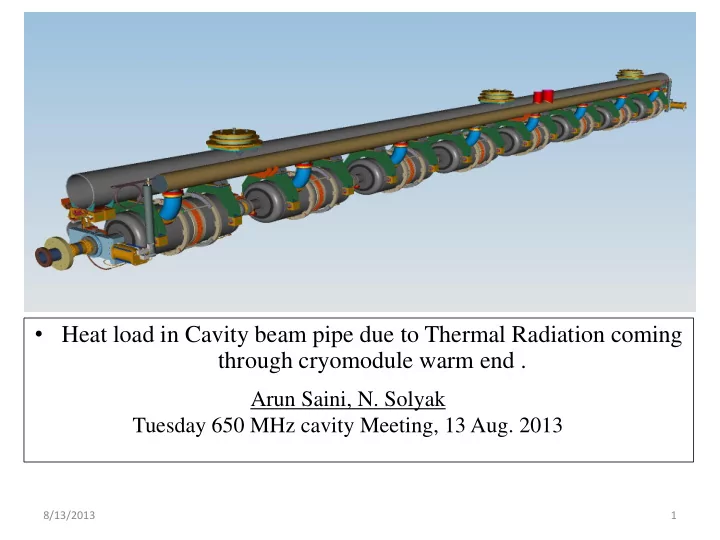
- Heat load in Cavity beam pipe due to Thermal Radiation coming
through cryomodule warm end .
Arun Saini, N. Solyak Tuesday 650 MHz cavity Meeting, 13 Aug. 2013
8/13/2013 1
Heat load in Cavity beam pipe due to Thermal Radiation coming - - PowerPoint PPT Presentation
Heat load in Cavity beam pipe due to Thermal Radiation coming through cryomodule warm end . Arun Saini, N. Solyak Tuesday 650 MHz cavity Meeting, 13 Aug. 2013 8/13/2013 1 Thermal Radiation Radiation emitted by a surface: =
Arun Saini, N. Solyak Tuesday 650 MHz cavity Meeting, 13 Aug. 2013
8/13/2013 1
12 1 4 2 4 1 12 12 1 2 2 2 1 1 1 4 2 4 1 12
8/13/2013 2
– Both boundaries are next to each other.
– Both are black bodies.
12 2 12 1 12 1 4 2 4 1 12
300 K 2 K {1}
8/13/2013 3
– 2K boundary is grey and opaque surface.
300 K 2K
cavity beam pipe ~ 0.16 W.
in interval of [ 0.16 5]
L 11 20.05
View Factor from bottom to curved surface
{2} {3}
8/13/2013 4
– Steady state surface to surface radiation boundary condition is applied. – – No Convection effect. – Emissivity of 80 K and 5 K Stainless steel pipe is varied.
300 K 2 K 80 K 5 K 0.25 m 0.1 0.1 0.175 1 0.05
inci inci emit net
Q Q Q Q ) 1 (
8/13/2013 5
Cavity BP S.Steel BP
Ptotal = 0.05 W Ptotal = 0.1355 W Ptotal = 0.2358 W
and 5K pipes can reduce energy deposition in Cavity BP.
Steel BP might also help.
8/13/2013 6
– Sandblasting and chemical etching
be easily intercepted by 80 K and 5 K cold sheild.
thermal radiation.
8/13/2013 7
Black Surface Rough Black Surface
0.16m 0.m T1 =5K T2 =2K
pipe beam
e unit volum per generated heat
Rate
2 2
q K q z T
For 1D steady state equation. K = Thermal conductivity.
1 2 1).
( ) (
2 1
T T dT T K i K
T T i avg
8/13/2013 8
Termal Conductivity vs. Temp
1 10 100 1000 1 10 Temperatur [K] Wärmeleitfähigkeit [W/mK]
RRR=760 RRR=525 RRR=400 RRR=270 RRR=120 RRR=40
L270T ( ) exp 4.57848 31.01ln T ( ) 54.77795ln T ( )2 46.41167ln T ( )3 17.89282ln T ( )4 2.56625ln T ( )5
L400T ( ) exp 4.38 31.0ln T ( ) 54.69ln T ( )2 46.40ln T ( )3 17.917 ln T ( ) ( )4 2.5741ln T ( )5
Fit:
8/13/2013 9
Thermal conductivity along beam pipe
8/13/2013 10
0.02 0.04 0.06 0.08 0.1 0.12 0.14 0.16 1 2 3 4 5 6 7 8 9 10 Temperature distribution for different emissivity, Power Input 2 W
z (m) Temperature (K)
e =1.0 e =0.75 e =0.5 e =0.25 e =0.1 e=0.05 no power deposit
T1 =5K T2 =2K 2W
8/13/2013 11
Variation in Max. Temperature with emissivity Variation in Max. Temperature with input thermal radiation
8/13/2013 12
resistance.
pipe. – Assumption
1 J stored energy.
122.5 J.
d d c c c c c B
P U Q ds H Rs P T T f Rs T T T T T T T k T T K Rs T Rs . . . . 2 1 . . ) . . exp( * * ) 2 ( ) (
2 2 2
8/13/2013 13
0.02 0.04 0.06 0.08 0.1 0.12 0.14 0.16 10 10
1
10
2
10
3
10
4
Surface Resistance along beam pipe for different emissivity, Power Input 2 W
z (m) Rs (n Ohm)
e =1.0 e =0.75 e =0.5 e =0.25 e =0.1 e=0.05
Surface Resistance along beam pipe RF Power dissipation in beam pipe for operating gradient
8/13/2013 14
0.02 0.04 0.06 0.08 0.1 0.12 0.14 0.16 10
10
10
10 10
1z (m) Power Dissipation in Beam Pipe (mW)
e =1.0
Q0 ~ 2.9E+13
8/13/2013 15
Power coupler for 650 MHz cavity Dimensions of cold part of power coupler
8/13/2013 16
Ceramic Window @ 300 K Antenna tip @ 300 K Antenna @ 300 K
Cavity Beam pipe @ 2K ANSYS simulation shows power deposition in cavity beam pipe is ~ 0.15 W
cryomodule warm end and power coupler. – Estimation for simplified configuration shows no problem in beam pipe.
– Improving the model and perform the more precise studies.
8/13/2013 17
1. http://webserver.dmt.upm.es/~isidoro/tc3/Radiation%20View%20factors.pdf 2. http://www.dtic.mil/dtic/tr/fulltext/u2/a284447.pdf 3. http://ieeexplore.ieee.org/stamp/stamp.jsp?arnumber=05643103
8/13/2013 18
8/13/2013 19
8/13/2013 20
8/13/2013 21
8/13/2013 22
8/13/2013 23