Experimental investigation on a radiative heat pipe heat exchanger - - PowerPoint PPT Presentation

experimental investigation on a radiative heat pipe heat
SMART_READER_LITE
LIVE PREVIEW

Experimental investigation on a radiative heat pipe heat exchanger - - PowerPoint PPT Presentation

Experimental investigation on a radiative heat pipe heat exchanger in steel industry Sulaiman Almahmoud, Amisha Chauhan, Rocio Llera, Francisco lago, Juan-jose Arribas, Hussam Jouhara Overview Flat Heat Pipe (FHP) application Flat


slide-1
SLIDE 1

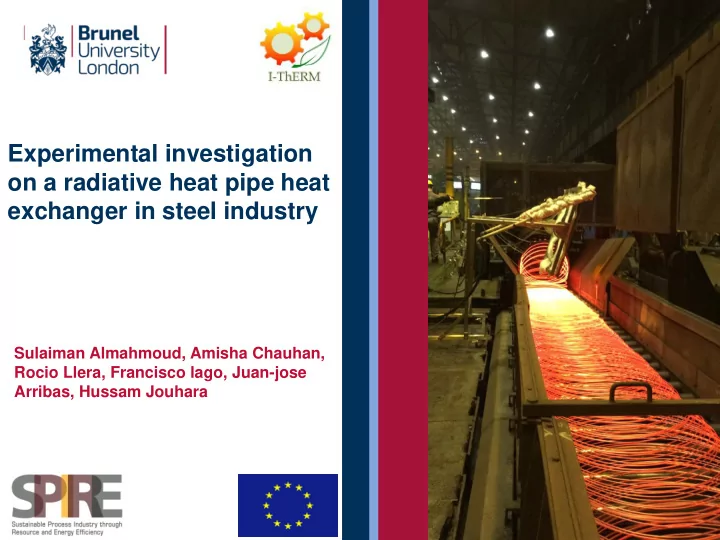
Experimental investigation

  • n a radiative heat pipe heat

exchanger in steel industry

Sulaiman Almahmoud, Amisha Chauhan, Rocio Llera, Francisco lago, Juan-jose Arribas, Hussam Jouhara

slide-2
SLIDE 2

Brunel University London

Overview

Experimental investigation on a radiative heat pipe heat exchanger in steel industry

2

  • Flat Heat Pipe (FHP) application
  • Flat Heat Pipe design
  • Experimental Setup
  • Results
slide-3
SLIDE 3

Brunel University London Experimental Investigation on a Radiative Heat Pipe Heat Exchanger in Steel Industry

3

Introduction

  • Energy consumption in

steel industry presents 5% world energy consumption

  • 40% of total operating cost

is for Energy cost

  • Challenges:

Limited Space, Inaccessibility, Temperature Restrictions Payback periods, Project and investment costs

60% 40%

Total operating cost

Other costs Energy costs

slide-4
SLIDE 4

Brunel University London

FHP Application

Experimental investigation on a radiative heat pipe heat exchanger in steel industry

4

Moving Shields Up and Down Wire Rod Mill

  • The Flat Heat Pipe (FHP) is designed to recover the heat by radiation and

convection from hot sources >500 °C (Mainly hot steel)

  • Test were carried out at ArcelorMittal steel company (Spain)
slide-5
SLIDE 5

Brunel University London

FHP Mechanical design

Experimental investigation on a radiative heat pipe heat exchanger in steel industry

5

Back Panel

FHP

Bottom Collector Top header Rupture Disk

slide-6
SLIDE 6

Brunel University London

Mechanical design

Experimental investigation on a radiative heat pipe heat exchanger in steel industry

6

Number of Vertical pipes: 14 pipes Material: SS 304, Weight: 45 kg

slide-7
SLIDE 7

Brunel University London

FHP Design

Experimental investigation on a radiative heat pipe heat exchanger in steel industry

7

Balance Weight

slide-8
SLIDE 8

Brunel University London

Heat transfer schematic

Experimental investigation on a radiative heat pipe heat exchanger in steel industry

8

slide-9
SLIDE 9

Brunel University London

FHP testing Concept

Inclination angle: 12.5 ° to 25°

Distance from the Barrier

Experimental Investigation on a Radiative Heat Pipe Heat Exchanger

9

Hot Steel

slide-10
SLIDE 10

Brunel University London

FHP Modelling

29 March 2019 Experimental investigation on a radiative heat pipe heat exchanger in steel industry

10

Condenser

Tcold, in

Evaporator

T cold, out

Rrad: Radiation thermal resistance, Rcond_e: Conduction thermal resistance of the evaporator wall, Rei: Boiling thermal resistance Rci: Condensation thermal resistance, Rcond_c: Conduction thermal resistance at the condenser wall, Rco: Forced convection thermal resistance

Rrad Rei Rcond_e

Tv Tei Teo Th Tc

Rci

Tco

Rco Rcond_c

Tci

Rhp

Tcold,in

slide-11
SLIDE 11

Brunel University London

Experimental Setup

Experimental investigation on a radiative heat pipe heat exchanger in steel industry

11

HP 4 HP 7 HP 9 EV 1 HP 5 HP 1 AD 1 HP 2 HP 3 HP 6 AD 2 AD 3 HP 8 EV 3 EV 2 a

  • 3 Thermocouples were placed on the bottom collector (EV1 to EV3)
  • 9 Thermocouples placed on the FHP surface (HP1to HP9)
  • 3 Thermocouples placed on the top header (AD1,AD2,AD3)
  • Thermocouples to measure water inlet and outlet temperatures
slide-12
SLIDE 12

Brunel University London

Tests Conditions

Experimental investigation on a radiative heat pipe heat exchanger in steel industry

12

The FHP performance is influenced by the following parameters:

  • 1. Steel temperature which is represented by the distance from the laying head
  • 2. The diameter of the steel wires
  • 3. The absorptivity and emissivity of the FHP surface (was tested by painting

the FHP with black paint)

  • 4. The overall heat transfer area of the FHP (The effect of the back panel)
slide-13
SLIDE 13

Brunel University London

FHP testing

Experimental investigation on a radiative heat pipe heat exchanger in steel industry

13

FHP testing (unpainted)

slide-14
SLIDE 14

Brunel University London

FHP testing

Experimental investigation on a radiative heat pipe heat exchanger in steel industry

14

FHP testing (unpainted at two inclination angles (25° and 12.5°) And different steel diameters

slide-15
SLIDE 15

Brunel University London

FHP testing

Experimental investigation on a radiative heat pipe heat exchanger in steel industry

15

FHP testing (unpainted at two inclination angles (25° and 12.5°) And positions

slide-16
SLIDE 16

Brunel University London

FHP testing

Experimental investigation on a radiative heat pipe heat exchanger in steel industry

16

FHP testing (unpainted at two inclination angles (25° and 12.5°) Laying Head

slide-17
SLIDE 17

Brunel University London

FHP testing

Experimental investigation on a radiative heat pipe heat exchanger in steel industry

17

FHP testing (Black painted) without and with a back panel

slide-18
SLIDE 18

Brunel University London

Effect of the steel temperature on the amount of heat recovery

Experimental investigation on a radiative heat pipe heat exchanger in steel industry

18

  • The steel temperature decreases as it moves far from the laying head
slide-19
SLIDE 19

Brunel University London

Results Comparison

19

  • Black Paint Case
  • No Panel : Steel temperature 580 °C
  • With Panel: Steel Temperature 500 °C

2 4 6 8 10 12 Black Paint ( No Panel) Black Paint (With Panel)

Heat recovery Comparison

Experimental (Factory) Theoretical

Heat recovery (kW) Steel: 580 °C Steel:500 °C

slide-20
SLIDE 20

Brunel University London

30 40 50 60 70 80 90 100 50 100 150 200 250 300 350 400 Temperature (°C) Time (s) Bottom Collector 1 Bottom Collector 2 Adiabatic 1 Adiabatic 2 Adiabatic 3 Water Inlet Water Outlet Average Surface Temperature

Experimental Results

20

Adiabatic Bottom Collector Water Inlet & Outlet

  • The Fluctuation is due to the intermittence of the steel production

process

  • FHP Black painted
  • Steel Temperature 500 °C

Surface temperature

slide-21
SLIDE 21

Brunel University London 29 March 2019 Presentation Title

21

Test Results

  • FHP Black painted
  • Steel Temperature 500 °C
  • The Fluctuation is due to the intermittence of the steel production process

2 4 6 8 10 12 14 50 100 150 200 250 300 350 400 Heat recovery (kW) Time (sec)

Heat Recovery

Experimental heat recovered Theoretical prediction

Theoretical Experimental

slide-22
SLIDE 22

Brunel University London

Summary

29 March 2019 Experimental investigation on a radiative heat pipe heat exchanger in steel industry

22

  • A design of Radiative Flat Heat Pipe heat exchanger was

presented

  • Results of the validation in factory were presented
  • The heat recovery is significantly influenced by the

temperature and the diameter of the steel

  • The black coating of the FHP surface increases the

amount of heat recovery

slide-23
SLIDE 23

Brunel University London

Acknowledgements

This project has received funding from the European Union Horizon 2020 research and innovation programme under grant agreement No 680599

slide-24
SLIDE 24

Thank you