Pipe Bursting Case Study at Zeeland, MI Collections Seminar - - PDF document

pipe bursting
SMART_READER_LITE
LIVE PREVIEW

Pipe Bursting Case Study at Zeeland, MI Collections Seminar - - PDF document

Pipe Bursting Case Study at Zeeland, MI Collections Seminar September 6, 2012 By: Brian Hannon, PE and John Racek, PE What is Pipe Bursting? History of Pipe Bursting Types of Pipe


slide-1
SLIDE 1

1

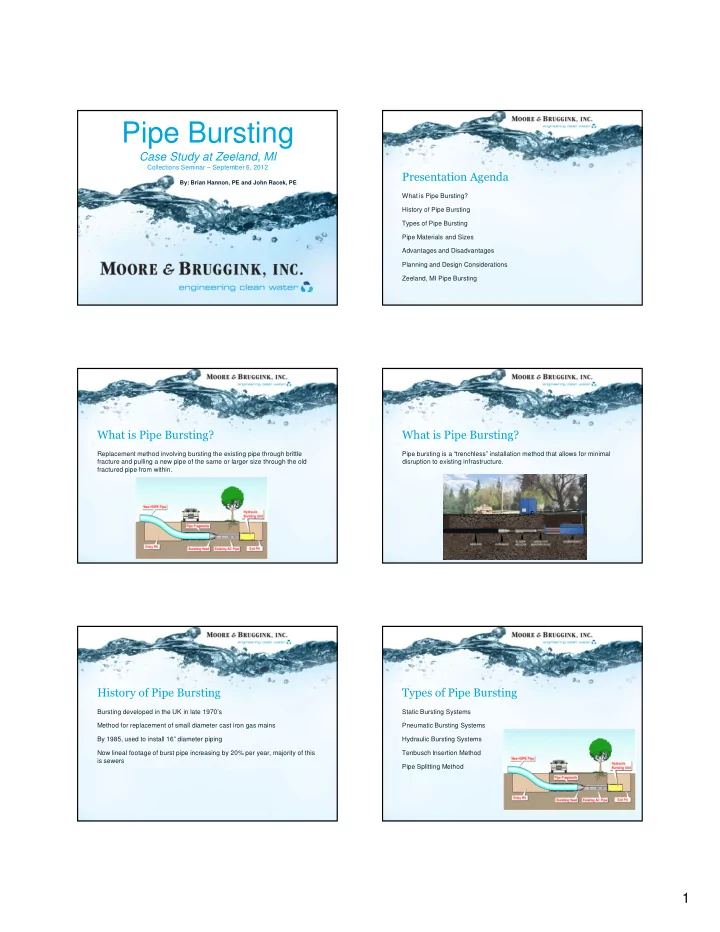
Pipe Bursting

Case Study at Zeeland, MI

Collections Seminar – September 6, 2012

By: Brian Hannon, PE and John Racek, PE

  • What is Pipe Bursting?

History of Pipe Bursting Types of Pipe Bursting Pipe Materials and Sizes Advantages and Disadvantages Planning and Design Considerations Zeeland, MI Pipe Bursting

  • Replacement method involving bursting the existing pipe through brittle

fracture and pulling a new pipe of the same or larger size through the old fractured pipe from within.

  • Pipe bursting is a “trenchless” installation method that allows for minimal

disruption to existing infrastructure.

  • Bursting developed in the UK in late 1970’s

Method for replacement of small diameter cast iron gas mains By 1985, used to install 16” diameter piping Now lineal footage of burst pipe increasing by 20% per year, majority of this is sewers

  • Static Bursting Systems

Pneumatic Bursting Systems Hydraulic Bursting Systems Tenbusch Insertion Method Pipe Splitting Method

slide-2
SLIDE 2

2

  • Static Bursting Systems

Pneumatic Bursting Systems Hydraulic Bursting Systems Tenbusch Insertion Method Pipe Splitting Method

  • Static Bursting Systems

Pneumatic Bursting Systems Hydraulic Bursting Systems Tenbusch Insertion Method Pipe Splitting Method

  • Static Bursting Systems

Pneumatic Bursting Systems Hydraulic Bursting Systems Tenbusch Insertion Method Pipe Splitting Method

  • Static Bursting Systems

Pneumatic Bursting Systems Hydraulic Bursting Systems Tenbusch Insertion Method Pipe Splitting Method

  • Standard Cone Shaped Head
  • Pneumatic Head
slide-3
SLIDE 3

3

  • Expanding Cone Head
  • Splitting Head

(cutting wheel or knives)

  • Type of Existing Pipe

Type of Soils Type of New Pipe TABLE 2.1 from ASCE MOP 112 Discuss with Contractors

  • What types of pipe materials can be burst?

CI, DI, VCP, AC, RCP, PVC, HDPE, Copper, etc. What types of pipe materials can be installed? HDPE, PVC, DI, VCP, RCP What are the minimum and maximum sizes that can be burst? Pipe bursting has been successfully completed on 4”-36” piping. How large can you make the new pipe? New pipe can be upsized 2-3 sizes depending on soil conditions, new pipe material, and depth.

  • No trenching involved means minimal disruption of existing infrastructure.

Pipe size can be increased along the same route. Can be more cost effective given project conditions. Faster installation than open cut, especially for deep pipe. Minimal dewatering necessary in wet conditions. Minimizes social costs such as traffic diversions, etc.

  • Must dig up lateral locations

Cannot change slope of line Bypass Pumping is usually necessary Cannot burst through valves Repair sleeves or encasements may be difficult or impossible to burst If HDPE or welded PVC is pulled through, need room for long run of pipe If heaving occurs, may need some surface restoration

slide-4
SLIDE 4

4

  • Soil Types and Conditions and Groundwater Depths

Existing Pipe Material and New Pipe Material Surface Heaving Utility Locations and Connection Points Televise Existing Pipeline Pit Locations and Pipe Layout Locations Cost Considerations (including Social) Background: Business Growth Created Need for Increased Pipe Size, Larger Pump station Project: Increase 700 LFt of VC gravity sewer from 8” to 12” by pipe burst Increase pump station capacity Increase forcemain size from 6” to 10” by open cut

  • Utilities over the existing deep sewer pipe
  • Water
  • Electrical (4)
  • Storm Sewer
  • Gas
  • Sidewalk
  • Parking Lots
  • Storm Pond
  • Fiber Optic Cable
  • Utilities over the existing deep sewer pipe
  • Water
  • Electrical (4)
  • Storm Sewer
  • Gas
  • Sidewalk
  • Parking Lots
  • Storm Pond
  • Fiber Optic Cable
  • Pipe type conditions were favorable

Deep pipe would have had large dewatering costs Minimal laterals to connect Distance (700 ft) favorable for single pull Directly outside of business parking lot Prevent Dewatering of Decorative Stormwater Pond Surface heave not a problem in this case

!"# $%&

slide-5
SLIDE 5

5

!" '($"'

  • )

)

  • )

Capacity = 300 ton

slide-6
SLIDE 6

6

#) *

  • *

!" !"+

&&!*,+,*-.

%/!"

slide-7
SLIDE 7

7

%/ ' !" &0

  • "102
  • )
  • 3%
  • !

!" *'4

slide-8
SLIDE 8

8

  • !
  • !

!+

152

  • !

'3%

slide-9
SLIDE 9

9

3% 3%

  • &!
slide-10
SLIDE 10

ERROR: undefined OFFENDING COMMAND: f‘ STACK: