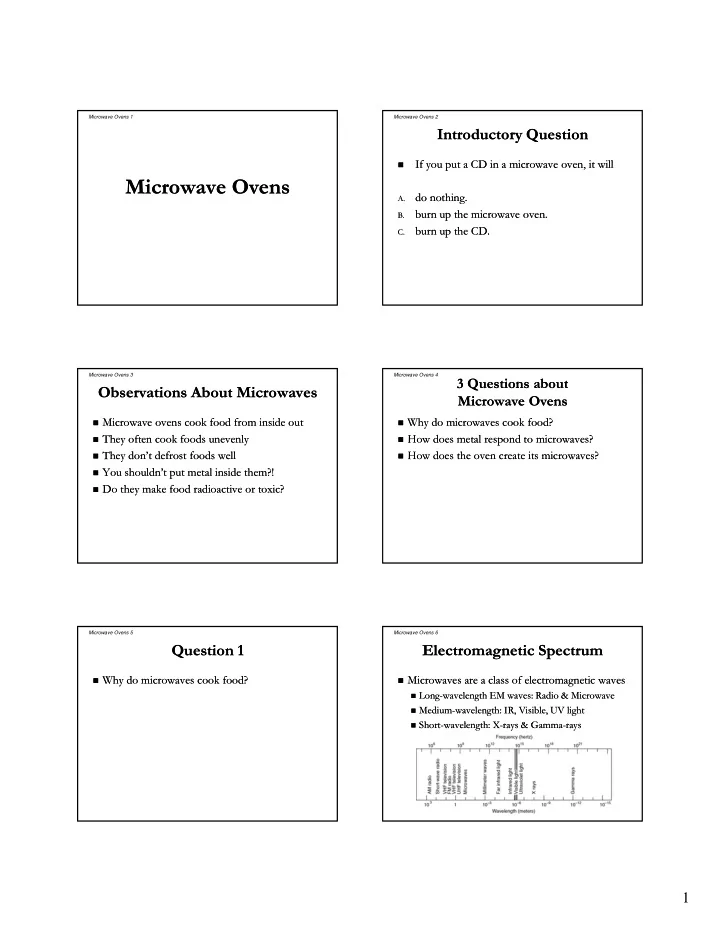
Microwave Ovens Microwave Ovens do nothing. do nothing. A. A. - - PDF document

microwave ovens microwave ovens
SMART_READER_LITE
LIVE PREVIEW

Microwave Ovens Microwave Ovens do nothing. do nothing. A. A. - - PDF document

Microwave Ovens 1 Microwave Ovens 2 Introductory Question Introductory Question If you put a CD in a microwave oven, it will If you put a CD in a microwave oven, it will Microwave Ovens Microwave Ovens do nothing. do nothing. A. A.


slide-1
SLIDE 1

1

Microwave Ovens 1

Microwave Ovens Microwave Ovens

Microwave Ovens 2

Introductory Question Introductory Question

  • If you put a CD in a microwave oven, it will

If you put a CD in a microwave oven, it will

A. A.

do nothing. do nothing.

B. B.

burn up the microwave oven. burn up the microwave oven.

C. C.

burn up the CD. burn up the CD.

Microwave Ovens 3

Observations About Microwaves Observations About Microwaves

  • Microwave ovens cook food from inside out

Microwave ovens cook food from inside out

They often cook foods unevenly

They often cook foods unevenly

They don’t defrost foods well

They don’t defrost foods well

You shouldn’t put metal inside them?!

You shouldn’t put metal inside them?!

Do they make food radioactive or toxic?

Do they make food radioactive or toxic?

Microwave Ovens 4

3 Questions about 3 Questions about Microwave Ovens Microwave Ovens

Why do microwaves cook food?

Why do microwaves cook food?

How does metal respond to microwaves?

How does metal respond to microwaves?

How does the oven create its microwaves?

How does the oven create its microwaves?

Microwave Ovens 5

Question 1 Question 1

  • Why do microwaves cook food?

Why do microwaves cook food?

Microwave Ovens 6

Electromagnetic Spectrum Electromagnetic Spectrum

Microwaves are a class of electromagnetic waves

Microwaves are a class of electromagnetic waves

Long

Long-

  • wavelength EM waves: Radio & Microwave

wavelength EM waves: Radio & Microwave

Medium

Medium-

  • wavelength: IR, Visible, UV light

wavelength: IR, Visible, UV light

Sh rt

Sh rt l n th X l n th X r & G mm r & G mm r

Short

Short-wavelength: X wavelength: X-

  • rays & Gamma

rays & Gamma-

  • rays

rays

slide-2
SLIDE 2

2

Microwave Ovens 7

Clicker Question Clicker Question

A US cell phone can communicate using waves

A US cell phone can communicate using waves at 850 MHz (35 cm wavelength). How long at 850 MHz (35 cm wavelength). How long should a resonant cell phone antenna be? should a resonant cell phone antenna be?

A.

  • A. 35 cm (14 inches)

35 cm (14 inches)

B.

  • B. 17.5 cm (7 inches)

17.5 cm (7 inches)

C.

  • C. 8.7 cm (3.5 inches)

8.7 cm (3.5 inches)

D.

  • D. 4.4 cm (1.7 inches)

4.4 cm (1.7 inches)

Microwave Ovens 8

Clicker Question Clicker Question

Wireless internet (Wi

Wireless internet (Wi-

  • Fi) communication is done

Fi) communication is done at 2.54 GHz (11.8 cm wavelength). How long is at 2.54 GHz (11.8 cm wavelength). How long is a resonant Wi a resonant Wi-

  • Fi antenna?

Fi antenna?

A.

  • A. 11.8 cm (4.6 inches)

11.8 cm (4.6 inches)

B.

  • B. 5.9 cm (2.3 inches)

5.9 cm (2.3 inches)

C.

  • C. 2.9 cm (1.2 inches)

2.9 cm (1.2 inches)

D.

  • D. 1.5 cm (0.6 inches)

1.5 cm (0.6 inches)

Microwave Ovens 9

Clicker Question Clicker Question

As the communication wave from a Wi

As the communication wave from a Wi-

  • Fi

Fi transmitter passes an electric charge, what transmitter passes an electric charge, what happens to that electric charge? happens to that electric charge?

A.

  • A. It accelerates away from the transmitter

It accelerates away from the transmitter

B.

  • B. It accelerates toward the transmitter

It accelerates toward the transmitter

C.

  • C. It shakes back and forth

It shakes back and forth

D.

  • D. Nothing

Nothing

Microwave Ovens 10

Clicker Question Clicker Question

As the communication wave from a Wi

As the communication wave from a Wi-

  • Fi

Fi transmitter passes an electric dipole (a + charge transmitter passes an electric dipole (a + charge attached to an equal attached to an equal – – charge), what happens to charge), what happens to that dipole? that dipole? that dipole? that dipole?

A.

  • A. It shakes back and forth

It shakes back and forth

B.

  • B. It twists back and forth

It twists back and forth

C.

  • C. It accelerates away from the transmitter

It accelerates away from the transmitter

D.

  • D. Nothing

Nothing

Microwave Ovens 11

Water Molecules Water Molecules

Water molecules are

Water molecules are unusually polar unusually polar

An electric field orients

An electric field orients water molec les water molec les water molecules water molecules

A fluctuating electric field

A fluctuating electric field causes water molecules to causes water molecules to fluctuate in orientation fluctuate in orientation

Microwave Ovens 12

Microwave Heating Microwave Heating

Microwaves have alternating electric fields

Microwaves have alternating electric fields

Water molecules orient back and forth

Water molecules orient back and forth

Liquid water heats due to molecular “friction”

Liquid water heats due to molecular “friction”

Ice doesn’t heat due to

Ice doesn’t heat due to orientational

  • rientational stiffness

stiffness

Steam doesn’t heat due to lack of “friction”

Steam doesn’t heat due to lack of “friction”

Food’s liquid water content heats the food

Food’s liquid water content heats the food

slide-3
SLIDE 3

3

Microwave Ovens 13

Clicker Question Clicker Question

Popcorn kernels feel solid and dry, so how can

Popcorn kernels feel solid and dry, so how can those kernels pop in the microwave oven? those kernels pop in the microwave oven? Mi h lid i l i ll Mi h lid i l i ll

A.

  • A. Microwaves heat solid materials quite well

Microwaves heat solid materials quite well

B.

  • B. Microwaves heat dry materials quite well

Microwaves heat dry materials quite well

C.

  • C. Corn kernels contain some trapped liquid water

Corn kernels contain some trapped liquid water

Microwave Ovens 14

Question 2 Question 2

How does metal respond to microwaves?

How does metal respond to microwaves?

Microwave Ovens 15

Effects of Microwaves Effects of Microwaves

Non

Non-

  • Conductors: Polarization

Conductors: Polarization

Mobile polar molecules orient and heat

Mobile polar molecules orient and heat

Immobile polar molecules do nothing much

Immobile polar molecules do nothing much

N n

N n p l r m l l d n thin m h p l r m l l d n thin m h

Non

Non-polar molecules do nothing much polar molecules do nothing much

Conductors: Current flow

Conductors: Current flow

Good, thick conductors reflect microwaves

Good, thick conductors reflect microwaves

Poor conductors experience resistive heating

Poor conductors experience resistive heating

Thin conductors experience resistive heating

Thin conductors experience resistive heating

Sharp conductors initiate discharges in the air

Sharp conductors initiate discharges in the air

Microwave Ovens 16

Clicker Question Clicker Question

A microwave oven’s cooking chamber has 6

A microwave oven’s cooking chamber has 6

  • sides. What are those sides made of?
  • sides. What are those sides made of?

5 l d 1 i l i h 5 l d 1 i l i h

A.

  • A. 5 are metal and 1 is plastic mesh

5 are metal and 1 is plastic mesh

B.

  • B. 5 are plastic and 1 is plastic mesh

5 are plastic and 1 is plastic mesh

C.

  • C. 5 are metal and 1 is metal mesh

5 are metal and 1 is metal mesh

D.

  • D. 5 are plastic and 1 is metal mesh

5 are plastic and 1 is metal mesh

Microwave Ovens 17

Interference Interference

Identical waves that overlap can interfere

Identical waves that overlap can interfere

Interference is when the fields add or cancel

Interference is when the fields add or cancel

Adding fields are constructive interference

Adding fields are constructive interference C li fi ld d i i f C li fi ld d i i f

Canceling fields are destructive interference

Canceling fields are destructive interference

Reflections lead to interference in a microwave

Reflections lead to interference in a microwave

Interference causes uneven cooking

Interference causes uneven cooking

Most ovens “stir” the waves or move the food

Most ovens “stir” the waves or move the food

Microwave Ovens 18

Introductory Question Introductory Question (revisited)

(revisited)

  • If you put a CD in a microwave oven, it will

If you put a CD in a microwave oven, it will

A. A.

do nothing. do nothing.

B. B.

burn up the microwave oven. burn up the microwave oven.

C. C.

burn up the CD. burn up the CD.

slide-4
SLIDE 4

4

Microwave Ovens 19

Clicker Question Clicker Question

If you put an ordinary wooden pencil in a

If you put an ordinary wooden pencil in a microwave oven and turn the oven on, what will microwave oven and turn the oven on, what will happen? happen?

A.

  • A. The pencil will emit sparks

The pencil will emit sparks

B.

  • B. The pencil will get warm but nothing else

The pencil will get warm but nothing else

C.

  • C. The pencil will burn up but nothing else

The pencil will burn up but nothing else

D.

  • D. The pencil will burn and emit plasma balls

The pencil will burn and emit plasma balls

Microwave Ovens 20

Question 3 Question 3

How does the oven create its microwaves?

How does the oven create its microwaves?

Microwave Ovens 21

Generating Microwaves Generating Microwaves

  • Magnetron tube has tank circuits in it

Magnetron tube has tank circuits in it

  • Streams of electrons amplify tank oscillations

Streams of electrons amplify tank oscillations

  • A loop of wire extracts energy from tanks

A loop of wire extracts energy from tanks

A short ¼

A short ¼-

  • wave antenna emits the microwaves

wave antenna emits the microwaves

Microwave Ovens 22

Summary about Summary about Microwave Ovens Microwave Ovens

They cook food because of its water content

They cook food because of its water content

Polar water molecules heat in microwave fields

Polar water molecules heat in microwave fields

Thin or sharp metals overheat or spark

Thin or sharp metals overheat or spark

The microwaves are produced by a magnetrons

The microwaves are produced by a magnetrons