
SLIDE 1
1
2016 REPORT TO THE LEGISLATURE
EXECUTIVE SUMMARY ENCLOSED WITHIN THIS REPORT
harrischainoflakescouncil.com
Harris Chain of Lakes Restoration Council 2016 R EPORT TO THE L - - PDF document
Harris Chain of Lakes Restoration Council 2016 R EPORT TO THE L EGISLATURE E XECUTIVE S UMMARY E NCLOSED W ITHIN THIS R EPORT harrischainoflakescouncil.com 1 Issued by: Harris Chain of Lakes Restoration Council harrischainoflakescouncil.com
1
EXECUTIVE SUMMARY ENCLOSED WITHIN THIS REPORT
harrischainoflakescouncil.com
2
Issued by:
harrischainoflakescouncil.com
Bob Johnson, Chairman Skip Goerner, Vice Chairman Don Nicholson, Secretary Keith Truenow Sid Grow Stephanie Bishop
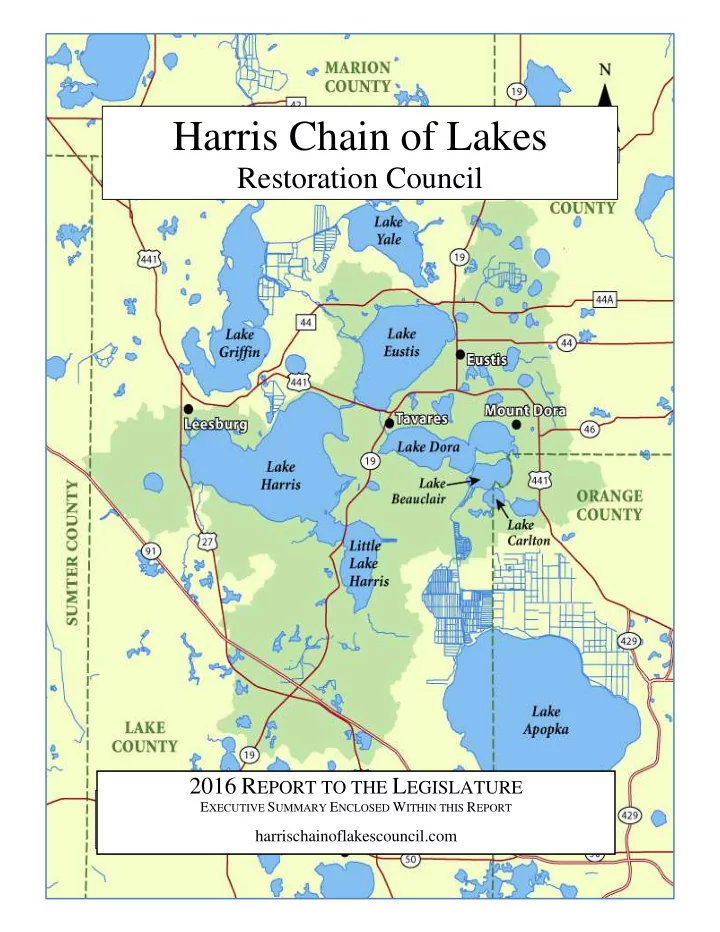
On the Cover The Harris Chain of Lakes, consisting of Lake Apopka, Lake Beauclair, Lake Carlton, Lake Dora, Lake Eustis, Lake Griffin, Lake Harris, Little Lake Harris, and Lake Yale, are in Lake and Orange counties in central Florida.
3
EXECUTIVE SUMMARY
The Harris Chain of Lakes Restoration Council (Council) was established by the Florida Legislature in 2001 (Chapter 373.467, Florida Statutes) with the powers and duties to (a) review audits and all data specifically related to lake restoration techniques and sport fish population recovery strategies, including data and strategies for shoreline restoration, sediment control and removal, exotic species management, floating tussock management or removal, navigation, water quality, and fish and wildlife habitat improvement, particularly as they may apply to the Harris Chain of Lakes; (b) evaluate whether additional studies are needed; (c) explore all possible sources of funding to conduct the restoration activities; and (d) report to the President of the Senate and the Speaker of the House of Representatives before November 25
for the next fiscal year. This report represents the recommendations of the Council to the Legislature. The mission of the Council is to maximize successful restoration of the Harris Chain of Lakes, by ensuring sensible efforts to restore clean water quality, sound environmental policy, ecological diversity, and economic stability, now and into the future. The Council, in conjunction with state and local agency partners, met regularly during the reporting period of November 2015 through October 2016. The Council received technical presentations throughout this period on studies and initiatives to restore and manage the Harris Chain of Lakes. The Council also drafted letters to the Council’s Technical Advisory Group agencies and stakeholders to seek input regarding policy positions and programs expected to be recommended to the Legislature within the next ten years. To maximize successful restoration of the Harris Chain of Lakes in 2016, the Council specifically supports and recommends the following: Lake Level Management and Minimum Flows and Levels (MFLs): 1) Maintaining the highest water levels possible during the dry period of the year as fisheries benefit by higher water levels during the spawning season.
2) Connecting Lake Apopka to the north shore.
Lake Apopka Restoration:
1) Utilizing the Mitton cavitation process and wedgewire screens for removing sediments and
phosphorus.
2) Dredging in Lake Apopka to create areas for vegetation.
Aquatic Vegetation: 1) Establishing additional aquatic vegetation in Lake Apopka and the Harris Chain of Lakes. Fish Attractors:
1) Installing additional artificial structures in the Harris Chain of Lakes.
Fishery Access: 1) Improving public access to Lake Apopka.
Fishery Research: 1) Expanding pesticide testing of game fish and ducks from the NSRA to demonstrate
whether sportfishing and hunting can be expanded into the NSRA.
Water Quality: 1) Expanding LAKEWATCH water quality sampling into Lake Apopka.
4
TABLE OF CONTENTS
EXECUTIVE SUMMARY ................................................................................................................... 3 LIST OF TABLES .............................................................................................................................. 5 LIST OF FIGURES ............................................................................................................................ 5 LIST OF ACRONYMS........................................................................................................................ 5 1.0 ENABLING LEGISLATION ..................................................................................................... 6 2.0 REPRESENTATION................................................................................................................ 7 3.0 2016 MEETINGS AND PRESENTATIONS ............................................................................... 7 4.0 SUMMARY OF PRESENTATIONS AND RECOMMENDATIONS................................................. 9 4.1 Lake Water Level Management.................................................................................... 9 4.2 Lake Apopka Restoration ............................................................................................ 10 4.3 Aquatic Vegetation ....................................................................................................... 12 4.4 Fish Attractor Program ............................................................................................... 14 4.5 Fishery Access ................................................................................................................... 14 4.6 Fishery Research ............................................................................................................... 14 4.7 Water Quality ............................................................................................................... 15 5.0 2016/2017 PROJECTS BY PARTNERS ................................................................................ 15 6.0 APPENDICES ....................................................................................................................... 17 6.1 Appendix A: Statutory Authority ............................................................................... 17 6.2 Appendix B: Copy of Harris Chain of Lakes Restoration Council Plan Letter ..... 19 7.0 MEETING INFORMATION ................................................................................................... 24 Meeting 1: November 6, 2015, Meeting Information Meeting 2: February 5, 2016, Meeting Information Meeting 3: March 4, 2016, Meeting Information Meeting 4: April 1, 2016, Meeting Information Meeting 5: May 6, 2016, Meeting Information Meeting 6: June 3, 2016, Meeting Information Meeting 7: July 8, 2016, Meeting Information Meeting 8: August 12, 2016, Meeting Information Meeting 9: September 9, 2016, Meeting Information Meeting 10: October 14, 2016, Meeting Information
5
LIST OF TABLES
Table 1: Technical Presentations from November 2014 to October 2015 ............................... 7 Table 2: 2014/2015 Technical Advisory Group (TAG) Members ............................................ 7 Table 3: 2016 Technical Advisory Group (TAG) Members ..................................................... 8 Table 4. 2016/2017Projects for the Harris Chain of Lakes ..................................................... 15
LIST OF FIGURES
Figure 1: Map of the Harris Chain of Lakes .............................................................................. 6 Figure 2. Aerial photograph of the Lake Apopka Marsh Flowway showing clear water discharging from the Marsh Flowway, mixing with turbid lake water in the center of the photograph..................................................................................................................................... 9 Figure 3. Mean total phosphorus concentrations in Lake Apopka, 1977-2015 ..................... 11 Figure 4. Mean chlorophyll concentrations in Lake Apopka, 1977-2015 .............................. 11 Figure 5. Secchi depth in Lake Apopka, 1977-2015 ................................................................. 11 Figure 6. Mean total nitrogen concentrations in Lake Apopka, 1977-2015 .......................... 12 Figure 7. Ground view of spatterdock re-established on Lake Apopka ................................ 13 Figure 8. Aerial photograph of planted spatterdock in Lake Apopka................................... 13
LIST OF ACRONYMS
CHL Chlorophyll DEP Florida Department of Environmental Protection EPA Environmental Protection Agency FDOT Florida Department of Transportation FWC Florida Fish and Wildlife Conservation Commission HCOL Harris Chain of Lakes LCWA Lake County Water Authority MFLs Minimum Flows and Levels NSRA North Shore Restoration Area NuRF Nutrient Reduction Facility SJRWMD
TAG Technical Advisory Group TN Total Nitrogen TP Total Phosphorus UF University of Florida USFWS United States Fish and Wildlife Service
6
1.0 ENABLING LEGISLATION
The Florida Legislature enacted legislation in 2001 creating the Harris Chain of Lakes Restoration Council (Council) to review audits and all data specifically related to lake restoration techniques and sport fish population recovery strategies, including data and strategies for shoreline restoration, sediment control and removal, exotic species management, floating tussock management or removal, navigation, water quality, and fish and wildlife habitat improvement, particularly as they may apply to the Harris Chain of Lakes (Figure 1), evaluate whether additional studies are needed, explore all possible sources of funding to conduct the restoration activities, and report to the President of the Senate and the Speaker of the House of Representatives before November 25 of each year on the progress of the Harris Chain of Lakes restoration program, and any recommendations for the next fiscal year. Statutory authority, as amended in July 2016, is included as Appendix A. Figure 1: Map of the Harris Chain of Lakes
7
2.0 REPRESENTATION
The council consists of nine voting members listed in Table 1. The council includes a representative of waterfront property owners, a representative of the sport fishing industry, a person with experience in environmental science or regulation, a person with training in biology
county who are not required to meet any additional qualifications for membership, each to be appointed by the Lake County legislative delegation. In February 2016 Robert (Bob) Johnson was elected Chairman, Skip Goerner was elected Vice-Chairman, and Don Nicholson was elected Secretary. Table 1: 2016 Harris Chain of Lakes Restoration Council Members Member Representative Robert (Bob) Johnson, Chairman Science/Biology Skip Goerner, Vice-Chairman Sport Fishing Don Nicholson, Secretary Waterfront Property Owners Stephanie Bishop, PE Engineer Sid Grow Member at Large Keith Truenow Member at Large Vacant Environmental Science/Regulation Vacant Attorney Vacant Physician
3.0 2016 MEETINGS AND PRESENTATIONS
The Council conducted ten meetings during the 2016 reporting period (i.e., November 2015 to October 2016). Meetings were cancelled in December 2015 and January 2016. During the reporting period, the Council received scientific information and presentations (Table 2) on restorative measures for the Harris Chain of Lakes and data concerning water quality and aquatic ecological conditions. Representatives from SJRWMD, FWC, the University of Florida (UF), the Allied Group, and Ferthaul provided technical presentations and information to the Council. Table 2: Technical Presentations from November 2015 to September 2016 Meeting Date Presentations February 5, 2016 Update on McDonald Canal Improvements – Bob Naleway, SJRWMD March 4, 2016 Using Nature to Restore Lakes & Canals–Jay Barfield, Allied Group USA April 1, 2016 Update on FertHaul Cavitation Technology Project on Lake Apopka–Bill Hooper Mike Ramsay-Ferthaul May 6, 2016 Restoration of the Harris Chain of Lakes: Return to Neverland— How Shifting Baselines Affect Eutrophication Restoration Targets -
Update on the Planting of Vegetation in Lake Apopka - Bruce Jaggers, FWC
8 Meeting Date Presentations June 3, 2016 Review of Emeralda Marsh and Lake Apopka Water Quality - Dr. Rolland Fulton, SJRWMD July 8, 2016 Pesticide levels in fish from Lake Apopka and the Lake Apopka North Shore- Dr. Rolland Fulton, SJRWMD September 9, 2016 Improving Florida’s Fisheries: Actions Today that Benefit Tomorrow - Mr. Dennis Renfro, FWC Members of the Council’s Technical Advisory Group (TAG) also provided periodic updates to the Council on various topics related to lake water quality and restoration issues. The members of the TAG are listed in Table 3. All Council meetings were appropriately noticed and open to the public. Members of the public regularly attended Council meetings and provided information and feedback to the Council. Information from the technical presentations, TAG member updates, and public was reviewed and discussed in detail by the Council. This information was used by the Council as the basis for developing recommendations for future restorative measures and management practices for the Harris Chain of Lakes. Copies of the Council meeting minutes and technical presentations for the reporting period are provided under separate cover to this report. Information is provided in digital format and may be downloaded from the Council’s website at harrischainoflakescouncil.com. Table 3: 2016 Technical Advisory Group (TAG) Members Agency Representative DEP Kevin Coyne FDOT Vacant FWC Dennis Renfro LCWA Michael Perry SJRWMD Rolland Fulton UF Mark Hoyer U.S. Army Corps of Engineers Vacant
9
4.0 SUMMARY OF PRESENTATIONS AND RECOMMENDATIONS
The Council received technical presentations in a variety of areas of interest during the reporting period of November 2015 through October 2016. These presentations are summarized by area of interest as follows:
4.1 Lake Water Level Management
As part of frequent updates on water levels, Mr. Mike Perry, LCWA, and Dr. Rolland Fulton, SJRWMD, discussed the regulation schedule, seasonal rainfall, and changes in Lake Apopka lake level and the Harris Chain of Lakes in February, April, May, June, July, August, September, and October 2015. Minimal outflow from Lake Apopka through the Apopka- Beauclair Canal occurred until May 2016 when lake levels fell below the minimum permitted level on the regulation schedule. There were no further releases through the end of the reporting period. Council received briefings from both Dr. Fulton and Mr. Perry on developments with SJRWMD minimum flows and levels (MFLs) development for the lower Ocklawaha River and lakes Apopka, Beauclair, Dora, Eustis, Griffin and Harris. MFLs are the minimum water flows and/or levels adopted by the SJRWMD Governing Board to prevent significant harm to water resources or ecology of an area resulting from permitted water withdrawals. MFLs define how often and for how long high, intermediate and low water flows and/or levels should occur to prevent significant harm. MFLs for the Harris Chain of Lakes are scheduled for adoption in 2019. Council recommendations 2016: Council supports MFLs maintaining the highest water levels possible during the dry period
Council recommends connecting Lake Apopka to the north shore. Figure 2. Aerial photograph of the Lake Apopka Marsh Flowway showing clear water discharging from the Marsh Flowway, mixing with turbid lake water in the center of the photograph (photo courtesy of Bob Johnson)
10
4.2 Lake Apopka Restoration
The Council received presentations from two private contractors conducting experimental restoration projects on Lake Apopka under the auspices of FWC. Mr. Jay Barfield, The Allied Group, made a presentation in March 2016 describing a 250-acre treatment area at Magnolia Park in which 99 microporous ceramic diffusers were installed to aerate and oxidize flocculent bottom sediments. Mr. Barfield estimated approximately 4-6 inches of muck have been reduced to inorganic mineral-type material in the four months of testing completed at the time
end of 2016. Council and TAG will review report results during the upcoming fiscal year.
describing a free pilot study on Lake Apopka in 2015, in which water and muck were suctioned from the canal connected to the lake, and treated with Mitton Cavitation technology and parabolic wedgewire screens. Testing occurred over 43 days in Winter 2015 and Ferthaul processed 8,500,000 gallons of canal water and removed over 3 tons of phosphorous. Results were verified by DEP testing completed on water samples. Both Council and TAG members were impressed with the results of the initial testing and subsequently visited the project site. In May 2016, Dr. Dan Canfield, University of Florida, discussed restoration of the Harris Chain
aquatic history of Lake Apopka and discussed the concept of restoration, and the need to pick an historical period in which to restore. Dr. Canfield briefed the Council on trophic state, noting regional differences in algal production correlate with geological structure of the watershed; and lakes in agricultural, calcareous regions are greener than lakes in forested, granitic
In Lake Apopka, Dr. Canfield noted large-scale movement of sediments (mud) was a constraint
geotubes to break up wave action, allow sediments to stabilize behind the tubes, and provide substrate for macrophyte growth. In summary, Dr. Canfield speculated the simple solution could be multiple punctures to the North Shore Restoration Area dike, and reflood that area. The existing wetlands would be lost, but perhaps the mud in the lake would move into the flooded area.
mean chlorophyll (Figure 4), Secchi depth (Figure 5), and mean total nitrogen (Figure 6) in Lake Apopka using data from SJRWMD for the period 1977-2015. Dr. Canfield proposed an alternative way to control nutrients through aquatic plant management. Dr. Canfield suggested establishing a local area strike force and direct the legislature to redirect or reallocate funds under local control to immediately handle aquatic plant issues.
11 Figure 3. Mean total phosphorus concentrations in Lake Apopka, 1977-2015. (Data provided by Dr. Canfield.) Figure 4. Mean chlorophyll concentrations in Lake Apopka, 1977-2015. (Data provided by Dr. Canfield) Figure 5. Secchi depth in Lake Apopka, 1977-2015. (Data provided by Dr. Canfield.)
12 Figure 6. Mean total nitrogen concentrations in Lake Apopka, 1977-2015. (Data provided by Dr. Canfield). The Council discussed development of a Harris Chain of Lakes restoration planning letter during meetings in June, July, and August 2016. In August 2016, a final letter was mailed to the executive management of SJRWMD, FWC, FDEP, LCWA, and FDOH. The letter was also mailed to the Governing Boards of SJRWMD and LCWA, and to members of the Lake County legislative delegation. A copy of the letter is included as Appendix A. Council recommendations 2016: Council supports projects utilizing the Mitton cavitation process and wedgewire screens for removing sediments and phosphorus. Council supports dredging in Lake Apopka to create areas for vegetation.
4.3 Aquatic Vegetation
spatterdock (Nuphar spp.) (Figures 5 and 6), and giant bulrush (Schoenoplectus californicus) as the current conditions (in 2014) showed less than 1% aquatic vegetation in Lake Apopka. The goal of the project was to re-establish 10% aquatic vegetation in Lake Apopka within 10
harvested plants, up to 80% survival for plants propagated in the University of Florida
and massive root stocks have developed.
(SAV) in Lakes Griffin, Harris, and Apopka in 2015. It is Council’s opinion hydrilla is growing at an advanced pace in the Harris Chain of Lakes, and requires immediate agency attention.
Marsh on the east side of Lake Griffin. FWC’s efforts will result in a reconnection of drained marsh habitat to the major system. Mr. Renfro noted four wildlife islands are planned using 30
13 foot by 15 foot sections of internal levee upon which native trees and emerged vegetation will be planted. Council recommendations 2016: Council support efforts to establish additional beneficial aquatic vegetation in Lake Apopka and the Harris Chain of Lakes. Figure 5. Ground view of spatterdock re-established on Lake Apopka (photo courtesy of Bruce Jaggers, FWC) Figure 6. Aerial photograph of planted spatterdock in Lake Apopka. This is an example of the success of replanting aquatic vegetation, on a small scale in Lake
14
4.4 Fish Attractor Program
installing fish attractors to enhance angling opportunities. Mr. Renfro discussed aerial images
in either Lake Eustis or Lake Dora. Council recommendation: Council supports the installation of additional artificial structures in the Harris Chain.
4.5 Fishery Access
A presentation in February 2016 by Bob Naleway, SJRWMD, described improvements in recreational access to Lake Apopka through the McDonald Canal. The canal connects to the northern part of Lake Apopka through the Apopka-Beauclair canal. The SJRWMD McDonald Canal Recreation Area improves public access along the north shore of Lake Apopka by providing 20 boat trailer spaces, public parking, handicapped parking, and a pavilion. Council recommendation 2016: Council supports continued efforts to improve public access to Lake Apopka.
4.6 Fishery Research
Presentation by Dr. Fulton in June and July 2016 discussed pesticide levels in fish from Lake Apopka and the Lake Apopka North Shore Restoration Area. Pesticide sampling was conducted over the last two years and data were compared to toxicity thresholds for both SJRWMD toxicity reference values (TRVs) for ecological risk and Florida Department of Health (FDOH) screening values for human consumption. Both screenings were for whole
Nearly all pesticide levels in the fish samples fell below the TRVs, so it was determined to be safe to shallowly flood the North Shore Restoration Area.
the sample fish included bluegill and crappie. The data showed Duda and Sand farms with the best results, but there were still exceedances of the FDOH screening values in one-third of samples tested. Other areas in the NSRA had much higher frequencies of exceedance of the FDOH screening values. The data gave an indication that fish are not currently safe for human consumption, part of the reason for not reconnecting the marsh in the NSRA. During the July 2016 meeting, Dr. Fulton discussed toxicity threshold levels and TRVs in whole fish, for a more comprehensive list of pesticides, including toxaphene, DDE, and
North Shore for the assessment of ecological risk in 2014-2015. 4.6% of the samples exceeded the TRV for the pesticide DDE and 0.3 % of the samples exceeded the TRV for the pesticide
shallow flooding of the North Shore was authorized. Dr. Fulton reported that a human consumption advisory assessment has not been done for fish fillets from the North Shore because of the limited numbers of sportfish in the NSRA.
15 Council recommendation 2016: Council recommends expanded pesticide testing of game fish and ducks from the NSRA to demonstrate whether sportfishing and hunting can be expanded into the NSRA. FDOH must be the lead agency for pesticide testing and determining safety of fish for human consumption.
4.7 Water Quality
In June 2016, Dr. Rolland Fulton, SJRWMD, presented information on the water quality of the Harris Chain of Lakes, Lake Apopka and Emeralda Marsh Area III.
chlorophyll-a (chl-a) concentrations to Lake Apopka from 1989 to 2014. The data shows loading decreases over time, with decreases associated with drops in discharge from the NSRA. Total phosphorus concentrations in Area 3 of the Emeralda Marsh shows all areas have been below the reconnection target of 200 ug/l for the last two years. There is no target concentration for total nitrogen, but it remains low overall. A comparison of concentrations both before and after reconnection, in Areas 2 and 4 of Emeralda Marsh, shows total phosphorus reduced in both areas, and it continues to decline. Council Recommendation 2016 Recommends expanding LAKEWATCH water quality sampling in Lake Apopka.
5.0 2016/2017 PROJECTS BY PARTNERS
The Harris Chain of Lakes Restoration Council will review proposals for restoration projects from federal, state, and local agencies that benefit Harris Lakes during the next fiscal year. Priority projects that demonstrate economic benefit, improve water quality, enhance aquatic vegetation, or improve fisheries will be recommended for funding by the Florida Legislature in the 2017 Annual Report. Projects budgeted, or in the planning stages for the 2016/2017 fiscal year are listed in Table 4, and include project title, location, funding amount, project description, and project partners. Table 4. Projects Budgeted or Planned for the Harris Chain of Lakes Project Waterbody Funding Project Description Project Partner (s) Lake Apopka Pilot Restoration Projects Lake Apopka $4 million Projects Under Development SJRWMD, FWC Emeralda Marsh Lake Griffin $625,000 Marsh reconnection to Lake Griffin, including levee breaches, creation
vegetation mat removal. SJRWMD. FWC Gizzard Shad Removal Lake Apopka $675,000 Removal of gizzard shad by seine netting as a SJRWMD
16 Project Waterbody Funding Project Description Project Partner (s) nutrient (in fish bodies) removal tool. Native Marsh Grass Planting Lake Apopka North Shore, Emeralda Marsh $400,000 Re-introduction of native marsh grasses for restoration purposes. SJRWMD Shrub Control Lake Apopka North Shore, Emeralda Marsh $100,000 Exotic and invasive plant removal SJRWMD Monitoring and Analyses Harris Chain $74,000 Analyses of pesticides and other contaminants SJRWMD Nearshore Suction Dredging Lake Apopka Planning Removal of nearshore flocculent sediment via suction dredge. SJRWMD Winter Garden Sediment Removal Lake Apopka Planning Sediment removal project in the Winter Garden area to provide benefits including habitat, navigation, and lake access. SJRWMD Apopka Orange County Potable Water Service Installations* Orange, Lake Apopka $250,000 Removal of 60 homes, located adjacent to the closed Keene Road Landfill, from private well water service and provide safe municipal potable water service from the City of Apopka City of Apopka Orange Blossom KOA Sewer Connection Orange, Lake Apopka $68,850 Connect the Orange Blossom KOA RV park's sewer system to the City
sewer system to reduce nutrient loading and benefit nearby Lake Apopka. City of Apopka, SJRWMD
*Funding appropriated but not committed yet.
17
6.0 APPENDICES
6.1 Appendix A: Statutory Authority
2016 Florida Statutes Title XXVIII NATURAL RESOURCES; CONSERVATION, RECLAMATION, AND USE Chapter 373 WATER RESOURCES SECTION 467 The Harris Chain of Lakes Restoration Council—There is created within the
Conservation Commission and the Lake County Water Authority, the Harris Chain of Lakes Restoration Council. (1)(a) The council shall consist of nine voting members which shall include a representative of waterfront property owners, a representative of the sport fishing industry, a person with experience in environmental science or regulation, a person with training in biology or another scientific discipline, an attorney, a physician, an engineer, and two residents of the county who are not required to meet any additional qualifications for membership, each to be appointed by the Lake County legislative delegation. The Lake County legislative delegation may waive the qualifications for membership on a case-by-case basis if good cause is shown. A person serving
group agency. The council members shall serve as advisors to the governing board of the St. Johns River Water Management District. The council is subject to chapters 119 and 120. (b) There shall be an advisory group to the council which shall consist of one representative each from the St. Johns River Water Management District, the Department of Environmental Protection, the Department of Transportation, the Fish and Wildlife Conservation Commission, the Lake County Water Authority, the United States Army Corps of Engineers, and the University
with the exception of the representatives from the Lake County Water Authority and the University
(2) Immediately after appointment, the council shall meet and organize by electing a chair, a vice chair, and a secretary, whose terms shall be for 2 years each. Council officers shall not serve consecutive terms. Each council member shall be a voting member. (3) The council shall meet at the call of its chair, at the request of six of its members, or at the request of the chair of the governing board of the St. Johns River Water Management District. Resignation by a council member, or failure by a council member to attend three consecutive meetings without an excuse approved by the chair, results in a vacancy on the council. (4) The council shall have the powers and duties to: (a) Review audits and all data specifically related to lake restoration techniques and sport fish population recovery strategies, including data and strategies for shoreline restoration, sediment control and removal, exotic species management, floating tussock management or removal, navigation, water quality, and fish and wildlife habitat improvement, particularly as they may apply to the Harris Chain of Lakes. (b) Evaluate whether additional studies are needed. (c) Explore all possible sources of funding to conduct the restoration activities.
18 (d) Report to the President of the Senate and the Speaker of the House of Representatives before November 25 of each year on the progress of the Harris Chain of Lakes restoration program and any recommendations for the next fiscal year. (5) The St. Johns River Water Management District shall provide staff to assist the council in carrying out the provisions of this act. (6) Members of the council shall receive no compensation for their services, but are entitled to be reimbursed for per diem and travel expenses incurred during execution of their official duties, as provided in s. 112.061. State and federal agencies shall be responsible for the per diem and travel expenses of their respective appointees to the council, and the St. Johns River Water Management District shall be responsible for per diem and travel expenses of other appointees to the council. SECTION 468 The Harris Chain of Lakes restoration program— (1) The Fish and Wildlife Conservation Commission and the St. Johns River Water Management District, in conjunction with the Department of Environmental Protection, pertinent local governments, and the Harris Chain of Lakes Restoration Council, shall review existing restoration proposals to determine which ones are the most environmentally sound and economically feasible methods of improving the fish and wildlife habitat and natural systems of the Harris Chain of Lakes. (2) To initiate the Harris Chain of Lakes restoration program recommended by the Harris Chain
from the St. Johns River Water Management District and in consultation and by agreement with the Department of Environmental Protection and pertinent local governments, shall develop tasks to be undertaken by those entities for the enhancement of fish and wildlife habitat. These agencies shall: (a) Evaluate different methodologies for removing the extensive tussocks and buildup of organic matter along the shoreline and of the aquatic vegetation in the lake. (b) Conduct any additional studies as recommended by the Harris Chain of Lakes Restoration Council. (3) Contingent on the Legislature’s appropriating funds for the Harris Chain of Lakes restoration program and in conjunction with financial participation by federal, other state, and local governments, the appropriate agencies shall, through competitive bid, award contracts to implement the activities of the Harris Chain of Lakes restoration program. (4) The Fish and Wildlife Conservation Commission is authorized to conduct a demonstration restoration project on the Harris Chain of Lakes for the purpose of creating better habitat for fish and wildlife.
19
6.2 Appendix B: Copy of Harris Chain of Lakes Restoration Council Plan Letter
20
21
22
23
24
7.0 MEETING INFORMATION
Meeting information including agendas, minutes, and presentation information is provided under separate cover or may be found in digital format and downloaded from the Council’s website at harrischainoflakescouncil.com.