
SLIDE 1
Harris Chain of Lakes
RESTORATION COUNCIL
2019 Report to the Legislature
Executive Summary enclosed within this report harrischainoflakescouncil.com
Harris Chain of Lakes R ESTORATION C OUNCIL 2019 Report to the - - PDF document
Harris Chain of Lakes R ESTORATION C OUNCIL 2019 Report to the Legislature Executive Summary enclosed within this report harrischainoflakescouncil.com Issued by: Harris Chains of Lakes Restoration Council harrischainoflakescouncil.com Keith
Executive Summary enclosed within this report harrischainoflakescouncil.com
2
Issued by:
Harris Chains of Lakes Restoration Council
harrischainoflakescouncil.com
Keith Truenow, Chairman Bob Johnson, Secretary Stephanie Bishop Wade Boyette Joe Dunn Skip Goerner Sid Grow Don Nicholson John Stump
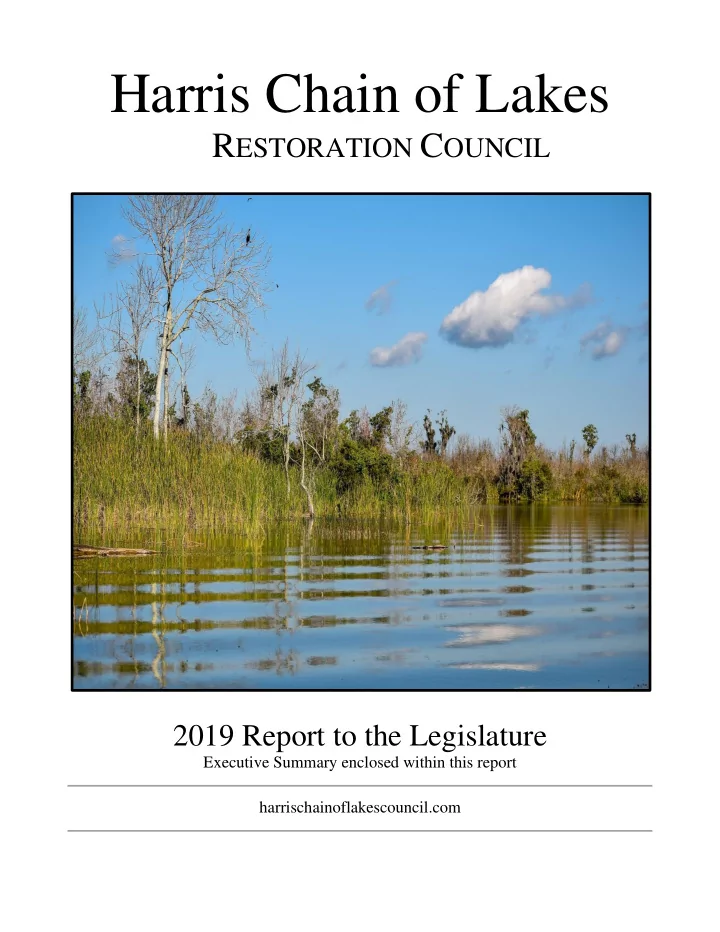
About the cover photograph Lake Apopka North Shore Restoration Area
Harris Chains of Lakes Restoration Council
3
2019 Report to the Florida Legislature
EXECUTIVE SUMMARY
The Harris Chain of Lakes Restoration Council (Council) was established by the Florida Legislature in 2001 with the powers and duties to (a) review audits and all data specifically related to lake restoration techniques and sport fish population recovery strategies, including data and strategies for shoreline restoration, sediment control and removal, exotic species management, floating tussock management or removal, navigation, water quality, and fish and wildlife habitat improvement, particularly as they may apply to the Harris Chain of Lakes; (b) evaluate whether additional studies are needed; (c) explore all possible sources of funding to conduct the restoration activities; and (d) report to the President of the Senate and the Speaker of the House of Representatives each year on the progress of the Harris Chain of Lakes restoration program, and any recommendations for the next fiscal year. The mission of the Council is to maximize successful restoration of the Harris Chain of Lakes, by ensuring sensible efforts to restore clean water quality, sound environmental policy, ecological diversity, and economic stability, now and into the future. The Council conducted eleven meetings during the reporting period of Nov. 2018 through Oct. 2019, including a tour of the Lake Apopka North Shore in July 2019. The Council reviewed projects, received technical presentations, and discussed water resources issues throughout this period on Harris Chain of Lakes restoration, lake water level management, fisheries research, water quality, and aquatic plant management. This report represents the recommendations of the Council to the Legislature. To maximize successful restoration of the Harris Chain of Lakes in 2019, the Council specifically supports and recommends the following: Harris Chain of Lakes Restoration Recommendations (if any) To be Completed by Council at the Sept. 6 meeting or sooner. Lake Level Management
include Double Run swamp (shown in Figure 1).
Fishery Research Recommendations (if any) To be Completed by Council at the Sept. meeting or sooner. Water Quality
home septic systems that do not function correctly.
Question for Council: support for what type of monitoring?
water if not operating as designed. DOH or the designated agency selected by the State of Florida to inspect and make recommendations needed to repair nonfunctioning septic systems on private property
4
Aquatic Plant Management
Commission (FWC) for Hydrilla management on the Harris Chain of Lakes in response to both public input and the scope of the problem.
Question for Council: Is this recommendation redundant?
new herbicides for eradication of hydrilla. Hydrilla may become immune to current herbicides.
5
TABLE OF CONTENTS
EXECUTIVE SUMMARY .................................................................................................................... 3 LIST OF TABLES............................................................................................................................... 5 LIST OF FIGURES ............................................................................................................................. 5 LIST OF ACRONYMS ........................................................................................................................ 5 1.0 ENABLING LEGISLATION ..................................................................................................... 6 2.0 REPRESENTATION ................................................................................................................ 7 3.0 2019 MEETINGS, PRESENTATIONS, AND COUNCIL ACTIONS .............................................. 8 4.0 BUDGET AND EXPENDITURES ............................................................................................. 16 5.0 MEETING INFORMATION.................................................................................................... 17 6.0 APPENDICES ....................................................................................................................... 18 6.1 Appendix A: Statutory Authority .................................................................................... 18
LIST OF TABLES
Table 1: Harris Chain of Lakes Restoration Council Members .............................................. 6 Table 2: 2018 Technical Advisory Group (TAG) Members ..................................................... 6 Table 3. Harris Chain of Lakes Restoration Council Meeting Summary ............................... 7 Table 4. Harris Chain of Lakes Restoration Council Expenditure Statement ....................... 13
LIST OF FIGURES
Figure 1: Map of the Harris Chain of Lakes ......................................................................................... 6
LIST OF ACRONYMS
FDEP Florida Department of Environmental Protection FDOT Florida Department of Transportation FWC Florida Fish and Wildlife Conservation Commission IFAS Institute of Food and Agricultural Sciences LANS Lake Apopka North Shore LCWA Lake County Water Authority MFLs Minimum Flows and Levels MFW Marsh Flowway NuRF Nutrient Reduction Facility SJRWMD
TAG Technical Advisory Group TN Total Nitrogen TP Total Phosphorus UF University of Florida UORB Upper Ocklawaha River Basin
6
1.0 ENABLING LEGISLATION
The Florida Legislature enacted legislation in 2001 creating the Harris Chain of Lakes Restoration Council (Council) to review audits and all data specifically related to lake restoration techniques and sport fish population recovery strategies, including data and strategies for shoreline restoration, sediment control and removal, exotic species management, floating tussock management or removal, navigation, water quality, and fish and wildlife habitat improvement, particularly as they may apply to the Harris Chain of Lakes (Figure 1), evaluate whether additional studies are needed, explore all possible sources
restoration program, and any recommendations for the next fiscal year. Statutory authority is included as Appendix A. Figure 1: Map of the Harris Chain of Lakes
7
2.0 REPRESENTATION
The Council consists of nine voting representatives each appointed by the Lake County Legislative Delegation, as listed in Table 1. Officers serve a two-year term. Elections for new officers occurred at the Apr. 6, 2018, meeting. Mr. Sid Grow was elected Chairman, Mr. Keith Truenow was elected Vice- Chairman, and Mr. Bob Johnson was elected Secretary. Two additional members were appointed to the Council in September 2018. Mr. Wade Boyette filled the position for Attorney, and Mr. Joe Dunn filled a Member-at-Large position. Chairman Grow resigned his position effective Sept. 6, 2019, with Vice- Chairman Truenow assuming the duties of Chair. The Vice-Chairman position will be left vacant until the next election in early 2020. Chairman Grow agreed to continue as a regular member of the Council. Table 1: 2019 Harris Chain of Lakes Restoration Council Members Member Representative Keith Truenow, Chairman Member-at-Large Robert (Bob) Johnson, Secretary Science/Biology Don Nicholson Waterfront Property Owners Skip Goerner Sport Fishing Sid Grow Member-at-Large Stephanie Bishop, PE Engineer John Stump Environmental Science/Regulation Wade Boyette Attorney Joe Dunn Member-at-Large The Council is supported by a Technical Advisory Group (TAG) consisting of agency representatives as listed in Table 2. Table 2: 2018 Technical Advisory Group (TAG) Members Agency Representative FDEP Kevin Coyne FDOT Vacant FWC Scott Bisping LCWA Jason Danaher SJRWMD Rolland Fulton UF Mark Hoyer U.S. Army Corps of Engineers Vacant All Council meetings were noticed in the Florida Administrative Weekly and open to the public. Members of the public regularly attended Council meetings and provided information and feedback to the Council. Information from the technical presentations, TAG member updates, and the public was reviewed and discussed in detail by the Council. This information was used by the Council as the basis for developing recommendations for future restorative measures and management practices for the Harris Chain of Lakes. The Council meeting minutes and technical presentations for the reporting period may be found on the Council’s website: harrischainoflakescouncil.com.
8
3.0 2019 MEETINGS, PRESENTATIONS, AND COUNCIL ACTIONS
The Council conducted ten regular meetings during the 2019 reporting period (November 2018 to Oct.2019). In addition, on Jan.18, 2019, Council held a special workshop to discuss 2019 Council agenda
Table 3. Harris Chain of Lakes Restoration Council Meetings Summary Meeting Date Council Member Attendance Presentations Council Actions
5
Fishery, Ryan Hamm, FWC Approval of September and October 2018 meeting minutes Approval of the 2018 Annual Report Dec.7, 2018
Meeting cancelled by Chairman Grow Jan.18, 2019 7
Regular meeting cancelled. Special workshop held January 18, 2019. Feb.1, 2019 8
water resources projects Lindsey Porter, P.E., SJRWMD project manager Approval of a list of prioritized projects for Council review in 2019. Mar.2, 2019 9
SJRWMD nonconformance to Florida Statute 373.467 (1)(b). Review and approval of letters to the Lake County Legislative Delegation, Florida Senate President and Florida House Speaker (Grow)
information related to Water Quality Memorandum 5 (Grow)6
level control for upcoming hurricane season, David Watt, SJRWMD (Grow) Approval of the November 2018, January 2019, and February 2019 Minutes Motion to approve letters to the Lake County Legislative Delegation, Florida Senate President and Florida House Speaker stating that Council considers SJRWMD in nonconformance to Florida Statute 373.467 (1)(b). The motion was rejected 5-4. Apr.5, 2019 7
Control, Nathalie Visscher, FWC. Approval of March 2019 minutes
9 Meeting Date Council Member Attendance Presentations Council Actions May 4, 2019 4
Phosphorus Removal: identifying package septic systems (apartments, group
septic systems around the Harris Chain. Mike Perry, LCWA.
contract with Phosphorus Free Solutions to remove phosphorus from Lake Apopka, presented by SJRWMD’s Robert Zammataro, P.E., Bureau Chief for the Bureau of District Projects and Construction. None June 7, 2019 5
Sewage Treatment and Disposal Systems and Phosphorus Removal, Roxanne Groover, Executive Director, Florida Onsite Wastewater Association.
OSTDS Coordination in Lake County, Mary Paulic, DEP. Approval of the Apr.2019 and May 2019 meeting minutes July 12, 2019 7
North Shore. None Aug.2, 2019 6
Approval of the June 2019 and July 2019 meeting minutes Approval to Change the Council Meeting Schedule from Monthly to Every Other Month Approval of a List of Specific Questions for the Lake County Attorney to Address Regarding the Sunshine Law Sept.6, 2019
Sunshine Law as it Pertains Approval of the August 2019 meeting minutes
10 Meeting Date Council Member Attendance Presentations Council Actions to the Harris Chain of Lakes Restoration Council, Lake County Attorney
replacement of old or failing septic tanks with individual distributed sewer systems. (Frazel)
Technical presentations listed in Table 3 are summarized by area of interest as follows: Harris Chain of Lakes Restoration In Feb. 2019, Lindsey Porter, P.E., SJRWMD project manager provided updates on a number of projects focused on Lake Apopka restoration, as follows:
SJRWMD sources, to improve the existing levee. The levee will be raised to 70 feet.
remove over 10,000 lbs. of phosphorus over 2 years.
with UF, with a total project cost of $750,000, with $250,000 being spent each year over 3 years. The primary goal is to re-establish beds of submerged aquatic vegetation, with project completion scheduled for 2020.
money through legislative appropriations, as part of a larger project totaling about $2.5 million. The goal of the project is to remove flocculent material along the north shore where SAV has high growth potential.
project in which the Council previously received an update in November 2018. The goal is to restore emergent aquatic vegetation such as spadderdock, white water lily, and American lotus to improve water quality, habitat and reduce wave action and provides additional levee protection.
budget of $1.05 million (legislative appropriations) and the total budget is $2.1 million. The purpose is to design and construct improvements to the north shore infrastructure, including raising the roads around phase 4 totaling 2000 acres. A pump station to pump from the other areas of the north shore into phase 4 is also under design.
the mouth of the Apopka-Beauclair Canal, and includes a dredged channel connection to the canal and improve access to the lake. The sump is complete, with navigation dredging to begin after a permit is obtained from the U.S. Army Corps of Engineers. Expected completion date for dredging is July 2019. Over 500,000 cubic yards of material will have been removed on project. The project
11 does not include future removal of sediments collected in the sump as no funds have yet been allocated. In May 2019, Robert Zammataro P.E., SJRWMD Bureau Chief for the Bureau of District Projects and Construction, provided an update on the Lake Apopka Innovative Total Phosphorus (TP) Removal
Free Water Solutions, LLC to remove approximately 6-12,000 pounds of TP from Lake Apopka. Mr. Zammataro gave a brief overview of the $2 million project, designed to treat 7,000 gallons per minutes, or 10 million gallons per day, at a site off Hooper Road in the northeast quadrant of the North
then pH adjusted and passed through a proprietary filter system to remove dissolved P. Water is then discharged back to the lake with total suspended solids, particulate P and dissolved P removed.
separating a Duda property from other cells in the north shore. The project will give staff the ability to move water within the north shore to prevent discharges to the lake. The project contractor is Four Waters Engineering. The contract allocates $185,000 for design of the $1.2 million-dollar project. Add to field discussion of the Lake Apopka North Shore Interconnect Pumping System Update by the SJRWMD Project Engineer Bob Naleway (paragraph below was already included, reference to the update was added to Table 3) (Grow) In Aug. 2019, Bob Naleway, P.E., SJRWMD Project Manager, provided an additional update on the Lake Apopka North Shore Interconnect Pumping System, reiterating that the project includes the design and construct a pumping system to better utilize existing storage on the north shore rather than discharging to the lake, and the installation of a 50 cubic foot per second pumping system to move water across lake level canal to take advantage of additional storage areas. The project will provide access to an additional 640 million gallons of storage. In July 2019, the Council participated in a tour of the Lake Apopka North Shore (LANS), with SJRWMD staff and members of the public. Erich Marzolf, Ph.D., SJRWMD Director of Water and Land Resources, acted as the guide for the tour of the Lake Apopka North Shore. Dr. Marzolf provided an overview and history of Lake Apopka and the LANS as the tour got underway. Dr. Marzolf noted the goals of the LANS Project are to reduce phosphorus in Lake Apopka, thereby reducing plankton concentrations, which will allow for more submerged aquatic vegetation and improved recreational fishing
The tour entered the LANS at the Duda property and visited the new public boat ramp on the McDonald
provide ADA access for kayaking. The location also houses the rough fish (gizzard shad) landing facility, though it was not operating at the time of the tour. The tour group then traveled to the West Marsh F&G cells on the LANS where sediments from the Lake Apopka sump dredging projects are deposited. The sump, constructed offshore from the Apopka-Beauclair Canal, is approximately 2,000 feet wide with a maximum depth of 5 feet. The sump is expected to collect about 500,000 cubic yards of nutrient-laden sediment.
12 The tour returned to the Duda property and viewed a newly completed pump station that provides alum
to being lifted back to lake elevation at the pump station at this location. Dr. Marzolf noted the nine feet of subsidence that occurred on the LANS as the result of over 5 decades of oxidation of the highly
the capture of alum flocculent in the sand farm pond at this location. The tour ended with a return north to the Unit 1 pump station and exit via Wildlife Drive. Ms. Lisa Kelley, discussed the public use of the wildlife drive, noting more the 100,000 visitors in the past year. The tour group observed more than a dozen vehicles, as well as bicyclists on the wildlife drive as the eco-tour buggy exited the LANS and returned to the Apopka Field Station. Council Recommendations 2019: To be Completed by Council Lake Water Level Management There were no specific presentations on lake level management minimum flows and levels (MFLs) (Frazel)during the reporting period; however, there were Council discussions on alternative forms of conveyance from Lake Apopka and minimum flows and levels (MFLs). (Frazel) In Jan. 2019, the Council discussed plans to control Lake Apopka surge in an emergency, including using some of the north shore property as a reservoir in dealing with hurricane surges. In March and June 2019 Council again discussed whether there should be a secondary conveyance from Lake Apopka and suggested the Double Run Swamp should be studied as an alternative since the Lake County owns much of the easements. In Aug. 2019, the Council discussed MFLs in relation to alternative conveyance and recommended SJRWMD accelerate the development of MFLs for Lake Apopka. (Frazel per Grow) In Mar. 2019, David Watt, P.E., Supervising Professional Engineer within SJRWMD’s Bureau of Operations and Maintenance, discussed lake level control for upcoming hurricane season. Mr. Watt discussed the Upper Ocklawaha River Basin (UORB) system design to help Council Members understand the systems design constraints, as well as to put discussions about flooding and hurricane preparedness in the proper context.
magnitude of flooding. According to the ACOE, the UORB system was designed to control the 10- year flood, which has a 10% chance of occurring in any given year. The Hurricane Irma rain event was considered to be between a 100 and 200-year flood in this area, which has between a 0.5 and 1% chance of occurring in any given year. Mr. Watt reported that the 30 days surrounding Hurricane Irma was so wet, the whole month’s rain was considered to be a 50-year flood, with only a 2% chance of
and what happened as a result of Hurricane Irma. SJRWMD estimated the peak stage for Lake Apopka would have risen another foot had the levee not failed to let water into the north shore properties. The
13 peak stage for the Burrell system, also known as the superpond, would also have been higher had it not been for the additional flow capacity of the Harris Bayou improvements.
gated culverts are now installed that are designed to allow water from Lake Apopka to enter the north shore properties. This is possible as the U.S. Fish and Wildlife Service has removed the restrictions on SJRWMD management of water levels on the north shore, so the option to store excess lake water on those properties is now possible. Council Recommendations 2019:
include Double Run swamp (shown in Figure 1).
Fishery Research In Nov. 2018, Mr. Ryan Hamm, FWC provided an update on the Harris Chain of Lakes Recreational
including management of fisheries, habitat enhancements, aquatic plant control/management, and
Lake Harris, Lake Dora and Lake Apopka.
marshes has improved clarity of the water and submersed vegetation has expanded. Vegetation
Griffin bass population and angler effort, reporting current estimated catch rates of 0.8 bass per hour for the past 3 years indicates a highly productive bass fishery. In addition to bass, Lake Griffin has long been recognized as a top “speck” fishery. Despite regulations that set size and bag limits on crappie, the yield of crappie per angler hour has met or exceeded pre-regulation levels. While anglers are harvesting a lower number of black crappie, they are obtaining a higher poundage in fillets.
a meter to almost 2 meters in 2018. Electrofishing catch rates of adult and age-1 bass were the highest on the chain in 2018, and creel survey results indicate Lake Harris is a premier bass fishery with over 70,000 angler hours and 0.55 bass per hour.
Dora has highest catch rates of bass >16” on the chain. Fish attractors have been a major project in Lake Dora with plastic fish attractors placed at 10 sites with either 50 or 100 units per site for a total of 750 plastic units. Anglers have been catching high numbers of bass and crappie thus far
Hamm reported FWC planted bulrush and spatterdock to increase habitat from 2012-2014 and pads have filled in nicely. As expected, the catch rates of bass at Lake Apopka are by far the
14 lowest in the chain. However, about a third of the sites that FWC samples, primarily on the south and southwest side, have suitable habitat and good populations of bass. Mr. Hamm noted each year, in the spring, FWC has encountered some of the largest bass in the Harris Chain at Lake Apopka.
by state and local agencies from sources such as nutrient reductions, connection of marshes, water fluctuations, plantings. In the past 10 years, FWC has observed water clarity (based on secchi depth) increase at most lakes on the chain. Mr. Hamm noted this increased clarity has allowed native vegetation to expand along with Hydrilla. In particular, submersed vegetation (e.g., eelgrass, southern naiad, Illinois pondweed, bladderwort, and Hydrilla) provides critical rearing cover for young fish to survive and this has resulted in a drastic increase in fish populations such as bass at many lakes.
attracting recreational anglers and tournaments for bass and crappie alike. In addition, data collected by FWC fisheries monitoring collaborates what many anglers are saying; that the Harris Chain is quickly becoming one of the premier bass fishing destinations in Florida. Council Recommendations 2019: To be Completed by Council by Sept.6 or sooner. Water Quality (Grow) Add to field the discussion of Water Quality Memorandum #54 by SJRWMD employee David
In Mar. 2019, Jim Troiano, the SJRWMD Intergovernmental Coordinator, provided Council with an update on Water Quality Memorandun #56, Dr. Erich Marzolf, SJRWMD, reported no SJRWMD plans to update Water Quality Memorandum 56. However, Memorandum #54 is to be updated by Dr. Fulton with data through 2018. This update is expected to be completed in early 2020. Mr. Troiano noted Dr. Fulton had made a presentation to Council on Memorandum #56 in January 2017 and reported the video of the presentation is on the Council website. In May 2019, Mike Perry, LCWA, updated Council on phosphorus removal and identified: package septic systems (apartments, group of trailers) and municipal septic systems around the Harris Chain.
home wastewater facilities, domestic, and industrial waste facilities. Mr. Perry noted there are only a few county owned facilities, mostly schools.
by the Florida Department of Health (DOH) in coordination with DEP. Mr. Perry reported 24,076 (18.1%) known OSTDS and 43,563 (32.8 %) likely OSTDS parcels, noting the data are available on the DOH website. Mr. Perry also discussed a series of loading estimates for lake systems, for all sources, including point sources/septic and provided a summary table of 2017 TP loading estimates to Upper Ocklawaha River Basin lakes. The highest estimated contributions from septic tanks 7.3% and 7.2% for Lakes Harris and Eustis respectively. The bottom line is that OSTDS are not contributing much to TP loading in the Harris Chain of Lakes.
15
inventory as of May 2017 to Council. Mr. Perry noted Florida ranks #1 with reported reuse. Most significant was a summary table of reuse, showing Lake County reusing 100% of wastewater, through a combination of residential, golf course, or municipal irrigation. In June 2019, Roxanne Groover, Executive Director, Florida Onsite Wastewater Association (FOWA) discussed OSTDS and phosphorus removal. Ms. Groover noted that in Florida, the fate of nutrients and fecal matter are currently major wastewater issues. Ms. Groover reported the primary device is a conventional (septic) treatment system consisting of a tank and drainfield. There are approximately 2.5 million conventional systems in Florida, and they are to treat fecal and biological oxygen demand (BOD), not nitrogen and phosphorus. The focus of Ms. Groover’s presentation was on a variety of non-conventional systems that focus on nutrient (nitrogen and phosphorus) reduction in addition to conventional treatment. These systems include aerobic treatment units (ATU), Performance Based Treatment Systems (PBTS). and both proprietary and non-proprietary nitrogen reducing systems. ATUs lower BOD and total suspended solids (TSS), facilitating the construction of larger houses on smaller property. Ms. Groover noted in the Florida Keys nutrients are also removed. Nitrogen is removed through a recirculation system that adds air, converting ammonia to nitrite, to nitrate. The solution is then denitrified into air, ultimately as nitrogen gas. Phosphorus is removed by passing effluent through a material that traps the phosphorus. The trapping material is replaced over time. Also, in June 2019, Mary Paulic, FDEP, reviewed FDEP and FDOH OSTDS coordination in Lake
was used along with maps linking parcels with drinking water source and wastewater treatment method. The data was completed by county, and for Lake Apopka and the Harris Chain of Lakes, data was collected in 2017. The data represent known septic and likely septic (high confidence that property has septic system) parcels. Ms. Paulic presented a map of Upper Ocklawaha septic systems, comprising approximately 66,000 systems basinwide. Within the Harris Chain of Lakes there are an estimated 23,357 septic systems, and 10,854 septic systems in the Lake Apopka Basin (Lake County 7,199 and Orange County 3,655).
was because P does not migrate that far from drainfields. Ms. Paulic showed a final map of septic system locations within 200 meters of waterbodies in the Harris Chain, indicating relatively few septic systems within 200 meters from the lake or contributing waterbodies. A map of Lake Apopka with the same 200- meter buffer delineated, showed 235 septic systems within the 200-meter zone. Council Recommendations 2019:
correction of home septic systems that do not function correctly.
water if not operating as designed. DOH or the designated agency selected by the State of Florida
16 to inspect and make recommendations needed to repair nonfunctioning septic systems on private property (Grow)
Aquatic Plant Management In Apr. 2019. Nathalie Visscher, FWC, updated Council on Hydrilla Control in the Harris Chain of Lakes, discussing the outcome of a series of workshops held throughout the state regarding aquatic plant management. Ms. Visscher reviewed hydrilla treatments on Harris Chain lakes since July1, 2018. In Aug. 2018, 475 acres of Lake Harris were treated by boat with the herbicide Aquastrike, focusing on navigation areas and an area near Long Island. Ms. Visscher noted a major infestation throughout Little Lake Harris, with 640 acres treated by boat with Aquastrike in Aug.2018. The treatment focus was on navigation channels for temporary relief. Little Lake Harris was treated again in Oct. 2018, with a whole lake treatment of Diquat covering 890 acres to reduce the biomass. In Nov. and Dec. 2018, and Jan. 2019, Little Lake Harris follow-up treatments were made using Sonar AS, covering 2,700 acres. A secondary treatment with SonarOne pellets was conducted on areas still containing high levels of hydrilla. Ms. Visscher noted the pellet treatment did have some transient impacts on Spadderdock but no impact on Vallisneria. The north side of Lake Eustis, covering 470 acres was treated with Aquastrike in Sept. and Oct. 2018.
million for this fiscal year provided by the Lake County Water Authority. Treatments are planned all along the north shore of Lake Dora, around the main access points and navigation areas of Lake Harris, navigation areas around the south side of Lake Eustis, and around the Herlong Park boat ramp and canal in Lake Griffin. On Lake Beauclair, the mouth of the Apopka canal will be treated for navigation use, and on Lake Yale, the south end by Marsh Park and East boat ramp will be treated. Once these treatments are completed all lakes will be re-mapped, and new stakeholder meetings will be held in the fall to develop the new treatment schedule. Council Recommendations 2019
new herbicides for eradication of hydrilla. Hydrilla may become immune to current herbicides. (Grow)
4.0 BUDGET AND EXPENDITURES
The LCWA FY 17-18 budget included $9,026.20 for the Harris Chain of Lakes Restoration Council under account 710-349, Water Resources Operating Expenses. In July 2018, Council approved the placement of advertisements in the Leesburg Commercial and Villages Daily Sun newspapers to advertise Council vacancies and agendas using these funds. Council also authorized the acquisition
are listed in Table 4.
17 Table 4. Harris Chain of Lakes Restoration Council Expenditure Statement Date Assets Budget 10/1/18 Previous legislative funds $9,026.20 Total Assets $9,026.20 Expenditures 11/16/18 Villages Daily Sun Advertising $203.40 12/21/18 Villages Daily Sun Advertising $86.40 3/29/19 Leesburg Daily Commercial Advertising $285.00 5/31/19 Moore Awards Inc. 82.80 Total Expenditures through 8/16/19 $657.60 Balance $8,368.60
5.0 MEETING INFORMATION
Meeting information including agendas, minutes, and presentation information may be found in digital format and downloaded from the Council’s website at www.harrischainoflakescouncil.com. Meeting 1: November 2, 2018 Meeting 2: January 18, 2019 Meeting 3: February 1, 2019 Meeting 4: March 2, 2019 Meeting 5: April 5, 2019 Meeting 6: May 4, 2019 Meeting 7: June 7, 2019 Meeting 8: July 12, 2019 Meeting 9: August 2. 2019 Meeting 10: September 6, 2019 Meeting 11: October 4. 2019
18
6.0 APPENDICES
6.1 Appendix A: Statutory Authority
2019 Florida Statutes Title XXVIII NATURAL RESOURCES; CONSERVATION, RECLAMATION, AND USE Chapter 373 WATER RESOURCES 373.467 The Harris Chain of Lakes Restoration Council. —There is created within the St. Johns River Water Management District, with assistance from the Fish and Wildlife Conservation Commission and the Lake County Water Authority, the Harris Chain of Lakes Restoration Council. (1)(a) The council shall consist of nine voting members which shall include a representative of waterfront property owners, a representative of the sport fishing industry, a person with experience in environmental science or regulation, a person with training in biology or another scientific discipline, an attorney, a physician, an engineer, and two residents of the county who are not required to meet any additional qualifications for membership, each to be appointed by the Lake County legislative
case-by-case basis if good cause is shown. A person serving on the council may not be appointed to a council, board, or commission of any council advisory group agency. The council members shall serve as advisors to the governing board of the St. Johns River Water Management District. The council is subject to chapters 119 and 120. (b) There shall be an advisory group to the council which shall consist of one representative each from the St. Johns River Water Management District, the Department of Environmental Protection, the Department of Transportation, the Fish and Wildlife Conservation Commission, the Lake County Water Authority, the United States Army Corps of Engineers, and the University of Florida, each of whom shall be appointed by his or her respective agency, and each of whom, with the exception of the representatives from the Lake County Water Authority and the University of Florida, shall have had training in biology or another scientific discipline. (2) Immediately after appointment, the council shall meet and organize by electing a chair, a vice chair, and a secretary, whose terms shall be for 2 years each. Council officers shall not serve consecutive
(3) The council shall meet at the call of its chair, at the request of six of its members, or at the request
council member, or failure by a council member to attend three consecutive meetings without an excuse approved by the chair, results in a vacancy on the council. (4) The council shall have the powers and duties to: (a) Review audits and all data specifically related to lake restoration techniques and sport fish population recovery strategies, including data and strategies for shoreline restoration, sediment control and removal, exotic species management, floating tussock management or removal, navigation, water quality, and fish and wildlife habitat improvement, particularly as they may apply to the Harris Chain of Lakes. (b) Evaluate whether additional studies are needed. (c) Explore all possible sources of funding to conduct the restoration activities. (d) Report to the President of the Senate and the Speaker of the House of Representatives before November 25 of each year on the progress of the Harris Chain of Lakes restoration program and any recommendations for the next fiscal year.
19 (5) The St. Johns River Water Management District shall provide staff to assist the council in carrying out the provisions of this act. (6) Members of the council shall receive no compensation for their services but are entitled to be reimbursed for per diem and travel expenses incurred during execution of their official duties, as provided in s. 112.061. State and federal agencies shall be responsible for the per diem and travel expenses of their respective appointees to the council, and the St. Johns River Water Management District shall be responsible for per diem and travel expenses of other appointees to the council.
373.468 The Harris Chain of Lakes restoration program. — (1) The Fish and Wildlife Conservation Commission and the St. Johns River Water Management District, in conjunction with the Department of Environmental Protection, pertinent local governments, and the Harris Chain of Lakes Restoration Council, shall review existing restoration proposals to determine which ones are the most environmentally sound and economically feasible methods of improving the fish and wildlife habitat and natural systems of the Harris Chain of Lakes. (2) To initiate the Harris Chain of Lakes restoration program recommended by the Harris Chain of Lakes Restoration Council, the Fish and Wildlife Conservation Commission, with assistance from the
those entities for the enhancement of fish and wildlife habitat. These agencies shall: (a) Evaluate different methodologies for removing the extensive tussocks and buildup of organic matter along the shoreline and of the aquatic vegetation in the lake. (b) Conduct any additional studies as recommended by the Harris Chain of Lakes Restoration Council. (3) Contingent on the Legislature’s appropriating funds for the Harris Chain of Lakes restoration program and in conjunction with financial participation by federal, other state, and local governments, the appropriate agencies shall, through competitive bid, award contracts to implement the activities of the Harris Chain of Lakes restoration program. (4) The Fish and Wildlife Conservation Commission is authorized to conduct a demonstration restoration project on the Harris Chain of Lakes for the purpose of creating better habitat for fish and wildlife.
20
Executive Summary enclosed within this report harrischainoflakescouncil.com
21
Executive Summary enclosed within this report harrischainoflakescouncil.com
22
Executive Summary enclosed within this report harrischainoflakescouncil.com