
SLIDE 1
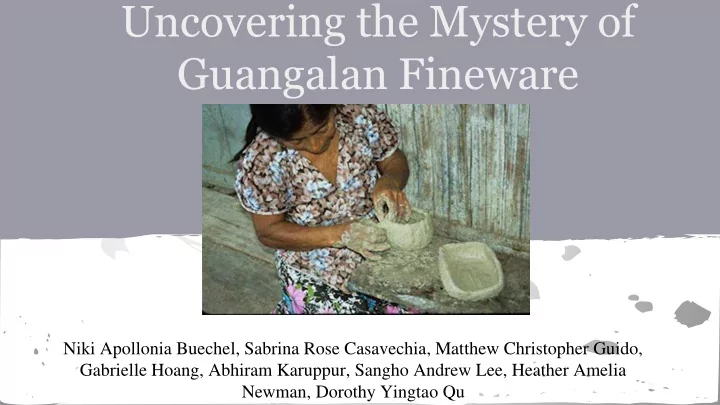
Uncovering the Mystery of Guangalan Fineware
Niki Apollonia Buechel, Sabrina Rose Casavechia, Matthew Christopher Guido, Gabrielle Hoang, Abhiram Karuppur, Sangho Andrew Lee, Heather Amelia Newman, Dorothy Yingtao Qu
Guangalan Fineware Niki Apollonia Buechel, Sabrina Rose Casavechia, - - PowerPoint PPT Presentation
Uncovering the Mystery of Guangalan Fineware Niki Apollonia Buechel, Sabrina Rose Casavechia, Matthew Christopher Guido, Gabrielle Hoang, Abhiram Karuppur, Sangho Andrew Lee, Heather Amelia Newman, Dorothy Yingtao Qu Introduction Guangala o
Niki Apollonia Buechel, Sabrina Rose Casavechia, Matthew Christopher Guido, Gabrielle Hoang, Abhiram Karuppur, Sangho Andrew Lee, Heather Amelia Newman, Dorothy Yingtao Qu
Ashfall; 100X; ppl; 1.2 mm Ashfall; 100X; xpl; 1.2 mm
Phenocrysts
Somberware Bichrome Polychrome
Hills - Igneous
supplies ash and pumice
from El Azucar
http://www.geodyssey.co.uk/ecuador/_images/maps/ecuador_map_100c .gif
El Azucar
10x 2mm field of view 40x 0.2 mm field of view
insight into mineralogical and material makeup
geological material
ceramics with known pumice and pumice-like inclusions
different materials
thin sections for analysis
Guangala archaeological samples (3 sombreware, 3 bichrome, 3 polychrome)
each under petrographic microscope
pumice
100X; 1.2 mm
shape, size, density, and phenocryst presence/absence
pumice inclusions in archaeological samples
○ Raw materials ○ Test tempers in experimental briquettes ○ Ashfall
Archaeological Sample; 100X; ppl; 1.2 mm
Control; 100X; ppl; 1.2 mm
Ashfall; 100X; ppl; 1.2 mm C97-3; 100X; ppl; 1.2 mm
experimental sample containing ashfall
properties of archaeological sample pumice
experimental sample a close match
unsupported
improve on:
○ Migration of people ■ Assimilation of cultures: Guangalan pottery-making ■ Transportation of pumice and obsidian
We would like to thank: Independent College Fund of NJ/Johnson & Johnson AT&T Actavis Pharmaceuticals Bayer Healthcare Celgene Novartis Laura (NJGSS ’86) and John Overdeck NJGSS Alumnae and Parents of Alumnae Board of Overseers, New Jersey Governor’s Schools State of New Jersey Drew University
Anna Mae Dinio-Bloch
Google Maps-https://www.google.com/maps/place/Az%C3%BAcar,+Ecuador/@-2.2333266,- 80.6705318,47623m/data=!3m1!1e3!4m2!3m1!1s0x902dee4850331017:0x4ded5c1e08485fdb Polychrome pot- (http://luckyjor.org/intersito/cultura/figguangala3.jpg) Timeline- http://www.precolombino.cl/images/lineas-de-tiempo/intermedia/42.gif Ford Pots- http://www.marc.ucsb.edu/sites/www.marc.ucsb.edu/files/news_images/volc%20ash.png Volcano- http://static2.egu.eu/media/filer_public_thumbnails/filer_public/2012/07/14/karymsky- 3c438e544cb046916800fcbd69724d0f.jpg__1280x99999_q85_subject_location- 1568,1061_subsampling-2.jpg Fedex- http://blog.pixellogo.com/wp-content/uploads/2010/07/federal-express-truck.jpg Microscope- http://www.geosci.ipfw.edu/sem/pics/petrographicmicroscope.jpg The Andes- http://www.geodyssey.co.uk/ecuador/_images/maps/ecuador_map_100c.gif Obsidian- http://www.ablogabouthistory.com/wp-content/uploads/2012/09/obsidian.jpg Phenocrysts-https://encrypted-tbn2.gstatic.com/images?q=tbn:ANd9GcSrof9DYsl9jjZc-8- q2Mda9jLFAhDNSKmf8Fp6wxWGso3D7PXv9A Ford’s Powerpoint Ashfall-https://feww.files.wordpress.com/2013/08/sakurajima-dumps-ash-on-kagoshima-city.jpg