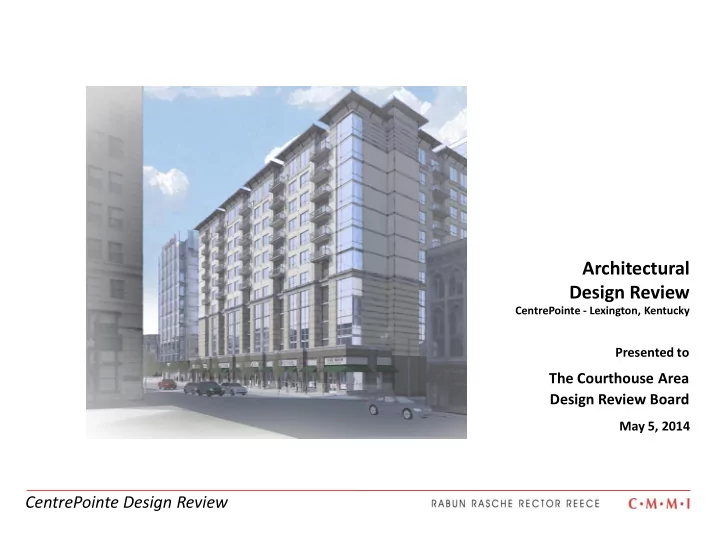
SLIDE 1
CentrePointe Design Review
Architectural Design Review
CentrePointe - Lexington, Kentucky
Presented to May 5, 2014
The Courthouse Area Design Review Board
SLIDE 2
CentrePointe Design Review
Intersection of Limestone and Main
SLIDE 3
CentrePointe Design Review
Main Street
SLIDE 4
CentrePointe Design Review
Detail View, Main Street Retail
SLIDE 5
CentrePointe Design Review
Intersection of Upper and Main
SLIDE 6
CentrePointe Design Review
Intersection of Limestone and Vine
SLIDE 7
CentrePointe Design Review
Vine Street
SLIDE 8
CentrePointe Design Review
Detail View, Intersection of Upper and Vine
SLIDE 9
CentrePointe Design Review
GENERAL DESIGN GUIDELINES 2.1 Maintain the alignment of buildings at the sidewalk edge. This sidewalk cafe gives public access to the landscaped motor court/courtyard at the interior of the block Pedestrian-friendly motor court
SLIDE 10
CentrePointe Design Review
GENERAL DESIGN GUIDELINES 2.2 Orient the primary entrance of a building toward the street. 2.14 Locate the primary building entrance to face the street.
Apartment Hotel Office Sidewalk Cafe
SLIDE 11 CentrePointe Design Review
RETAIL RETAIL RETAIL
OUTDOOR RESTAURANT SEATING SPECIALTY RESTAURANT OUTDOOR RESTAURANT SEATING
LANDSCAPED MOTOR COURT
GENERAL DESIGN GUIDELINES 2.2 Develop the ground floor level of a project to encourage pedestrian activity.
SLIDE 12
CentrePointe Design Review
ALL MECHANICAL AND UTILITY CONNECTIONS OCCUR UNDERGROUND IN PARKING GARAGE GENERAL DESIGN GUIDELINES 2.22 Minimize the visual impact of mechanical equipment on the public way. 2.23 Minimize the visual impacts of utility connections and service boxes 2.25 Minimize the visual impacts of trash storage and service areas. SERVICE AREA IS CONCEALED BEHIND OVERHEAD DOORS
SLIDE 13 CentrePointe Design Review
GENERAL DESIGN GUIDELINES 2.3 New interpretations of traditional building styles are encouraged.
- Rusticated base
- Polychrome brickwork
- Stone inlay
- Cornices
- Corner glazing
- Cantilevered balconies
- Steel elements
SLIDE 14
CentrePointe Design Review
GENERAL DESIGN GUIDELINES 2.4 A new building should incorporate a base, a middle and a cap.
C B A C B A
SLIDE 15
CentrePointe Design Review
GENERAL DESIGN GUIDELINES 2.5 A new building should maintain the alignment of horizontal elements along the block. 2.6 Floor-to-Floor heights should appear to be similar to those seen historically.
SLIDE 16
CentrePointe Design Review
GENERAL DESIGN GUIDELINES 2.7 Consider dividing larger buildings into “modules” that are similar in scale to buildings seen historically
B A A A B B B C
SLIDE 17
CentrePointe Design Review
GENERAL DESIGN GUIDELINES 2.7 Consider dividing larger buildings into “modules” that are similar in scale to buildings seen historically. 2.8 Maintain the established building scale of two to four stories in height.
Mid-height band at the “four story mark” Upper stories set back from street
SLIDE 18
CentrePointe Design Review
GENERAL DESIGN GUIDELINES 2.9 Materials should appear similar to those used historically. 2.10 A simple material finish is encouraged for a large expanse of wall plane.
Brick Aluminum Cast Stone Appearance Stucco Steel Stone Inlay Aluminum Stone Brick
SLIDE 19
CentrePointe Design Review
GENERAL DESIGN GUIDELINES 2.11 Upper-story windows with vertical emphasis are encouraged. 2.12 Windows should align with others in a block.
1:2 Proportion
SLIDE 20 CentrePointe Design Review
GENERAL DESIGN GUIDELINES 2.13 Building entrances should appear similar to those used historically. 2.16 A fabric awning is encouraged. 2.18 Mount awnings to accentuate character-defining features of window
SLIDE 21
CentrePointe Design Review
PUBLIC STREETSCAPE IMPROVEMENTS
SLIDE 22 CHAPTER 2 (GENERAL DESIGN GUIDELINES)
- 2.1 Maintain alignment of buildings at the sidewalk edge. Nearly 100% of the building façade
at the street level is built to the property line/sidewalk edge. The exceptions are pedestrian and vehicular openings which give access to the interior of the block.
- 2.2 Orient the primary entrance of a building toward the street. This Project features seven
components and numerous entries, among them retail, commercial office, apartment, condominium and hotel. The entrances are handled differently for each. The office, apartment, and retail components orient their primary entrances to Main Street. The extended stay hotel and full-service hotel components have vehicular drop offs on the motor court at the interior of the block, but also feature secondary walk-up entrances oriented to Main and Vine Streets
- respectively. The feature restaurant component orients its main entrance to Vine Street. The
condominium component, located atop the hotel on Vine Street, shares a front entrance with the hotel.
- 2.3 New interpretations of traditional building styles are encouraged. The design of the
Project varies in style around the block depending on the adjacent context. Along Main Street, the building uses many traditional design elements, such as cornice lines, polychrome brickwork, individual windows, and fabric awnings, but is not a literal imitation any of its historic neighbors.
- 2.4 New buildings should incorporate a base, a middle and a cap. The Project, with respect to
its elevation along Main Street, complies with this item. The street level story and top stories are both visually distinct from the remainder of the building.
- 2.5 A new building should maintain the alignment of horizontal elements along the block. This
guideline is largely not applicable to this project, which does not adjoin existing buildings within the block. However, the Project does address the guideline by aligning the retail sign band along Main Street.
- 2.6 Floor-to-floor heights should appear to be similar to those seen historically. The floor-to-
floor heights of this project, along Main Street, are in the range 9’-4” to 13’-6”. In each case, individual floors and windows are discernable as such.
- 2.7 Consider dividing a larger building into “modules” that are similar in scale to buildings
seen historically. The length of this Project along Main Street has been divided visually into modules approximately 42 feet in width, in accordance with this recommendation.
- 2.8 Maintain the established building scale of two to four stories in height. This guideline also
- ffers the following recommendation for buildings taller than four stories: “Although a new
building may be taller than surrounding buildings, the first several stories should visually relate in scale to the surrounding historical context.” The project addresses this guideline by making the architecture of the lower stories distinct from that of the upper stories. At a line approximately 55 feet above the street level, the Project features a cornice and a change in exterior veneer, which achieves the aim of this guideline with respect to building character without limiting the height of the building to a historical norm.
- 2.9 Materials should appear similar to those used historically. The majority of the Main Street
elevation is brick with aluminum and glass punched window openings, which is in straightforward compliance with this guideline.
SLIDE 23
- 2.10 A simple material finish is encouraged for a large expanse of wall plane. The aim of this
guideline is to limit the use of reflective materials over large areas of the building’s surface. The extended stay hotel/apartment block complies with this guideline by using brick as its primary exterior material and non-mirrored glass for glazing.
- 2.11 Upper-story windows with vertical emphasis are encouraged. The windows and glazing
patterns along the Project’s Main Street elevation are divided in such a way as to make their height greater than their width, in straightforward compliance with this guideline.
- 2.12 Windows should align with others in a block. This guideline is not applicable to this
project, which does not adjoin existing buildings within the block.
- 2.13 Building entrances should appear similar to those used historically. Entrances along Main
Street are recessed, and defined with brick pilasters and fabric awnings.
- 2.14 Locate the primary building entrance to face the street. Reference guideline 2.2.
- 2.15 Develop the ground floor level of a project to encourage pedestrian activity. This Project
enthusiastically complies with this guideline in a variety of ways. The Main Street side features ground level retail with generous storefront along most of its length. It also features a sidewalk cafe, giving public pedestrian access to the interior of the block.
- 2.16 A fabric awning is encouraged. The Project uses fabric awnings for all of the retail
storefront areas.
- 2.17 A fixed metal canopy may be considered on a case-by-case basis. The Project does not
propose any fixed metal canopies on the street elevations.
- 2.18 On a historic building, mount an awning or canopy to accentuate character-defining
features of window openings. Not Applicable
- 2.19 Use lighting to accent architectural details, building entrances, signage, and illuminate
- sidewalks. Lighting elements will be mounted along the street level façade as a decorative
feature and to provide street level lighting evenings and nights. Applicant anticipates that the retail storefronts will also have interior lighting at night to feature products in display windows. Applicant also anticipates limited building-mounted lighting to accent architectural features. This must be balanced with the concern over light intrusion into residential units.
- 2.20 Minimize the visual impacts of site and architectural lighting. In compliance with this
item, Applicant proposes low levels of luminescence for exterior lighting, white color, limited building-mounted feature lighting, and a fixture style sympathetic to the architectural style of the building.
- 2.21 Prevent glare by using shielded and focuses light sources. In compliance with this item,
Applicant proposes using shielded and focused light sources, with no upward-directed lights. Lighting associated with service areas and parking structures is either below grade or behind service doors.
- 2.22 Minimize the visual impact of mechanical equipment on the public way. The mechanical
equipment is located either in mechanical rooms within the building or on rooftop locations. This project’s roof-mounted mechanical equipment will be shielded from view from Main, Limestone, and Vine Streets through the use of screening parapets or by situating the equipment out of the line of sight.
SLIDE 24
- 2.23 Minimize the visual impacts of utility connections and service boxes. All utility
connections in the Project are located in the below-ground parking structure. Exceptions are those connections required to be on the street for fire department access.
- 2.24 Locate standpipes and other service equipment such that they will not damage historic
façade materials. Not applicable to this project.
- 2.25 Minimize the visual impacts of trash storage and service areas. The service area and trash
storage area for the Project is located on Upper Street and is shielded from view by an overhead coiling door extending the full width of the service and trash area. CHAPTER 3 (GUIDELINES FOR HISTORIC PROPERTIES): Not applicable. CHAPTER 4 (PARKING FACILITIES)
- 4.1 Locate a parking facility, particularly a surface lot, in the interior of a block whenever
- possible. The parking for the Project is located completely within an underground parking
structure.
- 4.2 Site a parking lot so it will minimize gaps in the continuous building wall of a block. Not
applicable.
- 4.3 Where a parking lot abuts a public sidewalk, provide a visual buffer. Not applicable.
- 4.4 To reduce the visual impacts of a large parking lot area, divide it into a number of smaller
parking parcels and separate them with landscaping. Not applicable.
- 4.5 Design a parking structure so that it creates a visually attractive and active street edge.
Not applicable.
- 4.6 A parking structure should be compatible with traditional buildings in the surrounding
- area. Not applicable.
- 4.7 Design a parking facility so that pedestrian access is easy and clearly defined. The
underground parking will be safely lighted and feature clear signage. All levels of the parking structure are directly connected to the supporting businesses above via elevators to the street level. CHAPTER 5 (PUBLIC STREETSCAPE IMPROVEMENTS)
- 5.1 Use a consistent decorative paving design to convey a sense of visual continuity. The
project anticipates the complete removal and reconstruction of all existing sidewalks surrounding the Site. As these pedestrian areas are rebuilt, Applicant will incorporate the pertinent recommendations of the streetscape design studies developed for the Lexington- Fayette Urban County Government. The details of the hardscape and plant materials to be used in connection with the Project are included on the conceptual landscape plan included with the
- submission. Various decorative paving designs are used to denote distinct activity zones, such
as Vine Street pedestrian, Vine Sreet vehicular, motor court, sidewalk cafe, etc. in accordance with this guideline.
SLIDE 25
- 5.2 Brick pavers should be incorporated in all sidewalks. To the extent this guideline still
applies in this district, the Project will comply.
- 5.3 Provide expanded sidewalk areas, or “plazas,” where conditions permit. The Project
achieves this by reclaiming sidewalk where possible, particularly near the Upper St/Vine St intersection, and along Main Street by maximizing the sidewalk width directly in front of the retail and office entrances.
- 5.4 Coordinate private open space development with that of the streetscape design of public
sidewalks, when conditions permit. This has been achieved on both Main and Vine Streets, where the design of the private open space is designed to coordinate with the design of the public sidewalks.
- 5.5 Open spaces should read as “accents” in the street wall of building fronts. In general, the
majority of the Project’s building frontage is building walls. Less than 50% of the frontage on each bordering street is open space, in straightforward compliance with this guideline.
- 5.6 Define the edges of the open space along the sidewalk. The edge of the sidewalk cafe on
Main Street is defined by a change in paving pattern, in accordance with this guideline.
- 5.7 Frame public open space activities that will be in use year round. Pedestrian circulation
routes to the hotel, condominium, and restaurant entrances are designed to cross the sidewalk cafe and motor court areas, to help animate the space. Major entrances to the hotels and condominiums are oriented to the motor court.
- 5.8 Site open space to maximize opportunities for sun and shade. This is achieved to the
extent possible. Both the hotel restaurant dining terrace and the restaurant outdoor dining area are on the south (Vine Street) side of the site, and are provided shade by deciduous tree canopy in the summer and sun in the winter.
- 5.9 All street furniture in the public right-of-way should have similar materials and colors.
Final street furniture selection cannot be offered at the time of this submission. To the extent required by the review committee, Applicant agrees to abide by the selection recommendations as outlined in this guideline, which references the Lexington Downtown Streetscape Master Plan (1996).
- 5.10 Street furniture should be located in areas of high pedestrian activity. Applicant will
provide street furniture at pedestrian route intersections, major building entrances, and near
- utdoor gathering places, as stated in this guideline.
- 5.11 Street furnishings should be clustered in “groupings,” when feasible. Applicant
anticipates that the final street furnishings layout will comply with this guideline.
- 5.12 Public seating should be provided to enhance the pedestrian experience. Applicant
proposes public outdoor seating in the Main Street sidewalk cafe area, near the hotel and condominium entrances, near the entrance to the restaurant, and in the pedestrian zone along Vine Street. Applicant further agrees to select seating designs consistent with other street furnishings, in accordance with this guideline.
- 5.13 Position a bench to provide a sense of comfort. Applicant proposes to locate public
seating away from traffic, away from curbs, or buffered from these areas, in accordance with this guideline.
SLIDE 26
- 5.14 Cluster waste receptacles with other furnishings. Applicant affirms that the location of
waste receptacles will comply with this guideline.
- 5.15 When feasible, cluster planters with other furnishings. Applicant proposes to install
freestanding planters in groupings of 3-5 at seating areas, in the pedestrian plaza, and in clustered furnishing areas in accordance with this guideline.
- 5.16 Use indigenous plant materials when feasible. Final plant material layout and Applicant
agrees to follow this guideline where feasible.
- 5.17 Trees installed in the sidewalks shall have tree wells that reflect the intensity of
pedestrian traffic. Applicant agrees to follow this guideline in the design and specification of tree wells.
- 5.18 Install new street trees to enhance the pedestrian experience. The Project will install new
trees along all four bounding streets. The spacing of new street trees approximately follows the guideline average of 35 feet.
- 5.19 Street tree species should be consistent along designated streets. To the extent it is still
applicable at the time of this submission, Applicant agrees to comply with the Lexington Downtown Streetscape Master Plan (1996) in the specification of tree species.
- 5.20 Provide electrical service for string lights in trees. If this guideline is still applicable at the
time of this submission, Applicant agrees to comply with this provision in the design of exterior electric power.
- 5.21 Light pole designs should be decorative and complement other street furniture. To the
extent Applicant is responsible for specifying street lighting, Applicant agrees to comply with this guideline in the selection and specification of light poles.
- 5.22 The light pole, or standard, should be designed to accommodate special decorative
- accessories. To the extent Applicant is responsible for specifying street lighting, Applicant
agrees to comply with this guideline in the selection and specification of light poles.
- 5.23 Street lights in mid-block locations should convey a pedestrian-oriented scale. To the
extent applicant is responsible for specifying street lighting, Applicant agrees to comply with this guideline in the selection and specification of light poles.
- 5.24 Higher light levels may be provided at street intersections, if necessary. To the extent
applicant is responsible for specifying street lighting, Applicant agrees to comply with this guideline in the selection and specification of light poles. CHAPTER 6 (SIGNS) The Design Guidelines provide that the tradition of “having a diversity of signs that remain subordinate to the overall context, and of signs complementing architectural compositions, should be maintained.” Although specific details about the signage to be used for the Project cannot be offered at this time, Applicant anticipates that the Project will feature a variety of signage appropriate for the Project’s design and multiple users.