
SLIDE 1
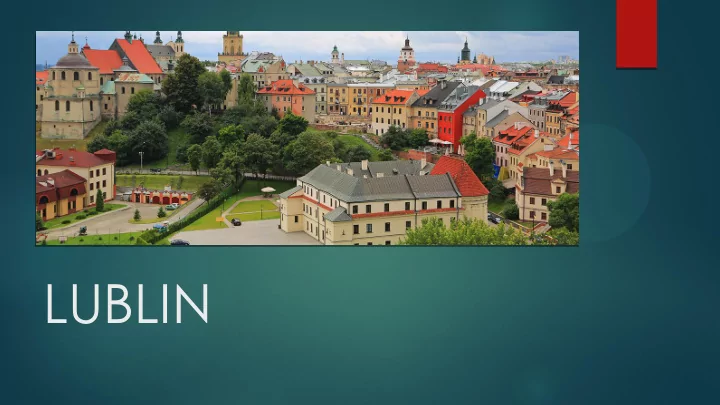
LUBLIN The most important information the city is located in - - PowerPoint PPT Presentation
LUBLIN The most important information the city is located in eastern Poland Is the capital city of Lublin Voivodeship Ninth most populous city ( 348 thousand) of Poland Sixteenth largest city of Poland(147 km 2 ) Lublin is
the city is located in eastern Poland Is the capital city of Lublin Voivodeship Ninth most populous city ( 348 thousand) of Poland Sixteenth largest city of Poland(147 km2) Lublin is located on the Lublin Upland at the Bystrzyca
River
Old Town
Town
tenements , The Archicathedral Church , Trynitarska Tower, Dominican basilica, Po Farze Square, Litewski Square
Underground route of Lublin Lublin Castle and Holy Trinity Chapel Lublin Village Museum Majdanek – former doom camp
State Museum at Majdanek is situated at the
area of former german concentration camp
Is directly exposed to Ministry of Culture and
National Heritage.
Museum at Majdanek persues exhibition,
educational and scientific activities
Its main purpose is preservation of historical
memory and developement of historical education about German occupation in Lublin Voivoidship during The Second World War
Lublin’s Old Town
The most beautiful places in Lublin are located in
Old Town. Being located on the edge of a scarp, makes it look picturesque.
Many burgess tenements were saved from
Crown Tribunal built in XVI century is situated in
the Centre of Old Town.
The most magnificent temple of Old Town is
Dominican Church founded in1342.
From Krakowskie Przedmieście you can see the Krakow Gate It was formed after the terrible invasion of the Tatars in 1341 It was decided to encircle the city with defensive walls after this tragedy and to supply them with gates. It was built in Gothic style In the beginning was the only entrance gate
Located on Królewska Street, is one of the monuments which is forgotten
It is called semicircular tower because of a shape of it
It was built in1341 r
It was reconstructed in the 80s
It is a part of old city walls
Merchants took care of it. They were supposed to provide the tower with cannons and gunpowder.
During Old Polish period, thick church candles were being made inside of this tower
In the XVI century, Lublin was influenced by
Renaissance architecture and became modern, and more beautiful.
The greatest sculptors and decorators, who
were mostly italian, took part in the rebuilding of them.
Tenements had residential nature. Most of the owners were building new
tenements, which were decorated with renaissance sculpture, which was architectural detail.
The church is one of the oldest Baroque buildings, apart from the ones that were built in Italy
Facade of a church, originally built in Rennaisance-Baroque style, has been influenced by many different periods in art
In the XVIII century, the church was ruined, and in the XIX century was renovated
In 1823, the church started to function as a cathedral
A unique acoustic chapel can be found there
We can admire a unique trompe l’oeil (painting that creates
vault
It is the highest view point in Lublin. The viewing terrace reaches a height of 40 metres. Inside of the tower, we can visit Muzeum Archidiecezjalne
Sztuki Religijnej (the Archidiocesan Museum of Religious Art.). Collection of liturgical equipment, paintings, icons, sculptures, textiles, sarcophaguses, musical instruments, coffin portraits and other historic items can be found inside.
Apart from functioning as a museum, the tower also functions
a belfry of archicathedral church.
Bells ring during important ceremonies
Located in the eastern part of old town hill, on
a small elevation so called dominican hill.
Most likely constructed in the XIII century. Currently, the church represents modern
architectural style, so called Lublin
many characteristic features of late Rennaisance left.
Relics of the Holy Cross used to be located in
this church.
Po Farze Square is one of the oldest places in
Old Towin in Lublin kryjącym remmants of the medieval buildings of the city.
This is where the church of Saint Michael was
built in the past, which was first parish in Lublin.
It was one of the most important elements
shaping landscape of the city.
Today, the fundations which were elevated in
2001-2002 are an evidence of its existence.
Łokietka Square’s localization, at a time of its
creation, was at the entrance to the city
It used to function as a marketplace Its origins date back to 1611, when Sigismund III
agreed to remove fortificationsn and to fill moats in front of Krakowska Gate
Tumultous past of this square are mirrored by
numerous changes of an appearence and functions of buildings
Everyday at 12.00 a bugle call is played at the town
hall.
Around 280 metres long, located under the market and Old Town
The route was created as a result of linking numerous basements of Old Town. Corridors merged and in such a way an underground labyrinth was created underneath the city.
The route has a touristic and educational nature
A tour through this route may bring a lot of emotions, because it allows you to go back in time and discover the past of the city
There are two models of the city. Panorama of the City from the first half of XVII century and a movable model of the great fire.
Originally build in the XII century, was rebuilt many
times.
In the second half of XIX century and in the first half of
XX century it served as a prison, and since1954, functions as Lublin Museum.
The castle has been constructed on a rectangular
plan with internal courtyard. Elements that are characteristic for neo-Gothic style can be seen on the facade, for example pointed window frames.
The most valueable monument is Holy Trinity Chapel
with Byzanthine polychrome.
It is a great example of multiculturalism and
coexistence in harmony of two religions – Roman Catholic and Orthodox – in the Kingdom of Poland.
There is a tower on the castle courtyard which also has
a viewing platform.
Located in picturesque valleys of Czechówka
river, is one of the biggest open-air museums in Poland
Museum exposition has been divided into
sectors reflecting variety in terms of landscapes and etnography of Lublin Voivodship: Lublin Upland, Roztocze, Powiśle, Podlasie, mansion sector and town sector.
Definite attraction of Lublin Village Museum is
town sector, which is a model of provincial town from the 30s.
Karnawał Sztukmistrzów (Carnaval of Masters of Art)
Dni Lublina (Days of Lublin)
Festiwal Kultury Alternatywnej "Zdarzenia” (Festival of Alternative Culture Happenings)
Festiwal Prowokacje (Festival Provocations)
Międzynarodowy Festiwal Teatralny „Konfrontacje” (International Theatre Festival Confrontaions)
Studencki Ogólnopolski Festiwal Teatralny Kontestacje (Polish Student Theatre Festival Contestations)
Miasto Poezji (City of Poetry)
Międzynarodowe Dni Filmu Dokumentalnego „Rozstaje Europy” (Crossroads of Europe – International Film Festival
Międzynarodowe Lubelskie Spotkania Teatrów Tańca (International Lublin Dance Theatres)
Międzynarodowe Spotkania Folklorystyczne im. Ignacego Wachowiaka (International Folklore Festival of Ignacy Wachowiak)
Noc Kultury (Culture Night)
Open City
Teatry i festiwale teatralne w Lublinie (Theatres and Theatre Festivals in Lublin)
Zwierciadła (Mirrors)
Festiwal Smaku (Taste Festival)