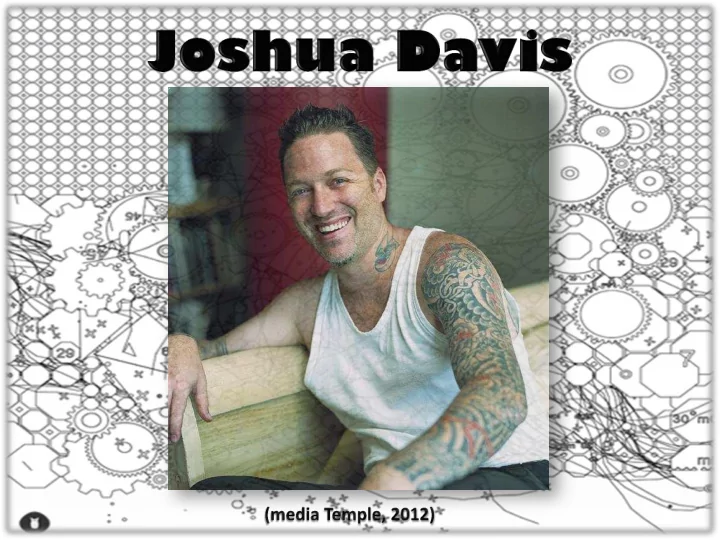
American web designer, author and artist in new media. Worked with - - PowerPoint PPT Presentation

american web designer author and artist in new media
SMART_READER_LITE
LIVE PREVIEW

American web designer, author and artist in new media. Worked with - - PowerPoint PPT Presentation

American web designer, author and artist in new media. Worked with the web production company Kioken. Became an independent web designer. An Illustrator and Painter with Passion for technology History of graphic design


slide-1
SLIDE 1
slide-2
SLIDE 2
  • American web designer, author and artist in new media.
  • Worked with the web production company Kioken.
  • Became an independent web designer.
  • An Illustrator and Painter with Passion for technology
  • History of graphic design
  • Combines his passions
slide-3
SLIDE 3

Success story

  • Began in Colorado, where he was a painter in high school. Came second in a stateside

art competition, he ended up doing some artwork in the lower downtown art scene in Denver.

  • In New York, frustration at lack of progress led to the Pratt Institute, a respected art
  • school. A switch to illustration and debts encouraged Davis to send work off to a few

publishers.

  • Rejection across the board. Enter the internet: "This buddy of mine said, 'You don't

need to publish, man, paper's dead, books are dead, there's this whole internet thing'.“

  • Worked art by day and teaching himself programming by night, he went on to create a

number of experimental, pioneering sites (such as Praystation, Once Upon A Forest and Dreamless).

  • “I got a little bit more hip to what it was I was doing," he says. "The net became a place

to create projects, art and portfolios. It all kind of snowballed from there - totally by accident." After three years with the web production company Kioken, Davis set up a studio with Branden Hall in 2001, before starting his own small company - Joshua Davis Studios.

(Computer Arts 2007).

slide-4
SLIDE 4

Personal Interests and work

  • A love for both Technology and Art, Based on the idea of design as

chaos theory, he is an artist who develops computer code that randomly creates patterns out of his own drawings.

  • Skateboarding (has a ramp in his garden)
  • Tattoos
  • Teaching, giving talks and personal projects
slide-5
SLIDE 5

Influences

  • Davis was strongly influenced by Jackson Pollock, an abstract

expressionist whose work came of age in the 1940s and 1950s.

  • Pollock splattered paint (as well as other items) across large canvases with

the idea that his art was the process of its creation rather than the final product.

slide-6
SLIDE 6
  • Computer as a tool for generating his work, wrote code that randomly

distributed, arranged, and distorted his artwork, essentially creating new work.

  • Generated entire pieces practically completely at random. That is, the art is

the code that produces the final result rather than the final randomly generated works themselves.

  • “Among modern artists, I conceptually identify with Jackson Pollock — not

that I'm a particular fan of his visual style, but because he always identified himself as a painter,”

  • Joshua Davies
  • Davis was also influenced by classic video games and even used a sprite
  • f an alien from Space Invaders as his logo for Praystation.
slide-7
SLIDE 7

Flash

  • Uses Macromedia Flash to create Art (An interactive tool to add

animation to web pages).

  • New genre of randomized computer art
  • Publish book: Flash to the core 2002: An Interactive Sketchbook by

Joshua Davis.

  • Flash to the Core is about the creative process and what Joshua Davis

can teach about taking Flash design and development to new extremes.

(Amazon 2012).

slide-8
SLIDE 8

Overview

  • He combines self-created technology with self-produced art.
  • "I'm still the artist but I like to write programs that take my handmade

drawings and generate things’.

  • What Davis does is to write computer code that duplicates the random

patterns he sees around him, and then throws his artwork into that system.

(Computer Arts 2007)

slide-9
SLIDE 9

How it works

  • Images are sent to program and he asks the program to select 300

things (images) it will then randomly choose which ones and duplicates it

  • Once satisfied with the images the program can be paused.
  • Then they are tidied up in Adobe Illustrator.

(Computer Arts 2007).

slide-10
SLIDE 10

Joshua Explains

  • It's as if he's trying to synthesize his own art with the beauty found in
  • nature. Or, as Davis would have it, "Every time I ask the system to run

and pause I'll get a completely unique set of patterns - just like a

  • snowflake. (computer Arts 2007).
  • http://www.youtube.com/watch?v=-iKkEpW0N5Q

(computer Arts 2007).

slide-11
SLIDE 11

Projects

  • Joshua Davis has had many projects
  • Personal Projects
  • Projects for massive cooperation's such as Orbit and music

such as Album covers.

  • Here is a few examples…
slide-12
SLIDE 12

PrayStation.com

  • PrayStation.com is one of his websites, which he would use to exhibit new

design work and experiments, and was one of the first to offer open source Flash files.

praystation / ps3.v1 / 2001 praystation / ps3.v1 / 2001

slide-13
SLIDE 13

Dreamless.org

  • Dreamless.org was the site of a popular Internet forum, hosted by Joshua Davis from

1999 to 2001.

  • Its minimal design, understated Web presence and hidden registration page all added

to its intrigue.

  • for a while it was a gathering place for many graphic and web designers and

programmers. (Wikipedia 2012)

slide-14
SLIDE 14

Deadmau5 Gear Head / 2012

slide-15
SLIDE 15

Orbit 2011

slide-16
SLIDE 16

OFFF Mexico Mural / 2012

slide-17
SLIDE 17

Adidas 2011

slide-18
SLIDE 18

Motorola RIZR / 2007

slide-19
SLIDE 19

Kanye West 2006

slide-20
SLIDE 20

Hyp ype

  • Created by Branden Hall & Joshua Davis, HYPE is a creative coding

framework built on top of ActionScript 3. A major goal of HYPE is to allow newcomers to Flash and ActionScript to creatively play and express themselves while they are learning how to program.

  • HYPE is not just for people who are new to programming. is for

anyone, regardless of skill, who wants to play with code.

  • The point of HYPE is to make Flash fun again. We made HYPE to

help bring back the playfulness that once defined our community.

  • As the user learns more about programming they can extend HYPE

and thus grow their skills.

  • http://www.youtube.com/watch?v=k1yFqbgR-tQ

(Computer Arts 2007).

slide-21
SLIDE 21

Awards & accolades

  • Joshua Davis was the winner of the 2001 Prix Ars Electronica Golden Nica

in the category “Net Excellence” and has exhibited his works at the Tate Modern (London), the Ars Electronica(Austria), the Design Museum (London), le Centre Pompidou (France), the Institute of Contemporary Arts(London), PS.1 MoMA (New York), among others.

  • In December 2006, His work will be inducted into the Smithsonian’s Cooper-

Hewitt, National Design Museum’s "National Design Triennial: Design Life Now" exhibit. (Wikipedia 2012)

slide-22
SLIDE 22

Bibliography

slide-23
SLIDE 23
  • Do you recognise Joshua Davis’

work?

  • Do you like his work?
  • What do you like and dislike about

it?