
SLIDE 1
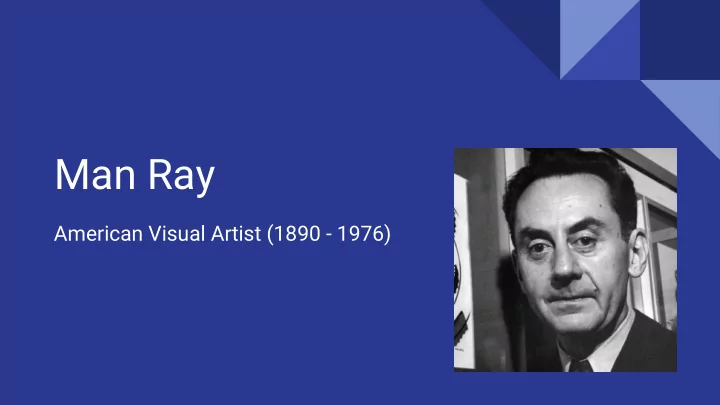
Man Ray American Visual Artist (1890 - 1976) The Life of Man Ray - - - PowerPoint PPT Presentation
Man Ray American Visual Artist (1890 - 1976) The Life of Man Ray - Born August 27,1890 in Pennsylvania - The artist was known in the United States and Europe - He spent his time between Paris, Hollywood and New York - His main influencers
November of 1976, in Paris.
way of working
immediately by adding one layer upon the next layer. He used inanimate objects as well as his own body to create his earlier pictures, and the pictures sometimes have an autobiographical quality, with many of his photographs portraying his lovers.”
Surrealist art movements (Man Ray Biography).
accessing the untapped creativity of the unconscious mind.
EO
Marquise Casati, 1922
photograph Italian born aristocrat Casati and capture her personal style of messy hair and striking eyes.
unconscious desire with reality (Lountzis).
EO
heavily influenced by his friendship with American-French painter Marcel Duchamp.
EO
Les Larmes, (Glass Tears), 1932 Man Ray
effect of tears on this woman’s face by using glass beads
really accentuated eyelashes, Ray wants to invoke a sense of wonder about her distressful gaze (Larmes).
be representational of his recent break up with Lee Miller.
EO
1922
paper and exposing the composition to light.
representational as the resulting silhouettes tended to simplify objects.
time and their unorthodox approach to art, culture, and society (Man Ray).
EO
A camera alone does not make a picture. To make a picture you need a camera, a photographer and above all a subject. It is the subject that determines the interest
What interests me about this photo is it could be seen today in a magazine. He did work for Vanity Fair and Vogue that made long lasting impressions on the fashion industry. This photo is shot on a backdrop with a single light source placed directly to the left of the model. You can see the corner of the backdrop is worn and there are a few scattered items on the ground that add dimension. It is a
"To create is divine, to reproduce is human."
The dimension of this photo draws the attention
textile material. The assembly of the gears draws your eye around the photogram.
“I would photograph an idea rather than an object, a dream rather than an idea."
This solarized print is uniquely captured. He framed the women’s arm to run parallel with the edge of the frame
Man Ray: "I think… women."
interest in painting he encouraged her
Violin which tells us how controlling he was with his lovers
Date: 1922 Location: Museum of Modern Art, NYC, NY The process of this photograph: using photosensitive paper, objects were laid on top and exposed to light. The two heads are pictures silhouettes of his lover at the time and his past lover.
Original Title: Le Violon d'Ingres Date: 1924 This piece became popular among many young people at the time. Musicians and fashion designers got tattoos of the music note. Jean-Auguste-Dominique Ingres's La Grande Baigneuse was an artist that inspired Man Ray with this piece. Ingre’s Violin means hobby and at that time he was portraying his muse, Kiki, as a hobby. Model: KiKi de Montparnasse (his lover for 6 years)
This piece was meant to reference the black and white nature of photos. It was taken at a time when African fashions and styles were popular. He uses the contrast between the similar expressions and light and dark color to symbolize the conflict of society. Ray also strategically places one “oval” laying on its side, while the other is straight up.
(Observatory Time: The Lovers)
One of Ray’s most memorable works. This piece is frequently parodied in pop culture, such as the logo for The Rocky Horror Picture Show. The piece suggests that the woman is either having a nightmare or a vivid errotic dream. The chessboard is in there because Ray loved playing chess, and he considered the board as a form of order and basis for all art.
Solarization was a common technique Ray liked to use. Solarization tends to flatten the tonal range, while simultaneously giving the image a luminosity and the figures a dark black outline.
Ray also really enjoyed the effects that solarization had. He used it often, sometimes to emulate the effect that it was drawn rather than a photo. Solarization is done when briefly exposing a developing photograph to light.
“To create is divine, to reproduce is human.”
EO
Lountzis, Gerasimos. "The Art of Seeing." Inframe. November 25, 2016. Accessed January 28, 2018. https://www.inframe.gr/single-post/2016/11/25/The-Art-of-Seeing-07. "Man Ray Biography, Art, and Analysis of Works." The Art Story. Accessed January 25, 2018. http://www.theartstory.org/artist-ray-man.htm. Man Ray (American, 1890 - 1976). Femme (Mary Gill). 1930. Harvard Art Museums<br/>Department of Photographs, Fogg Museum, Robert M. Sedgwick II Fund. http://library.artstor.org/asset/AWSS35953_35953_29355855. Web. 25 Jan Man Ray, American, 1890 - 1976. 1925. Clock Wheels. Works on Paper. Place: Yale University Art Gallery, Prints, Drawings, and Photographs, http://artgallery.yale.edu/, Gift of Collection Société
Man Ray, American, 1890 - 1976. 1925. Clock Wheels. Works on Paper. Place: Yale University Art Gallery, Prints, Drawings, and Photographs, http://artgallery.yale.edu/, Gift of Collection Société
Ray, Man. "Ingre's Violin, 1924 - Man Ray." Www.wikiart.org. January 01, 1970. Accessed January 28, 2018. https://www.wikiart.org/en/man-ray/ingre-s-violin-1924. Ray, Man. "Rayograph (The Kiss), 1922 - Man Ray." Www.wikiart.org. January 01, 1970. Accessed January 28, 2018. https://www.wikiart.org/en/man-ray/rayograph-the-kiss-1922. "Women dominate the frame in Man Ray exhibition." HeraldScotland. Accessed January 28, 2018. http://www.heraldscotland.com/arts_ents/13108588.Women_dominate_the_frame_in_Man_Ray_exhibition/. "Larmes (Tears) (Getty Museum)." The J. Paul Getty in Los Angeles. Accessed January 27, 2018. http://www.getty.edu/art/collection/objects/37756/man-ray-larmes-tears-american-1930-to-1932/.
"Man Ray | Rayograph | The Met." The Metropolitan Museum of Art, i.e. The Met Museum. Accessed January 28, 2018. https://www.metmuseum.org/art/collection/search/265487. Man Ray Biography, Art, and Analysis of Works http://www.theartstory.org/artist-ray-man-artworks.htm Finarte: Photographs https://www.artsy.net/artwork/man-ray-egg-and-shell-solarization Exposing the dark side of human nature https://www.japantimes.co.jp/culture/2002/05/29/arts/exposing-the-dark-side-of-human-nature/#.Wm1WPKinHZs "Solarization and Sabattier Class." Print Room. Accessed January 27, 2018. http://theprintroomkl.com/solarization-and-sabatier-effect-class/