GHG assessment of aeroponic lettuce cultivation 2nd International - - PowerPoint PPT Presentation

ghg assessment of aeroponic lettuce cultivation
SMART_READER_LITE
LIVE PREVIEW

GHG assessment of aeroponic lettuce cultivation 2nd International - - PowerPoint PPT Presentation

GHG assessment of aeroponic lettuce cultivation 2nd International Conference ADAPTtoCLIMATE 24-25 June 2019 Heraklion, Crete Island Konstadinos Sofja Anna Barla Georgios Abeliotis PhD student Salahas Harokopio Harokopio University,


slide-1
SLIDE 1

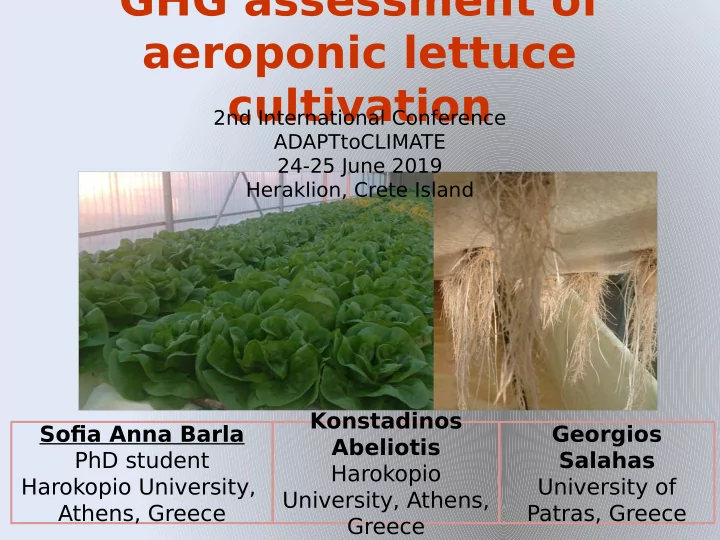
GHG assessment of aeroponic lettuce cultivation

Sofja Anna Barla PhD student Harokopio University, Athens, Greece Konstadinos Abeliotis Harokopio University, Athens, Greece Georgios Salahas University of Patras, Greece

2nd International Conference ADAPTtoCLIMATE 24-25 June 2019 Heraklion, Crete Island

slide-2
SLIDE 2

The aim is to…

Evaluate greenhouse gases (GHG) emissions aeroponic lettuce cultivation Resulti ng from Resulti ng from

slide-3
SLIDE 3

Aeroponic cultivation in general is …

The most modern method of farming technology  vegetables grow faster  zero run – ofg (dripping) to the environment (in closed-loop systems)

slide-4
SLIDE 4

Advantages

 also :

rapid growth & maturation higher plant density Increased yields year round at least 30% more than hydroponics  environment rich in oxygen for plant roots  low requirements in water, nutrients, pesticides & energy

 reduces usage of :

 water Fertilizer pesticides

slide-5
SLIDE 5

 Is a: green technology  With:

 Disease-free environment  Zero environmental pollution  ideal working conditions  healthier and potentially more nutritious products

t exist and some disadvantages

higher initial cost lack of farmers expertise in new technologies sensitive system demands back up system with electric generator demand continuous control for pH and nutrient density ratios

slide-6
SLIDE 6

maximize their yields

Plan ts and roots

hanging in the air in closed trays sprayed with water and nutrients

droplets and help of high pressure (mist) wit h

slide-7
SLIDE 7

water nutrien ts energy

Consumption of is kept to a minimum

maximize their yields

Because plants

slide-8
SLIDE 8

Case study: aeroponic lettuce cultivation

slide-9
SLIDE 9

K1 in winter with 480 plants, yield 120 kg and days of cultivation 36 K2 in spring with 720 plants and yield 226.8 kg with cultivation days 43 K3 in autumn - winter with 950 plants and yield 279.3 kg and days of cultivation 42.

3 cultivations conducted: K1, K2, K3

slide-10
SLIDE 10

Location: Amaliada, Western Greece

 Automatic greenhouse  Electronically controlled system  Department of Agricultural Science, University of Patras

slide-11
SLIDE 11

Focus

  • on the consumption of

water

  • nutrients &
  • energy

Data collection

Also other estimated

  • construction of
  • greenhouse &
  • control room
  • distance of seedling

transportation

slide-12
SLIDE 12

Description of system

controlled electronically

1

the system is closed-loop no dripping

to the environment

So…

2

and

Prepares & make difgerent nutrient solutions for various treatments at same time

slide-13
SLIDE 13

contains a drain tank

So..

3

drained solution collected, rectifjed and reused

used zero pesticides and fungicides

4

Nutrient solution decontamination

Only

slide-14
SLIDE 14

Plant roots

sprayed for 30’’ every 5’during daytime every 10’during night &

6 5

hung in a canal (vessel) and watered by spraying the nutrient solution onto them

And they

slide-15
SLIDE 15

Canals - vessels

In the up side of the canals polysterene sheets are placed and plants, planting in holes with special plastic pots and neoprene discs

&

8 7

placed with a slight slope for natural fmow for drainage

slide-16
SLIDE 16

Heating - lighting

The fjxable temperature is that of the nutrient solution to the root system.

But 1 1 9

The greenhouse does not need heating for the requirements of lettuce natural lighting

1 1 1 1

adjust the root zone atmosphere temperature ofgering ideal root growth conditions for each plant species

That

slide-17
SLIDE 17

Impact assessment

with Simapro 8 software and CML 2 impact assessment method

LCA was used to evaluate the three cultivations of lettuce

Life Cycle Assessment

slide-18
SLIDE 18

Aeroponic lettuce cultivation

slide-19
SLIDE 19

25/3/201 6 19/3/201 6

slide-20
SLIDE 20

Κ1, K2, K3 characterization

slide-21
SLIDE 21

K1 with fewer plants, has the

smallest carbon footprint

K2 consumes more water and

energy because of the seasonal planting, has the highest carbon footprint in comparison with the

  • ther two cultivations

K3 with most plants of all,

afgected somewhat the same with K1, because of the yield and seasonal planting, as also the carbon footprint was about the same between K1 and K3

characteriza tion

K 1 K 3 K 2

slide-22
SLIDE 22

Results per kg of lettuce

gene ral K2 > K3 > K1

based on the kg CO2 eq Impact category Unit

K1 K2 K3

Global warming (GWP100) kg CO2 eq

2.14 2.77 2.17

Product yield K3 (279.3 kg), K2 (226.8 kg), K1 (120 kg)

slide-23
SLIDE 23

elec tricit y elec tricit y polycarbonate polycarbonate Fertiliser (N) Fertiliser (N) Stainless steel grade 304 Stainless steel grade 304

Κ 1 , K 2 , K 3

Most important processes

slide-24
SLIDE 24

was the most signifjcant process in all impact categories

characterization and normalization showed

That for K1, K2, K3

Electricity input

slide-25
SLIDE 25

Comparison of results with other relevant studies

Literature review reveals a lack of relevant quantitative studies

slide-26
SLIDE 26

Sanyé-Mengual E.et al (2015) Bologna, Italy between 2012 and 201

urban agriculture 3 difgerent techniques Nutrient fjlm  fmoating hydroponic soil cultivation

  • n the top fmoor (roof)

promotes local food production

Lack of studies

slide-27
SLIDE 27

Water , Fertilizer s Material for cultivatio ns, electricit y Substrates (manufacturin g & transportatio n) Pestici de free Pestici de free

LCA

global warming, kg CO2 eq period NFT Floatin g soil 2012 (summer) 2.51 0.567

  • 2013a
slide-28
SLIDE 28

Kg CO2 eq in our case

Global warming (GWP100) kg CO2 eq

K1

(winter)

K2

(spring)

K3

(winter) 2.14 2.77 2.17

Comparing Our results are comparable with NFT and fmoating hydroponic systems

global warming, kg CO2 eq period NFT Floatin g soil 2012 (summer) 2.51 0.567

  • 2013a

(summer) 4.88 1.19

  • 2013b

(autumn) 3.97 1.08 0.323

slide-29
SLIDE 29

Conclusions

 An LCA has been conducted for aeroponic lettuce

cultivation in Greece

 The results indicate that aeroponic cultivation is a

low environmental impact process

 Electricity usage is the key process contributing to

the GHG emissions of the aeroponic cultivation

slide-30
SLIDE 30

 replacement with electricity from renewable sources  usage of greenhouse with lighter construction

Proposals

for improving the environmental impacts

The greenhouse that was used to conduct this research is for experimental purposes and its construction is complicate,

  • verburdened in structures and

expensive.

slide-31
SLIDE 31

References

Sanyé-Mengual E., Orsini F ., Oliver-Solà J., Rieradevall J., Montero J. I. Gianquinto G., 2015, T echniques and crops for effjcient rooftop gardens in Bologna, Italy,

  • Agron. Sustain. Dev. (2015) 35:1477–1488.

1

Hospido A., Llorenç Milà i Canals, McLaren S., T runinger M., Gareth Edwards-Jones, Clift R., (2009), The role of seasonality in lettuce consumption: a case study of environmental and social aspects, LCA FOR FOOD PRODUCTS, vol. 14, p.381–391.

2

Foteinis S. and Chatzisymeon E., 2016, Life cycle assessment of organic versus conventional agriculture. A case study of lettuce cultivation in Greece, Journal of Cleaner Production, vol. 112, p. 2462-2471

3
slide-32
SLIDE 32

Thank you for your attentio n!

Sofja Anna Barla PhD student Harokopio University, Athens, Greece Konstadinos Abeliotis Harokopio University, Athens, Greece Georgios Salahas University of Patras, Greece

2nd International Conference ADAPTtoCLIMATE 24-25 June 2019 Heraklion, Crete Island