
SLIDE 1
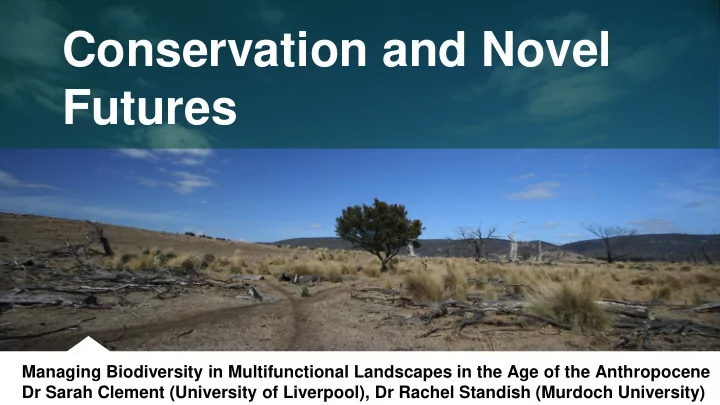
Conservation and Novel Futures
Managing Biodiversity in Multifunctional Landscapes in the Age of the Anthropocene Dr Sarah Clement (University of Liverpool), Dr Rachel Standish (Murdoch University)
Futures Managing Biodiversity in Multifunctional Landscapes in the - - PowerPoint PPT Presentation
Conservation and Novel Futures Managing Biodiversity in Multifunctional Landscapes in the Age of the Anthropocene Dr Sarah Clement (University of Liverpool), Dr Rachel Standish (Murdoch University) Ecosystem transformation & novel and
Conservation and Novel Futures
Managing Biodiversity in Multifunctional Landscapes in the Age of the Anthropocene Dr Sarah Clement (University of Liverpool), Dr Rachel Standish (Murdoch University)
Ecosystem transformation & novel and hybrid ecosystems
◍ Why & how systems are transforming ◍ Hybrid ecosystems - most of the measurable traits of the ecosystem (i.e. nutrient load, hydrology, species diversity, etc.) are the same but most of the species have changed. ◍ Novel state - measurable traits altered from historical ranges - new species, interactions, and functions
Image: Resilience Alliance.
Novel ecosystems: (mal)adaptive?
◍ Controversial concept in ecological literature – adaptive response to change or giving up and giving in? ◍ Restoration & conservation – adherence to historical baselines ◍ Degraded or just different? ◍ How, where, and when to manage? ◍ Reversibility of changes ◍ Non-technical questions
◍ Governance and public values discussed as important aspects – but mainly barriers. ◍ Little investigation of how governance and policy can provided a broadening framework for decision making about how to restore and manage novel ecosystems.
Governance and novel ecosystems
Key questions ◍ What has been said so far about the governance aspects of novel ecosystems? ◍ How are we currently dealing with transforming ecosystems? ◍ What might it mean to re-define conservation ‘success’ in transforming landscapes?
Photo: dried up Lake Hume reservoir during drought by suburbanbloke, via Flickr
Ecological perspectives on governance
Clement et al. (2015). A diagnostic framework for biodiversity institutions. Pacific Conservation Biology
◍ Used this conceptual framework to structure review ◍ General & adaptive capacity ◍ Only four of the components form a major discussion in the ecological literature
Framing
Summary of challenges in the literature Policy and legal barriers to managing and restoring ecosystems in novel ways (Collier 2015; Hobbs et al. 2009), and do not consider value of NE or functional equivalence in current approaches (Starzomski 2013). But also potential dangers in removing barriers (Graham et
Lack of clear definition and diverse ways of viewing the problem and potential management actions (Morse et al. 2014; Murcia et al. 2014; Truitt et al. 2015).
Photo: frames by George via Fickr, daniandgeorge, CC
Summary of challenges in the literature
fidelity and ecological integrity (Manning et al. 2009); sentimentality about historic ecosystems; static view of ecosystems as particular assemblages in particular places (Hobbs et al. 2009; Hobbs 2016; Light et al. 2013). Fostering “new norms”is potentially dangerous (Graham et al. 2014; Murcia et al. 2014; Standish et al. 2013).
2014; Hobbs 2016). Social values in relation to NE are largely unknown (Collier 2015).
with transformation(Hagerman and Satterfield 2014).
Culture & Norms
Power & Authority
Summary of challenges in the literature Deliberate management of ecosystems as novel could provide authority to approaches that degrade ecosystems (Graham et al. 2014; Murcia et al. 2014; Standish et al. 2013). Practical legal challenges, such as property systems and land tenure (Hulvey et al. 2013), allocating rights and responsibilities and setting new procedures for practice (Richardson and Lefroy 2016)
Photo: Westminster at night.
Administrative competence
Summary of challenges in the literature The feasibility of managing for historical, hybrid, or NE are determined in part to budget constraints and scale of interventions. Need for new practices and technical knowledge about how to manage NE and the efficacy of differing management actions (Collier 2015; Hobbs et al. 2014; Seastedt et al. 2008). Criteria including reference points, baselines, and bio- and environmental indicators as metrics of change are needed to standardize the use of the novel ecosystems concept for management and policy decision-making (Morse et al. 2014; Truitt et
Buffering
Summary of challenges in the literature Mismatch between policy framing and ecological reality is problematic for conservation (Hobbs et
Governance needs to enable different responses according to local contexts and mechanisms to adjudicate between different perspectives (Richardson and Lefroy 2016) and address fundamental influences on conservation and restoration such as social values (Collier 2015).
◍ Ecology: Patchwork, <30% native vegetation (1/4 of which is lowland native grassland), tree decline ◍ Restoration to pre-European state not feasible for much of the landscape + agricultural intensification. ◍ Most (listed) grasslands on 12 properties ◍ Suitable climate for listed grasslands will disappear across 50% of geographic extent ◍ Adaptive capacity high among those with current listed grasslands - Lower capacity among 64% of landholders with areas projected to be suitable by 2050
Example: Tasmanian Midlands
See: Clement et al 2016 Policy Sciences Harris et al 2015 PlosOne Raymond et al 2015 JEM
Climate Models & Species Distribution Models Informed the Scenarios
The question for me has changed away from the traditional conserve, protect, language to functional thresholds…just what makes a healthy functional landscape that other things can operate in, like agriculture?
Example: Australian Wheatbelt
◍ How “success” is defined in Australian policy. ◍ Interconnected social and ecological issues. ◍ Clearing, fragmentation, weed invasion, secondary salinity, nutrient enrichment ◍ But also: declining production, changing terms of trade, social decline ◍ Landscapes across southern Australia facing similar issues.
Grassland 4.Old-field 3b.Exotic annual grasses 3a.Exotic annual & native perennial grasses Woodland 5.Salt-affected land 1.Undegraded state 2.Degraded states Standish, Cramer & Yates 2009 Unfavourable Favourable (unusual) Key to transitions:
State-and-transition model for wheatbelt woodlands
Role for carbon market in re-defining success?
◍Carbon market: large-scale restoration of degraded agricultural landscapes. ◍Achieving restoration goals, such as habitat for wildlife, is more likely if mixes of local native species are planted. ◍Theory suggests a positive saturating relationship between biodiversity and ecosystem function. Experiments are underway to test this relationship.
Mallee plantings & biofuel: an
Eucalypt woodland Wheat field Old-field Grow trees for carbon credits & biodiversity
Restoring function: new measure of success Old-field example
Restoration at Ridgefield
Richard Hobbs
If you plant more species, do you get more function?
Perring et al. 2012
Planted species richness Multi-functionality
Nicola Mitchell Bridget Johnson
The Moors (UK)
◍ Cultural landscape – long-term human intervention ◍ Low intensity agriculture – profitability, resilience ◍ Exposes tensions between different objectives, classes (and the relationship between the two) ◍ Re-wilding projects but also intensive management for grouse
The Moors, Grouse, Fire & Flooding
Re-defining success in the moors?
◍ Cross-cultural differences - What makes a European cultural landscape “novel”? ◍ Changing social and economic context - and who benefits? ◍ Role of moors in carbon capture - restoration of bogs (Moors for the Future) ◍ Different visions of what would “improve” the uplands
Research currently underway
◍ Support for ‘taboo’ options ◍ Noah’s Ark policies vs ecosystem function ◍ Re-defining ‘success’ in the Anthropocene - social, economic, ecological aspects ◍ Cognitive challenges and novel futures ◍ Cross-cultural comparison (Australia & UK)
Photo: Wheatbelt Sky by Allan Rostron via Flickr (top); Peak District Heather by author
Questions?