SLIDE 1
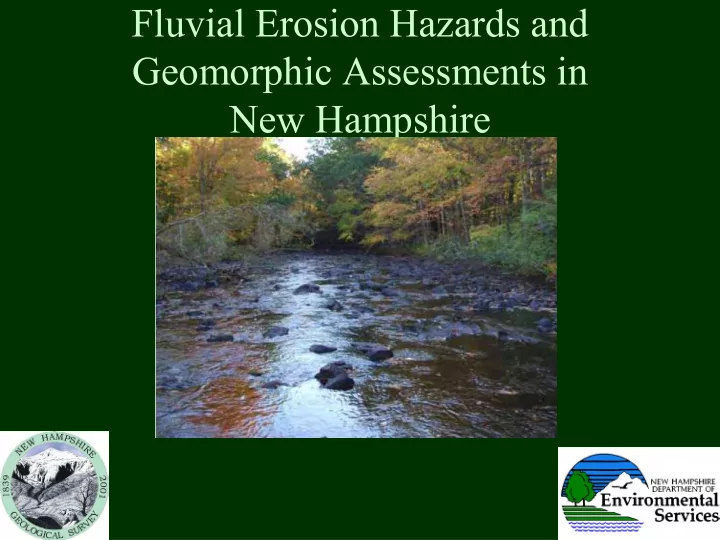
Fluvial Erosion Hazards and Geomorphic Assessments in New Hampshire
SLIDE 2 What is fluvial geomorphology?
Fluvial = action of running water Geomorphology Geo = Earth morph = form
The study of how running water shapes the landforms on the Earth’s surface.
SLIDE 3 Connecticut River – northern NH/VT line Lamprey River – southeast New Hampshire
SLIDE 4 Fluvial erosion = the wearing away of river channel bed and banks by the action
Is a natural process Typically seen at high flows (bankfull flows) or during flood events, and particularly in reaches that have been altered by human activity or recent natural events.
Fluvial Erosion
SLIDE 5 Erosion on the ground
November 2009 March 2010 June 2010
SLIDE 6 1979 1998
Photos courtesy of Dan Cemerelli, USFS
- Stream narrowed by culvert
- Velocity increased → erosion downstream of culvert
Erosion on the ground
SLIDE 7
SLIDE 8
Fluvial erosion ... and its effects
SLIDE 9
SLIDE 10 Piscataquog River Watershed
- Major flood events in New
Hampshire (20052007)
- $75.6 million total inundation
and erosion damage
- Heavy rains and repetitive rains
- New Hampshire’s highest recurring natural hazard
risk
SLIDE 11 New Hampshire Flood Damage $$$$
Since 1978
SLIDE 12
Can we determine areas that are most susceptible to these kinds of events?
SLIDE 13
Fluvial Erosion Hazard (FEH) and River Geomorphic Assessments (RGA) Program
SLIDE 14 New Hampshire’s FEH/RGA Program
2008 Upper and Lower Exeter River Watersheds – Bear Creek Environmental 2009 Ammonoosuc – Field Geology Services Isinglass – New Hampshire Geological Survey Middle Exeter – Bear Creek Environmental Late 2010 2011 Cocheco/Lamprey watersheds, southeast New Hampshire Beyond Piscataquog Souhegan ????
SLIDE 15
Methods
SLIDE 16
SLIDE 17
SLIDE 18
SLIDE 19 How can this information be used?
- Hazard mitigation plans
- The geomorphic condition data will be available in a
database for stream restoration activities
- Stream restoration and alteration of terrain activities
- Prioritization of problematic culverts for
rehabilitation or replacement
- Watershed management plans
- Fluvial Erosion Hazard zoning
SLIDE 20 Stream restoration activities
geomorphic processes are adequately considered in assessing the longterm sustainability of project benefits.
make sure a proposed project or modification to a river doesn’t cause more problems down the road.
SLIDE 21 We want to work with the river as a system!
- With some understanding of how rivers
naturally work, we can try to minimize future infrastructure effects by reducing constrictions and disruptions to river process.
- Put another way – managing toward rivers
that are in balance
SLIDE 22 2008 & 2009 2009 & 2010
SLIDE 23
SLIDE 24 Methods
- Phase 1 Stream Geomorphic Assessment
- Phase 2 Stream Geomorphic Assessment
- Bridge and Culvert Assessment
- River Corridor Plan
Stressor Maps Departure Analysis FEH zones
SLIDE 25 Major Stressors: Exeter River
- Stormwater inputs from suburban areas
- Impacts to riparian buffer
- Floodplain encroachment
- Undersized & poorly aligned stream crossings
- Relict structures
- Impoundments (dams)
- Agricultural impacts
SLIDE 26
SLIDE 27 Localized stormwater
SLIDE 28
Relic stream ford
SLIDE 29
Bank failure & buffer encroachment
SLIDE 30 Dam Impoundments
ME07: Phillips Mill Dam ME07: Scribner Road Dam Flooding & erosion problems Altered flow regime
SLIDE 31
Retrofit Culvert & Plant Trees
SLIDE 32
Little River, Exeter: Land protection
SLIDE 33
SLIDE 34 Projects to Address Stressors
- Stormwater management
- Conservation and corridor easements
- Remove relic structures
- Replace/retrofit undersized bridges and
culverts
- Streambank restoration
- Streamside planting
- Riparian buffer restoration and protection
- Further protect floodplain and floodplain
access