FABRICATION AND PHYSICAL PROPERTIES OF POLYCAPROLACTONE/STARCH - - PDF document

fabrication and physical properties of polycaprolactone
SMART_READER_LITE
LIVE PREVIEW

FABRICATION AND PHYSICAL PROPERTIES OF POLYCAPROLACTONE/STARCH - - PDF document

18 TH INTERNATIONAL CONFERENCE ON COMPOSITE MATERIALS FABRICATION AND PHYSICAL PROPERTIES OF POLYCAPROLACTONE/STARCH BLENDS WITH CORN BASED COUPLING AGENT F.M. Nor 1 , D. Kurniawan 1 , Y.K. Seo 2 , J.K. Park 2 , S.A. Park 3 , W.D. Kim 3 , H.Y.


slide-1
SLIDE 1

18TH INTERNATIONAL CONFERENCE ON COMPOSITE MATERIALS

1 Introduction Polycaprolactone (PCL) is being developed as the material of scaffolds for tissue engineering [1]. PCL is considered having fair mechanical properties and characteristics of potentials for load bearing applications, including cardiovascular, dental, and musculoskeletal [1-4]. Yet, its implementation faces some issues, e.g. inadequate mechanical properties, bioresorbability, and hydrophilicity [1,5]. Possible way in an attempt to address these issues is by compounding with other biocompatible materials, and starch is of interest. Immiscibility is an issue in blending starch to PCL. It leads to deteriorating mechanical properties and may affect the blend’s overall performance. Considering the intended applications, options are limited in compatibilizing these constituents where any substance to be incorporated into the blend should also be biocompatible. Previous studies for compatibilizing PCL and starch reported the use of predried starch [6], chlorinated starch (by using methanesulfonylchloride in dimethylformamide) [7], glycidyl methacrylate [8], and plasticizer [9]. The use of those compatibilizing agents resulted some improvements on physical properties of the PCL/starch blends but did not solve the immiscibility problem. In the purpose of similar attempt to address the issue, this study proposes the use of zein, a prolamine protein from corn. Zein is amphiphilic, having affinity for both polar and non-polar groups [10]. Zein was used as coupling agent for natural fiber/thermoplastic composite and resulted in enhanced mechanical properties [11], an indication

  • f improved miscibility between its constituents.

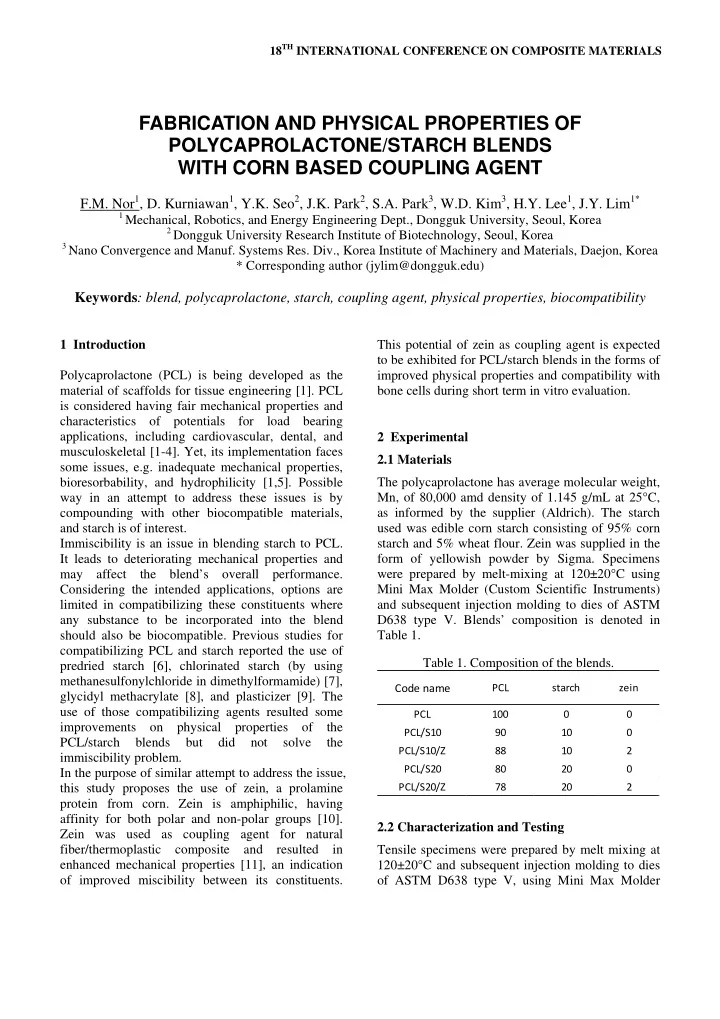
This potential of zein as coupling agent is expected to be exhibited for PCL/starch blends in the forms of improved physical properties and compatibility with bone cells during short term in vitro evaluation. 2 Experimental 2.1 Materials The polycaprolactone has average molecular weight, Mn, of 80,000 amd density of 1.145 g/mL at 25°C, as informed by the supplier (Aldrich). The starch used was edible corn starch consisting of 95% corn starch and 5% wheat flour. Zein was supplied in the form of yellowish powder by Sigma. Specimens were prepared by melt-mixing at 120±20°C using Mini Max Molder (Custom Scientific Instruments) and subsequent injection molding to dies of ASTM D638 type V. Blends’ composition is denoted in Table 1. Table 1. Composition of the blends.

Code name

PCL starch zein PCL 100 PCL/S10 90 10 PCL/S10/Z 88 10 2 PCL/S20 80 20 PCL/S20/Z 78 20 2

2.2 Characterization and Testing Tensile specimens were prepared by melt mixing at 120±20°C and subsequent injection molding to dies

  • f ASTM D638 type V, using Mini Max Molder

FABRICATION AND PHYSICAL PROPERTIES OF POLYCAPROLACTONE/STARCH BLENDS WITH CORN BASED COUPLING AGENT

F.M. Nor1, D. Kurniawan1, Y.K. Seo2, J.K. Park2, S.A. Park3, W.D. Kim3, H.Y. Lee1, J.Y. Lim1*

1 Mechanical, Robotics, and Energy Engineering Dept., Dongguk University, Seoul, Korea 2 Dongguk University Research Institute of Biotechnology, Seoul, Korea 3 Nano Convergence and Manuf. Systems Res. Div., Korea Institute of Machinery and Materials, Daejon, Korea

* Corresponding author (jylim@dongguk.edu)

Keywords: blend, polycaprolactone, starch, coupling agent, physical properties, biocompatibility

slide-2
SLIDE 2

(Custom Scientific Instruments). Houndsfield H5KT (Tinius Olsen) with 5 kN load cell was used for the tensile tests. The cross head speed for tensile testing neat PCL and its blends was 5 mm/min. In determining the significance of starch content and zein addition to mechanical properties, statistical analysis was used. Analysis of variance (ANOVA) was used, set at probabilistic value, Prob > F, of maximum 5% as the criterion for the variables to be considered significant. Thermal analysis was conducted using Perkin-Elmer DSC 7 differential scanning calorimetry (DSC) set for scanning from 20 to 80°C at 10°C/min under nitrogen atmosphere. The observed output was melting temperature (Tm), heat of of fusion (ΔHf), and crystallinity. Fourier transform infrared spectroscopy (FTIR) was conducted on selected samples using Thermo Scientific Nicolet iS10 with KBr/Ge beam splitter. The FTIR spectra were recorded from 4000 to 600 cm−1 with 2 cm−1 resolution, averaged over 32 scans. For morphology analysis, scanning electron microscope (SEM) JEOL JSM 5800 was used. To evaluate hydrophilicity, contact angle measurement was conducted using pendant drop tensiometer Krüss DSA100. Contact angle was measured from the interface between the specimen and the droplet of 2 μl distilled water on specimen’s

  • surface. Further evaluation was conducted by

analyzing the blends’ tendency to absorb simulated body fluid. PCL and its blends were immersed for 24 hours in saline solution at 37°C and their weight gain was measured. 2.3 In vitro analysis For in vitro analysis of the blends, human bone marrow mesenchymal stem cells were seeded and cultured on selected samples. The isolation, seeding, incubation, and cultivation procedures were according to previous experiences reported elsewhere [12,13]. Mononuclear cells were plated into tissue culture flasks in expansion medium, consisted

  • f Dulbecco’s Modified Eagle’s Medium (DMEM,

Invitrogen) and 10% fetal bovine serum (Cambrex), at a density of 5 × 10⁴ cells/cm2. Upon reaching 80% confluency, cells were detached with Accutase (Innovative Cell Technologies) and replated at a density of approximately 1 × 10⁴ cells/cm2. The cells were then expanded further for two to six passages. For assessment of cell proliferation, an MTT assay (Sigma) was used. Cell-cultured specimens after 1 and 14 days of incubation were transferred to a 6 well plate, and serum-free DMEM supplemented with MTT (0.33 mg/ml) was added to each well. The plates were then incubated in the dark at 37°C in an atmosphere containing 5% CO2 for 2 hours, aspirating the supernatant. Isopropyl alcohol (1 ml) containing 0.04 N HCl was added and the plate was shaken slowly for 15 min. The absorption was measured at 540 nm. 3 Results and Discussion From tensile test (overall results shown in Table 2), the blend’s strength reduced and its stiffness increased with higher starch content, a common indication of immiscibility. Addition of zein does not improve the blend’s mechanical properties, except for increased stiffness for blend with 10% starch. ANOVA for tensile strength and modulus unveiled that only starch content was considered significant in affecting the mechanical properties of the blend. Addition of zein was not significant enough to influence the blend’s strength and stiffness. Table 2. Mechanical properties of the blends.

PCL 16.37 ± 1.67 159.38 ± 11.35 18.46 ± 1.31 PCL/S10 16.03 ± 1.66 159.14 ± 10.88 16.80 ± 1.43 PCL/S10/Z 15.22 ± 1.25 163.18 ± 9.02 16.30 ± 0.80 PCL/S20 14.36 ± 0.32 174.07 ± 6.82 12.60 ± 2.26 PCL/S20/Z 13.35 ± 1.04 169.79 ± 9.37 13.81 ± 0.91 Type Yield strength E Elongation (MPa) (MPa) (%)

Zein, like starch, is a relatively high modulus thermoplastic [14]. Therefore, addition of zein increases the blend’s stiffness, including when compared to that of neat PCL. Yet, yield strength of the blend decreases with addition of zein. Considering that PCL is a good dispersant of fillers, it indicates that zein also has high mobility, causing instability within the PCL matrix when tensile loaded. FTIR analysis on PCL, starch, zein, and the blends indicated that the spectra of both PCL/starch and PCL/starch/zein blends are similar to that of neat

  • PCL. Peak around 1700 cm-1 for internal esther

group of the PCL within blends was not affected by

slide-3
SLIDE 3

3 FABRICATION AND PHYSICAL PROPERTIES OF POLYCAPROLACTONE/STARCH BLENDS WITH CORN BASED COUPLING AGENT

internal C—O—C (around 1650 cm-1) of the starch

  • r bands of amide II (1750–1600 cm-1) of the zein

[7,15]. This implies that no molecular bond occurred between PCL and starch or zein.

  • Fig. 1. FTIR spectra of PCL and its blends.

Thermal analysis Table 3 disclosed slight change in melting point of the blends compared to that of neat

  • PCL. In term of crystallinity, addition of starch

causes the blend to be less crystalline while adding zein on the blend increases its crystallinity. Higher crystallinity often relates to increased mechanical

  • properties. In this case, although zein increases

crystallinity of the PCL matrix, it does not translate to higher strength of the blend. This means interfaces between PCL and zein do not adhere well. Table 3. DSC analysis on the blends.

T m Δ H f

a)

Crystallinityb) (0C) J/g %

PCL 62.14 62.59 44.9 PCL/S10 62.94 55.30 44.0 PCL/S10/Z 60.94 56.87 46.3 PCL/S20 60.17 50.48 45.2 PCL/S20/Z 61.31 59.33 54.5

a) Per gram of total sample b) Based on unit mass of PCL component

Type

Image analysis on the blend using SEM (Fig. 2) confirmed the immiscibility of starch on PCL. Zein surface partially adhered to PCL. Yet, starch and zein particles were not compounded. Contact angle of the blend decreased with more fillers (both starch and zein) content (Table 5). The blend became more hydrophilic with addition of zein, likely due to the hydrophilic portion of its molecules. Immersion of the blends in saline solution showed higher weight gain occurred on the blends compared to neat PCL (Fig. 3). This indicates better wettability when starch and zein is added to PCL. Similar to the results shown on the blend’s surface (by contact angle measurement), simulated body fluid also penetrated the blend better with addition of zein.

a b

  • Fig. 2. Image of (a) PCL/S10 and (b) PCL/S10/Z.

Table 5. Contact angle measurement.

PCL 88.9 ± 2.3 PCL/S10 82.8 ± 1.2 PCL/S10/Z 81.0 ± 2.1 PCL/S20 78.4 ± 3.3 PCL/S20/Z 72.0 ± 1.1 Type Contact angle (deg)

  • Fig. 3. Weight gain after 24 hours immersion in

saline solution at 37°C.

This increased hydrophilicity is expected to lead to better cell affinity to the zein added blend. Cell growth results indicated that this was the case (Fig. 4). After 1 day of cell culture, the number of cells on zein added blend was similar to that of PCL/starch

  • blend. After 14 days, the advantage of adding zein to

the blend was more apparent with the increase in cell number.

slide-4
SLIDE 4
  • Fig. 4. Cell growth after 1 and 14 days.

4 Conclusions Addition of zein to PCL/starch blends did not cause reinforcement effect. Zein did not perform well as coupling agent due to its partial immiscibility to PCL matrix and it did not compound with the starch. However, in terms of hydrophilicity, zein addition enhanced the blend’s behavior. Acknowledgment

Financial supports from the Ministry of Education, Science, and Technology, Korea and Dongguk University are acknowledged.

References

[1] M.A. Woodruff, D.W. Hutmacher. “The return of a forgotten polymer—Polycaprolactone in the 21st century”. Progress in Polymer Science. Vol. 35, pp 1217-1256, 2010. [2] W.Y. Yeong, N. Sudarmadji, H.Y. Yu, C.K. Chua, K.F. Leong, S.S. Venkatraman, Y.C.F. Boey, L.P.

  • Tan. “Porous polycaprolactone scaffold for cardiac

tissue engineering fabricated by selective laser sintering”. Acta Biomaterialia. Vol. 6, pp 2028- 2034, 2010. [3] K.H. Schuckert, S. Jopp, S.H. Teoh. “Mandibular defect reconstruction using three-dimensional polycaprolactone scaffold in combination with platelet-rich plasma and recombinant human bone morphogenetic protein-2: de novo synthesis of bone in a single case”. Tissue Engineering A. Vol. 15, pp 493-499, 2009. [4] J.M. Williams, A. Adewunmi, R.M. Schek, C.L. Flanagan, P.H. Krebsbach, S.E. Feinberg, S.J. Hollister, S. Das. “Bone tissue engineering using polycaprolactone scaffolds fabricated via selective laser sintering”. Biomaterials. Vol. 26, pp 4817-4827, 2005. [5] S.A. Park, G.H. Kim, Y.C. Jeon, Y.H. Koh, W.D. Kim. “3D polycarprolactone scaffolds with controlled pore structure using a rapid prototyping system”. Journal of Materials Science: Materials in

  • Medicine. Vol. 20, pp 229–234, 2009.

[6] O.S. Odusanya, D.M.A. Manan, U.S. Ishiaku, B.M.N.

  • Azemi. “Effect of starch predrying on the mechanical

properties of starch/poly(ε-caprolactone) composites”. Journal of Applied Polymer Science. Vol. 87, pp 877- 884, 2003. [7] D.K. Kweon, N. Kawasaki, A. Nakayama,S. Aiba. “Preparation and characterization

  • f

starch/polycaprolactone blend”. Journal of Applied Polymer Science, Vol. 92, pp 1716–1723, 2004. [8] A.K. Sugih, J.P. Drijfhout, F. Picchioni, L.P.B.M. Janssen, H.J. Heeres. “Synthesis and properties of reactive interfacial agents for polycaprolactone-starch blends”. Journal of Applied Polymer Science. Vol. 114, pp 2315–2326, 2009. [9] Y. Wang, M.A. Rodriguez-Perez, R.L. Reis, J.F.

  • Mano. “Thermal and thermomechanical behaviour of

polycaprolactone and starch/polycaprolactone blends for biomedical applications”. Macromolecular Materials Engineering. Vol. 290, pp 792–801, 2005. [10]P. Argos, K. Pedersen, M.D. Marks and B.A. Larkins, “A structural model for maize zein proteins”. Journal

  • f Biological Chemistry. Vol. 257, pp 9984–9990,

1982. [11] M.J. John, R.D. Anandjiwala, “Chemical modification

  • f

flax reinforced polypropylene composites”. Composites Part A: Applied Science and Manufacturing. Vol. 40, pp 442-448, 2009. [12] Y.K. Seo, H.H. Yoon, Y.S. Park, K.Y. Song, W.S. Lee, J.K. Park. “Correlation between scaffold in vivo biocompatibility and in vitro cell compatibility using mesenchymal and mononuclear cell cultures”. Cell Biology and Toxicology. Vol. 25, pp 513-522, 2009. [13] B.Y. Yoo, Y.H. Shin, H.H. Yoon, Y.K. Seo, K.Y. Song, J.K. Park. “Application of mesenchymal stem cells derived from bone marrow and umbilical cord in human hair multiplication”. Journal

  • f

Dermatological Science. Vol. 60, pp 74-83, 2010. [14] H.M. Lai, G.W. Padua. “Properties and Microstructure of Plasticized Zein Films”. Cereal

  • Chemistry. Vol. 74, pp 771–775, 1997.

[15] H.J. Wang, S.J. Gong, Z.X. Lin, J.X. Fu, S.T. Xue, J.C. Huang, J.Y. Wang. “In vivo biocompatibility and mechanical properties of porous zein scaffolds”.

  • Biomaterials. Vol. 28,pp 3952-3964, 2007.