F OOT AND A NKLE C ASE 3 Dhinu Jayaseelan, DPT, OCS, FAAOMPT - - PDF document

f oot and a nkle c ase 3
SMART_READER_LITE
LIVE PREVIEW

F OOT AND A NKLE C ASE 3 Dhinu Jayaseelan, DPT, OCS, FAAOMPT - - PDF document

Property of VOMPTI, LLC www.vompti.com F OOT AND A NKLE C ASE 3 Dhinu Jayaseelan, DPT, OCS, FAAOMPT Orthopaedic Manual Physical Therapy Series Charlottesville 2017-2018 Orthopaedic Manual Physical Therapy Series 2017-2018 John Doe, 28 y/o male


slide-1
SLIDE 1

Property of VOMPTI, LLC For Use of Participants Only. No Use or Reproduction Without Consent 1

www.vompti.com

Orthopaedic Manual Physical Therapy Series 2017-2018

Orthopaedic Manual Physical Therapy Series Charlottesville 2017-2018

FOOT AND ANKLE CASE 3

Dhinu Jayaseelan, DPT, OCS, FAAOMPT

Orthopaedic Manual Physical Therapy Series 2017-2018 www.vompti.com

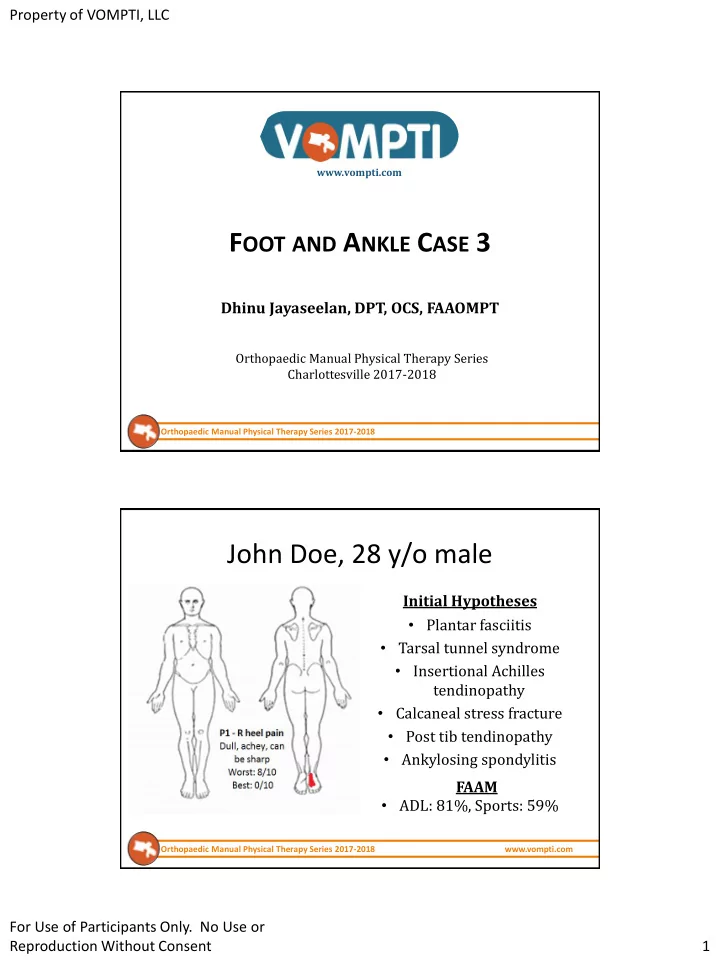
John Doe, 28 y/o male

Initial Hypotheses

  • Plantar fasciitis
  • Tarsal tunnel syndrome
  • Insertional Achilles

tendinopathy

  • Calcaneal stress fracture
  • Post tib tendinopathy
  • Ankylosing spondylitis
  • ADL: 81%, Sports: 59%

FAAM

slide-2
SLIDE 2

Property of VOMPTI, LLC For Use of Participants Only. No Use or Reproduction Without Consent 2

Orthopaedic Manual Physical Therapy Series 2017-2018 www.vompti.com

Outcome Measure Psychometrics

Foot and Ankle Ability Measure (FAAM) Foot Function Index (FFI) Foot Health Status Questionnaire (FHSQ) Items 21 ADL scale 8 sports subscale 23 items, 3 subscales: pain, disability, activity limitation 13 items, 4 subscales: pain, function, footwear, general foot health Scoring Higher scores = greater self-reported function Higher scores = greater disability Higher scores = greater self-reported function Reliability 0.89 (ADL) 0.87 (sports) 0.69 – 0.87 0.74 – 0.92 MDC 5.7 (ADL) 12.3 (sports) n/a n/a MCID 8 (ADL) 9 (sports) n/a 13 (pain) 7 (function) 2 (footwear) (General foot health unresponsive to change)

Martin RL, JOSPT 2007

Orthopaedic Manual Physical Therapy Series 2017-2018 www.vompti.com

Subjective Exam Asterisks

(Aggravating/easing factors, description/location of symptoms, behavior, mechanisms of injury)

28 y/o male, 1.5 yr history of plantar heel pain MOI After running first ½ marathon; notes no specific training program or history of running Aggravating activities First steps in am, after prolonged sitting at desk (1 hr), prolonged standing (> 1 hr), running Alleviating activities Stretching, not doing above Prior treatment MD prescribed OTC inserts and stretches after initial

  • nset, reported min/mod benefit

PMHx 2 inversion ankle sprains in high school (same side)

slide-3
SLIDE 3

Property of VOMPTI, LLC For Use of Participants Only. No Use or Reproduction Without Consent 3

Orthopaedic Manual Physical Therapy Series 2017-2018 www.vompti.com

Structure(s) at fault

  • Primary hypothesis after subjective: chronic plantar fasciitis
  • Differential (rank order): tarsal tunnel, post tib tendinopathy,

insertional AT, myofascial pain syndrome, lumbar radic

Joints in/refer to painful region Myofascial tissue in/refer to painful region Non-contractile tissue in/refer to painful region Neural tissue in/refer to painful region Other structures to be examined (non-MSK) Talocrural Subtalar Distal tib-fib Talonavicular Calcaneocuboid TMT joints Hip, SIJ, L-spine Achilles tendon Post tib tendon FHL, FDL Trigger point referral Plantar fascia Fat pad Retrocalcaneal bursa Deltoid, spring ligaments Tibial n. (medial calcaneal/plantar) L5,S1 Calcaneal fx? Ankylosing spondylitis?

Orthopaedic Manual Physical Therapy Series 2017-2018 www.vompti.com

Physical Exam Asterisks

(Special tests, movement/joint dysfunction, posture, palpation, etc)

28 y/o male, 1.5 yr history of plantar heel pain Posture Pes cavus bilaterally ROM Decr DF (worse with knee straight) and pronation Single leg heel raises L: 26 reps; R: 15 reps* Special tests (+) windlass test, (-) SLR/slump, Tinel’s Stability tests (-) Palpation TTP (+) R medial calcaneal tubercle and proximal ½ plantar fascia (thickness also noted)* Joint accessory motion Hypomobile R TCJ AP, STJ medial glide, midfoot throughout, 1st MTP AP and PA glides

slide-4
SLIDE 4

Property of VOMPTI, LLC For Use of Participants Only. No Use or Reproduction Without Consent 4

Orthopaedic Manual Physical Therapy Series 2017-2018 www.vompti.com

Rate your assessment of severity/irritability

Justify your assessment with examples from the subjective and/or objective exam

  • Severity:

None Min

Mod

Max

– Impacts ability to run or WB for durations, not disabling in functional tasks

  • Irritability: None

Min

Mod Max

– Symptoms brought on with prolonged activity reduced fairly rapidly

Stage and stability?

  • Acute

Subacute

Chronic

Acute on chronic

– 1.5 yr history, no recent mechanism or indicators of inflammatory processes

  • Stable

Improving Worsening Fluctuating Red flags?

– Symptoms generally the same, not better or worse, appears mechanical/MSK

Orthopaedic Manual Physical Therapy Series 2017-2018 www.vompti.com

  • Are the relationships between the areas on the body

chart, the interview, and physical exam consistent? “Do the features fit” a recognizable clinical pattern? If YES, what? Chronic plantar fasciitis

(plantar fasciosis, plantar fasciopathy)

  • Identify any potential risk factors (yellow, red flags,

non-MSK involvement, biopsychosocial) Frustration with lack of improvement?

slide-5
SLIDE 5

Property of VOMPTI, LLC For Use of Participants Only. No Use or Reproduction Without Consent 5

Orthopaedic Manual Physical Therapy Series 2017-2018 www.vompti.com Orthopaedic Manual Physical Therapy Series 2017-2018 www.vompti.com

Recommendations based on evidence published before Jan 2013

slide-6
SLIDE 6

Property of VOMPTI, LLC For Use of Participants Only. No Use or Reproduction Without Consent 6

Orthopaedic Manual Physical Therapy Series 2017-2018 www.vompti.com

Plantar Fasciitis

  • Background/Demographics

– Most common foot condition treated in health care, up to 2 million Americans / year – Affects athletic and non-athletic populations – Mean symptom duration: 13.3 – 14.1 months

  • Risk Factors:

– Limited ankle DF ROM (Odds Ratio: 23.3) – High BMI in non-athletic patients (OR: 5.6) – Work-related WB activities (OR: 3.6) – Running – Cavus foot, high arch

JOSPT 2014 CPG JBJS 2003 Riddle

Orthopaedic Manual Physical Therapy Series 2017-2018 www.vompti.com

Plantar Fasciitis

  • Subjective Report

– Pain in plantar aspect of heel – Worse with initial steps after prolonged inactivity or prolonged weight bearing – Precipitated by recent increase in WB activity

  • Objective Examination

– Tenderness at plantar fascia (medial calcaneal tubercle) – (+) Windlass test – (-) Tarsal tunnel/neurodynamic tests – Decr A/PROM ankle DF; 1st ray extension mobility

JOSPT 2014 CPG

slide-7
SLIDE 7

Property of VOMPTI, LLC For Use of Participants Only. No Use or Reproduction Without Consent 7

Orthopaedic Manual Physical Therapy Series 2017-2018 www.vompti.com

Additional Considerations

  • Patients with chronic PF

demonstrate the following:

(Fernandez-Lao, et al. 2016)

– Widespread and bilateral hypersensitivity – Lower Q of L – Increased thickness of the plantar fascia in the affected foot (+ correlation to symptoms Mahowald S 2011) – Increased fascial vascularity (+ correlation to symptoms Chen H 2013)

  • Imaging not typically

necessary, unless ruling

  • ut other conditions

Orthopaedic Manual Physical Therapy Series 2017-2018 www.vompti.com

Treatment Planning

  • What is your primary objective after intial eval?

– Education: anatomy, pathology, prognosis – Manual therapy: calf/PF STM, rearfoot mobilizations gr III-IV – Exercise prescription: self-stretching, neuro re-ed (load dispersion, facilitate mid/medial foot loading)

Impairments Functional Limitations Goals Pain Foot/ankle hypomobility Decr gastroc length Plantarflexion weakness Altered gait Inability to run Limited standing tolerance Normalize joint mobility No walking or running gait deviations Pain free return to run

slide-8
SLIDE 8

Property of VOMPTI, LLC For Use of Participants Only. No Use or Reproduction Without Consent 8

Orthopaedic Manual Physical Therapy Series 2017-2018 www.vompti.com

Anatomy / Pathophysiology

  • 3 dense bands of connective tissue
  • O: medial calcaneal tubercle
  • I: fans distally into base of proximal phalanx
  • Usually chronic/degenerative process related to

repetitive microtrauma

  • Histologic analysis: marked thickening/fibrosis of PF,

collagen necrosis, chondroid metaplasia, calcification

Orthopaedic Manual Physical Therapy Series 2017-2018 www.vompti.com

slide-9
SLIDE 9

Property of VOMPTI, LLC For Use of Participants Only. No Use or Reproduction Without Consent 9

Orthopaedic Manual Physical Therapy Series 2017-2018 www.vompti.com

Abnormalities Resulting from the Underpronated Foot:

  • Related to joint stiffness, decreased plantar fascia

extensibility, muscle tightness

  • Unable to dissipate forces or absorb shock (lacks

pronation)

  • Decreased distance between met heads and calcaneus
  • Plantarflexed 1st ray

Orthopaedic Manual Physical Therapy Series 2017-2018 www.vompti.com

Gait Implications

(Cavus foot, midfoot stiffness)

  • Plantar heel pain associated with: lower maximum

force beneath heel and medial forefoot, greater mid/forefoot contact time (Sullivan et al, Gait Posture 2015)

  • Gait cycle breakdown/ plantar fascia considerations:

– IC and LR: shock absorption

  • More lateral loading = less dampening of GRFs

– MS: pronation

  • Midfoot stiffness prevents ‘unlocking’ of transverse

tarsal segments – TS, PS: supinate, become rigid for toe off

  • PF 1st ray doesn’t extend as well
slide-10
SLIDE 10

Property of VOMPTI, LLC For Use of Participants Only. No Use or Reproduction Without Consent 10

Orthopaedic Manual Physical Therapy Series 2017-2018 www.vompti.com Orthopaedic Manual Physical Therapy Series 2017-2018 www.vompti.com

Physical Therapy Treatment

  • A lot of options…

– Joint mobilization/manipulation, soft tissue – Gastroc, soleus, plantar fascia stretching – Exercise

  • Pes planus – strengthen intrinsics, proximal segments;

mid/lateral loading v. medial overloading

  • Pes cavus – exercise emphasizes load dispersion, medial loading
  • v. lateral overloading

– Education – Orthotics/Inserts, Night splints? – Modalities: TDN? Ionto? LLLT? ESWT? Taping? Ultrasound?

slide-11
SLIDE 11

Property of VOMPTI, LLC For Use of Participants Only. No Use or Reproduction Without Consent 11

Orthopaedic Manual Physical Therapy Series 2017-2018 www.vompti.com

  • 6 visits over 4 weeks: MT + exercise v.

electrophysiological agents + exercise

  • Individuals with symptoms < 7.2 months were 4.2-8.5

times more likely to respond (depending on success criteria)

  • Age and BMI not significant predictors to success

Orthopaedic Manual Physical Therapy Series 2017-2018 www.vompti.com

  • 1248 articles screened, 8 RCTs included in analysis
  • 4 scored 6/10 or more on PEDro, others low quality
  • Manual therapy associated with improved outcomes in

pain and function compared to comparative group/control

  • MT: joint treatment, soft tissue, neural mobilization
slide-12
SLIDE 12

Property of VOMPTI, LLC For Use of Participants Only. No Use or Reproduction Without Consent 12

Orthopaedic Manual Physical Therapy Series 2017-2018 www.vompti.com

TCJ Distraction (thrust/non-thrust)

Orthopaedic Manual Physical Therapy Series 2017-2018 www.vompti.com

Talocrural AP Glide

slide-13
SLIDE 13

Property of VOMPTI, LLC For Use of Participants Only. No Use or Reproduction Without Consent 13

Orthopaedic Manual Physical Therapy Series 2017-2018 www.vompti.com

Subtalar Glides

(Lateral) (Medial)

Orthopaedic Manual Physical Therapy Series 2017-2018 www.vompti.com

Non-specific Midfoot Pronation/Supination Mobilization

(Pronation) (Supination) (Neutral)

slide-14
SLIDE 14

Property of VOMPTI, LLC For Use of Participants Only. No Use or Reproduction Without Consent 14

Orthopaedic Manual Physical Therapy Series 2017-2018 www.vompti.com

Plantar Glides with ML Rotation

Navicular on Talus, Cuboid on Calcaneus Medial Cuneiform on Navicular

Orthopaedic Manual Physical Therapy Series 2017-2018 www.vompti.com

Dorsal Cuboid Whip Manipulation

slide-15
SLIDE 15

Property of VOMPTI, LLC For Use of Participants Only. No Use or Reproduction Without Consent 15

Orthopaedic Manual Physical Therapy Series 2017-2018 www.vompti.com

1st MTP Plantar Glide

(indicated for limited extension)

Orthopaedic Manual Physical Therapy Series 2017-2018 www.vompti.com

Soft Tissue Mobilization

slide-16
SLIDE 16

Property of VOMPTI, LLC For Use of Participants Only. No Use or Reproduction Without Consent 16

Orthopaedic Manual Physical Therapy Series 2017-2018 www.vompti.com

“The angle of your hands guides your depth” – Jim B.

(Superficial) (Deep)

Orthopaedic Manual Physical Therapy Series 2017-2018 www.vompti.com

TrP Release

slide-17
SLIDE 17

Property of VOMPTI, LLC For Use of Participants Only. No Use or Reproduction Without Consent 17

Orthopaedic Manual Physical Therapy Series 2017-2018 www.vompti.com Orthopaedic Manual Physical Therapy Series 2017-2018 www.vompti.com

  • n = 82, mean symptom duration > 10 months
  • All subjects received pre-fab soft insoles (Spenco), 3

wk course of Celebrex, and an educational video on PF

  • PF stretching v. Achilles tendon stretching
  • At 8 weeks, PF stretching superior to WB achilles

stretching for pain, activity limitations, pt satisfaction

  • No sig. difference at 2 yr f/u
slide-18
SLIDE 18

Property of VOMPTI, LLC For Use of Participants Only. No Use or Reproduction Without Consent 18

Orthopaedic Manual Physical Therapy Series 2017-2018 www.vompti.com

1st MTP Extension and Ankle DF Mobilization with PF STM

Orthopaedic Manual Physical Therapy Series 2017-2018 www.vompti.com

  • Plantar fascia specific stretching v. strengthening

(single leg heel raises with towel under toes)

  • 3x12 rep max progression  10 rep max  8 rep max

every other day

  • FFI 29 points lower at 3 mo in strength group
  • No difference at 1, 6, 12 months
slide-19
SLIDE 19

Property of VOMPTI, LLC For Use of Participants Only. No Use or Reproduction Without Consent 19

Orthopaedic Manual Physical Therapy Series 2017-2018 www.vompti.com

Motor Control

(WB Through Medial Column)

Orthopaedic Manual Physical Therapy Series 2017-2018 www.vompti.com

Controlled Pronation/Supination

(Unstable Surface)

slide-20
SLIDE 20

Property of VOMPTI, LLC For Use of Participants Only. No Use or Reproduction Without Consent 20

Orthopaedic Manual Physical Therapy Series 2017-2018 www.vompti.com

Concentric Pronation, Eccentric Supination (with resistance)

Orthopaedic Manual Physical Therapy Series 2017-2018 www.vompti.com

  • What are you going to reassess at subsequent visits?

– VAS, pain with am steps, standing tolerance

PROGNOSIS/EXPECTATIONS

  • How do you expect to progress your treatment over

subsequent visits?

– Motor control to become more dynamic, higher grade mobilization/manip, self-mobilization HEP

Associated factors for expected outcome:

  • Favorable

– Typical clinical presentation, low symptom irritability

  • Unfavorable

– Chronicity of symptoms

Possible referrals:

– Orthotist for custom inserts? Ortho for injection?

slide-21
SLIDE 21

Property of VOMPTI, LLC For Use of Participants Only. No Use or Reproduction Without Consent 21

Orthopaedic Manual Physical Therapy Series 2017-2018 www.vompti.com

‘Gap’ in Knowledge

  • Article reviewed: Celik D, et al. Joint mobilization and stretching

exercise vs steroid injection in the treatment of plantar fasciitis: a randomized controlled trial. Foot Ankle Int. 2016;37(2):150-6.

  • Relevance to the clinical case: Both groups had significant

improvement in FAAM and VAS in short term (3, 6, 12 wk) with greater improvement noted in injection group. Improvements continued from wk 12 through 1 yr for MT group only.

Patient or Population Intervention Comparison Outcomes Patients with plantar fasciitis Manual therapy & exercise Injection Pain relief, functional status

Orthopaedic Manual Physical Therapy Series 2017-2018 www.vompti.com

Clinical Pattern

Subjective Objective

  • Plantar heel pain
  • Overuse/insidious

mechanism

  • Pain worse with first steps

in am

  • Functional limitations:

prolonged standing, running

  • TTP at medial calcaneal

tubercle

  • (+) Windlass test
  • Pes cavus
  • Joint stiffness and

muscle length impairments

  • (-) neurodynamics