C ASE P REPARATION : part 1 Most debates are won and lost in the - - PowerPoint PPT Presentation

c ase p reparation part 1
SMART_READER_LITE
LIVE PREVIEW

C ASE P REPARATION : part 1 Most debates are won and lost in the - - PowerPoint PPT Presentation

The big picture The issue and the definition The case approach C ASE P REPARATION : part 1 Most debates are won and lost in the preparation room. www.learndebating.com C ASE P REPARATION ( PART 1) The big picture The issue


slide-1
SLIDE 1

The ‘big picture’ The issue and the definition The case approach

CASE PREPARATION: part 1

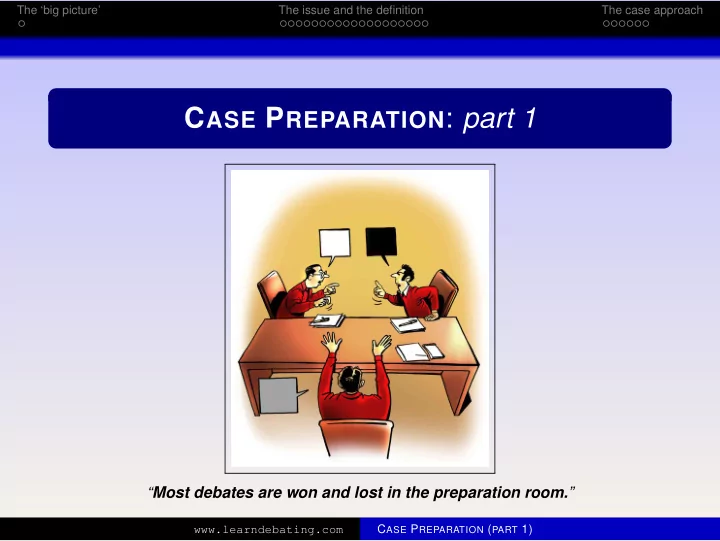
“Most debates are won and lost in the preparation room.”

www.learndebating.com CASE PREPARATION (PART 1)
slide-2
SLIDE 2

The ‘big picture’ The issue and the definition The case approach

Outline

1

The ‘big picture’

2

The issue and definition

3

The case approach

4

The arguments

5

The split

6

Writing speeches

7

Teamwork in preparation

www.learndebating.com CASE PREPARATION (PART 1)

slide-3
SLIDE 3

The ‘big picture’ The issue and the definition The case approach

Outline

1

The ‘big picture’

2

The issue and definition

3

The case approach

4

The arguments

5

The split

6

Writing speeches

7

Teamwork in preparation

www.learndebating.com CASE PREPARATION (PART 1)

slide-4
SLIDE 4

The ‘big picture’ The issue and the definition The case approach

The ‘big picture’

To win a debate, you need to do two things. . .

1

Show why your side of the motion is true. This is what these slides are about. It involves:

Defining the motion, Developing arguments, in a case approach, and Dividing arguments between speakers: the split.

2

Show why your opposition’s reasons are wrong.

www.learndebating.com CASE PREPARATION (PART 1)

slide-5
SLIDE 5

The ‘big picture’ The issue and the definition The case approach

The ‘big picture’

To win a debate, you need to do two things. . .

1

Show why your side of the motion is true. This is what these slides are about. It involves:

Defining the motion, Developing arguments, in a case approach, and Dividing arguments between speakers: the split.

2

Show why your opposition’s reasons are wrong.

www.learndebating.com CASE PREPARATION (PART 1)

slide-6
SLIDE 6

The ‘big picture’ The issue and the definition The case approach

The ‘big picture’

To win a debate, you need to do two things. . .

1

Show why your side of the motion is true. This is what these slides are about. It involves:

Defining the motion, Developing arguments, in a case approach, and Dividing arguments between speakers: the split.

2

Show why your opposition’s reasons are wrong.

www.learndebating.com CASE PREPARATION (PART 1)

slide-7
SLIDE 7

The ‘big picture’ The issue and the definition The case approach

The ‘big picture’

To win a debate, you need to do two things. . .

1

Show why your side of the motion is true. This is what these slides are about. It involves:

Defining the motion, Developing arguments, in a case approach, and Dividing arguments between speakers: the split.

2

Show why your opposition’s reasons are wrong.

www.learndebating.com CASE PREPARATION (PART 1)

slide-8
SLIDE 8

The ‘big picture’ The issue and the definition The case approach

The ‘big picture’

To win a debate, you need to do two things. . .

1

Show why your side of the motion is true. This is what these slides are about. It involves:

Defining the motion, Developing arguments, in a case approach, and Dividing arguments between speakers: the split.

2

Show why your opposition’s reasons are wrong.

www.learndebating.com CASE PREPARATION (PART 1)

slide-9
SLIDE 9

The ‘big picture’ The issue and the definition The case approach

The ‘big picture’

To win a debate, you need to do two things. . .

1

Show why your side of the motion is true. This is what these slides are about. It involves:

Defining the motion, Developing arguments, in a case approach, and Dividing arguments between speakers: the split.

2

Show why your opposition’s reasons are wrong.

www.learndebating.com CASE PREPARATION (PART 1)

slide-10
SLIDE 10

The ‘big picture’ The issue and the definition The case approach

The ‘big picture’

To win a debate, you need to do two things. . .

1

Show why your side of the motion is true. This is what these slides are about. It involves:

Defining the motion, Developing arguments, in a case approach, and Dividing arguments between speakers: the split.

2

Show why your opposition’s reasons are wrong.

www.learndebating.com CASE PREPARATION (PART 1)

slide-11
SLIDE 11

The ‘big picture’ The issue and the definition The case approach

Outline

1

The ‘big picture’

2

The issue and definition

3

The case approach

4

The arguments

5

The split

6

Writing speeches

7

Teamwork in preparation

www.learndebating.com CASE PREPARATION (PART 1)

slide-12
SLIDE 12

The ‘big picture’ The issue and the definition The case approach

Outline

1

The ‘big picture’

2

The issue and definition

3

The case approach

4

The arguments

5

The split

6

Writing speeches

7

Teamwork in preparation

www.learndebating.com CASE PREPARATION (PART 1)

slide-13
SLIDE 13

The ‘big picture’ The issue and the definition The case approach Finding the issue

Some examples and some principles. . .

Where there is a clear issue, debate that issue.

e.g. THIS HOUSE WOULD BAN SMOKING

Where the issue is not clear, choose the most obvious, most relevant, most debatable issue.

e.g. THIS HOUSE BELIEVES THAT IT’S NOT WHETHER YOU WIN OR LOSE BUT HOW YOU PLAY THE GAME

Where there is no obvious issue, choose an issue to which the motion can relate.

e.g. THIS HOUSE BELIEVES THAT BIG IS BEAUTIFUL

www.learndebating.com CASE PREPARATION (PART 1)

slide-14
SLIDE 14

The ‘big picture’ The issue and the definition The case approach Finding the issue

Some examples and some principles. . .

Where there is a clear issue, debate that issue.

e.g. THIS HOUSE WOULD BAN SMOKING

Where the issue is not clear, choose the most obvious, most relevant, most debatable issue.

e.g. THIS HOUSE BELIEVES THAT IT’S NOT WHETHER YOU WIN OR LOSE BUT HOW YOU PLAY THE GAME

Where there is no obvious issue, choose an issue to which the motion can relate.

e.g. THIS HOUSE BELIEVES THAT BIG IS BEAUTIFUL

www.learndebating.com CASE PREPARATION (PART 1)

slide-15
SLIDE 15

The ‘big picture’ The issue and the definition The case approach Finding the issue

Some examples and some principles. . .

Where there is a clear issue, debate that issue.

e.g. THIS HOUSE WOULD BAN SMOKING

Where the issue is not clear, choose the most obvious, most relevant, most debatable issue.

e.g. THIS HOUSE BELIEVES THAT IT’S NOT WHETHER YOU WIN OR LOSE BUT HOW YOU PLAY THE GAME

Where there is no obvious issue, choose an issue to which the motion can relate.

e.g. THIS HOUSE BELIEVES THAT BIG IS BEAUTIFUL

www.learndebating.com CASE PREPARATION (PART 1)

slide-16
SLIDE 16

The ‘big picture’ The issue and the definition The case approach Finding the issue

Some examples and some principles. . .

Where there is a clear issue, debate that issue.

e.g. THIS HOUSE WOULD BAN SMOKING

Where the issue is not clear, choose the most obvious, most relevant, most debatable issue.

e.g. THIS HOUSE BELIEVES THAT IT’S NOT WHETHER YOU WIN OR LOSE BUT HOW YOU PLAY THE GAME

Where there is no obvious issue, choose an issue to which the motion can relate.

e.g. THIS HOUSE BELIEVES THAT BIG IS BEAUTIFUL

www.learndebating.com CASE PREPARATION (PART 1)

slide-17
SLIDE 17

The ‘big picture’ The issue and the definition The case approach The definition

What is ‘the definition’?

The definition is. . . . . . a brief statement about what your team thinks the words

  • f the motion mean, for the purposes of this debate.

Both teams need to prepare a definition. However, only the Proposition team needs to present its definition. The Opposition team only presents its definition if it disagrees with the Proposition’s definition. . . . . . and this should not happen! (More on definitional disagreements later. . . )

www.learndebating.com CASE PREPARATION (PART 1)

slide-18
SLIDE 18

The ‘big picture’ The issue and the definition The case approach The definition

What is ‘the definition’?

The definition is. . . . . . a brief statement about what your team thinks the words

  • f the motion mean, for the purposes of this debate.

Both teams need to prepare a definition. However, only the Proposition team needs to present its definition. The Opposition team only presents its definition if it disagrees with the Proposition’s definition. . . . . . and this should not happen! (More on definitional disagreements later. . . )

www.learndebating.com CASE PREPARATION (PART 1)

slide-19
SLIDE 19

The ‘big picture’ The issue and the definition The case approach The definition

What is ‘the definition’?

The definition is. . . . . . a brief statement about what your team thinks the words

  • f the motion mean, for the purposes of this debate.

Both teams need to prepare a definition. However, only the Proposition team needs to present its definition. The Opposition team only presents its definition if it disagrees with the Proposition’s definition. . . . . . and this should not happen! (More on definitional disagreements later. . . )

www.learndebating.com CASE PREPARATION (PART 1)

slide-20
SLIDE 20

The ‘big picture’ The issue and the definition The case approach The definition

What is ‘the definition’?

The definition is. . . . . . a brief statement about what your team thinks the words

  • f the motion mean, for the purposes of this debate.

Both teams need to prepare a definition. However, only the Proposition team needs to present its definition. The Opposition team only presents its definition if it disagrees with the Proposition’s definition. . . . . . and this should not happen! (More on definitional disagreements later. . . )

www.learndebating.com CASE PREPARATION (PART 1)

slide-21
SLIDE 21

The ‘big picture’ The issue and the definition The case approach The definition

What is ‘the definition’?

The definition is. . . . . . a brief statement about what your team thinks the words

  • f the motion mean, for the purposes of this debate.

Both teams need to prepare a definition. However, only the Proposition team needs to present its definition. The Opposition team only presents its definition if it disagrees with the Proposition’s definition. . . . . . and this should not happen! (More on definitional disagreements later. . . )

www.learndebating.com CASE PREPARATION (PART 1)

slide-22
SLIDE 22

The ‘big picture’ The issue and the definition The case approach The definition

What is ‘the definition’?

The definition is. . . . . . a brief statement about what your team thinks the words

  • f the motion mean, for the purposes of this debate.

Both teams need to prepare a definition. However, only the Proposition team needs to present its definition. The Opposition team only presents its definition if it disagrees with the Proposition’s definition. . . . . . and this should not happen! (More on definitional disagreements later. . . )

www.learndebating.com CASE PREPARATION (PART 1)

slide-23
SLIDE 23

The ‘big picture’ The issue and the definition The case approach The definition

What is ‘the definition’?

The definition is. . . . . . a brief statement about what your team thinks the words

  • f the motion mean, for the purposes of this debate.

Both teams need to prepare a definition. However, only the Proposition team needs to present its definition. The Opposition team only presents its definition if it disagrees with the Proposition’s definition. . . . . . and this should not happen! (More on definitional disagreements later. . . )

www.learndebating.com CASE PREPARATION (PART 1)

slide-24
SLIDE 24

The ‘big picture’ The issue and the definition The case approach The definition

What is ‘the definition’?

The definition is. . . . . . a brief statement about what your team thinks the words

  • f the motion mean, for the purposes of this debate.

Both teams need to prepare a definition. However, only the Proposition team needs to present its definition. The Opposition team only presents its definition if it disagrees with the Proposition’s definition. . . . . . and this should not happen! (More on definitional disagreements later. . . )

www.learndebating.com CASE PREPARATION (PART 1)

slide-25
SLIDE 25

The ‘big picture’ The issue and the definition The case approach The definition

Defining a motion: some pointers

Define terms in the motion, not every single word.

e.g. THIS HOUSE WOULD PUNISH FORMER NATIONAL LEADERS FOR FOREIGN CRIMES

The Proposition probably needs only to define the highlighted terms. Do not define metaphorical terms literally.

e.g. THIS HOUSE BELIEVES THAT THE CARROT IS BETTER THAN THE STICK

Use your own words, to keep things simple. Consider using brief examples to illustrate potentially ambiguous aspects of your definition.

e.g. THIS HOUSE WOULD STAND UP TO CHINA

www.learndebating.com CASE PREPARATION (PART 1)

slide-26
SLIDE 26

The ‘big picture’ The issue and the definition The case approach The definition

Defining a motion: some pointers

Define terms in the motion, not every single word.

e.g. THIS HOUSE WOULD PUNISH FORMER NATIONAL LEADERS FOR FOREIGN CRIMES

The Proposition probably needs only to define the highlighted terms. Do not define metaphorical terms literally.

e.g. THIS HOUSE BELIEVES THAT THE CARROT IS BETTER THAN THE STICK

Use your own words, to keep things simple. Consider using brief examples to illustrate potentially ambiguous aspects of your definition.

e.g. THIS HOUSE WOULD STAND UP TO CHINA

www.learndebating.com CASE PREPARATION (PART 1)

slide-27
SLIDE 27

The ‘big picture’ The issue and the definition The case approach The definition

Defining a motion: some pointers

Define terms in the motion, not every single word.

e.g. THIS HOUSE WOULD PUNISH FORMER NATIONAL LEADERS FOR FOREIGN CRIMES

The Proposition probably needs only to define the highlighted terms. Do not define metaphorical terms literally.

e.g. THIS HOUSE BELIEVES THAT THE CARROT IS BETTER THAN THE STICK

Use your own words, to keep things simple. Consider using brief examples to illustrate potentially ambiguous aspects of your definition.

e.g. THIS HOUSE WOULD STAND UP TO CHINA

www.learndebating.com CASE PREPARATION (PART 1)

slide-28
SLIDE 28

The ‘big picture’ The issue and the definition The case approach The definition

Defining a motion: some pointers

Define terms in the motion, not every single word.

e.g. THIS HOUSE WOULD PUNISH FORMER NATIONAL LEADERS FOR FOREIGN CRIMES

The Proposition probably needs only to define the highlighted terms. Do not define metaphorical terms literally.

e.g. THIS HOUSE BELIEVES THAT THE CARROT IS BETTER THAN THE STICK

Use your own words, to keep things simple. Consider using brief examples to illustrate potentially ambiguous aspects of your definition.

e.g. THIS HOUSE WOULD STAND UP TO CHINA

www.learndebating.com CASE PREPARATION (PART 1)

slide-29
SLIDE 29

The ‘big picture’ The issue and the definition The case approach The definition

Defining a motion: some pointers

Define terms in the motion, not every single word.

e.g. THIS HOUSE WOULD PUNISH FORMER NATIONAL LEADERS FOR FOREIGN CRIMES

The Proposition probably needs only to define the highlighted terms. Do not define metaphorical terms literally.

e.g. THIS HOUSE BELIEVES THAT THE CARROT IS BETTER THAN THE STICK

Use your own words, to keep things simple. Consider using brief examples to illustrate potentially ambiguous aspects of your definition.

e.g. THIS HOUSE WOULD STAND UP TO CHINA

www.learndebating.com CASE PREPARATION (PART 1)

slide-30
SLIDE 30

The ‘big picture’ The issue and the definition The case approach The definition

Defining a motion: some pointers

Define terms in the motion, not every single word.

e.g. THIS HOUSE WOULD PUNISH FORMER NATIONAL LEADERS FOR FOREIGN CRIMES

The Proposition probably needs only to define the highlighted terms. Do not define metaphorical terms literally.

e.g. THIS HOUSE BELIEVES THAT THE CARROT IS BETTER THAN THE STICK

Use your own words, to keep things simple. Consider using brief examples to illustrate potentially ambiguous aspects of your definition.

e.g. THIS HOUSE WOULD STAND UP TO CHINA

www.learndebating.com CASE PREPARATION (PART 1)

slide-31
SLIDE 31

The ‘big picture’ The issue and the definition The case approach The definition

Defining a motion: some pointers

Define terms in the motion, not every single word.

e.g. THIS HOUSE WOULD PUNISH FORMER NATIONAL LEADERS FOR FOREIGN CRIMES

The Proposition probably needs only to define the highlighted terms. Do not define metaphorical terms literally.

e.g. THIS HOUSE BELIEVES THAT THE CARROT IS BETTER THAN THE STICK

Use your own words, to keep things simple. Consider using brief examples to illustrate potentially ambiguous aspects of your definition.

e.g. THIS HOUSE WOULD STAND UP TO CHINA

www.learndebating.com CASE PREPARATION (PART 1)

slide-32
SLIDE 32

The ‘big picture’ The issue and the definition The case approach The definition

Defining a motion: some pointers

Define terms in the motion, not every single word.

e.g. THIS HOUSE WOULD PUNISH FORMER NATIONAL LEADERS FOR FOREIGN CRIMES

The Proposition probably needs only to define the highlighted terms. Do not define metaphorical terms literally.

e.g. THIS HOUSE BELIEVES THAT THE CARROT IS BETTER THAN THE STICK

Use your own words, to keep things simple. Consider using brief examples to illustrate potentially ambiguous aspects of your definition.

e.g. THIS HOUSE WOULD STAND UP TO CHINA

www.learndebating.com CASE PREPARATION (PART 1)

slide-33
SLIDE 33

The ‘big picture’ The issue and the definition The case approach The definition

Defining a motion: some pointers

Define terms in the motion, not every single word.

e.g. THIS HOUSE WOULD PUNISH FORMER NATIONAL LEADERS FOR FOREIGN CRIMES

The Proposition probably needs only to define the highlighted terms. Do not define metaphorical terms literally.

e.g. THIS HOUSE BELIEVES THAT THE CARROT IS BETTER THAN THE STICK

Use your own words, to keep things simple. Consider using brief examples to illustrate potentially ambiguous aspects of your definition.

e.g. THIS HOUSE WOULD STAND UP TO CHINA

www.learndebating.com CASE PREPARATION (PART 1)

slide-34
SLIDE 34

The ‘big picture’ The issue and the definition The case approach The definition

Defining a motion: some pointers

Define terms in the motion, not every single word.

e.g. THIS HOUSE WOULD PUNISH FORMER NATIONAL LEADERS FOR FOREIGN CRIMES

The Proposition probably needs only to define the highlighted terms. Do not define metaphorical terms literally.

e.g. THIS HOUSE BELIEVES THAT THE CARROT IS BETTER THAN THE STICK

Use your own words, to keep things simple. Consider using brief examples to illustrate potentially ambiguous aspects of your definition.

e.g. THIS HOUSE WOULD STAND UP TO CHINA

www.learndebating.com CASE PREPARATION (PART 1)

slide-35
SLIDE 35

The ‘big picture’ The issue and the definition The case approach The definition

Limiting motions by definition

The definition may specify the scope of the debate.

e.g. THIS HOUSE BELIEVES THAT CRIMINAL SENTENCES ARE TOO HARSH

This motion may (legitimately) refer to: Your local country/region, or The world as a whole. However, two forms of limitation are banned: ‘Time setting’: Limiting a general motion to some other time.

e.g. “Criminal sentences were too harsh in the 1800s.”

‘Place setting’: Limiting a general motion to some other place.

e.g. “Criminal sentences are too harsh in Madagascar.”

www.learndebating.com CASE PREPARATION (PART 1)

slide-36
SLIDE 36

The ‘big picture’ The issue and the definition The case approach The definition

Limiting motions by definition

The definition may specify the scope of the debate.

e.g. THIS HOUSE BELIEVES THAT CRIMINAL SENTENCES ARE TOO HARSH

This motion may (legitimately) refer to: Your local country/region, or The world as a whole. However, two forms of limitation are banned: ‘Time setting’: Limiting a general motion to some other time.

e.g. “Criminal sentences were too harsh in the 1800s.”

‘Place setting’: Limiting a general motion to some other place.

e.g. “Criminal sentences are too harsh in Madagascar.”

www.learndebating.com CASE PREPARATION (PART 1)

slide-37
SLIDE 37

The ‘big picture’ The issue and the definition The case approach The definition

Limiting motions by definition

The definition may specify the scope of the debate.

e.g. THIS HOUSE BELIEVES THAT CRIMINAL SENTENCES ARE TOO HARSH

This motion may (legitimately) refer to: Your local country/region, or The world as a whole. However, two forms of limitation are banned: ‘Time setting’: Limiting a general motion to some other time.

e.g. “Criminal sentences were too harsh in the 1800s.”

‘Place setting’: Limiting a general motion to some other place.

e.g. “Criminal sentences are too harsh in Madagascar.”

www.learndebating.com CASE PREPARATION (PART 1)

slide-38
SLIDE 38

The ‘big picture’ The issue and the definition The case approach The definition

Limiting motions by definition

The definition may specify the scope of the debate.

e.g. THIS HOUSE BELIEVES THAT CRIMINAL SENTENCES ARE TOO HARSH

This motion may (legitimately) refer to: Your local country/region, or The world as a whole. However, two forms of limitation are banned: ‘Time setting’: Limiting a general motion to some other time.

e.g. “Criminal sentences were too harsh in the 1800s.”

‘Place setting’: Limiting a general motion to some other place.

e.g. “Criminal sentences are too harsh in Madagascar.”

www.learndebating.com CASE PREPARATION (PART 1)

slide-39
SLIDE 39

The ‘big picture’ The issue and the definition The case approach The definition

Limiting motions by definition

The definition may specify the scope of the debate.

e.g. THIS HOUSE BELIEVES THAT CRIMINAL SENTENCES ARE TOO HARSH

This motion may (legitimately) refer to: Your local country/region, or The world as a whole. However, two forms of limitation are banned: ‘Time setting’: Limiting a general motion to some other time.

e.g. “Criminal sentences were too harsh in the 1800s.”

‘Place setting’: Limiting a general motion to some other place.

e.g. “Criminal sentences are too harsh in Madagascar.”

www.learndebating.com CASE PREPARATION (PART 1)

slide-40
SLIDE 40

The ‘big picture’ The issue and the definition The case approach The definition

Above all, keep the definition neutral!

The definition must be neutral: fair to both teams. You cannot define the motion to. . . Argue something that is true by logic (a ‘tautology’).

e.g.

THIS HOUSE WOULD BREAK A BAD LAW

“A ‘bad law’ is ‘a law that is impossible to obey’.”

Argue something that your opposition cannot reasonably oppose (a ‘truism’).

e.g.

THIS HOUSE WOULD PAY MORE ATTENTION TO THE ENVIRONMENT

“‘The environment’ means ‘the political, economic and social situation’.”

Argue something very different to the plain meaning of the motion.

e.g.

THIS HOUSE WOULD ALLOW CLONING

“By ‘cloning’, we mean ‘copying of CDs and DVDs’.”

www.learndebating.com CASE PREPARATION (PART 1)

slide-41
SLIDE 41

The ‘big picture’ The issue and the definition The case approach The definition

Above all, keep the definition neutral!

The definition must be neutral: fair to both teams. You cannot define the motion to. . . Argue something that is true by logic (a ‘tautology’).

e.g.

THIS HOUSE WOULD BREAK A BAD LAW

“A ‘bad law’ is ‘a law that is impossible to obey’.”

Argue something that your opposition cannot reasonably oppose (a ‘truism’).

e.g.

THIS HOUSE WOULD PAY MORE ATTENTION TO THE ENVIRONMENT

“‘The environment’ means ‘the political, economic and social situation’.”

Argue something very different to the plain meaning of the motion.

e.g.

THIS HOUSE WOULD ALLOW CLONING

“By ‘cloning’, we mean ‘copying of CDs and DVDs’.”

www.learndebating.com CASE PREPARATION (PART 1)

slide-42
SLIDE 42

The ‘big picture’ The issue and the definition The case approach The definition

Above all, keep the definition neutral!

The definition must be neutral: fair to both teams. You cannot define the motion to. . . Argue something that is true by logic (a ‘tautology’).

e.g.

THIS HOUSE WOULD BREAK A BAD LAW

“A ‘bad law’ is ‘a law that is impossible to obey’.”

Argue something that your opposition cannot reasonably oppose (a ‘truism’).

e.g.

THIS HOUSE WOULD PAY MORE ATTENTION TO THE ENVIRONMENT

“‘The environment’ means ‘the political, economic and social situation’.”

Argue something very different to the plain meaning of the motion.

e.g.

THIS HOUSE WOULD ALLOW CLONING

“By ‘cloning’, we mean ‘copying of CDs and DVDs’.”

www.learndebating.com CASE PREPARATION (PART 1)

slide-43
SLIDE 43

The ‘big picture’ The issue and the definition The case approach The definition

Above all, keep the definition neutral!

The definition must be neutral: fair to both teams. You cannot define the motion to. . . Argue something that is true by logic (a ‘tautology’).

e.g.

THIS HOUSE WOULD BREAK A BAD LAW

“A ‘bad law’ is ‘a law that is impossible to obey’.”

Argue something that your opposition cannot reasonably oppose (a ‘truism’).

e.g.

THIS HOUSE WOULD PAY MORE ATTENTION TO THE ENVIRONMENT

“‘The environment’ means ‘the political, economic and social situation’.”

Argue something very different to the plain meaning of the motion.

e.g.

THIS HOUSE WOULD ALLOW CLONING

“By ‘cloning’, we mean ‘copying of CDs and DVDs’.”

www.learndebating.com CASE PREPARATION (PART 1)

slide-44
SLIDE 44

The ‘big picture’ The issue and the definition The case approach The definition

Above all, keep the definition neutral!

The definition must be neutral: fair to both teams. You cannot define the motion to. . . Argue something that is true by logic (a ‘tautology’).

e.g.

THIS HOUSE WOULD BREAK A BAD LAW

“A ‘bad law’ is ‘a law that is impossible to obey’.”

Argue something that your opposition cannot reasonably oppose (a ‘truism’).

e.g.

THIS HOUSE WOULD PAY MORE ATTENTION TO THE ENVIRONMENT

“‘The environment’ means ‘the political, economic and social situation’.”

Argue something very different to the plain meaning of the motion.

e.g.

THIS HOUSE WOULD ALLOW CLONING

“By ‘cloning’, we mean ‘copying of CDs and DVDs’.”

www.learndebating.com CASE PREPARATION (PART 1)

slide-45
SLIDE 45

The ‘big picture’ The issue and the definition The case approach The definition

Above all, keep the definition neutral!

The definition must be neutral: fair to both teams. You cannot define the motion to. . . Argue something that is true by logic (a ‘tautology’).

e.g.

THIS HOUSE WOULD BREAK A BAD LAW

“A ‘bad law’ is ‘a law that is impossible to obey’.”

Argue something that your opposition cannot reasonably oppose (a ‘truism’).

e.g.

THIS HOUSE WOULD PAY MORE ATTENTION TO THE ENVIRONMENT

“‘The environment’ means ‘the political, economic and social situation’.”

Argue something very different to the plain meaning of the motion.

e.g.

THIS HOUSE WOULD ALLOW CLONING

“By ‘cloning’, we mean ‘copying of CDs and DVDs’.”

www.learndebating.com CASE PREPARATION (PART 1)

slide-46
SLIDE 46

The ‘big picture’ The issue and the definition The case approach The definition

Above all, keep the definition neutral!

The definition must be neutral: fair to both teams. You cannot define the motion to. . . Argue something that is true by logic (a ‘tautology’).

e.g.

THIS HOUSE WOULD BREAK A BAD LAW

“A ‘bad law’ is ‘a law that is impossible to obey’.”

Argue something that your opposition cannot reasonably oppose (a ‘truism’).

e.g.

THIS HOUSE WOULD PAY MORE ATTENTION TO THE ENVIRONMENT

“‘The environment’ means ‘the political, economic and social situation’.”

Argue something very different to the plain meaning of the motion.

e.g.

THIS HOUSE WOULD ALLOW CLONING

“By ‘cloning’, we mean ‘copying of CDs and DVDs’.”

www.learndebating.com CASE PREPARATION (PART 1)

slide-47
SLIDE 47

The ‘big picture’ The issue and the definition The case approach The definition

Above all, keep the definition neutral!

The definition must be neutral: fair to both teams. You cannot define the motion to. . . Argue something that is true by logic (a ‘tautology’).

e.g.

THIS HOUSE WOULD BREAK A BAD LAW

“A ‘bad law’ is ‘a law that is impossible to obey’.”

Argue something that your opposition cannot reasonably oppose (a ‘truism’).

e.g.

THIS HOUSE WOULD PAY MORE ATTENTION TO THE ENVIRONMENT

“‘The environment’ means ‘the political, economic and social situation’.”

Argue something very different to the plain meaning of the motion.

e.g.

THIS HOUSE WOULD ALLOW CLONING

“By ‘cloning’, we mean ‘copying of CDs and DVDs’.”

www.learndebating.com CASE PREPARATION (PART 1)

slide-48
SLIDE 48

The ‘big picture’ The issue and the definition The case approach The definition

Above all, keep the definition neutral!

The definition must be neutral: fair to both teams. You cannot define the motion to. . . Argue something that is true by logic (a ‘tautology’).

e.g.

THIS HOUSE WOULD BREAK A BAD LAW

“A ‘bad law’ is ‘a law that is impossible to obey’.”

Argue something that your opposition cannot reasonably oppose (a ‘truism’).

e.g.

THIS HOUSE WOULD PAY MORE ATTENTION TO THE ENVIRONMENT

“‘The environment’ means ‘the political, economic and social situation’.”

Argue something very different to the plain meaning of the motion.

e.g.

THIS HOUSE WOULD ALLOW CLONING

“By ‘cloning’, we mean ‘copying of CDs and DVDs’.”

www.learndebating.com CASE PREPARATION (PART 1)

slide-49
SLIDE 49

The ‘big picture’ The issue and the definition The case approach The definition

Above all, keep the definition neutral!

The definition must be neutral: fair to both teams. You cannot define the motion to. . . Argue something that is true by logic (a ‘tautology’).

e.g.

THIS HOUSE WOULD BREAK A BAD LAW

“A ‘bad law’ is ‘a law that is impossible to obey’.”

Argue something that your opposition cannot reasonably oppose (a ‘truism’).

e.g.

THIS HOUSE WOULD PAY MORE ATTENTION TO THE ENVIRONMENT

“‘The environment’ means ‘the political, economic and social situation’.”

Argue something very different to the plain meaning of the motion.

e.g.

THIS HOUSE WOULD ALLOW CLONING

“By ‘cloning’, we mean ‘copying of CDs and DVDs’.”

www.learndebating.com CASE PREPARATION (PART 1)

slide-50
SLIDE 50

The ‘big picture’ The issue and the definition The case approach The definition

Above all, keep the definition neutral!

The definition must be neutral: fair to both teams. You cannot define the motion to. . . Argue something that is true by logic (a ‘tautology’).

e.g.

THIS HOUSE WOULD BREAK A BAD LAW

“A ‘bad law’ is ‘a law that is impossible to obey’.”

Argue something that your opposition cannot reasonably oppose (a ‘truism’).

e.g.

THIS HOUSE WOULD PAY MORE ATTENTION TO THE ENVIRONMENT

“‘The environment’ means ‘the political, economic and social situation’.”

Argue something very different to the plain meaning of the motion.

e.g.

THIS HOUSE WOULD ALLOW CLONING

“By ‘cloning’, we mean ‘copying of CDs and DVDs’.”

www.learndebating.com CASE PREPARATION (PART 1)

slide-51
SLIDE 51

The ‘big picture’ The issue and the definition The case approach The right of definition

A bit of a technicality, but. . .

Different debating competitions use different rules. There are two alternative rules about when a Proposition’s definition is

  • reasonable. . .

The Proposition has an exclusive right of definition.

The Proposition’s definition must be: Reasonable, and Reasonably close to the plain meaning of the motion.

The Proposition has no exclusive right of definition.

If the teams disagree on the definition (discussed later), they may legitimately compete to persuade the judge about whose definition is: More reasonable, and Closer to the plain meaning of the motion.

The exclusive right is more common. You should find out which rule applies for your competition!

www.learndebating.com CASE PREPARATION (PART 1)

slide-52
SLIDE 52

The ‘big picture’ The issue and the definition The case approach The right of definition

A bit of a technicality, but. . .

Different debating competitions use different rules. There are two alternative rules about when a Proposition’s definition is

  • reasonable. . .

The Proposition has an exclusive right of definition.

The Proposition’s definition must be: Reasonable, and Reasonably close to the plain meaning of the motion.

The Proposition has no exclusive right of definition.

If the teams disagree on the definition (discussed later), they may legitimately compete to persuade the judge about whose definition is: More reasonable, and Closer to the plain meaning of the motion.

The exclusive right is more common. You should find out which rule applies for your competition!

www.learndebating.com CASE PREPARATION (PART 1)

slide-53
SLIDE 53

The ‘big picture’ The issue and the definition The case approach The right of definition

A bit of a technicality, but. . .

Different debating competitions use different rules. There are two alternative rules about when a Proposition’s definition is

  • reasonable. . .

The Proposition has an exclusive right of definition.

The Proposition’s definition must be: Reasonable, and Reasonably close to the plain meaning of the motion.

The Proposition has no exclusive right of definition.

If the teams disagree on the definition (discussed later), they may legitimately compete to persuade the judge about whose definition is: More reasonable, and Closer to the plain meaning of the motion.

The exclusive right is more common. You should find out which rule applies for your competition!

www.learndebating.com CASE PREPARATION (PART 1)

slide-54
SLIDE 54

The ‘big picture’ The issue and the definition The case approach The right of definition

A bit of a technicality, but. . .

Different debating competitions use different rules. There are two alternative rules about when a Proposition’s definition is

  • reasonable. . .

The Proposition has an exclusive right of definition.

The Proposition’s definition must be: Reasonable, and Reasonably close to the plain meaning of the motion.

The Proposition has no exclusive right of definition.

If the teams disagree on the definition (discussed later), they may legitimately compete to persuade the judge about whose definition is: More reasonable, and Closer to the plain meaning of the motion.

The exclusive right is more common. You should find out which rule applies for your competition!

www.learndebating.com CASE PREPARATION (PART 1)

slide-55
SLIDE 55

The ‘big picture’ The issue and the definition The case approach The right of definition

A bit of a technicality, but. . .

Different debating competitions use different rules. There are two alternative rules about when a Proposition’s definition is

  • reasonable. . .

The Proposition has an exclusive right of definition.

The Proposition’s definition must be: Reasonable, and Reasonably close to the plain meaning of the motion.

The Proposition has no exclusive right of definition.

If the teams disagree on the definition (discussed later), they may legitimately compete to persuade the judge about whose definition is: More reasonable, and Closer to the plain meaning of the motion.

The exclusive right is more common. You should find out which rule applies for your competition!

www.learndebating.com CASE PREPARATION (PART 1)

slide-56
SLIDE 56

The ‘big picture’ The issue and the definition The case approach The right of definition

A bit of a technicality, but. . .

Different debating competitions use different rules. There are two alternative rules about when a Proposition’s definition is

  • reasonable. . .

The Proposition has an exclusive right of definition.

The Proposition’s definition must be: Reasonable, and Reasonably close to the plain meaning of the motion.

The Proposition has no exclusive right of definition.

If the teams disagree on the definition (discussed later), they may legitimately compete to persuade the judge about whose definition is: More reasonable, and Closer to the plain meaning of the motion.

The exclusive right is more common. You should find out which rule applies for your competition!

www.learndebating.com CASE PREPARATION (PART 1)

slide-57
SLIDE 57

The ‘big picture’ The issue and the definition The case approach Triggers

The concept of ‘triggers’

‘Triggers’ are words or concepts that often occur in motions. They ‘trigger’ familiar ways of thinking about the issue. They also help with the case approach (covered shortly). We consider. . . Triggers for what your team needs to show; Triggers for the degree to which you show it; Other triggers.

www.learndebating.com CASE PREPARATION (PART 1)

slide-58
SLIDE 58

The ‘big picture’ The issue and the definition The case approach Triggers

The concept of ‘triggers’

‘Triggers’ are words or concepts that often occur in motions. They ‘trigger’ familiar ways of thinking about the issue. They also help with the case approach (covered shortly). We consider. . . Triggers for what your team needs to show; Triggers for the degree to which you show it; Other triggers.

www.learndebating.com CASE PREPARATION (PART 1)

slide-59
SLIDE 59

The ‘big picture’ The issue and the definition The case approach Triggers

The concept of ‘triggers’

‘Triggers’ are words or concepts that often occur in motions. They ‘trigger’ familiar ways of thinking about the issue. They also help with the case approach (covered shortly). We consider. . . Triggers for what your team needs to show; Triggers for the degree to which you show it; Other triggers.

www.learndebating.com CASE PREPARATION (PART 1)

slide-60
SLIDE 60

The ‘big picture’ The issue and the definition The case approach Triggers

The concept of ‘triggers’

‘Triggers’ are words or concepts that often occur in motions. They ‘trigger’ familiar ways of thinking about the issue. They also help with the case approach (covered shortly). We consider. . . Triggers for what your team needs to show; Triggers for the degree to which you show it; Other triggers.

www.learndebating.com CASE PREPARATION (PART 1)

slide-61
SLIDE 61

The ‘big picture’ The issue and the definition The case approach Triggers

The concept of ‘triggers’

‘Triggers’ are words or concepts that often occur in motions. They ‘trigger’ familiar ways of thinking about the issue. They also help with the case approach (covered shortly). We consider. . . Triggers for what your team needs to show; Triggers for the degree to which you show it; Other triggers.

www.learndebating.com CASE PREPARATION (PART 1)

slide-62
SLIDE 62

The ‘big picture’ The issue and the definition The case approach Triggers

The concept of ‘triggers’

‘Triggers’ are words or concepts that often occur in motions. They ‘trigger’ familiar ways of thinking about the issue. They also help with the case approach (covered shortly). We consider. . . Triggers for what your team needs to show; Triggers for the degree to which you show it; Other triggers.

www.learndebating.com CASE PREPARATION (PART 1)

slide-63
SLIDE 63

The ‘big picture’ The issue and the definition The case approach Triggers for what your team needs to show

‘Should’ and ‘would’

Many motions ask whether we should do something. . .

THIS HOUSE WOULD BAN SMOKING THIS HOUSE BELIEVES THAT CHINA SHOULD NOT HAVE BEEN AWARDED THE OLYMPICS

Such motions require the Proposition to show two things. . . A moral imperative to act, and

e.g. “It is immoral that smokers be allowed to endangers others’ health through passive smoking.”

A practical imperative to act.

e.g. “Banning smoking will reduce the health consequences on smokers, and the significant resulting social cost.”

Such debates often also focus on practicality of action.

e.g. How feasible would it be to ban smoking?

www.learndebating.com CASE PREPARATION (PART 1)

slide-64
SLIDE 64

The ‘big picture’ The issue and the definition The case approach Triggers for what your team needs to show

‘Should’ and ‘would’

Many motions ask whether we should do something. . .

THIS HOUSE WOULD BAN SMOKING THIS HOUSE BELIEVES THAT CHINA SHOULD NOT HAVE BEEN AWARDED THE OLYMPICS

Such motions require the Proposition to show two things. . . A moral imperative to act, and

e.g. “It is immoral that smokers be allowed to endangers others’ health through passive smoking.”

A practical imperative to act.

e.g. “Banning smoking will reduce the health consequences on smokers, and the significant resulting social cost.”

Such debates often also focus on practicality of action.

e.g. How feasible would it be to ban smoking?

www.learndebating.com CASE PREPARATION (PART 1)

slide-65
SLIDE 65

The ‘big picture’ The issue and the definition The case approach Triggers for what your team needs to show

‘Should’ and ‘would’

Many motions ask whether we should do something. . .

THIS HOUSE WOULD BAN SMOKING THIS HOUSE BELIEVES THAT CHINA SHOULD NOT HAVE BEEN AWARDED THE OLYMPICS

Such motions require the Proposition to show two things. . . A moral imperative to act, and

e.g. “It is immoral that smokers be allowed to endangers others’ health through passive smoking.”

A practical imperative to act.

e.g. “Banning smoking will reduce the health consequences on smokers, and the significant resulting social cost.”

Such debates often also focus on practicality of action.

e.g. How feasible would it be to ban smoking?

www.learndebating.com CASE PREPARATION (PART 1)

slide-66
SLIDE 66

The ‘big picture’ The issue and the definition The case approach Triggers for what your team needs to show

‘Should’ and ‘would’

Many motions ask whether we should do something. . .

THIS HOUSE WOULD BAN SMOKING THIS HOUSE BELIEVES THAT CHINA SHOULD NOT HAVE BEEN AWARDED THE OLYMPICS

Such motions require the Proposition to show two things. . . A moral imperative to act, and

e.g. “It is immoral that smokers be allowed to endangers others’ health through passive smoking.”

A practical imperative to act.

e.g. “Banning smoking will reduce the health consequences on smokers, and the significant resulting social cost.”

Such debates often also focus on practicality of action.

e.g. How feasible would it be to ban smoking?

www.learndebating.com CASE PREPARATION (PART 1)

slide-67
SLIDE 67

The ‘big picture’ The issue and the definition The case approach Triggers for what your team needs to show

‘Should’ and ‘would’

Many motions ask whether we should do something. . .

THIS HOUSE WOULD BAN SMOKING THIS HOUSE BELIEVES THAT CHINA SHOULD NOT HAVE BEEN AWARDED THE OLYMPICS

Such motions require the Proposition to show two things. . . A moral imperative to act, and

e.g. “It is immoral that smokers be allowed to endangers others’ health through passive smoking.”

A practical imperative to act.

e.g. “Banning smoking will reduce the health consequences on smokers, and the significant resulting social cost.”

Such debates often also focus on practicality of action.

e.g. How feasible would it be to ban smoking?

www.learndebating.com CASE PREPARATION (PART 1)

slide-68
SLIDE 68

The ‘big picture’ The issue and the definition The case approach Triggers for what your team needs to show

‘Should’ and ‘would’

Many motions ask whether we should do something. . .

THIS HOUSE WOULD BAN SMOKING THIS HOUSE BELIEVES THAT CHINA SHOULD NOT HAVE BEEN AWARDED THE OLYMPICS

Such motions require the Proposition to show two things. . . A moral imperative to act, and

e.g. “It is immoral that smokers be allowed to endangers others’ health through passive smoking.”

A practical imperative to act.

e.g. “Banning smoking will reduce the health consequences on smokers, and the significant resulting social cost.”

Such debates often also focus on practicality of action.

e.g. How feasible would it be to ban smoking?

www.learndebating.com CASE PREPARATION (PART 1)

slide-69
SLIDE 69

The ‘big picture’ The issue and the definition The case approach Triggers for what your team needs to show

‘Should’ and ‘would’

Many motions ask whether we should do something. . .

THIS HOUSE WOULD BAN SMOKING THIS HOUSE BELIEVES THAT CHINA SHOULD NOT HAVE BEEN AWARDED THE OLYMPICS

Such motions require the Proposition to show two things. . . A moral imperative to act, and

e.g. “It is immoral that smokers be allowed to endangers others’ health through passive smoking.”

A practical imperative to act.

e.g. “Banning smoking will reduce the health consequences on smokers, and the significant resulting social cost.”

Such debates often also focus on practicality of action.

e.g. How feasible would it be to ban smoking?

www.learndebating.com CASE PREPARATION (PART 1)

slide-70
SLIDE 70

The ‘big picture’ The issue and the definition The case approach Triggers for what your team needs to show

‘Should’ and ‘would’

Many motions ask whether we should do something. . .

THIS HOUSE WOULD BAN SMOKING THIS HOUSE BELIEVES THAT CHINA SHOULD NOT HAVE BEEN AWARDED THE OLYMPICS

Such motions require the Proposition to show two things. . . A moral imperative to act, and

e.g. “It is immoral that smokers be allowed to endangers others’ health through passive smoking.”

A practical imperative to act.

e.g. “Banning smoking will reduce the health consequences on smokers, and the significant resulting social cost.”

Such debates often also focus on practicality of action.

e.g. How feasible would it be to ban smoking?

www.learndebating.com CASE PREPARATION (PART 1)

slide-71
SLIDE 71

The ‘big picture’ The issue and the definition The case approach Triggers for what your team needs to show

‘Should’ and ‘would’

Many motions ask whether we should do something. . .

THIS HOUSE WOULD BAN SMOKING THIS HOUSE BELIEVES THAT CHINA SHOULD NOT HAVE BEEN AWARDED THE OLYMPICS

Such motions require the Proposition to show two things. . . A moral imperative to act, and

e.g. “It is immoral that smokers be allowed to endangers others’ health through passive smoking.”

A practical imperative to act.

e.g. “Banning smoking will reduce the health consequences on smokers, and the significant resulting social cost.”

Such debates often also focus on practicality of action.

e.g. How feasible would it be to ban smoking?

www.learndebating.com CASE PREPARATION (PART 1)

slide-72
SLIDE 72

The ‘big picture’ The issue and the definition The case approach Triggers for what your team needs to show

‘Should’ and ‘would’

Many motions ask whether we should do something. . .

THIS HOUSE WOULD BAN SMOKING THIS HOUSE BELIEVES THAT CHINA SHOULD NOT HAVE BEEN AWARDED THE OLYMPICS

Such motions require the Proposition to show two things. . . A moral imperative to act, and

e.g. “It is immoral that smokers be allowed to endangers others’ health through passive smoking.”

A practical imperative to act.

e.g. “Banning smoking will reduce the health consequences on smokers, and the significant resulting social cost.”

Such debates often also focus on practicality of action.

e.g. How feasible would it be to ban smoking?

www.learndebating.com CASE PREPARATION (PART 1)

slide-73
SLIDE 73

The ‘big picture’ The issue and the definition The case approach Triggers for what your team needs to show

‘Too’

To show that there is ‘too much’ of something means showing: An abundance causing harm. The second step is easy to forget! For example. . .

THIS HOUSE BELIEVES THERE IS TOO MUCH MONEY IN SPORT

The Proposition must show: There is lots of money in sport, which causes ⇒ and the debate focuses on this step! harm (to sport, society, etc). These principles extend to motions about ‘too little’, etc.

www.learndebating.com CASE PREPARATION (PART 1)

slide-74
SLIDE 74

The ‘big picture’ The issue and the definition The case approach Triggers for what your team needs to show

‘Too’

To show that there is ‘too much’ of something means showing: An abundance causing harm. The second step is easy to forget! For example. . .

THIS HOUSE BELIEVES THERE IS TOO MUCH MONEY IN SPORT

The Proposition must show: There is lots of money in sport, which causes ⇒ and the debate focuses on this step! harm (to sport, society, etc). These principles extend to motions about ‘too little’, etc.

www.learndebating.com CASE PREPARATION (PART 1)

slide-75
SLIDE 75

The ‘big picture’ The issue and the definition The case approach Triggers for what your team needs to show

‘Too’

To show that there is ‘too much’ of something means showing: An abundance causing harm. The second step is easy to forget! For example. . .

THIS HOUSE BELIEVES THERE IS TOO MUCH MONEY IN SPORT

The Proposition must show: There is lots of money in sport, which causes ⇒ and the debate focuses on this step! harm (to sport, society, etc). These principles extend to motions about ‘too little’, etc.

www.learndebating.com CASE PREPARATION (PART 1)

slide-76
SLIDE 76

The ‘big picture’ The issue and the definition The case approach Triggers for what your team needs to show

‘Too’

To show that there is ‘too much’ of something means showing: An abundance causing harm. The second step is easy to forget! For example. . .

THIS HOUSE BELIEVES THERE IS TOO MUCH MONEY IN SPORT

The Proposition must show: There is lots of money in sport, which causes ⇒ and the debate focuses on this step! harm (to sport, society, etc). These principles extend to motions about ‘too little’, etc.

www.learndebating.com CASE PREPARATION (PART 1)

slide-77
SLIDE 77

The ‘big picture’ The issue and the definition The case approach Triggers for what your team needs to show

‘Too’

To show that there is ‘too much’ of something means showing: An abundance causing harm. The second step is easy to forget! For example. . .

THIS HOUSE BELIEVES THERE IS TOO MUCH MONEY IN SPORT

The Proposition must show: There is lots of money in sport, which causes ⇒ and the debate focuses on this step! harm (to sport, society, etc). These principles extend to motions about ‘too little’, etc.

www.learndebating.com CASE PREPARATION (PART 1)

slide-78
SLIDE 78

The ‘big picture’ The issue and the definition The case approach Triggers for what your team needs to show

‘Too’

To show that there is ‘too much’ of something means showing: An abundance causing harm. The second step is easy to forget! For example. . .

THIS HOUSE BELIEVES THERE IS TOO MUCH MONEY IN SPORT

The Proposition must show: There is lots of money in sport, which causes ⇒ and the debate focuses on this step! harm (to sport, society, etc). These principles extend to motions about ‘too little’, etc.

www.learndebating.com CASE PREPARATION (PART 1)

slide-79
SLIDE 79

The ‘big picture’ The issue and the definition The case approach Triggers for what your team needs to show

‘Too’

To show that there is ‘too much’ of something means showing: An abundance causing harm. The second step is easy to forget! For example. . .

THIS HOUSE BELIEVES THERE IS TOO MUCH MONEY IN SPORT

The Proposition must show: There is lots of money in sport, which causes ⇒ and the debate focuses on this step! harm (to sport, society, etc). These principles extend to motions about ‘too little’, etc.

www.learndebating.com CASE PREPARATION (PART 1)

slide-80
SLIDE 80

The ‘big picture’ The issue and the definition The case approach Triggers for what your team needs to show

‘Too’

To show that there is ‘too much’ of something means showing: An abundance causing harm. The second step is easy to forget! For example. . .

THIS HOUSE BELIEVES THERE IS TOO MUCH MONEY IN SPORT

The Proposition must show: There is lots of money in sport, which causes ⇒ and the debate focuses on this step! harm (to sport, society, etc). These principles extend to motions about ‘too little’, etc.

www.learndebating.com CASE PREPARATION (PART 1)

slide-81
SLIDE 81

The ‘big picture’ The issue and the definition The case approach Triggers for what your team needs to show

‘Too’

To show that there is ‘too much’ of something means showing: An abundance causing harm. The second step is easy to forget! For example. . .

THIS HOUSE BELIEVES THERE IS TOO MUCH MONEY IN SPORT

The Proposition must show: There is lots of money in sport, which causes ⇒ and the debate focuses on this step! harm (to sport, society, etc). These principles extend to motions about ‘too little’, etc.

www.learndebating.com CASE PREPARATION (PART 1)

slide-82
SLIDE 82

The ‘big picture’ The issue and the definition The case approach Triggers for what your team needs to show

‘Too’

To show that there is ‘too much’ of something means showing: An abundance causing harm. The second step is easy to forget! For example. . .

THIS HOUSE BELIEVES THERE IS TOO MUCH MONEY IN SPORT

The Proposition must show: There is lots of money in sport, which causes ⇒ and the debate focuses on this step! harm (to sport, society, etc). These principles extend to motions about ‘too little’, etc.

www.learndebating.com CASE PREPARATION (PART 1)

slide-83
SLIDE 83

The ‘big picture’ The issue and the definition The case approach Triggers for what your team needs to show

‘Too’

To show that there is ‘too much’ of something means showing: An abundance causing harm. The second step is easy to forget! For example. . .

THIS HOUSE BELIEVES THERE IS TOO MUCH MONEY IN SPORT

The Proposition must show: There is lots of money in sport, which causes ⇒ and the debate focuses on this step! harm (to sport, society, etc). These principles extend to motions about ‘too little’, etc.

www.learndebating.com CASE PREPARATION (PART 1)

slide-84
SLIDE 84

The ‘big picture’ The issue and the definition The case approach Triggers for what your team needs to show

‘Failed’

Some topics ask us to judge whether something has or has not

  • failed. . .

THIS HOUSE BELIEVES THAT THE UN HAS FAILED THIS HOUSE BELIEVES THAT CAPITALISM HAS FAILED

Topics about failure require the Proposition to provide a specific test as to what constitutes failure. Two standard tests are:

1

A failure to meet expectations, and

2

A failure to meet specific external criteria.

www.learndebating.com CASE PREPARATION (PART 1)

slide-85
SLIDE 85

The ‘big picture’ The issue and the definition The case approach Triggers for what your team needs to show

‘Failed’

Some topics ask us to judge whether something has or has not

  • failed. . .

THIS HOUSE BELIEVES THAT THE UN HAS FAILED THIS HOUSE BELIEVES THAT CAPITALISM HAS FAILED

Topics about failure require the Proposition to provide a specific test as to what constitutes failure. Two standard tests are:

1

A failure to meet expectations, and

2

A failure to meet specific external criteria.

www.learndebating.com CASE PREPARATION (PART 1)

slide-86
SLIDE 86

The ‘big picture’ The issue and the definition The case approach Triggers for what your team needs to show

‘Failed’

Some topics ask us to judge whether something has or has not

  • failed. . .

THIS HOUSE BELIEVES THAT THE UN HAS FAILED THIS HOUSE BELIEVES THAT CAPITALISM HAS FAILED

Topics about failure require the Proposition to provide a specific test as to what constitutes failure. Two standard tests are:

1

A failure to meet expectations, and

2

A failure to meet specific external criteria.

www.learndebating.com CASE PREPARATION (PART 1)

slide-87
SLIDE 87

The ‘big picture’ The issue and the definition The case approach Triggers for what your team needs to show

‘Big, red ball’ motions

Consider a silly hypothetical motion about a hypothetical object:

THIS HOUSE BELIEVES THAT THE OBJECT IS A BIG, RED BALL.

What must the Proposition show? Clearly, That the object is big, and That it is red, and That it is a ball. The Opposition can attack any of these, or any combination. More serious motions sometimes follow the same structure. . .

THIS HOUSE WOULD LIMIT POPULATION GROWTH BY LEGISLATION; THIS HOUSE WOULD NOT HAVE GRANTED BEIJING THE

2008 OLYMPICS. The same principles apply.

www.learndebating.com CASE PREPARATION (PART 1)

slide-88
SLIDE 88

The ‘big picture’ The issue and the definition The case approach Triggers for what your team needs to show

‘Big, red ball’ motions

Consider a silly hypothetical motion about a hypothetical object:

THIS HOUSE BELIEVES THAT THE OBJECT IS A BIG, RED BALL.

What must the Proposition show? Clearly, That the object is big, and That it is red, and That it is a ball. The Opposition can attack any of these, or any combination. More serious motions sometimes follow the same structure. . .

THIS HOUSE WOULD LIMIT POPULATION GROWTH BY LEGISLATION; THIS HOUSE WOULD NOT HAVE GRANTED BEIJING THE

2008 OLYMPICS. The same principles apply.

www.learndebating.com CASE PREPARATION (PART 1)

slide-89
SLIDE 89

The ‘big picture’ The issue and the definition The case approach Triggers for what your team needs to show

‘Big, red ball’ motions

Consider a silly hypothetical motion about a hypothetical object:

THIS HOUSE BELIEVES THAT THE OBJECT IS A BIG, RED BALL.

What must the Proposition show? Clearly, That the object is big, and That it is red, and That it is a ball. The Opposition can attack any of these, or any combination. More serious motions sometimes follow the same structure. . .

THIS HOUSE WOULD LIMIT POPULATION GROWTH BY LEGISLATION; THIS HOUSE WOULD NOT HAVE GRANTED BEIJING THE

2008 OLYMPICS. The same principles apply.

www.learndebating.com CASE PREPARATION (PART 1)

slide-90
SLIDE 90

The ‘big picture’ The issue and the definition The case approach Triggers for what your team needs to show

‘Big, red ball’ motions

Consider a silly hypothetical motion about a hypothetical object:

THIS HOUSE BELIEVES THAT THE OBJECT IS A BIG, RED BALL.

What must the Proposition show? Clearly, That the object is big, and That it is red, and That it is a ball. The Opposition can attack any of these, or any combination. More serious motions sometimes follow the same structure. . .

THIS HOUSE WOULD LIMIT POPULATION GROWTH BY LEGISLATION; THIS HOUSE WOULD NOT HAVE GRANTED BEIJING THE

2008 OLYMPICS. The same principles apply.

www.learndebating.com CASE PREPARATION (PART 1)

slide-91
SLIDE 91

The ‘big picture’ The issue and the definition The case approach Triggers for what your team needs to show

‘Big, red ball’ motions

Consider a silly hypothetical motion about a hypothetical object:

THIS HOUSE BELIEVES THAT THE OBJECT IS A BIG, RED BALL.

What must the Proposition show? Clearly, That the object is big, and That it is red, and That it is a ball. The Opposition can attack any of these, or any combination. More serious motions sometimes follow the same structure. . .

THIS HOUSE WOULD LIMIT POPULATION GROWTH BY LEGISLATION; THIS HOUSE WOULD NOT HAVE GRANTED BEIJING THE

2008 OLYMPICS. The same principles apply.

www.learndebating.com CASE PREPARATION (PART 1)

slide-92
SLIDE 92

The ‘big picture’ The issue and the definition The case approach

The concept of ‘triggers’

‘Triggers’ are words or concepts that often occur in motions. They ‘trigger’ familiar ways of thinking about the issue. They also help with the case approach (covered shortly). We consider. . . Triggers for what your team needs to show; Triggers for the degree to which you show it; Other triggers.

www.learndebating.com CASE PREPARATION (PART 1)

slide-93
SLIDE 93

The ‘big picture’ The issue and the definition The case approach

The concept of ‘triggers’

‘Triggers’ are words or concepts that often occur in motions. They ‘trigger’ familiar ways of thinking about the issue. They also help with the case approach (covered shortly). We consider. . . Triggers for what your team needs to show; Triggers for the degree to which you show it; Other triggers.

www.learndebating.com CASE PREPARATION (PART 1)

slide-94
SLIDE 94

The ‘big picture’ The issue and the definition The case approach Triggers for the degree to which you need to show things

General truth

  • Consider. . .

THIS HOUSE BELIEVES THAT IT IS BETTER TO BE SMART THAN TO BE KIND.

Now consider this Opposition argument:

“Hitler was brilliant, but very unkind. Look at all the suffering he caused.”

This is true, but not convincing: it is a very extreme example! What this motion really means is

THIS HOUSE BELIEVES THAT IT IS GENERALLY TRUE TO SAY THAT IT IS BETTER TO BE SMART THAN TO BE KIND.

This principle applies to many motions, particularly motions about what is, rather than what should be.

www.learndebating.com CASE PREPARATION (PART 1)

slide-95
SLIDE 95

The ‘big picture’ The issue and the definition The case approach Triggers for the degree to which you need to show things

General truth

  • Consider. . .

THIS HOUSE BELIEVES THAT IT IS BETTER TO BE SMART THAN TO BE KIND.

Now consider this Opposition argument:

“Hitler was brilliant, but very unkind. Look at all the suffering he caused.”

This is true, but not convincing: it is a very extreme example! What this motion really means is

THIS HOUSE BELIEVES THAT IT IS GENERALLY TRUE TO SAY THAT IT IS BETTER TO BE SMART THAN TO BE KIND.

This principle applies to many motions, particularly motions about what is, rather than what should be.

www.learndebating.com CASE PREPARATION (PART 1)

slide-96
SLIDE 96

The ‘big picture’ The issue and the definition The case approach Triggers for the degree to which you need to show things

General truth

  • Consider. . .

THIS HOUSE BELIEVES THAT IT IS BETTER TO BE SMART THAN TO BE KIND.

Now consider this Opposition argument:

“Hitler was brilliant, but very unkind. Look at all the suffering he caused.”

This is true, but not convincing: it is a very extreme example! What this motion really means is

THIS HOUSE BELIEVES THAT IT IS GENERALLY TRUE TO SAY THAT IT IS BETTER TO BE SMART THAN TO BE KIND.

This principle applies to many motions, particularly motions about what is, rather than what should be.

www.learndebating.com CASE PREPARATION (PART 1)

slide-97
SLIDE 97

The ‘big picture’ The issue and the definition The case approach Triggers for the degree to which you need to show things

General truth

  • Consider. . .

THIS HOUSE BELIEVES THAT IT IS BETTER TO BE SMART THAN TO BE KIND.

Now consider this Opposition argument:

“Hitler was brilliant, but very unkind. Look at all the suffering he caused.”

This is true, but not convincing: it is a very extreme example! What this motion really means is

THIS HOUSE BELIEVES THAT IT IS GENERALLY TRUE TO SAY THAT IT IS BETTER TO BE SMART THAN TO BE KIND.

This principle applies to many motions, particularly motions about what is, rather than what should be.

www.learndebating.com CASE PREPARATION (PART 1)

slide-98
SLIDE 98

The ‘big picture’ The issue and the definition The case approach Triggers for the degree to which you need to show things

General truth

  • Consider. . .

THIS HOUSE BELIEVES THAT IT IS BETTER TO BE SMART THAN TO BE KIND.

Now consider this Opposition argument:

“Hitler was brilliant, but very unkind. Look at all the suffering he caused.”

This is true, but not convincing: it is a very extreme example! What this motion really means is

THIS HOUSE BELIEVES THAT IT IS GENERALLY TRUE TO SAY THAT IT IS BETTER TO BE SMART THAN TO BE KIND.

This principle applies to many motions, particularly motions about what is, rather than what should be.

www.learndebating.com CASE PREPARATION (PART 1)

slide-99
SLIDE 99

The ‘big picture’ The issue and the definition The case approach Triggers for the degree to which you need to show things

Absolutes

Many motions concern ‘absolutes’. . .

THIS HOUSE WOULD REQUIRE ALL ADULTS TO VOTE THIS HOUSE BELIEVES THAT EVERYONE HAS THE RIGHT TO A TERTIARY EDUCATION

The Proposition must support the motion for everyone except an insignificant minority. For example, the Opposition here cannot ask, “What about people shipwrecked on a tropical island?”. Of course, sometimes there is no ‘insignificant minority’. For example,

THIS HOUSE WOULD ABOLISH THE DEATH PENALTY

The Proposition cannot argue, “We should abolish it for everyone except terrorists”!

www.learndebating.com CASE PREPARATION (PART 1)

slide-100
SLIDE 100

The ‘big picture’ The issue and the definition The case approach Triggers for the degree to which you need to show things

Absolutes

Many motions concern ‘absolutes’. . .

THIS HOUSE WOULD REQUIRE ALL ADULTS TO VOTE THIS HOUSE BELIEVES THAT EVERYONE HAS THE RIGHT TO A TERTIARY EDUCATION

The Proposition must support the motion for everyone except an insignificant minority. For example, the Opposition here cannot ask, “What about people shipwrecked on a tropical island?”. Of course, sometimes there is no ‘insignificant minority’. For example,

THIS HOUSE WOULD ABOLISH THE DEATH PENALTY

The Proposition cannot argue, “We should abolish it for everyone except terrorists”!

www.learndebating.com CASE PREPARATION (PART 1)

slide-101
SLIDE 101

The ‘big picture’ The issue and the definition The case approach Triggers for the degree to which you need to show things

Absolutes

Many motions concern ‘absolutes’. . .

THIS HOUSE WOULD REQUIRE ALL ADULTS TO VOTE THIS HOUSE BELIEVES THAT EVERYONE HAS THE RIGHT TO A TERTIARY EDUCATION

The Proposition must support the motion for everyone except an insignificant minority. For example, the Opposition here cannot ask, “What about people shipwrecked on a tropical island?”. Of course, sometimes there is no ‘insignificant minority’. For example,

THIS HOUSE WOULD ABOLISH THE DEATH PENALTY

The Proposition cannot argue, “We should abolish it for everyone except terrorists”!

www.learndebating.com CASE PREPARATION (PART 1)

slide-102
SLIDE 102

The ‘big picture’ The issue and the definition The case approach Triggers for the degree to which you need to show things

Absolutes

Many motions concern ‘absolutes’. . .

THIS HOUSE WOULD REQUIRE ALL ADULTS TO VOTE THIS HOUSE BELIEVES THAT EVERYONE HAS THE RIGHT TO A TERTIARY EDUCATION

The Proposition must support the motion for everyone except an insignificant minority. For example, the Opposition here cannot ask, “What about people shipwrecked on a tropical island?”. Of course, sometimes there is no ‘insignificant minority’. For example,

THIS HOUSE WOULD ABOLISH THE DEATH PENALTY

The Proposition cannot argue, “We should abolish it for everyone except terrorists”!

www.learndebating.com CASE PREPARATION (PART 1)

slide-103
SLIDE 103

The ‘big picture’ The issue and the definition The case approach Triggers for the degree to which you need to show things

Absolutes

Many motions concern ‘absolutes’. . .

THIS HOUSE WOULD REQUIRE ALL ADULTS TO VOTE THIS HOUSE BELIEVES THAT EVERYONE HAS THE RIGHT TO A TERTIARY EDUCATION

The Proposition must support the motion for everyone except an insignificant minority. For example, the Opposition here cannot ask, “What about people shipwrecked on a tropical island?”. Of course, sometimes there is no ‘insignificant minority’. For example,

THIS HOUSE WOULD ABOLISH THE DEATH PENALTY

The Proposition cannot argue, “We should abolish it for everyone except terrorists”!

www.learndebating.com CASE PREPARATION (PART 1)

slide-104
SLIDE 104

The ‘big picture’ The issue and the definition The case approach Triggers for the degree to which you need to show things

Absolutes

Many motions concern ‘absolutes’. . .

THIS HOUSE WOULD REQUIRE ALL ADULTS TO VOTE THIS HOUSE BELIEVES THAT EVERYONE HAS THE RIGHT TO A TERTIARY EDUCATION

The Proposition must support the motion for everyone except an insignificant minority. For example, the Opposition here cannot ask, “What about people shipwrecked on a tropical island?”. Of course, sometimes there is no ‘insignificant minority’. For example,

THIS HOUSE WOULD ABOLISH THE DEATH PENALTY

The Proposition cannot argue, “We should abolish it for everyone except terrorists”!

www.learndebating.com CASE PREPARATION (PART 1)

slide-105
SLIDE 105

The ‘big picture’ The issue and the definition The case approach Triggers for the degree to which you need to show things

‘Justify’

Some topics ask whether something is ‘justified’, or ‘justifiable’. In most cases, ‘justify’ debates fall into the ‘absolute’ category. For example,

THAT TERRORISM IS JUSTIFIED

Here, the Proposition is required to show at least a significant minority of cases where terrorism is justified. The Proposition is not required, however, to defend the actions of all terrorist groups, nor even a majority. In some cases, a ‘justify’ debate is just a ‘should’ debate.

THAT THE COST OF SPACE EXPLORATION IS JUSTIFIABLE

(It makes no sense here to talk about a ‘significant minority’ of cases!)

www.learndebating.com CASE PREPARATION (PART 1)

slide-106
SLIDE 106

The ‘big picture’ The issue and the definition The case approach Triggers for the degree to which you need to show things

‘Justify’

Some topics ask whether something is ‘justified’, or ‘justifiable’. In most cases, ‘justify’ debates fall into the ‘absolute’ category. For example,

THAT TERRORISM IS JUSTIFIED

Here, the Proposition is required to show at least a significant minority of cases where terrorism is justified. The Proposition is not required, however, to defend the actions of all terrorist groups, nor even a majority. In some cases, a ‘justify’ debate is just a ‘should’ debate.

THAT THE COST OF SPACE EXPLORATION IS JUSTIFIABLE

(It makes no sense here to talk about a ‘significant minority’ of cases!)

www.learndebating.com CASE PREPARATION (PART 1)

slide-107
SLIDE 107

The ‘big picture’ The issue and the definition The case approach Triggers for the degree to which you need to show things

‘Justify’

Some topics ask whether something is ‘justified’, or ‘justifiable’. In most cases, ‘justify’ debates fall into the ‘absolute’ category. For example,

THAT TERRORISM IS JUSTIFIED

Here, the Proposition is required to show at least a significant minority of cases where terrorism is justified. The Proposition is not required, however, to defend the actions of all terrorist groups, nor even a majority. In some cases, a ‘justify’ debate is just a ‘should’ debate.

THAT THE COST OF SPACE EXPLORATION IS JUSTIFIABLE

(It makes no sense here to talk about a ‘significant minority’ of cases!)

www.learndebating.com CASE PREPARATION (PART 1)

slide-108
SLIDE 108

The ‘big picture’ The issue and the definition The case approach Triggers for the degree to which you need to show things

‘Justify’

Some topics ask whether something is ‘justified’, or ‘justifiable’. In most cases, ‘justify’ debates fall into the ‘absolute’ category. For example,

THAT TERRORISM IS JUSTIFIED

Here, the Proposition is required to show at least a significant minority of cases where terrorism is justified. The Proposition is not required, however, to defend the actions of all terrorist groups, nor even a majority. In some cases, a ‘justify’ debate is just a ‘should’ debate.

THAT THE COST OF SPACE EXPLORATION IS JUSTIFIABLE

(It makes no sense here to talk about a ‘significant minority’ of cases!)

www.learndebating.com CASE PREPARATION (PART 1)

slide-109
SLIDE 109

The ‘big picture’ The issue and the definition The case approach

The concept of ‘triggers’

‘Triggers’ are words or concepts that often occur in motions. They ‘trigger’ familiar ways of thinking about the issue. They also help with the case approach (covered shortly). We consider. . . Triggers for what your team needs to show; Triggers for the degree to which you show it; Other triggers.

www.learndebating.com CASE PREPARATION (PART 1)

slide-110
SLIDE 110

The ‘big picture’ The issue and the definition The case approach

The concept of ‘triggers’

‘Triggers’ are words or concepts that often occur in motions. They ‘trigger’ familiar ways of thinking about the issue. They also help with the case approach (covered shortly). We consider. . . Triggers for what your team needs to show; Triggers for the degree to which you show it; Other triggers.

www.learndebating.com CASE PREPARATION (PART 1)

slide-111
SLIDE 111

The ‘big picture’ The issue and the definition The case approach Other triggers

Comparison debates

Many debates call for a comparison. For example,

THAT NATO IS A BETTER HUMAN RIGHTS DEFENDER THAN THE UN THAT THE MEDIA IS MORE POWERFUL THAN THE CHURCH

In such debates, the Opposition must not fall into the easy trap

  • f choosing to ‘negate by equality’. For example the

Opposition should not argue, “NATO is an equally good human rights defender as the UN”.

www.learndebating.com CASE PREPARATION (PART 1)

slide-112
SLIDE 112

The ‘big picture’ The issue and the definition The case approach Other triggers

Comparison debates

Many debates call for a comparison. For example,

THAT NATO IS A BETTER HUMAN RIGHTS DEFENDER THAN THE UN THAT THE MEDIA IS MORE POWERFUL THAN THE CHURCH

In such debates, the Opposition must not fall into the easy trap

  • f choosing to ‘negate by equality’. For example the

Opposition should not argue, “NATO is an equally good human rights defender as the UN”.

www.learndebating.com CASE PREPARATION (PART 1)

slide-113
SLIDE 113

The ‘big picture’ The issue and the definition The case approach Other triggers

Comparison debates

Many debates call for a comparison. For example,

THAT NATO IS A BETTER HUMAN RIGHTS DEFENDER THAN THE UN THAT THE MEDIA IS MORE POWERFUL THAN THE CHURCH

In such debates, the Opposition must not fall into the easy trap

  • f choosing to ‘negate by equality’. For example the

Opposition should not argue, “NATO is an equally good human rights defender as the UN”.

www.learndebating.com CASE PREPARATION (PART 1)

slide-114
SLIDE 114

The ‘big picture’ The issue and the definition The case approach Other triggers

Speculative debates

Many debates relate to issues about the way that future may or may not be. For example, “THAT THE 21ST CENTURY WILL BE BETTER

THAN THE 20TH CENTURY”.

Such debates are obviously speculative: nobody knows for certain what the future holds, so both teams will be required to project current trends into the future. The Proposition should note this when defining the motion.

www.learndebating.com CASE PREPARATION (PART 1)

slide-115
SLIDE 115

The ‘big picture’ The issue and the definition The case approach Other triggers

Speculative debates

Many debates relate to issues about the way that future may or may not be. For example, “THAT THE 21ST CENTURY WILL BE BETTER

THAN THE 20TH CENTURY”.

Such debates are obviously speculative: nobody knows for certain what the future holds, so both teams will be required to project current trends into the future. The Proposition should note this when defining the motion.

www.learndebating.com CASE PREPARATION (PART 1)

slide-116
SLIDE 116

The ‘big picture’ The issue and the definition The case approach Other triggers

Speculative debates

Many debates relate to issues about the way that future may or may not be. For example, “THAT THE 21ST CENTURY WILL BE BETTER

THAN THE 20TH CENTURY”.

Such debates are obviously speculative: nobody knows for certain what the future holds, so both teams will be required to project current trends into the future. The Proposition should note this when defining the motion.

www.learndebating.com CASE PREPARATION (PART 1)

slide-117
SLIDE 117

The ‘big picture’ The issue and the definition The case approach Other triggers

Speculative debates

Many debates relate to issues about the way that future may or may not be. For example, “THAT THE 21ST CENTURY WILL BE BETTER

THAN THE 20TH CENTURY”.

Such debates are obviously speculative: nobody knows for certain what the future holds, so both teams will be required to project current trends into the future. The Proposition should note this when defining the motion.

www.learndebating.com CASE PREPARATION (PART 1)

slide-118
SLIDE 118

The ‘big picture’ The issue and the definition The case approach Other triggers

Sensitivities

If your team finds itself on the ‘moral low-ground’ of a topic (for example, justifying child labour), or on territory that some would consider morally controversial (for example, arguing either for or against abortion rights), it is wise to ‘invest in moral insurance’. This means adding a reminder early in your team’s case that:

1

This is an emotive topic upon which many people have legitimately strong feelings, and

2

Both teams must nonetheless take a rational and

  • bjective look at the issues involved.

Hopefully, this clarification will help to distance your team from issues personally, and encourage an intelligent weighing of the relevant issues in the debate.

www.learndebating.com CASE PREPARATION (PART 1)

slide-119
SLIDE 119

The ‘big picture’ The issue and the definition The case approach Other triggers

Sensitivities

If your team finds itself on the ‘moral low-ground’ of a topic (for example, justifying child labour), or on territory that some would consider morally controversial (for example, arguing either for or against abortion rights), it is wise to ‘invest in moral insurance’. This means adding a reminder early in your team’s case that:

1

This is an emotive topic upon which many people have legitimately strong feelings, and

2

Both teams must nonetheless take a rational and

  • bjective look at the issues involved.

Hopefully, this clarification will help to distance your team from issues personally, and encourage an intelligent weighing of the relevant issues in the debate.

www.learndebating.com CASE PREPARATION (PART 1)

slide-120
SLIDE 120

The ‘big picture’ The issue and the definition The case approach Other triggers

Sensitivities

If your team finds itself on the ‘moral low-ground’ of a topic (for example, justifying child labour), or on territory that some would consider morally controversial (for example, arguing either for or against abortion rights), it is wise to ‘invest in moral insurance’. This means adding a reminder early in your team’s case that:

1

This is an emotive topic upon which many people have legitimately strong feelings, and

2

Both teams must nonetheless take a rational and

  • bjective look at the issues involved.

Hopefully, this clarification will help to distance your team from issues personally, and encourage an intelligent weighing of the relevant issues in the debate.

www.learndebating.com CASE PREPARATION (PART 1)

slide-121
SLIDE 121

The ‘big picture’ The issue and the definition The case approach

Outline

1

The ‘big picture’

2

The issue and definition

3

The case approach

4

The arguments

5

The split

6

Writing speeches

7

Teamwork in preparation

www.learndebating.com CASE PREPARATION (PART 1)

slide-122
SLIDE 122

The ‘big picture’ The issue and the definition The case approach

Outline

1

The ‘big picture’

2

The issue and definition

3

The case approach

4

The arguments

5

The split

6

Writing speeches

7

Teamwork in preparation

www.learndebating.com CASE PREPARATION (PART 1)

slide-123
SLIDE 123

The ‘big picture’ The issue and the definition The case approach The ‘case line’ or ‘theme’

What is a ‘case line’?

A ‘case line’ (or ‘theme’) is a single, concise sentence that explains the main idea behind your team’s case. Ideally, a case line will explain two things:

1

WHY your team says the motion is (or is not) true; and

2

HOW your team claims that this comes about. The case line should be stated at least once in each speech. Every speaker should return repeatedly to the key idea that underpins his or her team’s case, but there is no need to repeat the theme many times.

www.learndebating.com CASE PREPARATION (PART 1)

slide-124
SLIDE 124

The ‘big picture’ The issue and the definition The case approach The ‘case line’ or ‘theme’

What is a ‘case line’?

A ‘case line’ (or ‘theme’) is a single, concise sentence that explains the main idea behind your team’s case. Ideally, a case line will explain two things:

1

WHY your team says the motion is (or is not) true; and

2

HOW your team claims that this comes about. The case line should be stated at least once in each speech. Every speaker should return repeatedly to the key idea that underpins his or her team’s case, but there is no need to repeat the theme many times.

www.learndebating.com CASE PREPARATION (PART 1)

slide-125
SLIDE 125

The ‘big picture’ The issue and the definition The case approach The ‘case line’ or ‘theme’

What is a ‘case line’?

A ‘case line’ (or ‘theme’) is a single, concise sentence that explains the main idea behind your team’s case. Ideally, a case line will explain two things:

1

WHY your team says the motion is (or is not) true; and

2

HOW your team claims that this comes about. The case line should be stated at least once in each speech. Every speaker should return repeatedly to the key idea that underpins his or her team’s case, but there is no need to repeat the theme many times.

www.learndebating.com CASE PREPARATION (PART 1)

slide-126
SLIDE 126

The ‘big picture’ The issue and the definition The case approach The ‘case line’ or ‘theme’

An example case line

Consider the motion

THAT GLOBALISATION IS DOING MORE HARM THAN GOOD

An effective Proposition case line might be,

“Globalisation’s emphasis on economic competition

advantages a few developed nations at the expense of the majority of the world’s population.” This case line explains both WHY the motion is said to be true, and HOW.

www.learndebating.com CASE PREPARATION (PART 1)

slide-127
SLIDE 127

The ‘big picture’ The issue and the definition The case approach The ‘case line’ or ‘theme’

An example case line

Consider the motion

THAT GLOBALISATION IS DOING MORE HARM THAN GOOD

An effective Proposition case line might be,

“Globalisation’s emphasis on economic competition

advantages a few developed nations at the expense of the majority of the world’s population.” This case line explains both WHY the motion is said to be true, and HOW.

www.learndebating.com CASE PREPARATION (PART 1)

slide-128
SLIDE 128

The ‘big picture’ The issue and the definition The case approach The ‘case line’ or ‘theme’

An example case line

Consider the motion

THAT GLOBALISATION IS DOING MORE HARM THAN GOOD

An effective Proposition case line might be,

“Globalisation’s emphasis on economic competition

advantages a few developed nations at the expense of the majority of the world’s population.” This case line explains both WHY the motion is said to be true, and HOW.

www.learndebating.com CASE PREPARATION (PART 1)

slide-129
SLIDE 129

The ‘big picture’ The issue and the definition The case approach The ‘case line’ or ‘theme’

An example case line

Consider the motion

THAT GLOBALISATION IS DOING MORE HARM THAN GOOD

An effective Proposition case line might be,

“Globalisation’s emphasis on economic competition

advantages a few developed nations at the expense of the majority of the world’s population.” This case line explains both WHY the motion is said to be true, and HOW.

www.learndebating.com CASE PREPARATION (PART 1)

slide-130
SLIDE 130

The ‘big picture’ The issue and the definition The case approach The team stance

The importance of a team stance

In many debates, teams need to present more detail than than the motion (or definition) provides. Suppose you are Proposition on the motion

THIS HOUSE SUPPORTS THE DEATH PENALTY.

What details does the Proposition need to provide?

www.learndebating.com CASE PREPARATION (PART 1)

slide-131
SLIDE 131

The ‘big picture’ The issue and the definition The case approach A model

Time for an illustration. . .

Suppose you are Proposition on the motion

THIS HOUSE WOULD LEGALISE MARIJUANA.

Suggest a model. . .

www.learndebating.com CASE PREPARATION (PART 1)

slide-132
SLIDE 132

The ‘big picture’ The issue and the definition The case approach An alternative from the Opposition

The value of an alternative

Sometimes, the Opposition should counter with a model of its

  • wn: an alternative. This is particularly important when the

Proposition supports a change to the status quo, and the status quo is difficult to defend. For example, consider the motion

THIS HOUSE BELIEVES THAT WE SHOULD INTERVENE MILITARILY FOR HUMAN RIGHTS.

www.learndebating.com CASE PREPARATION (PART 1)

slide-133
SLIDE 133

The ‘big picture’ The issue and the definition The case approach Fear complexity, not controversy

The key idea: Play hardball if your argument, although harder to stomach, is easier to understand. For example,

THIS HOUSE BELIEVES THAT THE KYOTO SUMMIT DIDN’T GO FAR ENOUGH.

www.learndebating.com CASE PREPARATION (PART 1)

slide-134
SLIDE 134

The ‘big picture’ The issue and the definition The case approach

Outline

1

The ‘big picture’

2

The issue and definition

3

The case approach

4

The arguments

5

The split

6

Writing speeches

7

Teamwork in preparation

www.learndebating.com CASE PREPARATION (PART 1)

slide-135
SLIDE 135

The ‘big picture’ The issue and the definition The case approach

Outline

1

The ‘big picture’

2

The issue and definition

3

The case approach

4

The arguments

5

The split

6

Writing speeches

7

Teamwork in preparation

www.learndebating.com CASE PREPARATION (PART 1)

slide-136
SLIDE 136

The ‘big picture’ The issue and the definition The case approach

CASE PREPARATION: part 1

“Most debates are won and lost in the preparation room.”

Slides by Andrew Quinn and Simon Quinn. Artwork by Armand Homsi for the Arabic translation, ‘The Complete Guide to the Art of Debate’, published by QatarDebate.

www.learndebating.com CASE PREPARATION (PART 1)