John Doe, 28 y/o male www.vompti.com Initial Hypotheses Plantar - - PDF document

john doe 28 y o male
SMART_READER_LITE
LIVE PREVIEW

John Doe, 28 y/o male www.vompti.com Initial Hypotheses Plantar - - PDF document

Property of VOMPTI, LLC John Doe, 28 y/o male www.vompti.com Initial Hypotheses Plantar fasciitis Tarsal tunnel syndrome F OOT AND A NKLE C ASE 3 Insertional Achilles tendinopathy Calcaneal stress fracture Dhinu Jayaseelan, DPT,


slide-1
SLIDE 1

Property of VOMPTI, LLC For Use of Participants Only. No Use or Reproduction Without Consent 1

www.vompti.com

Orthopaedic Manual Physical Therapy Series 2017-2018

Orthopaedic Manual Physical Therapy Series Charlottesville 2017-2018

FOOT AND ANKLE CASE 3

Dhinu Jayaseelan, DPT, OCS, FAAOMPT

Orthopaedic Manual Physical Therapy Series 2017-2018 www.vompti.com

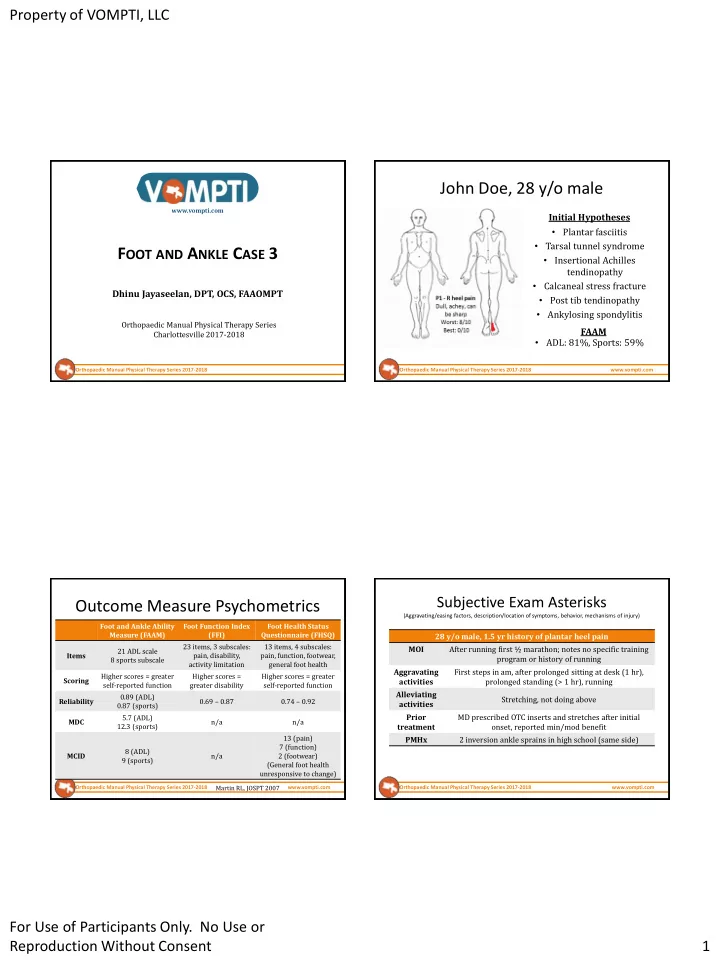
John Doe, 28 y/o male

Initial Hypotheses

  • Plantar fasciitis
  • Tarsal tunnel syndrome
  • Insertional Achilles

tendinopathy

  • Calcaneal stress fracture
  • Post tib tendinopathy
  • Ankylosing spondylitis
  • ADL: 81%, Sports: 59%

FAAM

Orthopaedic Manual Physical Therapy Series 2017-2018 www.vompti.com

Outcome Measure Psychometrics

Foot and Ankle Ability Measure (FAAM) Foot Function Index (FFI) Foot Health Status Questionnaire (FHSQ) Items 21 ADL scale 8 sports subscale 23 items, 3 subscales: pain, disability, activity limitation 13 items, 4 subscales: pain, function, footwear, general foot health Scoring Higher scores = greater self-reported function Higher scores = greater disability Higher scores = greater self-reported function Reliability 0.89 (ADL) 0.87 (sports) 0.69 – 0.87 0.74 – 0.92 MDC 5.7 (ADL) 12.3 (sports) n/a n/a MCID 8 (ADL) 9 (sports) n/a 13 (pain) 7 (function) 2 (footwear) (General foot health unresponsive to change)

Martin RL, JOSPT 2007

Orthopaedic Manual Physical Therapy Series 2017-2018 www.vompti.com

Subjective Exam Asterisks

(Aggravating/easing factors, description/location of symptoms, behavior, mechanisms of injury)

28 y/o male, 1.5 yr history of plantar heel pain MOI After running first ½ marathon; notes no specific training program or history of running Aggravating activities First steps in am, after prolonged sitting at desk (1 hr), prolonged standing (> 1 hr), running Alleviating activities Stretching, not doing above Prior treatment MD prescribed OTC inserts and stretches after initial

  • nset, reported min/mod benefit

PMHx 2 inversion ankle sprains in high school (same side)

slide-2
SLIDE 2

Property of VOMPTI, LLC For Use of Participants Only. No Use or Reproduction Without Consent 2

Orthopaedic Manual Physical Therapy Series 2017-2018 www.vompti.com

Structure(s) at fault

  • Primary hypothesis after subjective: chronic plantar fasciitis
  • Differential (rank order): tarsal tunnel, post tib tendinopathy,

insertional AT, myofascial pain syndrome, lumbar radic

Joints in/refer to painful region Myofascial tissue in/refer to painful region Non-contractile tissue in/refer to painful region Neural tissue in/refer to painful region Other structures to be examined (non-MSK) Talocrural Subtalar Distal tib-fib Talonavicular Calcaneocuboid TMT joints Hip, SIJ, L-spine Achilles tendon Post tib tendon FHL, FDL Trigger point referral Plantar fascia Fat pad Retrocalcaneal bursa Deltoid, spring ligaments Tibial n. (medial calcaneal/plantar) L5,S1 Calcaneal fx? Ankylosing spondylitis?

Orthopaedic Manual Physical Therapy Series 2017-2018 www.vompti.com

Physical Exam Asterisks

(Special tests, movement/joint dysfunction, posture, palpation, etc)

28 y/o male, 1.5 yr history of plantar heel pain Posture Pes cavus bilaterally ROM Decr DF (worse with knee straight) and pronation Single leg heel raises L: 26 reps; R: 15 reps* Special tests (+) windlass test, (-) SLR/slump, Tinel’s Stability tests (-) Palpation TTP (+) R medial calcaneal tubercle and proximal ½ plantar fascia (thickness also noted)* Joint accessory motion Hypomobile R TCJ AP, STJ medial glide, midfoot throughout, 1st MTP AP and PA glides

Orthopaedic Manual Physical Therapy Series 2017-2018 www.vompti.com

Rate your assessment of severity/irritability

Justify your assessment with examples from the subjective and/or objective exam

  • Severity:

None Min

Mod

Max

– Impacts ability to run or WB for durations, not disabling in functional tasks

  • Irritability: None

Min

Mod Max

– Symptoms brought on with prolonged activity reduced fairly rapidly

Stage and stability?

  • Acute

Subacute

Chronic

Acute on chronic

– 1.5 yr history, no recent mechanism or indicators of inflammatory processes

  • Stable

Improving Worsening Fluctuating Red flags?

– Symptoms generally the same, not better or worse, appears mechanical/MSK

Orthopaedic Manual Physical Therapy Series 2017-2018 www.vompti.com

  • Are the relationships between the areas on the body

chart, the interview, and physical exam consistent? “Do the features fit” a recognizable clinical pattern? If YES, what? Chronic plantar fasciitis

(plantar fasciosis, plantar fasciopathy)

  • Identify any potential risk factors (yellow, red flags,

non-MSK involvement, biopsychosocial) Frustration with lack of improvement?

slide-3
SLIDE 3

Property of VOMPTI, LLC For Use of Participants Only. No Use or Reproduction Without Consent 3

Orthopaedic Manual Physical Therapy Series 2017-2018 www.vompti.com Orthopaedic Manual Physical Therapy Series 2017-2018 www.vompti.com

Recommendations based on evidence published before Jan 2013

Orthopaedic Manual Physical Therapy Series 2017-2018 www.vompti.com

Plantar Fasciitis

  • Background/Demographics

– Most common foot condition treated in health care, up to 2 million Americans / year – Affects athletic and non-athletic populations – Mean symptom duration: 13.3 – 14.1 months

  • Risk Factors:

– Limited ankle DF ROM (Odds Ratio: 23.3) – High BMI in non-athletic patients (OR: 5.6) – Work-related WB activities (OR: 3.6) – Running – Cavus foot, high arch

JOSPT 2014 CPG JBJS 2003 Riddle

Orthopaedic Manual Physical Therapy Series 2017-2018 www.vompti.com

Plantar Fasciitis

  • Subjective Report

– Pain in plantar aspect of heel – Worse with initial steps after prolonged inactivity or prolonged weight bearing – Precipitated by recent increase in WB activity

  • Objective Examination

– Tenderness at plantar fascia (medial calcaneal tubercle) – (+) Windlass test – (-) Tarsal tunnel/neurodynamic tests – Decr A/PROM ankle DF; 1st ray extension mobility

JOSPT 2014 CPG

slide-4
SLIDE 4

Property of VOMPTI, LLC For Use of Participants Only. No Use or Reproduction Without Consent 4

Orthopaedic Manual Physical Therapy Series 2017-2018 www.vompti.com

Additional Considerations

  • Patients with chronic PF

demonstrate the following:

(Fernandez-Lao, et al. 2016)

– Widespread and bilateral hypersensitivity – Lower Q of L – Increased thickness of the plantar fascia in the affected foot (+ correlation to symptoms Mahowald S 2011) – Increased fascial vascularity (+ correlation to symptoms Chen H 2013)

  • Imaging not typically

necessary, unless ruling

  • ut other conditions

Orthopaedic Manual Physical Therapy Series 2017-2018 www.vompti.com

Treatment Planning

  • What is your primary objective after intial eval?

– Education: anatomy, pathology, prognosis – Manual therapy: calf/PF STM, rearfoot mobilizations gr III-IV – Exercise prescription: self-stretching, neuro re-ed (load dispersion, facilitate mid/medial foot loading)

Impairments Functional Limitations Goals Pain Foot/ankle hypomobility Decr gastroc length Plantarflexion weakness Altered gait Inability to run Limited standing tolerance Normalize joint mobility No walking or running gait deviations Pain free return to run

Orthopaedic Manual Physical Therapy Series 2017-2018 www.vompti.com

Anatomy / Pathophysiology

  • 3 dense bands of connective tissue
  • O: medial calcaneal tubercle
  • I: fans distally into base of proximal phalanx
  • Usually chronic/degenerative process related to

repetitive microtrauma

  • Histologic analysis: marked thickening/fibrosis of PF,

collagen necrosis, chondroid metaplasia, calcification

Orthopaedic Manual Physical Therapy Series 2017-2018 www.vompti.com

slide-5
SLIDE 5

Property of VOMPTI, LLC For Use of Participants Only. No Use or Reproduction Without Consent 5

Orthopaedic Manual Physical Therapy Series 2017-2018 www.vompti.com

Abnormalities Resulting from the Underpronated Foot:

  • Related to joint stiffness, decreased plantar fascia

extensibility, muscle tightness

  • Unable to dissipate forces or absorb shock (lacks

pronation)

  • Decreased distance between met heads and calcaneus
  • Plantarflexed 1st ray

Orthopaedic Manual Physical Therapy Series 2017-2018 www.vompti.com

Gait Implications

(Cavus foot, midfoot stiffness)

  • Plantar heel pain associated with: lower maximum

force beneath heel and medial forefoot, greater mid/forefoot contact time (Sullivan et al, Gait Posture 2015)

  • Gait cycle breakdown/ plantar fascia considerations:

– IC and LR: shock absorption

  • More lateral loading = less dampening of GRFs

– MS: pronation

  • Midfoot stiffness prevents ‘unlocking’ of transverse

tarsal segments – TS, PS: supinate, become rigid for toe off

  • PF 1st ray doesn’t extend as well

Orthopaedic Manual Physical Therapy Series 2017-2018 www.vompti.com Orthopaedic Manual Physical Therapy Series 2017-2018 www.vompti.com

Physical Therapy Treatment

  • A lot of options…

– Joint mobilization/manipulation, soft tissue – Gastroc, soleus, plantar fascia stretching – Exercise

  • Pes planus – strengthen intrinsics, proximal segments;

mid/lateral loading v. medial overloading

  • Pes cavus – exercise emphasizes load dispersion, medial loading
  • v. lateral overloading

– Education – Orthotics/Inserts, Night splints? – Modalities: TDN? Ionto? LLLT? ESWT? Taping? Ultrasound?

slide-6
SLIDE 6

Property of VOMPTI, LLC For Use of Participants Only. No Use or Reproduction Without Consent 6

Orthopaedic Manual Physical Therapy Series 2017-2018 www.vompti.com

  • 6 visits over 4 weeks: MT + exercise v.

electrophysiological agents + exercise

  • Individuals with symptoms < 7.2 months were 4.2-8.5

times more likely to respond (depending on success criteria)

  • Age and BMI not significant predictors to success

Orthopaedic Manual Physical Therapy Series 2017-2018 www.vompti.com

  • 1248 articles screened, 8 RCTs included in analysis
  • 4 scored 6/10 or more on PEDro, others low quality
  • Manual therapy associated with improved outcomes in

pain and function compared to comparative group/control

  • MT: joint treatment, soft tissue, neural mobilization

Orthopaedic Manual Physical Therapy Series 2017-2018 www.vompti.com

TCJ Distraction (thrust/non-thrust)

Orthopaedic Manual Physical Therapy Series 2017-2018 www.vompti.com

Talocrural AP Glide

slide-7
SLIDE 7

Property of VOMPTI, LLC For Use of Participants Only. No Use or Reproduction Without Consent 7

Orthopaedic Manual Physical Therapy Series 2017-2018 www.vompti.com

Subtalar Glides

(Lateral) (Medial)

Orthopaedic Manual Physical Therapy Series 2017-2018 www.vompti.com

Non-specific Midfoot Pronation/Supination Mobilization

(Pronation) (Supination) (Neutral)

Orthopaedic Manual Physical Therapy Series 2017-2018 www.vompti.com

Plantar Glides with ML Rotation

Navicular on Talus, Cuboid on Calcaneus Medial Cuneiform on Navicular

Orthopaedic Manual Physical Therapy Series 2017-2018 www.vompti.com

Dorsal Cuboid Whip Manipulation

slide-8
SLIDE 8

Property of VOMPTI, LLC For Use of Participants Only. No Use or Reproduction Without Consent 8

Orthopaedic Manual Physical Therapy Series 2017-2018 www.vompti.com

1st MTP Plantar Glide

(indicated for limited extension)

Orthopaedic Manual Physical Therapy Series 2017-2018 www.vompti.com

Soft Tissue Mobilization

Orthopaedic Manual Physical Therapy Series 2017-2018 www.vompti.com

“The angle of your hands guides your depth” – Jim B.

(Superficial) (Deep)

Orthopaedic Manual Physical Therapy Series 2017-2018 www.vompti.com

TrP Release

slide-9
SLIDE 9

Property of VOMPTI, LLC For Use of Participants Only. No Use or Reproduction Without Consent 9

Orthopaedic Manual Physical Therapy Series 2017-2018 www.vompti.com Orthopaedic Manual Physical Therapy Series 2017-2018 www.vompti.com

  • n = 82, mean symptom duration > 10 months
  • All subjects received pre-fab soft insoles (Spenco), 3

wk course of Celebrex, and an educational video on PF

  • PF stretching v. Achilles tendon stretching
  • At 8 weeks, PF stretching superior to WB achilles

stretching for pain, activity limitations, pt satisfaction

  • No sig. difference at 2 yr f/u

Orthopaedic Manual Physical Therapy Series 2017-2018 www.vompti.com

1st MTP Extension and Ankle DF Mobilization with PF STM

Orthopaedic Manual Physical Therapy Series 2017-2018 www.vompti.com

  • Plantar fascia specific stretching v. strengthening

(single leg heel raises with towel under toes)

  • 3x12 rep max progression  10 rep max  8 rep max

every other day

  • FFI 29 points lower at 3 mo in strength group
  • No difference at 1, 6, 12 months
slide-10
SLIDE 10

Property of VOMPTI, LLC For Use of Participants Only. No Use or Reproduction Without Consent 10

Orthopaedic Manual Physical Therapy Series 2017-2018 www.vompti.com

Motor Control

(WB Through Medial Column)

Orthopaedic Manual Physical Therapy Series 2017-2018 www.vompti.com

Controlled Pronation/Supination

(Unstable Surface)

Orthopaedic Manual Physical Therapy Series 2017-2018 www.vompti.com

Concentric Pronation, Eccentric Supination (with resistance)

Orthopaedic Manual Physical Therapy Series 2017-2018 www.vompti.com

  • What are you going to reassess at subsequent visits?

– VAS, pain with am steps, standing tolerance

PROGNOSIS/EXPECTATIONS

  • How do you expect to progress your treatment over

subsequent visits?

– Motor control to become more dynamic, higher grade mobilization/manip, self-mobilization HEP

Associated factors for expected outcome:

  • Favorable

– Typical clinical presentation, low symptom irritability

  • Unfavorable

– Chronicity of symptoms

Possible referrals:

– Orthotist for custom inserts? Ortho for injection?

slide-11
SLIDE 11

Property of VOMPTI, LLC For Use of Participants Only. No Use or Reproduction Without Consent 11

Orthopaedic Manual Physical Therapy Series 2017-2018 www.vompti.com

‘Gap’ in Knowledge

  • Article reviewed: Celik D, et al. Joint mobilization and stretching

exercise vs steroid injection in the treatment of plantar fasciitis: a randomized controlled trial. Foot Ankle Int. 2016;37(2):150-6.

  • Relevance to the clinical case: Both groups had significant

improvement in FAAM and VAS in short term (3, 6, 12 wk) with greater improvement noted in injection group. Improvements continued from wk 12 through 1 yr for MT group only.

Patient or Population Intervention Comparison Outcomes Patients with plantar fasciitis Manual therapy & exercise Injection Pain relief, functional status

Orthopaedic Manual Physical Therapy Series 2017-2018 www.vompti.com

Clinical Pattern

Subjective Objective

  • Plantar heel pain
  • Overuse/insidious

mechanism

  • Pain worse with first steps

in am

  • Functional limitations:

prolonged standing, running

  • TTP at medial calcaneal

tubercle

  • (+) Windlass test
  • Pes cavus
  • Joint stiffness and

muscle length impairments

  • (-) neurodynamics