ESKOM HOLDINGS LIMITED 1. Sign attendance register and discussion - - PowerPoint PPT Presentation

eskom holdings limited
SMART_READER_LITE
LIVE PREVIEW

ESKOM HOLDINGS LIMITED 1. Sign attendance register and discussion - - PowerPoint PPT Presentation

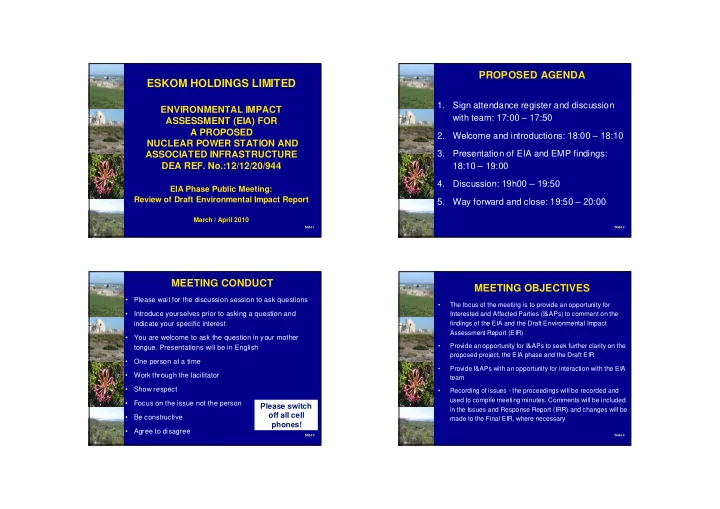
PROPOSED AGENDA ESKOM HOLDINGS LIMITED 1. Sign attendance register and discussion ENVIRONMENTAL IMPACT with team: 17:00 17:50 ASSESSMENT (EIA) FOR A PROPOSED 2. Welcome and introductions: 18:00 18:10 NUCLEAR POWER STATION AND 3.


slide-1
SLIDE 1

1

Slide 1

ESKOM HOLDINGS LIMITED

ENVIRONMENTAL IMPACT ASSESSMENT (EIA) FOR A PROPOSED NUCLEAR POWER STATION AND ASSOCIATED INFRASTRUCTURE DEA REF. No.:12/12/20/944

EIA Phase Public Meeting: Review of Draft Environmental Impact Report

March / April 2010

Slide 2

PROPOSED AGENDA

1. Sign attendance register and discussion with team: 17:00 – 17:50 2. Welcome and introductions: 18:00 – 18:10 3. Presentation of EIA and EMP findings: 18:10 – 19:00 4. Discussion: 19h00 – 19:50 5. Way forward and close: 19:50 – 20:00

Slide 3

MEETING CONDUCT

  • Please wait for the discussion session to ask questions
  • Introduce yourselves prior to asking a question and

indicate your specific interest

  • You are welcome to ask the question in your mother
  • tongue. Presentations will be in English
  • One person at a time
  • Work through the facilitator
  • Show respect
  • Focus on the issue not the person
  • Be constructive
  • Agree to disagree

Please switch

  • ff all cell

phones!

Slide 4

MEETING OBJECTIVES

  • The focus of the meeting is to provide an opportunity for

Interested and Affected Parties (I&APs) to comment on the findings of the EIA and the Draft Environmental Impact Assessment Report (EIR)

  • Provide an opportunity for I&APs to seek further clarity on the

proposed project, the EIA phase and the Draft EIR

  • Provide I&APs with an opportunity for interaction with the EIA

team

  • Recording of issues - the proceedings will be recorded and

used to compile meeting minutes. Comments will be included in the Issues and Response Report (IRR) and changes will be made to the Final EIR, where necessary

slide-2
SLIDE 2

2

Slide 5

KEY ISSUES

  • Some people are opposed to and others are in

favour of a nuclear power station at Bantamsklip, Thyspunt and Duynefontein

  • Concerns about the potential impacts on human

health and safety

  • Local residents share a deep-felt connection to the

area and have a strong “sense of place”

  • A power station could potentially be unsightly
  • Tourism is linked to conservation and preservation
  • f the coastline

Slide 6

KEY ISSUES

  • Marine life could potentially be adversely affected by altered

sea temperature and turbulence caused by inflow and output

  • f sea water to the plant
  • Concern that commercial and recreational fishing may be

negatively impacted

  • Light pollution
  • Concerns about potential drop in property values
  • Concern about cost of constructing a power station
  • Some people expressed a lack of trust in the EIA
  • Storage of hazardous waste
  • Renewable (‘green’) energy (e.g. wind, solar) vs. nuclear

Slide 7

PROJECT MOTIVATION

  • Increasing demand for electricity (> 4% growth per

annum)

  • Projected requirement for more than 40 000 MW of

new electricity generating capacity over the next 20 years

  • In SA only coal and nuclear power are solutions for

base load generation, while gas turbines, hydroelectric power stations and pumped storage schemes are used for peaking and emergency electricity generation

Slide 8

PROPOSED ACTIVITY

  • Eskom proposes the construction, operation and

decommissioning of a conventional nuclear power station and associated infrastructure either in the Eastern or Western Cape

  • A nuclear power station of the Pressurised

Water Reactor (PWR) type technology e.g. Koeberg Power Station

  • The transmission power lines are subject to

separate environmental authorisation processes

slide-3
SLIDE 3

3

Slide 9

TRANSMISSION (TX) LINE EIAs

  • Bantamsklip – Scoping phase has been

extended to include Multi-stakeholder Workshops and additional public consultation. Revised Draft Scoping Report will be made available for public comment

  • Thyspunt – Scoping Report accepted by

Authorities and EIA phase has commenced

  • Duynefontein – Scoping Report accepted by

Authorities and EIA phase has commenced

Slide 10

  • The power station and directly associated infrastructure will

require approximately 31 ha

  • The footprint assessed makes provision for the potential

future expansion of a power station, to 10 000 MW or the maximum carrying capacity

  • The proposed nuclear power station will include nuclear

reactor, turbine complex, spent fuel, nuclear fuel storage facilities, waste handling facilities, intake and outfall pipelines, desalinisation plant and auxiliary service infrastructure

  • Should the proposed project be authorised, it is anticipated

that construction of the station could commence in 2011 with the first unit being commissioned in 2018

PROJECT BACKGROUND

Slide 11

ENVELOPE OF CRITERIA

  • Detailed description of proposed nuclear plant is

not available, as preferred supplier has not been selected

  • Approach used has been to specify enveloping

environmental and other relevant requirements, to which the power station design and placement on site must comply

  • Enveloping criteria represent the most

conservative parameters associated with the various plant alternatives within the available PWR technology

Slide 12

slide-4
SLIDE 4

4

Slide 13 Slide 14

SCOPING PHASE

EIA process comprises the Scoping and EIA phases.

  • Approval of the Scoping Report
  • Application was submitted to the Department of

Environmental Affairs (DEA) in May 2007 and amended in July 2008 for a single nuclear power station of up to 4 000 MW

  • DEA approved the Scoping Report - November 2008
  • In mid 2009, after publication of the amended EIA

Regulations, Eskom announced that it was considering amending its application to include more than one nuclear power station. Eskom subsequently decided not to pursue the amendment of the application

Slide 15

SCOPING PHASE

  • In line with Eskom’s intention to investigate the potential

development of up to 20 000 MW of nuclear power generating capacity an application for the second nuclear power station may be submitted soon after the submission

  • f the Final EIR for Nuclear-1
  • Approval of the Plan of Study for EIA
  • The Plan of Study (PoS) for EIA was made available for

two rounds of public comment

  • DEA approved Final PoS for EIA - January 2010
  • The Scoping phase of the EIA process is complete

Slide 16

SITES INVESTIGATED

SITE SELECTION

slide-5
SLIDE 5

5

Slide 17

ASSESSMENT OF IMPACTS

  • The potential impacts assessed were

based on:

– Issues identified by I&APs during the public participation process (PPP) – Issues identified by specialists through research – Experience of relevant specialists with projects of a similar nature or in a similar environment – Consultation with local specialists – Environmental resources and conditions identified during site surveys

Slide 18

METHODOLOGY

  • Independent specialists assessed potential

positive and negative impacts with and without mitigation

  • According to the specialists, all potential

negative impacts can be mitigated

  • There are no fatal flaws at any of the

alternative sites

Slide 19

SPECIALIST STUDIES

  • Physical Impacts

Geology and geological risk Seismological risk Geo-hydrology Geotechnical characteristics

  • Biophysical Impacts

Dune geomorphology Flora Fauna (Invertebrate and Vertebrate) Hydrology Freshwater ecosystems Oceanographic conditions Marine biology Air quality Assessment of the1:100 year floodline

Slide 20

SPECIALIST STUDIES

  • Socio-economic Impacts

Social Economic Noise Visual Heritage and cultural resources Waste Tourism

  • As per the NNR / DEA co-operative agreement, a

number of specialist studies related to human health risk and safety were commissioned and included in this EIR for information (4 studies)

slide-6
SLIDE 6

6

Slide 21

SPECIALIST STUDY RESULTS

  • Seismological Risk

Seismic studies indicate that the design basis for the respective sites in terms of peak ground acceleration values (PGA) are as follows: – Duynefontein – PGA ~0.30 g – Bantamsklip - PGA ~0.23 g – Thyspunt - PGA ~0.16 g

Slide 22

SPECIALIST STUDY RESULTS

  • Impacts on Dune Geomorphology
  • Groundwater does not ‘daylight’ at the

Duynefontein or Bantamsklip sites: access roads and transmission lines can be built across the mobile dunes at these sites

  • Access roads and transmission lines at

Duynefontein can be built across the artificially vegetated and vegetated parabolic dunefields – provided dunes are stabilised

  • The interaction between dune systems and

wetlands is complex at Thyspunt, since groundwater ‘daylights’ in many inter-dune areas

Slide 23

SPECIALIST STUDY RESULTS

  • Impacts on Dune Geomorphology
  • As a result of the location of the proposed

construction of transmission lines, haul roads and conveyor belts between the nuclear power station in the south and the HV yard in the north, the negative potential impacts on dune geomorphology at Thyspunt are more extensive than at the other two sites

Slide 24

Aproximate position of Thyspunt Nuclear Power Station site

slide-7
SLIDE 7

7

Slide 25

SPECIALIST STUDY RESULTS

  • Impacts on Flora
  • Bantamsklip will experience the least potential

negative impact on plant communities and species, as the ecosystems on this site are fairly common along this section of coastline, provided that the power station is situated on the eastern half of the EIA corridor, away from the limestone fynbos

  • Thyspunt has by far the greatest diversity of

vegetation communities, including extensive and highly sensitive wetlands

Slide 26

SPECIALIST STUDY RESULTS

  • Impacts on Wetlands

– The development of a nuclear power station at Duynefontein is unlikely to result in any unmitigable, highly significant negative impacts on wetlands – Development of the proposed nuclear power station at Bantamsklip would not be associated with any unmitigable impacts to wetland systems – The Thyspunt wetland systems are complex and potential negative impacts could occur without appropriate mitigation

Slide 27

THYSPUNT WETLANDS

Slide 28

SPECIALIST STUDY RESULTS

  • Impacts on Terrestrial Vertebrates
  • The amount of land that is not of high faunal sensitivity at

Duynefontein is more than sufficient for the nuclear power station

  • At Bantamsklip the nuclear power station could have

significant negative potential impacts, without mitigation, because of the impacts on faunal habitats within the footprint

  • At Thyspunt a nuclear power station would have significant

potential negative impacts, without mitigation, because of the direct impacts on faunal habitats within the footprint, the development of two major new access roads, and the need for a development corridor across a large mobile dunefield

slide-8
SLIDE 8

8

Slide 29

SPECIALIST STUDY RESULTS

  • Impacts on Terrestrial Invertebrates
  • The potential impacts of the nuclear power station
  • n the terrestrial invertebrate communities are

very similar for all alternative sites, but there are site-specific differences

  • None of the butterflies occurring in the Cape Flats

Dune Fynbos area around Duynefontein are endangered or endemic

  • Non-vegetated and partially vegetated portions of

the site are of very low and low sensitivity, respectively.

  • The new species of ant found at Duynefontein is

regarded as a generalist and is likely to be found

  • n other areas of the site

Slide 30

SPECIALIST STUDY RESULTS

  • Impacts on Terrestrial Invertebrates
  • Thyspunt has the highest butterfly diversity and conservation

value of the alternative sites. Thyspunt is identified as higher sensitivity than Duynefontein, and only marginally lower than Bantamsklip

  • From the viewpoint of potential positive impacts of the

nuclear power station, Duynefontein already positively benefits under the management of Eskom, which means that it would experience the least improvement in conservation status

  • Bantamsklip and Thyspunt would benefit substantially from

formal protection status. The project would have a potential net positive impact on invertebrate communities at Bantamsklip or Thyspunt

Slide 31

SPECIALIST STUDY RESULTS

  • Economic Impacts
  • The overall positive macro-economic impacts will be greatest

at Bantamsklip and Duynefontein, and less at Thyspunt, as the sites are situated in a province with a larger, more diversified economy. Nuclear-1 would result in less dislocation of economic activities if located at Duynefontein than at either of the other two sites

  • Macroeconomic indicators favour Duynefontein and

Bantamsklip

  • The cost-effectiveness analysis indicates that Thyspunt has

a very slight edge over Duynefontein and a somewhat larger edge over Bantamsklip. The differences between the alternative sites are slight, and all the sites would have large positive economic impacts both on the local area and the province in which they are situated

  • The economic impact assessment gives greater weight to

the cost-effectiveness analysis

Slide 32

SPECIALIST STUDY RESULTS

  • Heritage Impacts
  • All alternative sites contain significant heritage

resources.

  • The amount of Late Stone Age heritage that will

be potentially impacted at Duynefontein will be substantially less than that of Bantamsklip and Thyspunt

  • Duynefontein is palaeontologically highly
  • sensitive. Bantamsklip is almost as sensitive as

Thyspunt in terms of its heritage richness

slide-9
SLIDE 9

9

Slide 33

SPECIALIST STUDY RESULTS Marine Biology Impacts

  • Potential impacts similar at all sites and the

impacts can be mitigated if the proposed designs are implemented as planned

  • Potentially the most significant impacts are:

Disruption of the marine environment through the offshore disposal of sediment Release of warmed cooling water

  • Potential impacts of marine spoil disposal will

have a potentially highly significant long-term negative affect on the marine environment

Slide 34

SPECIALIST STUDY RESULTS

Social Impacts

  • Potential negative impacts relate to

accommodation for temporary workers during construction

  • Potential positive impact is the provision
  • f electricity and related benefits to the

broader national and regional economies

  • Perceived risks associated with nuclear

incidents could potentially lead to a change in attitude and behaviour – reliable information is important

Slide 35

SPECIALIST STUDY RESULTS Tourism Impacts

  • Communities at Thyspunt and Bantamsklip have

expressed opposition to the proposed power station

  • Thyspunt community highlighted the premium

nature of the top-end coastal vacation destination

  • Bantamsklip community emphasised the new and

fragile nature of the developing tourism product and the local dependence thereon

  • Some Duynefontein tourism stakeholders have

personal objections to another power station, however they recognise the potential for increased business and promote a generally positive outlook for tourism

Slide 36

SPECIALIST STUDY RESULTS

Tourism Impacts

  • Assessment takes account decline in nature-

based tourism as well as an increase in business- related tourism associated with the proposed nuclear power station

  • Duynefontein – limited potential impact during
  • construction. During operation a potential 1.43%

improvement in tourism is predicted

  • Bantamsklip - potential 5% positive impact during
  • construction. During operation a potential 8.57%

improvement in tourism is predicted

  • Thyspunt – Potential 7.86% negative impact

during construction. During operation a zero potential impact is predicted

slide-10
SLIDE 10

10

Slide 37

PROJECT ALTERNATIVES

  • Forms of power generation
  • Nuclear plant types
  • Layout of the nuclear plant
  • Fresh water supply and utilisation of abstracted

groundwater

  • Management of brine
  • Intake of sea water
  • Outlet of water
  • Management of spoil material
  • Access to Thyspunt
  • Waste
  • The no-development alternative (i.e. ‘No-Go’)
  • Location of the power station (i.e. site selection)

Slide 38

SITE SELECTION

  • Site selection was based on:
  • Results of independent specialist studies: the

significance of potential impacts, with mitigation, at each of the sites

  • An integration workshop, involving all

specialists, where ranking of the sites and key decision factors were agreed on

  • Quantified ranking taking into account the key

decision factors

Slide 39

SITE SELECTION

  • Impacts of low significance at all alternative sites

filtered out e.g. noise, visual impacts, hydrology

  • Impacts of medium and high significance that have

the same significance at all sites were filtered out e.g. social

  • The key factors for decision-making:

– Integration into the national grid – Seismic suitability – Impacts on dune geomorphology – Impacts on wetlands – Impacts on vertebrate fauna – Impacts on invertebrate fauna – Economic impacts

Slide 40

INTEGRATION INTO THE NATIONAL GRID

  • Where do we require power stations for

future load growth?

  • Electricity needs to be transmitted from

the high voltage yard at the power station through a network of transmission and distribution lines to end users

  • To improve efficient, Eskom tries

connect new base load generation to the closest load, where possible

slide-11
SLIDE 11

11

Slide 41 East London East London Port Elizabeth Port Elizabeth Durban Durban Bloemfontein Bloemfontein Upington Upington Johannesburg Johannesburg Pretoria Pretoria Polokwane Polokwane Cape Town Cape Town Growth requires network strengthening Estimated load growth points

CAPE LOAD GROWTH AREAS

Slide 42

SITE SELECTION

A number of factors indicate that Bantamsklip cannot be regarded as a preferred alternative when compared with the other two alternative sites:

  • Substantially higher construction costs due to its

remote location (requirements for upgrading of roads and bridges and lengthy transmission lines)

  • Cumulative environmental impacts of the

transmission corridors

  • Potential impacts on invertebrate fauna

Bantamsklip is regarded as the least preferred site alternative for Nuclear-1

Slide 43

SITE SELECTION: RECOMMENDATIONS

A quantitative assessment of key criteria indicates that Thyspunt is preferred (with a score of 76 as

  • pposed to Duynefontein’s score of 57) due to:
  • Lower seismic risk
  • Relative ease of integration into the

transmission grid

  • Site’s locality relative to the Port Elizabeth load

centre

  • Potential overall positive conservation benefits of

the majority of the site, as well as additional land being managed for conservation purposes

  • Conservation benefits would not be realised at

Duynefontein

Slide 44

NUCLEAR PLANT LAYOUT

  • Sensitivity maps of all specialist studies were

integrated and composite maps were produced to indicate areas of high environmental suitability for each alternative site

  • Finalisation of the site layout plans will require

detailed investigations, in conjunction with relevant qualified and experienced specialists

slide-12
SLIDE 12

12

Slide 45

Site Sensitivity: Bantamsklip – Invertebrate Fauna

Slide 46

Site Sensitivity: Bantamsklip – Vertebrate Fauna

Slide 47

Site Sensitivity: Bantamsklip – Flora

Slide 48

Site Sensitivity: Bantamsklip – Wetlands

slide-13
SLIDE 13

13

Slide 49

Site Sensitivity: Bantamsklip – Heritage

Slide 50

Site Sensitivity: Bantamsklip – Combined Sensitivity

Slide 51

Site Sensitivity: Thyspunt – Combined Sensitivity

Slide 52

Site Sensitivity: Duynefontein – Combined Sensitivity

slide-14
SLIDE 14

14

Slide 53

FRESH WATER SUPPLY AND UTILISATION OF ABSTRACTED GROUNDWATER

  • At all sites desalination provides a

guaranteed source of fresh water supply for the lifespan of the proposed nuclear power station without jeopardising the availability of fresh water to other users

  • A desalinisation plant is therefore the

preferred alternative for the provision of fresh water at all sites

Slide 54

INTAKE AND OUTLET OF WATER

  • The installation of intake and outlet tunnels that obtain water

from the ocean and feed cooling water into a storage area located adjacent to the cooling water pump houses is the

  • nly feasible alternative for all sites
  • Outlet structures for cooling water and chemical effluent

must be offshore

  • All releases need to occur at the distances prescribed by the

relevant specialists

  • Provided that the specific mitigation measures identified in

the marine biology report are adhered to, offshore effluent release is the recommended alternative

Slide 55

WASTE

  • The only feasible alternative for the disposal of

Low-Level and Intermediate-Level radioactive waste is disposal at the Vaalputs nuclear waste disposal site

  • Vaalputs is the only authorised facility for this form
  • f waste in SA. Vaalputs has sufficient capacity for

the waste that will be generated by Nuclear-1

  • With regards to High-Level Waste (spent fuel), the
  • nly alternative currently available in SA is long-

term storage of the spent fuel in the nuclear power station

  • Vaalputs may be considered as a disposal site for

High-Level Waste in future

Slide 56

NO-DEVELOPMENT ALTERNATIVE

  • Given the urgent power demand in South Africa,

the No-Go alternative is not considered to be an alternative, as Eskom’s mandate is to provide power for the country

  • Eskom would likely apply to develop coal-fired

power stations if the current application is declined as coal-fired generation is the only feasible base load alternative

  • The life-cycle environmental impacts of coal-fired

power generation are much greater than nuclear- fuelled power generation

slide-15
SLIDE 15

15

Slide 57

NO-DEVELOPMENT ALTERNATIVE

  • If Eskom does not utilise Bantamsklip

and Thyspunt for nuclear development, it is likely to sell the properties

  • The sale of the properties will be to a

willing buyer at the market-related price, which may result in an alternative form of land use that may not involve management of the majority of the properties as nature reserves

Slide 58

KEY MITIGATION MEASURES

  • Independent specialists have proposed mitigation

measures to reduce potential negative impacts

  • Draft EMP has been compiled as part of draft EIR

and if authorised, it will be a legally binding document

  • Compliance to EMP must be independently audited

throughout construction and operation

  • Mitigation measures for botanical impacts, vertebrate

and invertebrate fauna, wetlands and heritage resources are particularly important

  • Mitigation of heritage impacts will require the work of

a site-specific team dedicated to excavations over a period of several years prior to construction

Slide 59

  • Qualified and experienced botanical, wetland,

vertebrate and invertebrate fauna, dune geomorphology and heritage specialists will need to find an acceptable final access route alignment

  • Additional groundwater studies are necessary to

better understand the interaction between groundwater and wetlands

KEY MITIGATION MEASURES

Slide 60

WAY FORWARD

  • Comment Period – 6 March to 10 May (66 days)
  • Public meetings and key stakeholder workshops will

be held around the sites assessed from 23 March to 21 April. Minutes of meetings will be sent to attendees

  • Comments received will be addressed in the Issues

and Response Report in the Final EIR

  • Final EIR will be submitted to the DEA for

consideration and decision-making

  • Final decision regarding EIA will be communicated

to registered I&APs

  • Construction of Nuclear-1 is subject to other

approvals e.g. the NNR site safety decision and transmission lines EIA authorisations

slide-16
SLIDE 16

16

Slide 61

WAY FORWARD

Written comments can be submitted by:

  • Post: Public Participation Office, Nuclear 1

EIA, PO Box 503, Mtunzini, 3867, SA

  • Fax: +27 (0) 35 340 2232
  • Email: nuclear1@acerafrica.co.za

Slide 62

MEETING CONDUCT

  • Please wait for the discussion session to ask questions
  • Introduce yourselves prior to asking a question and

indicate your specific interest

  • You are welcome to ask the question in your mother
  • tongue. Presentations will be in English
  • One person at a time
  • Work through the facilitator
  • Show respect
  • Focus on the issue not the person
  • Be constructive
  • Agree to disagree

Please switch

  • ff all cell

phones!

Slide 63

THANK YOU

Slide 64

SPECIALIST STUDY RESULTS

Oceanographic Impacts

  • Nuclear-1 will be built at least 10 m above high water mark
  • Dispersion of the plume is considered to be acceptable at

all alternative sites

  • Relatively unfavourable dispersion of the thermal plume

takes place at Thyspunt, where the plume hugs the coastline and shallow near shore areas

  • The most efficient dispersal of the thermal plume will occur

at Duynefontein

  • Potential for suspended sediment plumes to impact upon

tourism (e.g. shark cage diving at Dyer Island) should be mitigated

slide-17
SLIDE 17

17

Slide 65

SPECIALIST STUDY RESULTS Impact on Transportation Systems

  • Duynefontein

does not require significant upgrades to transport systems during construction and operation

  • Costly upgrades are required to the public

transport system for Bantamsklip and Thyspunt. Upgrades would be significant for Bantamsklip

Slide 66

SPECIALIST STUDY RESULTS

Impact on Fresh Water Supply

  • There are no rivers or perennial streams

at any of the alternative sites and construction and operation of the power station will thus not have any direct impacts

  • n

surface water supply schemes or catchments

  • As groundwater is near the end of the

flow path, the only existing groundwater use that could be directly affected are the coastal springs and potential impacts would be of a localised extent

Slide 67

SPECIALIST STUDY RESULTS

Impact on Hydrological Conditions

  • Direct

hydrological impacts at all alternative sites are of a low significance

  • Potential impacts relate to flood hazard at

low points along the coastal frontage of the EIA corridor and increased surface run-off volumes and peaks

Slide 68

SPECIALIST STUDY RESULTS

Impact on Geotechnical Suitability

  • Potential impacts related to slope stability

imposing safety risks are of a low significance and consequences at all sites, as slope stability design techniques will be employed to deal with these issues

  • Potential impacts associated with larger

volume excavations in sands will be significant at all sites, depending on the final footprint, and will need mitigation

slide-18
SLIDE 18

18

Slide 69

SPECIALIST STUDY RESULTS

Impacts on Geological Risk

  • There is a low geological risk and no

disqualifiers at any of the sites and surrounding environment

  • Potential impacts related to geological risk

is interrelated to the seismic hazard of the site and water quality in the area

Slide 70

SPECIALIST STUDY RESULTS

Agriculture Impacts

  • Agriculture around Thyspunt is based

mainly on milk production (2008: R150 m per annum) -

  • Fynbos farming prevails at the

Bantamsklip although there is some dairy as well as grape, beef, sheep and game farming (2008: R29 m per annum)

  • Duynefontein is based on mixed farming

(2008: R75 m per annum)

Slide 71

SPECIALIST STUDY RESULTS

Agriculture Impacts

  • Duynefontein – no impact on agriculture

during construction and operation

  • Bantamsklip – negative potential impact
  • f dust (construction). Potential of less

than 5% increase in local market due to water limitations that restrict expansion

  • Thyspunt – negative potential impact of

dust (construction). Potential for positive impact on production by increasing the size of the local market for fresh produce

Slide 72

SPECIALIST STUDY RESULTS Air Quality Impacts

  • Sources of impacts during construction would be

fugitive dust emissions from general construction activities and emissions from vehicles and equipment

  • Potential sources of non-radioactive air emissions

during operation:

Carbon, sulfur and nitrogen oxides in the exhaust gases from engines of the backup electricity generators Formaldehyde and carbon monoxide emitted by the insulation when installations go back into operation after servicing Ammonia discharged as the temperature rises in the steam generators during start-up

slide-19
SLIDE 19

19

Slide 73

SPECIALIST STUDY RESULTS Air Quality Impacts

  • Low

predicted impacts

  • f

non-radiological pollutants when compared to human health risk and vegetation impact criteria

  • During normal operation, trace quantities of

radiological materials will be released to the environment

  • Dispersion simulations included a number of

identified Design Basis Accidents. Predicted highest whole body dose at 1 km downwind of power station following such accidental releases was shown to be below the maximum acceptable limit of 50 mSv for a single event, as stipulated by the NNR

Slide 74

SPECIALIST STUDY RESULTS Noise Impacts

  • Potential negative noise impacts are of low or very

low significance

  • There will be no potential noise impact on

adjacent land surrounding any of the sites during construction and operation due to large distances between power station and site boundary

  • OCGT power plant (emergency power) will be

placed on property boundary at Thyspunt, which will result in a potential noise impact on residents situated within 1000 m of the plant

Slide 75

SPECIALIST STUDY RESULTS

Visual Impact

  • Due to the size of a nuclear power station

and its location in relative open, treeless landscapes along the coast, with negligible visual screening by landforms, potential visual impacts at all sites may be significant

  • The use of screens, appropriate lighting,

appropriate positioning of spoil dumps and attention to the colour of large structures

  • etc. is recommended

Slide 76

SPECIALIST STUDY RESULTS

Impacts of Emergency Planning

  • Duynefontein is currently in proximity to the

Koeberg Nuclear Power Station, therefore the emergency response infrastructure and systems are in place

  • Outcomes of the Safety Analyses will determine if

the current infrastructure would be adequate to cope with the demands of the proposed power station

  • Bantamsklip and Thyspunt will require substantial

upgrading of infrastructure since they are in remote areas

slide-20
SLIDE 20

20

Slide 77

SPECIALIST STUDY RESULTS Site Control Impacts

Duynefontein

  • Site already developed as a NPS with full access

and site control

  • It has full visitor facilities with a Visitor’s Centre
  • Access will be via new access control points and

upgraded existing roads leading off the R27 Thyspunt

  • Access to the site is currently limited and

controlled by fencing and electronic/locked gates

  • A new access control point will be developed on

the western or eastern owner controlled boundary and at the outer and inner security fence

Slide 78

SPECIALIST STUDY RESULTS Site Control Impacts

  • Bantamsklip

Access to the site is currently limited and controlled by fencing and gates The R43 tarred road passes through the site

Slide 79

SPECIALIST STUDY RESULTS

Human Health Impacts

  • The NNR will issue a license for the

establishment of an NNR at any particular site only if full compliance with the radiological dose limits and dose constraints is demonstrated, taking into account the principles of ALARA and all

  • ther matters relating to the overall

safety case

Slide 80

SPECIALIST STUDY RESULTS

Geohydrological Impacts Six potential environmental impacts involving groundwater have been identified:

  • Flooding by groundwater
  • Depletion of local aquifers
  • Degradation of ecologically sensitive wetlands /

phreatophytes/ seeps /springs

  • Contamination
  • Degradation of infrastructure
  • Contamination of the shore zone
  • The impacts are of low significance due to the sites

being situated in coastal zones with groundwater being at/near the end of its flow path and minimal downstream receptors

slide-21
SLIDE 21

21

Slide 81

SPECIALIST STUDY RESULTS

1:100 Flood Line The 1:100 year flood lines have been calculated for each site for the present day and 2075 (based on predicted sea level rise).

Present day: Excluding climate change Year 2075: Including climate change Site Min [m MSL] Max [m MSL] Min [m MSL] Max [m MSL] Thyspunt

4.4 9.9 5.7 11.2

Bantamsklip

4.0 9.4 4.8 10.8

Duynefontein

4.4 6.3 5.3 7.4