Design Concepts for a Manned Artificial Gravity Research Facility - - PowerPoint PPT Presentation

design concepts for a manned artificial gravity research
SMART_READER_LITE
LIVE PREVIEW

Design Concepts for a Manned Artificial Gravity Research Facility - - PowerPoint PPT Presentation

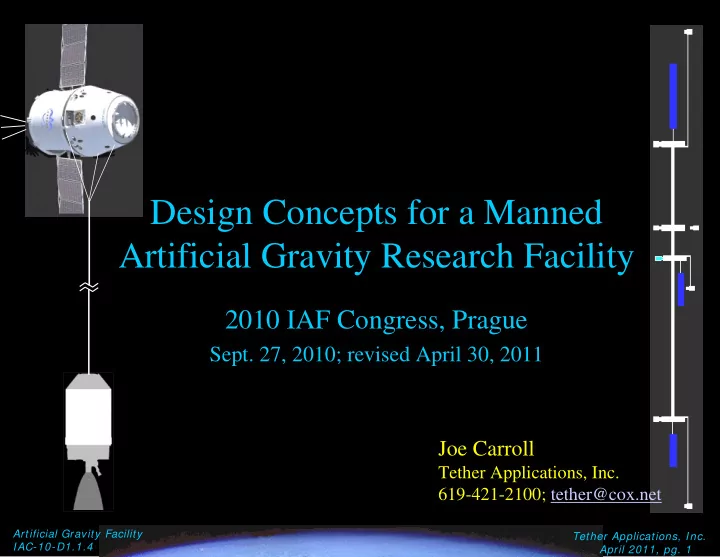
Design Concepts for a Manned Artificial Gravity Research Facility 2010 IAF Congress, Prague Sept. 27, 2010; revised April 30, 2011 Joe Carroll Tether Applications, Inc. 619-421-2100; tether@cox.net Artificial Gravity Facility Tether


slide-1
SLIDE 1

Tether Applications, Inc. April 2011, pg. 1 Artificial Gravity Facility IAC-10-D1.1.4

Design Concepts for a Manned Artificial Gravity Research Facility

2010 IAF Congress, Prague

  • Sept. 27, 2010; revised April 30, 2011

Joe Carroll

Tether Applications, Inc. 619-421-2100; tether@cox.net

slide-2
SLIDE 2

Tether Applications, Inc. April 2011, pg. 2 Artificial Gravity Facility IAC-10-D1.1.4

Possible Goals for Artificial Gravity Facility

  • 1. Focus on the overall effects of long-term hypogravity
  • 2. Allow realistic planning for Moon & Mars settlements
  • 3. Such a facility can address questions like:
  • a. Can people stay healthy for years—and years later?
  • b. Can mice and monkeys reproduce normally?
  • c. Can monkeys raised in low gravity adapt to earth?
  • d. What plants may be useful for food production?
  • e. Does hypogravity allow advances in basic biology?
  • 4. The facility can also resolve nearer-term issues, like:
  • f. How much gravity should we use in cruise to/from Mars?
  • g. How much gravity should we use on-station near NEOs
  • h. What spin rates and designs are desired for cruise?
  • i. What gravity countermeasures may still be needed?

Mars Moon

CM

slide-3
SLIDE 3

Tether Applications, Inc. April 2011, pg. 3 Artificial Gravity Facility IAC-10-D1.1.4

Basic Moon/Mars Dumbbell Concept

A Key Challenge:

We really don’t know what rotation rates are reasonable, since ground-based rotating rooms have very different effects. We need better tests of rotation & Coriolis susceptibility for these facilities. Until then, we should consider a variety of lengths and designs:

4 Options for Radial Structure:

Spin rate Length Radial structure Key length-limiters:

>2.0 rpm <120m Rigid modules Mass of radial modules >0.80 rpm <760m Airbeam tunnels Tunnel area, impact risk >0.55 rpm <1600m Tunnels+cables Area; post-cut perigees >0.25 rpm <8000m Cables Cable mass; node “

Mars node 0.06g node CM Moon node

slide-4
SLIDE 4

Tether Applications, Inc. April 2011, pg. 4 Artificial Gravity Facility IAC-10-D1.1.4

Why Aren’t Rotating-Room Tests Adequate?

  • 1. Different effects of rotation on the inner ear:
  • In rotating rooms, the felt rotation axis and rate stay

the same except when you tilt your head up or down.

  • In orbit, the axis and/or rate change if you turn around.
  • Ground tests show you can adapt to spin reversal, but

it takes time. In orbit, spin reversal will be common.

  • 2. Far different felt Coriolis accelerations:
  • In rotating rooms, horizontal motion always causes the

same felt side-force, and your weight does not vary.

  • In orbit, you get heavier if you walk with the spin, and

lighter against it. This may induce stumbling, as can

  • ccur if you walk in an elevator as it starts or stops.

Mars Moon

slide-5
SLIDE 5

Tether Applications, Inc. April 2011, pg. 5 Artificial Gravity Facility IAC-10-D1.1.4

How Can We Determine Allowable Spin?

  • 1. Slowly rotate seat with subject’s head tilted back
  • Then part of the spin is in the same felt axis as in orbit.
  • A co-rotating visual field is probably also needed.
  • 2. Some ground tests can simulate Coriolis effects:
  • A “research elevator” like the NASA Vertical Motion

Simulator can move in response to occupant motion.

  • Tests can evaluate whether visual cues aid adaptation.
  • 3. Finally, do Gemini-like tests on the way to ISS:
  • Dragon can use its spent booster as a counterweight.
  • Spend 2-3 days phasing at lunar to Mars gravity levels.

Mars Moon

slide-6
SLIDE 6

Tether Applications, Inc. April 2011, pg. 6 Artificial Gravity Facility IAC-10-D1.1.4

Why 0.06 Gee, and not Just Moon and Mars?

  • 1. It’s the next ~1/e step, after Earth—Mars—Moon
  • This makes it a useful step for fundamental bio studies.
  • Nobody knows what levels trigger gravity responses.
  • 2. It may be the lowest level allowing intuitive behavior
  • Sitting, using a desk, hygiene, even rolling over in bed.
  • It may not require days of accommodation—or may aid it.
  • It may be popular with tourists, or for unique exercises.
  • 3. It’s also good if you want some gravity, but not much
  • Plant growth tests; satellite assembly, etc.
  • 4. Finally, it’s very easy to add: same hardware, etc.

Mars Moon 0.06g

CM

slide-7
SLIDE 7

Tether Applications, Inc. April 2011, pg. 7 Artificial Gravity Facility IAC-10-D1.1.4

Radial Structure Options vs Length

Rigid modules: 2 rpm, 121m Short tunnels: 1.5 rpm, 216m Long tunnels: 1 rpm, 486m Tunnels+cables: 0.55 rpm, 1600m

Lunar cabins Mars cabins

OOP view IP view Typical acceleration vectors in elevator:

slide-8
SLIDE 8

Tether Applications, Inc. April 2011, pg. 8 Artificial Gravity Facility IAC-10-D1.1.4

Some Cabin Layout Options

3.6 meter dia 4.2 meter dia 5.2 meter dia ISS lab layout

slide-9
SLIDE 9

Tether Applications, Inc. April 2011, pg. 9 Artificial Gravity Facility IAC-10-D1.1.4

Falcon 9 Cabin Compared to 737-600

Standard F9 fairing ~Same bending moment 3.6 x 17m cabin; fabricate like Falcon 9 stage 1 tanks 3.5 x 18m 737-600 cabin

slide-10
SLIDE 10

Tether Applications, Inc. April 2011, pg. 10 Artificial Gravity Facility IAC-10-D1.1.4

Airbeam Tunnels for Radial Structure

Inflatable airbeams

  • Vectran fiber in flexible matrix
  • Damage tolerant; easy to customize
  • Two people can carry beam at left

Tunnel stowage for launch

  • Fold deflated beam in half & roll up
  • Keeps rigid end fixtures on outside:
slide-11
SLIDE 11

Tether Applications, Inc. April 2011, pg. 11 Artificial Gravity Facility IAC-10-D1.1.4

Five Stages of Facility Development

# cabins and key new operations

Tether crewed Dragon to booster, on the way to ISS 1 Launch 1 cabin, berth capsule, spin up with booster 3 Launch 2 more cabins; join; use any counterweight 6 Launch 3 more cabins + tunnels; join to lunar node 14 Launch 8 more cabins, despin; attach; & spin up

  • The first 3 stages are developmental precursors.
  • A final decision on radial structure is needed by stage 4.
  • Stage 5 requires 8 more cabins; do only when needed.

Mars Moon

slide-12
SLIDE 12

Tether Applications, Inc. April 2011, pg. 12 Artificial Gravity Facility IAC-10-D1.1.4

  • After MECO, pay out tether from Falcon to Dragon
  • Can be done during phasing, on any flight(s) to ISS
  • Spin up w/pulsed posigrade burns during phasing
  • Kite bridle on manned end can stabilize its attitude
  • Like Gemini XI test, but longer tether & faster spin
  • 150m from CM, 0.6-1 rpm gives 0.06-0.16 gee
  • Release spent booster when it is moving backward
  • To deorbit booster, boost in south & release in north

Stage 1: Gemini-like Tether Tests

slide-13
SLIDE 13

Tether Applications, Inc. April 2011, pg. 13 Artificial Gravity Facility IAC-10-D1.1.4

Stages 2-4: Initial Cabin Assemblies

Stage 2: 1 cabin

  • 1 cabin + spent booster
  • Can test trapeze capture

Stage 3: 3 cabins

  • Attach 2 more cabins

Stage 4: full assembly

  • Launch 3 cabins + tunnels
  • Join 6 cabins w/tunnels
  • Deploy tunnels 1 by 1
  • Inflate slightly to deploy
  • Spin up from Mars end

Mars Moon

slide-14
SLIDE 14

Tether Applications, Inc. April 2011, pg. 14 Artificial Gravity Facility IAC-10-D1.1.4

Stage 5: Facility Expansion

Expansion sequence:

  • Launch 8 new cabins
  • Assemble lunar pairs
  • Despin (or slow down?)
  • Capture & berth cabins
  • Spin facility up again
  • Adjust ballast, to balance
  • Outfit new cabins later

Mars Moon

0.06g CM

slide-15
SLIDE 15

Tether Applications, Inc. April 2011, pg. 15 Artificial Gravity Facility IAC-10-D1.1.4

Two Operational Derivatives

Spinning exploration cruise stage

  • Uses spent departure stage as ballast
  • Can retain stage through maneuvers
  • Tether cut: lose gravity, not mission

High-deltaV spinning LEO sling

  • 2-3.2 km/sec above and below VLEO
  • Similar trapeze accelerations (0.5-1g)
  • Low capture altitude, for soft reentry
  • Shown: 1.2 km/s ΔV; 290 km tether

(to scale with earth)

slide-16
SLIDE 16

Tether Applications, Inc. April 2011, pg. 16 Artificial Gravity Facility IAC-10-D1.1.4

Conclusions

  • 1. Man has been going into orbit for 50 years, but we

seem stuck. Maybe it’s time for us to take human physiology seriously before planning long missions.

  • 2. A manned artificial gravity facility in LEO lets us

learn more about our future and any limits on that future, and lets us test ways around those limits.

  • 3. We can start with spinning tether tests as done on

Gemini XI, to assess spin-related artifacts. This lets us determine a suitable facility spin-rate and design.