Conformal Tensors in Lovelock Gravity Lovelock gravity shares - - PowerPoint PPT Presentation

conformal tensors in lovelock gravity
SMART_READER_LITE
LIVE PREVIEW

Conformal Tensors in Lovelock Gravity Lovelock gravity shares - - PowerPoint PPT Presentation

Conformal Tensors in Lovelock Gravity Lovelock gravity shares important features with Einstein gravity But exactly which features? Do we know them all? Formulate some basic questions a) Higher Curvature Bianchi Identities b) Analogues


slide-1
SLIDE 1

David Kastor 2016 Northeast Gravity Workshop 1

Conformal Tensors in Lovelock Gravity

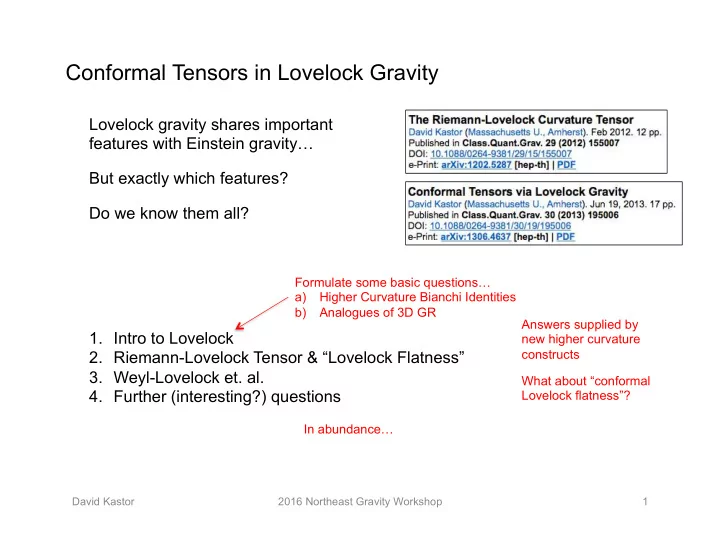
Lovelock gravity shares important features with Einstein gravity… But exactly which features? Do we know them all?

  • 1. Intro to Lovelock
  • 2. Riemann-Lovelock Tensor & “Lovelock Flatness”
  • 3. Weyl-Lovelock et. al.
  • 4. Further (interesting?) questions

Formulate some basic questions… a) Higher Curvature Bianchi Identities b) Analogues of 3D GR Answers supplied by new higher curvature constructs What about “conformal Lovelock flatness”? In abundance…

slide-2
SLIDE 2

David Kastor 2016 Northeast Gravity Workshop 2

1) Introduction to Lovelock

S = Z dDx√−g

kD

X

k=0

akR(k)

R(k) = δa1...a2k

b1...b2k Ra1a2 b1b2 . . . Ra2k−1a2k b2k−1b2k

δb1...bn

a1...an = δb1 [a1 · · · δbn an]

Coupling constants Higher curvature analogues of scalar curvature

R(0) = 1

Cosmological constant term

R(1) = R

Einstein-Hilbert term

R(2) = 1 6

  • Rae

cdRcd be − 2Rad bcRc d − 2Rc bRa c + Ra bR

  • R(k)

Gauss-Bonnet term Euler density in D=2k dimensions

  • vanishes for D<2k
  • variation vanishes in D=2k

kD = D − 1 2

slide-3
SLIDE 3

David Kastor 2016 Northeast Gravity Workshop 3

The nice thing about Lovelock…

Equations of motion depend only

  • n Riemann tensor and not its

derivatives

kD

X

k=0

akG(k)a

b = 0

S = Z dDx√−g

kD

X

k=0

akR(k)

G(k)

a b = (2k + 1)αk

2 δbc1...c2k

ad1...d2k Rc1c2 d1d2 . . . Rc2k−1c2k d2k−1d2k

Higher curvature analogues of Einstein tensor

  • no 4th derivatives of metric
  • no ghosts
  • same initial data as GR

raG(k)a

b = 0

Covariantly conserved

G(1)a

b

Einstein tensor

G(k)a

b

Vanishes for D < 2k+1

slide-4
SLIDE 4

David Kastor 2016 Northeast Gravity Workshop 4

Questions…

raG(k)a

b = 0

Covariantly conserved

A)

k=1 Follows from twice contracted Bianchi identity

r[aRbc]

de = 0

Is there an analogue of the uncontracted Bianchi identity for k>1? Is there a higher curvature Lovelock analogue of the Riemann tensor in this sense?

0 = r[aRbc]

bc

= 1 3(raR 2rbRb

a)

= 2 3rbGb

a

slide-5
SLIDE 5

David Kastor 2016 Northeast Gravity Workshop 5

Questions…

B)

Vacuum GR in D=3

δcdef

abgh Ref gh = 1

6 ⇣ Rab

cd − 4δ[c [aRb] d] + δcd ab R

Or simple Lovelock-type construction … LHS vanishes in D=3, determining Riemann tensor in terms of its contractions

Gab = 0 Rab

cd = 0

All solutions to Einstein’s equation are flat Both Riemann and Ricci tensors have 6 independent components 3 x 3 symmetric tensors Relation is true in all dimensions

slide-6
SLIDE 6

David Kastor 2016 Northeast Gravity Workshop 6

Questions…

B)

Vacuum GR in D=3

Gab = 0 Rab

cd = 0

All solutions to Einstein’s equation are flat Is there an analogue of this for k>1?

R(k) Euler density in D=2k dimensions

Look at “pure” kth order Lovelock gravity in D=2k+1 Only kth order Lovelock term in action

Spure = Z dDx√−gR(k)

D=2k+1 This is highest order Lovelock term available Expect all solutions to Lovelock will asymptote to solutions

  • f pure kth order theory in high curvature regime

Trivial in D=2k, like GR in D=2

slide-7
SLIDE 7

David Kastor 2016 Northeast Gravity Workshop 7

Questions… Only kth order Lovelock term in action

Spure = Z dDx√−gR(k)

Is there a higher curvature Lovelock flatness condition, such that all solutions to pure kth order Lovelock in D=2k+1 are kth order Lovelock flat? Like question 1, this calls for a higher curvature analogue of the Riemann tensor

B)

Vacuum GR in D=3

Gab = 0 Rab

cd = 0

All solutions to Einstein’s equation are flat Is there an analogue of this for k>1?

R(k) Euler density in D=2k dimensions

Look at “pure” kth order Lovelock gravity in D=2k+1

slide-8
SLIDE 8

David Kastor 2016 Northeast Gravity Workshop 8

2) Riemann-Lovelock tensors & “Lovelock flatness”

R(k)

a1b1...akbk c1d1...ckdk ≡ R[a1b1 [c1d1Ra2b2 c2d2 · · · Rakbk] ckdk]

Tensor of type (2k,2k), vanishes for D<2k and satisfies…

R(k)

a1...a2kb1...b2k = R(k) [a1...a2k]b1...b2k = R(k) a1...a2k[b1...b2k] = R(k) b1...b2ka1...a2k

R(k)

[a1...a2kb1] b2...b2k = 0

r[cR(k)

a1...a2k] b1...b2k = 0

Symmetries Bianchi identities Analogous to familiar properties of Riemann tensor kth order Lovelock flatness

  • r Riemann(k) flat

R(k)

a1b1...akbk c1d1...ckdk = 0

Like all 1D spaces are k=1 Lovelock flat

Call this Riemann(k) tensor

slide-9
SLIDE 9

David Kastor 2016 Northeast Gravity Workshop 9

Taking traces…

Tracing over all pairs of indices gives back scalar Lovelock interaction terms Ricci(k) tensor is an analogue of Ricci tensor

R(k) = R(k)

a1...a2k a1...a2k

R(k)

a b = R(k) ac1...c2k−1 bc1...c2k−1

G(k)

a b = kR(k) a b − (1/2)δa b R(k)

Einstein(k) tensor appears in Lovelock equation of motion

0 =r[aR(k)

b1...b2k] b1...b2k

= 1 2k + 1 ⇣ raR(k) 2krbR(k)b

a

⌘ = 2 2k + 1rbG(k)b

a Fully contracted Bianchi identity yields vanishing divergrance for Einstein(k) tensors

Answers 1st question Demonstrates some relevance for Riemann- Lovelock tensors

slide-10
SLIDE 10

David Kastor 2016 Northeast Gravity Workshop 10

Pure kth order Lovelock in D=2k+1

Analogue of vacuum GR in D=3

Spure = Z d2k+1x√−gR(k)

G(k)

a b = kR(k) a b − (1/2)δa b R(k) = 0 2nd Question Are all solutions kth order Lovelock flat?

R(k)

a1b1...akbk c1d1...ckdk ≡ R[a1b1 [c1d1Ra2b2 c2d2 · · · Rakbk] ckdk]

Same number of independent components as symmetric (2k+1)x(2k+1) tensor D=2k+1 Can show R(k)

a b = 0

R(k)

a1b1...akbk c1d1...ckdk = 0

Yes

slide-11
SLIDE 11

David Kastor 2016 Northeast Gravity Workshop 11

Are there interesting spacetimes that are higher

  • rder Lovelock flat, but not Riemann flat?

Riemann(k) tensor vanishes for any spacetime of dimension D < 2k

Can build higher dimensional Riemann(k) flat spacetimes by adding flat directions

Large set of examples… Interesting example in D=2k+1…

Static, spherically symmetric solutions of pure kth order Lovelock are missing solid angle spacetimes

ds2

2k+1 = −dt2 + dr2 + α2r2dΩ2 2k−1

slide-12
SLIDE 12

David Kastor 2016 Northeast Gravity Workshop 12

Static, spherically symmetric solutions of pure kth order Lovelock are missing solid angle spacetimes

ds2

2k+1 = −dt2 + dr2 + α2r2dΩ2 2k−1

Rµν

ρσ =

2 α2 r2 (1 − α2)δρσ

µν

Curved for α 6= 1 Only nonzero curvature components

µ, ν = 1, . . . , 2k − 1

Angular coordinates

  • n sphere

Riemann(k) tensor

R(k)

a1b1...akbk c1d1...ckdk ≡ R[a1b1 [c1d1Ra2b2 c2d2 · · · Rakbk] ckdk] = 0

Involves anti-symmetrization over 2k indices, but only 2k-1 are available…

slide-13
SLIDE 13

David Kastor 2016 Northeast Gravity Workshop 13

Static, spherically symmetric solutions of pure kth order Lovelock are missing solid angle spacetimes

ds2

2k+1 = −dt2 + dr2 + α2r2dΩ2 2k−1

Rµν

ρσ =

2 α2 r2 (1 − α2)δρσ

µν

Curved for α 6= 1 Only nonzero curvature components

µ, ν = 1, . . . , 2k − 1

Angular coordinates

  • n sphere

k=1

ds2

3 = −dt2 + dr2 + α2dφ2

GR in D=3

Missing angle Flat Global flat space with identifications

General case k>1

Missing solid angle Riemann(k) Flat Global flat space with identifications

Further question… Can we classify all Riemann(k) flat spacetimes?

slide-14
SLIDE 14

David Kastor 2016 Northeast Gravity Workshop 14

Conformal tensors in Lovelock… Riemann(k) flatness Conformal(k) flatness

Next step

A spacetime is Conformal(k) flat if it is related to to a Riemann(k) flat spacetime via a conformal transformation

Conformal flatness

D ≥ 4

Weyl tensor vanishes Trace free part of Riemann tensor Consider trace free part of Riemann(k) tensors Do Weyl(k) tensors determine Conformal(k) flatness? Weyl(k) tensors

slide-15
SLIDE 15

David Kastor 2016 Northeast Gravity Workshop 15

First recall some other constructs…

Wab

cd = Rab cd − 4δ[c [aSb] d]

Sa

b =

1 D − 2 ✓ Ra

b −

1 2(D − 1)δb

aR

◆ Schouten tensor

Cab

c = 2r[aSb] c

Cotton tensor

Cab

b = 0

Weyl tensor Conformal transformations

˜ gab = e2fgab ˜ Wab

cd = e−2fWab cd

˜ Cab

c = e−2f

Cab

c Wab cdrdf

slide-16
SLIDE 16

David Kastor 2016 Northeast Gravity Workshop 16

Conformal transformations

˜ gab = e2fgab ˜ Wab

cd = e−2fWab cd

˜ Cab

c = e−2f

Cab

c Wab cdrdf

  • D=3

Wab

cd = 0

δcdef

abgh Wef gh = (1/6)Wab cd

Vanishes in D=3

Cotton tensor is conformally invariant

Cab

c = 0

Conformal flatness condition in D=3 D=2 Weyl tensor not defined All metrics are locally conformally flat

slide-17
SLIDE 17

David Kastor 2016 Northeast Gravity Workshop 17

Conformal tensors in Lovelock… Define Weyl(k) tensor as traceless part of Riemann(k) tensor

W(k)

a1...a2k b1...b2k = R(k) a1...a2k b1...b2k + 2k

X

p=1

αp δ[b1...bp

[a1...apR(k) ap+1...a2k] bp+1...b2k] .

αp = ✓ (2k)! (2k − p)! ◆2 (−1)p(D − (4k − 1))! p!(D − (4k − p − 1))!

D < 4k − 1

Weyl(k) tensor undefined because of divergent coefficients Can show Riemann(k) tensor determined by its traces for D<4k Expect Weyl(k) tensor is nontrivial only for

D ≥ 4k

Like Weyl tensor in D=1,2

D = 4k − 1

Weyl(k) tensor defined, but vanishes identically Like Weyl tensor in D=3

slide-18
SLIDE 18

David Kastor 2016 Northeast Gravity Workshop 18

Schouten(k) and Cotton(k) tensors

W(k)

a1...a2k b1...b2k = R(k) a1...a2k b1...b2k − (2k)2δ[b1 [a1 S(k) a2...a2k] b2...b2k]

C(k)

a1...a2k b1...b2k−1 = 2k r[a1S(k) a2...a2k] b1...b2k−1

C(k)

a1...a2k−1c b1...b2k−2c = 0

Traceless

rcW(k)

a1...a2k cb1...b2k−1 = (D (4k 1)) C(k) a1...a2k b1...b2k−1

All in parallel with k=1 case…. Conformal transformations

˜ gab = e2fgab

˜ W(k)

a1...a2k b1...b2k = e−2kf W(k) a1...a2k b1...b2k

˜ C(k)

a1...a2k b1...b2k−1 = e−2kf ⇣

C(k)

a1...a2k b1...b2k−1 W(k) a1...a2k b1...b2k−1crcf

D=4k-1

Weyl(k) tensor vanishes Cotton(k) is conformally invariant

slide-19
SLIDE 19

David Kastor 2016 Northeast Gravity Workshop 19

  • Demonstrates properties of Riemann(k) tensors
  • Defines Weyl(k) tensors and shows conformal invariance

No connection to Lovelock, but roughly the same time period

slide-20
SLIDE 20

David Kastor 2016 Northeast Gravity Workshop 20

Conformal transformation of Weyl tensor…

Aab

cd

Aabcd = A[ab]cd = Aab[cd] = Acdab Aa

c = Aab cb

A = Aa

a

Let satisfy Traces Trace free part

A(t)

ab cd = Aab cd −

4 D − 2δ[c

[aAb] d] +

2 (D − 1)(D − 2)δcd

abA

Let

Λab = Λba

with Can show that….

˜ Aab

cd = Aab cd + δ[c [aΛb] d]

˜ A(t)

ab cd = A(t) ab cd

Conformal transformation

˜ Rab

cd = e−2f ⇣

Rab

cd + δ[c [aΛb] d]⌘

Λa

b = 4rarbf + 4(raf)rbf 2δb a(rcf)rcf

Result

Analogous construction works for all k

slide-21
SLIDE 21

David Kastor 2016 Northeast Gravity Workshop 21

Conformal(k) flatness conjectures

D < 2k

Riemann(k) tensor vanishes All spacetimes (locally) conformal(k) flat? No curvature in D=1

k=1 result

D = 2k

Riemann(k) tensor has a single component All spacetimes conformal(k) flat All D=2 spacetimes are (locally) conformally flat

D = 4k − 1

Conformal(k) flat if Cotton(k) tensor vanishes? D=3 spacetime is conformally flat if Cotton tensor vanishes

D ≥ 4k

Conformal(k) flat if Weyl(k) tensor vanishes?

2k < D < 4k − 1

Weyl(k) & Cotton(k) tensors not defined No k=1 analogue All spacetimes (locally) conformal(k) flat??

2 < D < 3 D ≥ 4

Weyl tensor vanishing implies conformal flatness

slide-22
SLIDE 22

David Kastor 2016 Northeast Gravity Workshop 22

New gravity models?

Recall that low dimensional gravity models make use of conformal tensors…

D=3 Topologically massive gravity (Deser, Jackiw & Templeton – 1982)

Cotton tensor appears in equation of motion

D=3 New massive gravity (Bergshoeff, Hohm & Townsend – 2009)

Schouten tensor is ingredient in action

Perhaps conformal(k) tensors can be useful in model building associated with Lovelock theories in low(ish) dimensions…

slide-23
SLIDE 23

David Kastor 2016 Northeast Gravity Workshop 23

Simple example Conformal(k) gravity in D=4k Conformal gravity in D=4

S = Z d4x√−g Wab

cdWcd ab

Ba

b = (rdrc + 1

2Rc

d)Wad bc

Bab = 0

Equation of motion Bach tensor

˜ Ba

b = e−4fBa b

Symmetric, traceless Equations of motion are conformally invariant

All Einstein metrics have vanishing Bach tensor Recall… All conformally Einstein spacetimes are solutions to conformal gravity

slide-24
SLIDE 24

David Kastor 2016 Northeast Gravity Workshop 24

Simple example Conformal(k) gravity in D=4k Equation of motion Bach tensor

S = Z d4kx√−g W(k)

a1...a2k b1...b2k W(k) b1...b2k a1...a2k.

B(k)

a b =

✓ R(k−1)

c1...c2k−2 d1...d2k−2rd2k−1rc2k−1 + k

2R(k)

c1...c2k−1 d1...d2k−1

◆ W(k)

ad1...d2k−1 bc1...c2k−1

Ba

b = (rdrc + 1

2Rc

d)Wad bc

Compare with…

B(k)

(ab) = 0

Expect anti-symmetric part of Bach tensor vanishes, but not straightforward to show… As it does for k=1 Also expect Bach(k) tensor is a conformal invariant, because of conformal invariance of action

slide-25
SLIDE 25

David Kastor 2016 Northeast Gravity Workshop 25

Simple example Conformal(k) gravity in D=4k

S = Z d4kx√−g W(k)

a1...a2k b1...b2k W(k) b1...b2k a1...a2k.

B(k)

a b =

✓ R(k−1)

c1...c2k−2 d1...d2k−2rd2k−1rc2k−1 + k

2R(k)

c1...c2k−1 d1...d2k−1

◆ W(k)

ad1...d2k−1 bc1...c2k−1

B(k)

(ab) = 0

Solved by Einstein(k) spaces…

slide-26
SLIDE 26

David Kastor 2016 Northeast Gravity Workshop 26

Conclusions… Riemann(k) tensor looks interesting. Lots of related questions…