Safety of autonomous shipping COLREGs and interaction between manned - - PowerPoint PPT Presentation

safety of autonomous shipping
SMART_READER_LITE
LIVE PREVIEW

Safety of autonomous shipping COLREGs and interaction between manned - - PowerPoint PPT Presentation

Safety of autonomous shipping COLREGs and interaction between manned and unmanned ships Thomas Porathe Professor, Interaction Design Department of Design Norwegian University of Science and Technology Trondheim, Norway thomas.porathe@ntnu.no


slide-1
SLIDE 1

thomas.porathe@ntnu.no

1/36

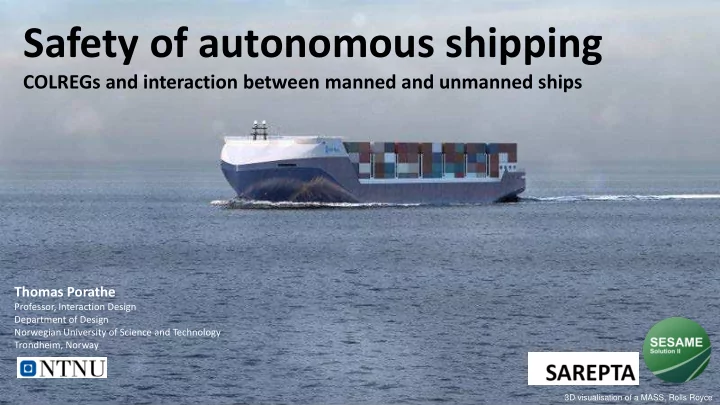
Safety of autonomous shipping

COLREGs and interaction between manned and unmanned ships

Thomas Porathe

Professor, Interaction Design Department of Design Norwegian University of Science and Technology Trondheim, Norway

3D visualisation of a MASS, Rolls Royce

slide-2
SLIDE 2

thomas.porathe@ntnu.no

2/36

The Trondheim autonomous all-electric passenger ferry

slide-3
SLIDE 3

thomas.porathe@ntnu.no

3/29

Concept model of the Trondheim AutoFerry, l.o.a. 8.4 m, taking 12 passengers (with bikes)

slide-4
SLIDE 4

thomas.porathe@ntnu.no

4/29

LIDAR

slide-5
SLIDE 5

thomas.porathe@ntnu.no

5/29 Wellcome aboard Emergency procedures. In case of fire remain calm at al times and press the ”fire” button

MOB

Talk

Fire

Human-machine interface Shore Control Centre Passenger-ferry interaction onboard Interaction between autonomous ferry and other manned vessels and crafts

Human-Factors Challenges

slide-6
SLIDE 6

thomas.porathe@ntnu.no

6/36

The YARA Birkeland autonomous all-electric short-sea container feeder

slide-7
SLIDE 7

thomas.porathe@ntnu.no

7/39

Estimated facts & figures Main particulars Length o.a.: 79,5 m Length p.p.: 72,4 m Width mld.: 14,8 m Depth shelter deck: 10,8 m Draught (full): 6 m Draught (ballast): 3 m Service speed: 6 knots Max speed: 13 knots Capacity Cargo capacity: 120 TEU Deadweight: 3 200 mt Propulsion system: Electric Propellers: 2 Azimuth pods Thrusters: 2 Tunnel thruster Battery pack: 7 – 9 MWh Proximity sensors Radar Lidar AIS Camera IR camera Connectivity & Communication Maritime Broadband Radio Satellite Communications GSM

https://www.km.kongsberg.com/ks/web/nokbg0240.nsf/AllWeb/4B8113B707A50A4FC125811D00407045?OpenDocument [acc. 2018-02-04]

slide-8
SLIDE 8
slide-9
SLIDE 9
slide-10
SLIDE 10

thomas.porathe@ntnu.no

10/36

slide-11
SLIDE 11

thomas.porathe@ntnu.no

11/36

Interaction MASS - MASS

Algorithm-based machine-to-machine negotiations (like aviation TCAS)

slide-12
SLIDE 12

thomas.porathe@ntnu.no

12/36

Autosea – Sensor fusion and collision avoidance for autonomous surface vehicles

https://www.ntnu.edu/autosea/

slide-13
SLIDE 13

thomas.porathe@ntnu.no

13/36

Interaction MASS - MASS

Algorithm-based machine-to-machine negotiations (like aviation TCAS)

Interaction between MASS and humans

COLREGS

slide-14
SLIDE 14

thomas.porathe@ntnu.no

14/36

The International Regulations for Preventing Collisions at Sea 1972 (“COLREGS”)

slide-15
SLIDE 15

thomas.porathe@ntnu.no

15/36

Rule 15: “When two power-driven vessels are crossing so as to involve risk of collision, the vessel which has the other on her own starboard side shall keep out of the way and shall, if the circumstances of the case admit, avoid crossing ahead of the

  • ther.”
slide-16
SLIDE 16

thomas.porathe@ntnu.no

16/36

Rule 15: “When two power-driven vessels are crossing so as to involve risk of collision, the vessel which has the other on her own starboard side shall keep out of the way and shall, if the circumstances of the case admit, avoid crossing ahead of the

  • ther.”
slide-17
SLIDE 17

thomas.porathe@ntnu.no

17/36

Rule 15: “When two power-driven vessels are crossing so as to involve risk of collision, the vessel which has the other on her own starboard side shall keep out of the way and shall, if the circumstances of the case admit, avoid crossing ahead of the

  • ther.”

Rule 16: “Every vessel which is directed to keep out of the way of another vessel shall, as far as possible, take early and substantial action to keep well clear.”

slide-18
SLIDE 18

thomas.porathe@ntnu.no

18/36

?

Rule 15: “When two power-driven vessels are crossing so as to involve risk of collision, the vessel which has the other on her own starboard side shall keep out of the way and shall, if the circumstances of the case admit, avoid crossing ahead of the

  • ther.”

Rule 16: “Every vessel which is directed to keep out of the way of another vessel shall, as far as possible, take early and substantial action to keep well clear.”

slide-19
SLIDE 19

thomas.porathe@ntnu.no

19/36

  • a. “Nothing in these Rules shall exonerate any vessel, or the owner,

master or crew thereof, from the consequences of any neglect to comply with these Rules or of the neglect of any precautions which may be required by the ordinary practice of seamen, or by the special circumstances of the case.”

  • b. “In construing and complying with these Rules due regard shall

be had to all dangers of navigation and collision and to any special circumstances, including the limitations of the vessels involved, which may make a departure from these Rules necessary to avoid immediate danger.”

Rule 2 “the ordinary practice of seamen”

slide-20
SLIDE 20

thomas.porathe@ntnu.no

20/36

“As a general guideline, attempt to achieve a CPA of 2 miles in the open sea and 1 mile in restricted waters”

The Nautical Institute

Lee & Parker, (2007), Managing Collision Avoidance at Sea, p. 35)

slide-21
SLIDE 21

thomas.porathe@ntnu.no

21/36 North Atlantic 12 June 2019

slide-22
SLIDE 22

thomas.porathe@ntnu.no

22/36 Singapore Strait, 25 March 2019

slide-23
SLIDE 23

thomas.porathe@ntnu.no

23/36

Examples of qualitative enumerations in COLREGS

Rule 2: ”…precautions which may be required by the ordinary practice of seamen, or by the special circumstances of the case.” “… due regard shall be had to all dangers of navigation and collision and to any special circumstances” Rule 8: “Any action to avoid collision shall be taken in accordance with the Rules of this Part and shall, if the circumstances of the case admit, be positive, made in ample time and with due regard to the observance of good seamanship.” Rule 19: “Conduct of vessels in restricted visibility.” “Every vessel shall proceed at a safe speed adapted to the prevailing circumstances and conditions of restricted visibility.” “(d) A vessel which detects by radar alone the presence of another vessel shall determine if a close-quarters situation is developing and/or risk of collision exists. If so, she shall take avoiding action in ample time…”

slide-24
SLIDE 24

thomas.porathe@ntnu.no

24/36

Should we develop machine-readable COLREGS?

slide-25
SLIDE 25

thomas.porathe@ntnu.no

25/36

Should we develop machine-readable COLREGS?

Human-readable Machine-readable

slide-26
SLIDE 26

thomas.porathe@ntnu.no

26/36

Local machine-readable COLREGS

slide-27
SLIDE 27

thomas.porathe@ntnu.no

27/36

Local machine-readable COLREGS Computing ”Safety zones”

slide-28
SLIDE 28

thomas.porathe@ntnu.no

28/36

Automation transparency

slide-29
SLIDE 29

thomas.porathe@ntnu.no

29/39

Examples of Automation Transparency

  • 1. Traffic separation. Dedicated fairways. Dedicated times.
  • 2. Identification. This is a ship in autonomous mode (marking)
  • 3. Sharing intentions. What is the autonomous ship’s intentions?
  • 4. Moving havens
slide-30
SLIDE 30

thomas.porathe@ntnu.no

30/39

Traffic Separation Schemes

Dover Strait TSS (1967)

slide-31
SLIDE 31

thomas.porathe@ntnu.no

31/39

”Motorways of the Sea”. A route network topology for Skagerrak (ACCSEAS project 2015)

AIS data Traffic density map for 2012 Most frequent used tracks Ship route network

slide-32
SLIDE 32

thomas.porathe@ntnu.no

32/36

Identification light for a ship in autonomous mode

slide-33
SLIDE 33

thomas.porathe@ntnu.no

33/36

Own ship A

Sharing intentions

slide-34
SLIDE 34

thomas.porathe@ntnu.no

34/36

Own ship A

Sharing intentions

slide-35
SLIDE 35

thomas.porathe@ntnu.no

35/36

Own ship A

Sharing intentions

slide-36
SLIDE 36

thomas.porathe@ntnu.no

36/36 Porathe, T. (2012). Transmitting intended and suggested routes in ship operations: cognitive off-loading by placing knowledge in the world. Work, 41 ( Supplement: 1 ) pp. 4873-4878.

Sharing intentions

slide-37
SLIDE 37

thomas.porathe@ntnu.no

37/36

The concept of ”moving havens”

slide-38
SLIDE 38

thomas.porathe@ntnu.no

38/36

Conclutions

Tools of human-autonomous ship interaction

  • 1. Localized machine-readable COLREGS
  • 2. Traffic separation schemes. Dedicated fairways. Dedicated times.
  • 3. Identification. This is a ship in autonomous mode (marking)
  • 4. Sharing intentions. What is the autonomous ship’s intentions?
  • 5. Moving havens