British Shipping British Shipping Thank-you for attending todays - - PowerPoint PPT Presentation

british shipping british shipping
SMART_READER_LITE
LIVE PREVIEW

British Shipping British Shipping Thank-you for attending todays - - PowerPoint PPT Presentation

British Shipping British Shipping Thank-you for attending todays talk. The objectives are: to present information about British Shipping and its importance to the country and the unseen part it plays in our lives. to describe the


slide-1
SLIDE 1

British Shipping British Shipping

< < < < < < < < < < Slide1

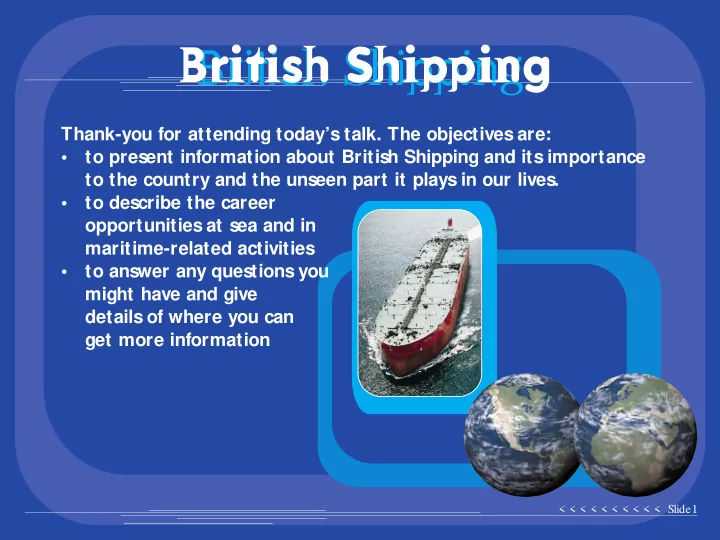
Thank-you for attending today’s talk. The objectives are:

  • to present information about British Shipping and its importance

to the country and the unseen part it plays in our lives.

  • to describe the career
  • pportunities at sea and in

maritime-related activities

  • to answer any questions you

might have and give details of where you can get more information

slide-2
SLIDE 2

British Shipping British Shipping

< < < < < < < < < < Slide2

British Merchant Fleet consists of an amazing variety of ship types which are designed to:

  • carry cargo - in huge quantities and volumes,

including oil, chemicals, grain, minerals, fertilisers, machinery ....

  • carry passengers - on ferries and cruise liners
  • carry out specialist operations - laying

communication cables, research and survey work, salvage and pollution control operations ... All these ships are known by the collective term of MERCHANT NAVY. It is made up of shipping companies who own and operate ships. You may have heard of some of the most famous names such as:

  • Cunard • P&O • Shell • BP • Maersk
slide-3
SLIDE 3

TASK 1 TASK 1

< < < < < < < < < < Slide3

  • Split into groups of three or four
  • Matching services and cargoes to types of ship
  • Do task 1: allow 5 minutes
slide-4
SLIDE 4

How many did you get?

How many did you get?

< < < < < < < < < < Slide4 11 T ugs 9 Stand-by and Supply vessels 6 V ery Large Crude Carrier (VLCC)

  • r ‘Superta

7 Car Carrier 10 Cable-layer 12 Royal Fleet Auxiliary ships 2 Bulk carrier 5 Gas carrier 14 Seismic Survey Ship 1 Ferries 3 Container ships 13 Oil Products Carrier 8 Aggregate Dredger 4 Passenger cruise ships

slide-5
SLIDE 5

Ship Types Ship Types

< < < < < < < < < < Slide5

  • That should have given you some ideas of the range of cargoes

and activities involved in the shipping industry

  • Now let’s see what some of these ships actually look like
slide-6
SLIDE 6

< < < < < < < < < < Slide6

Container Ship

Ship Types Ship Types

slide-7
SLIDE 7

< < < < < < < < < < Slide7

Bulk Carrier

Ship Types Ship Types

slide-8
SLIDE 8

< < < < < < < < < < Slide8

Cruise Ship

Ship Types Ship Types

slide-9
SLIDE 9

< < < < < < < < < < Slide9

Coastal Tanker

Ship Types Ship Types

slide-10
SLIDE 10

How good are you at jargon-busting??!! TASK 2 How good are you at jargon-busting??!! TASK 2

< < < < < < < < < < Slide10

  • Have a go at Task 2
  • You’ve got 10 minutes!
slide-11
SLIDE 11

Jargon-buster Answers!! Jargon-buster Answers!!

< < < < < < < < < < Slide11 1. Leeward Direction away from the wind 2. Donkeyman Engine Crew foreman 3. Fathom A measurement of 6 feet 4. Bollards Strong posts for taking mooring lines 5. Deck Floor 6. Companion Way Fixed staircase with banisters or handrails 7. Deckhead Ceiling 8. Windlass Machine at the front of the ship usually used for raising the anchor 9. J

  • lly boat

A boat used for working or recreation 10. Gooseneck A ‘U’ shape in a ventilator pipe 11. Yard A horizontal spar on a mast 12. Poop Deck at the stern of the ship 13. Starboard The right hand side of the ship looking forwards towards the front 14. Tarpaulin Canvas cover 15. Porthole Round window 16. Scupper Drain 17. Monkey Island Top of the wheelhouse 18. Hatch Opening in the deck for cargo 19. Bitter end The part of the anchor chain attached to the ship 20. Focsle Front part of the ship 21. Blue Peter The International Code Flag ‘P’ flown to say the ship is about to sail 22. Ballast Weight used to weigh the ship down 23. Aft Towards the back of the ship 24. Bridge From where the ship is navigated 25. Bilge Bottom of the ship where dirty water collects

How many did your team score?

slide-12
SLIDE 12

Why is the Merchant Navy important to our country? TASK 3 Why is the Merchant Navy important to our country? TASK 3

< < < < < < < < < < Slide12

  • See how many ideas you can come up with which may show the

importance of the Merchant Navy

  • take five minutes
slide-13
SLIDE 13

Important reasons for having a Merchant Navy Important reasons for having a Merchant Navy

< < < < < < < < < < Slide13

  • Trade:
  • 96% of trade into and out of the UK is carried by sea.

It is desirable if we can carry much of this in British ships

  • Economy:
  • British shipping is the fourth largest business sector, and

contributes £2.6bn p.a. to the country’s economy .

  • J
  • bs:
  • The Merchant Navy provides 25,000 jobs for people at sea

and another 17,000 jobs ashore which seafarers have traditionally moved on to

  • National Interest:
  • As an Island State we depend on maritime lifelines in time of
  • war. When our forces are deployed overseas they usually need

maritime backup. The Merchant Navy should be there to provide this.

slide-14
SLIDE 14

Your Career... Your Career...

< < < < < < < < < < Slide14

  • Working in your groups, list some of the things that you think will

be important to you in choosing a career...

  • Take five minutes
slide-15
SLIDE 15

Your Career... Your Career...

< < < < < < < < < < Slide15

  • OK - let’s now see if your lists have anything in common with

what you could expect in the Merchant Navy

slide-16
SLIDE 16

What’s in it for me? What’s in it for me?

< < < < < < < < < < Slide16

If you joined the Merchant Navy you could expect...

  • exciting responsibility at an early age
  • stimulating and varied work using the latest technology
  • internationally recognised

qualifications

  • education to degree level if desired
  • pportunities to travel (anywhere!)
  • good pay and conditions
  • first class career progression into

maritime or other fields ashore

slide-17
SLIDE 17

What are the jobs on a ship? What are the jobs on a ship?

< < < < < < < < < < Slide17

  • The person in charge on a Merchant Ship is

known as the Master, or the Captain.

  • Under him or

her, there are Officers, Petty Officers and Ratings.

slide-18
SLIDE 18

Jobs on ships Jobs on ships

< < < < < < < < < < Slide18

  • officers have responsibility for a wide range of

tasks and may control the work of junior officers and ratings

  • petty officers come between officers and ratings
  • ratings perform a wide range of technical and

non-technical jobs

slide-19
SLIDE 19

Jobs on ships: the Deck Department Jobs on ships: the Deck Department

< < < < < < < < < < Slide19

  • Deck Officers have responsibility for:
  • controlling the navigation of

the ship

  • loading and discharging the

cargo

  • planning and monitoring

routes

  • Deck ratings have many

tasks such as:

  • steering the ship
  • operating machinery
  • carrying out maintenance tasks
slide-20
SLIDE 20

Jobs on ships Jobs on ships

< < < < < < < < < < Slide20

Cadets getting instruction in Chartwork

slide-21
SLIDE 21

Jobs on ships: the Engine Department Jobs on ships: the Engine Department

< < < < < < < < < < Slide21

  • Engineer Officers have responsibility for:
  • main propulsion systems
  • auxiliary machinery in the engine room
  • deck machinery like winches and cranes
  • electrical and electronic systems
  • Engine ratings have many tasks such as:
  • routine maintenance
  • engine operation
  • machinery repair
slide-22
SLIDE 22

Jobs on ships Jobs on ships

< < < < < < < < < < Slide22

Engineers in a ship’s Control Room

slide-23
SLIDE 23

Jobs on ships Jobs on ships

< < < < < < < < < < Slide23

On passenger cruise ships there are numerous jobs focused on customer service, such as

  • hotel officers
  • secretarial workers
  • florists
  • photographers
  • catering staff
  • entertainment and casino staff
  • security officers
slide-24
SLIDE 24

Passenger ships Passenger ships

< < < < < < < < < < Slide24

  • Training for jobs on passenger ships other than deck or engine is

quite specialised. Each company will have its own system and may employ people only when they have gained experience at this type

  • f work ‘ashore’, in a hotel for instance
  • If a career in passenger ships is what you’re are looking for, write

to the Passenger Ship Companies listed on the websites given at the end of this presentation.

slide-25
SLIDE 25

Work on ships Work on ships

< < < < < < < < < < Slide25

  • Life on board ships is a 24-7 operation
  • Your work is divided into shifts called WATCHES and you could

typically work 4 hours On Watch followed by 8 hours Off Watch

  • At busy times this could increase to 6 on 6 off
slide-26
SLIDE 26

Work on ships Work on ships

< < < < < < < < < < Slide26

  • the work doesn’t

stop even in port since this is where all the cargo will be loaded or discharged

  • sometimes it is

possible to ‘get ashore’ and see something of the country you’re visiting

slide-27
SLIDE 27

Leave Leave

< < < < < < < < < < Slide27

  • Although the work is hard while you’re on board, you must

remember that the holidays (called ‘Leave’) are generous. After a voyage lasting , say 4 months, you could get as much as 2 months or more off at home

  • Leave, pay and other benefits vary from company to company

but are generally very good

slide-28
SLIDE 28

Waht do I need to get in? What do I need to get in?

< < < < < < < < < < Slide28

  • Good health, good eyesight, good hearing
  • Enthusiasm and willingness to work hard

There are a variety of entry routes depending on your academic qualifications, and each route can take you to the highest levels of responsibility depending on your ambition and ability Martime Traineeship - for those entering as ratings, 3 GCSE’s including Maths & English/Foundation GNVQ or equivalent Maritime Apprenticeship - for those entering as ratings and progressing to officer level, 4 GCSE’s including Maths, English, Physics

  • r Combined Science/A levels/Intermediate GNVQ or equivalent

Officer Cadet Training - training to Officer level. 4 GCSE’s including Maths, English, Physics or combined Science/Intermediate GNVQ or equivalent A levels Graduate Entry - for those for those qualified for special training courses leading to a degree and early progression at sea

slide-29
SLIDE 29

What about the training? What about the training?

< < < < < < < < < < Slide29

  • Whether Deck or Engine, you will follow a structured training

programme with periods at College followed by periods at Sea

  • The training for

Ratings takes about a year while the training for an Officer Cadet to get your first qualification takes about three years

slide-30
SLIDE 30

What will I learn? What will I learn?

< < < < < < < < < < Slide30

This will depend on the programme you choose but may include:

  • Seamanship
  • Ship Operations
  • Navigation
  • Cargo-handling
  • Ship Stability
  • Personal Survival
  • Fire-fighting
  • First Aid
  • Management
  • Ships’ propulsion

systems

  • Ships’ boilers
  • power

generators

  • mechanical

equipment

  • instrumentation
  • electronics
slide-31
SLIDE 31

During the training During the training

< < < < < < < < < < Slide31

  • while you’re training you will be

employed by a shipping company and paid a salary

  • while you’re at sea, (and for

some companies while you’re at college) all your living expenses are paid for

  • most ships’ personnel wear

uniforms and you’re expected to conform to a dress-code at College

slide-32
SLIDE 32

< < < < < < < < < < Slide32

  • Ratings will obtain a Level 2 VQ
  • Officers will achieve Levels 2 and 3

VQ and also an HND in Nautical Science or Marine Engineering

  • The main objective for an Officer

Cadet is to achieve their internationally-recognised Certificate

  • f Competency which follows on from

the above

Training: what qualifications will I get? Training: what qualifications will I get?

slide-33
SLIDE 33

Certificate of Competency Certificate of Competency

< < < < < < < < < < Slide33

  • sometimes called your ‘ticket’
  • this is extremely valuable:

it is your licence to practice and allows you to keep a watch

  • n board a Merchant Ship
slide-34
SLIDE 34

< < < < < < < < < < Slide34

  • No! that’s just the start! There

are higher qualifications and Certificates of Competence to aim for and, of course, you will look forward to promotion through the ranks, possibly to Master or Chief Engineer

  • It is also possible to study for a

degree in Nautical Science or Marine Engineering

Does training stop after the cadetship? Does training stop after the cadetship?

slide-35
SLIDE 35

< < < < < < < < < < Slide35

  • provided you show the right aptitude it should be possible to

study for your VQ 3 qualification and achieve Officer status

What happens if I join as a Rating and then decide I want to be an Officer? What happens if I join as a Rating and then decide I want to be an Officer?

slide-36
SLIDE 36

Where will I go to College? Where will I go to College?

< < < < < < < < < < Slide36

  • There are four main

Cadet Training Establishments at

  • Blackpool and

The Fylde College (Fleetwood)

  • Glasgow
  • South Tyneside
  • Warsash

(Southampton)

  • Your sponsoring

company usually decides where you go

slide-37
SLIDE 37

What about the future? What about the future?

< < < < < < < < < < Slide37

  • there are shortages of officers in most countries*
  • there is a forecast of continued growth in worldwide shipping ∆
  • this is probably the best opportunity in a generation for young

men and women who wish to make the sea their career

  • there are many opportunities for people with seafaring

experience in ship management and other maritime-related

  • ccupations ashore

* ISF interim manpower survey 1998

Chamber of Shipping Annual Review 1999

slide-38
SLIDE 38

Shore-based Opportunities Shore-based Opportunities

< < < < < < < < < < Slide38

  • Seafaring skills and experience can be used to progress into

shore-based employment when the seafarer is ready to leave the sea

  • Opportunities include:
  • ship management and fleet operations,
  • surveying ships to check seaworthiness, for repair and

maintenance purposes, to check cargo details

  • ports and harbour work
  • training the seafarers of the future
  • ship repair, marine equipment production
  • marine insurance, ship classification, maritime law

and arbitration There is great demand for those with seafaring skills and experience

slide-39
SLIDE 39

Where can I get more info? Where can I get more info?

< < < < < < < < < < Slide39

Merchant Navy Careers Carthusian Court 12 Carthusian Street London EC1M 6EZ 0800 085 0973

www.gotosea.org www.marine-society .org

slide-40
SLIDE 40

These are some extra picts that can be incorporated where appropriate 1 2 3 4 5 6 7 8 9 10 11 12 13 14 15 16 17 18 19