TEP4 1 1 5 / 4 1 2 0 Term odynam ikk Kap 9: Gas Power Systems - - PDF document

tep4 1 1 5 4 1 2 0 term odynam ikk
SMART_READER_LITE
LIVE PREVIEW

TEP4 1 1 5 / 4 1 2 0 Term odynam ikk Kap 9: Gas Power Systems - - PDF document

TEP4 1 1 5 / 4 1 2 0 Term odynam ikk Kap 9: Gas Power Systems Stempelmotorer Olav Bolland Begreper: Fig. 9.1/2, side 374 4 Stroke Engine Process *Intake Stroke Compression Stroke Power Stroke (Expansion) Exhaust Stroke *


slide-1
SLIDE 1

Kap 9: Gas Power Systems Stempelmotorer Olav Bolland

TEP4 1 1 5 / 4 1 2 0 Term odynam ikk

motorer.ppt

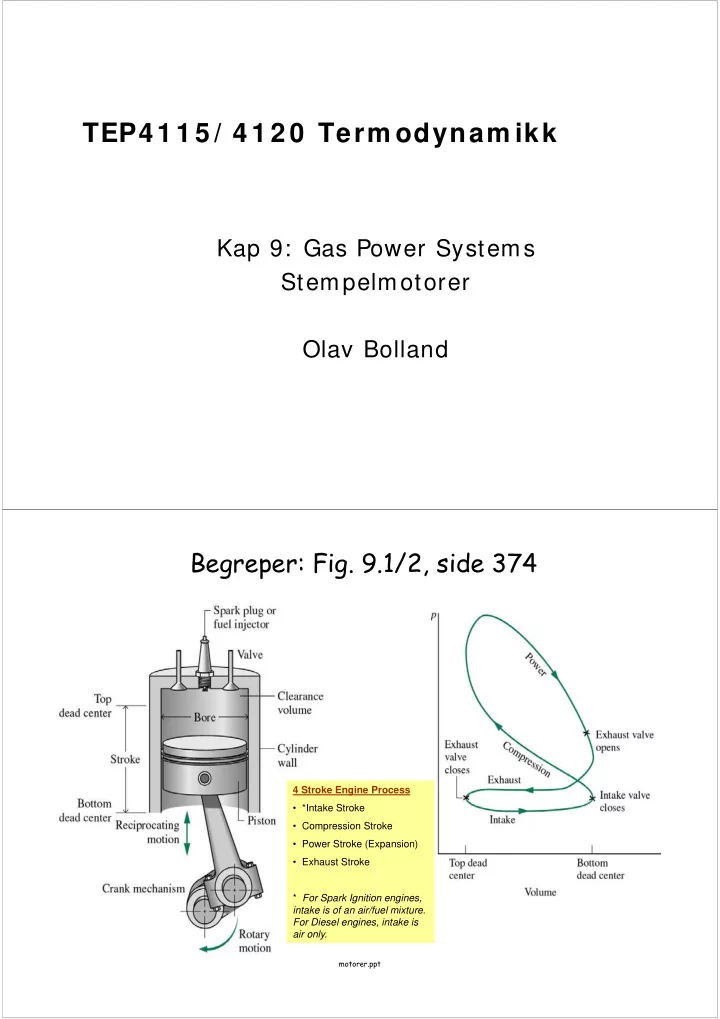
Begreper: Fig. 9.1/2, side 374

4 Stroke Engine Process

  • *Intake Stroke
  • Compression Stroke
  • Power Stroke (Expansion)
  • Exhaust Stroke

* For Spark Ignition engines, intake is of an air/fuel mixture. For Diesel engines, intake is air only.

slide-2
SLIDE 2

motorer.ppt

Work closed/open systems

2 1 2 1 2 2 2 1 1 1 2 2 1 2 1 1 2 1

First law for a closed system: Relating heat to entropy: Q W U U Q T dS T dS dU PdV Q T dS dU pdV U U pdV W U U W pdV                

     

1 2 2 2 2 1 1 1 2 2 1 1 2 2 1 1

First law for an open system (steady-state): Relating heat to entropy: and and dU Q W m h m h dt Q T dS dU pdV T dS dU PdV T dS dH Vdp H U pV dU dH pdV Vdp Q dH V dp Q m dh V dp                        

      

      

2 2 1 1 2 1 2 1

( ) ( ) m h h V dp W m h h W V dp         

 

     

motorer.ppt

Air Standard Analysis

The following assumptions are made:

  • Air, an Ideal Gas, is the working fluid
  • Combustion is replaced with Heat Addition

(see Chap 13 for details)

  • No exhaust and intake strokes – constant

volume heat rejection

  • All processes are internally reversible

For Cold-Air Standard, Specific Heats are also assumed constant
slide-3
SLIDE 3

motorer.ppt

Otto Cycle

4 Internally Reversible Processes:

  • Isentropic Compression
  • Constant Volume Heat Addition
  • Isentropic Expansion
  • Constant Volume Heat Rejection

*Cycle Analysis:

12 1 2

W u u m  

34 3 4

W u u m  

23 3 2

Q u u m  

41 1 4

Q u u m  

* Sign Conventions (Work in negative, etc.) are sometimes changed for cycle applications

  • Fig. 9.3, page 376

Nikolaus August Otto, 1876

motorer.ppt

Diesel Cycles

4 Internally Reversible Processes:

  • Isentropic Compression
  • Constant Pressure Heat Addition
  • Isentropic Expansion
  • Constant Volume Heat Rejection

*Cycle Analysis:

12 1 2

W u u m  

34 3 4

W u u m  

23 3 2

Q h h m  

41 1 4

Q u u m  

 

23 2 3 2

W p v v m  

  • Fig. 9.5, page 406

Rudolf Christian Karl Diesel, 1893

slide-4
SLIDE 4

motorer.ppt

Ottomotor - prinsipp

motorer.ppt

Otto 4-takts motor

slide-5
SLIDE 5

motorer.ppt

Totakts-motor

http://science.howstuffworks.com/two-stroke2.htm

motorer.ppt

Diesel vs Otto

  • Diesel engines, with higher compression ratios (20: 1 for a typical

diesel vs. 8: 1 for a typical gasoline engine), tend to be heavier than an equivalent gasoline engine

  • Diesel engines, because of the high compression ratio, tend to

have lower maximum RPM ranges than gasoline engines. This makes diesel engines high torque rather than high horsepower.

  • Diesel engines must be fuel injected, and in the past fuel

injection was expensive and less reliable

  • Diesel engines tend to produce more smoke and "smell funny"
  • Diesel engines are harder to start in cold weather, and if they

contain glow plugs, diesel engines can require you to wait before starting the engine so the glow plugs can heat up

  • Diesel engines are much noisier and tend to vibrate
slide-6
SLIDE 6

motorer.ppt

Hva er bensin/diesel ?

CmHn bensin (C9H20), diesel (C14H30), paraffin (C12) flytende ved omgivelsestilstand Greit å huske 1 liter bensin = 9.710 kWh varmeverdi (35 MJ) 1 liter diesel = 11.4 11 kWh varmeverdi (41 MJ) 1 Sm3 naturgass  10 kWh varmeverdi Sm3 er vanlig mengdemål for naturgass (trykk 1.013 bar, 15 °C) Nm3 er ellers vanlig mengdemål for gasser (trykk 1.013 bar, 0 °C)

motorer.ppt

Verdens største dieselmotor

Wärtsila-Sulzer RTA96-C Total engine weight: 2300 tons Height: 13.4m Max power: 108920 hp at 102 rpm 81 MW

Emma Maersk 81 MW from RTA96-C 30 MW from 5*Caterpillar 397m long, >1400 containers 157000 tonnes (deadweight)

25.5 knop = 47.2 Km/t

slide-7
SLIDE 7

V-motor (V8)

V16

Rekkemotor (R4)

slide-8
SLIDE 8

motorer.ppt

Stirling motor - prinsipp

motorer.ppt

Stirling motor - prinsipp