
SLIDE 1
1
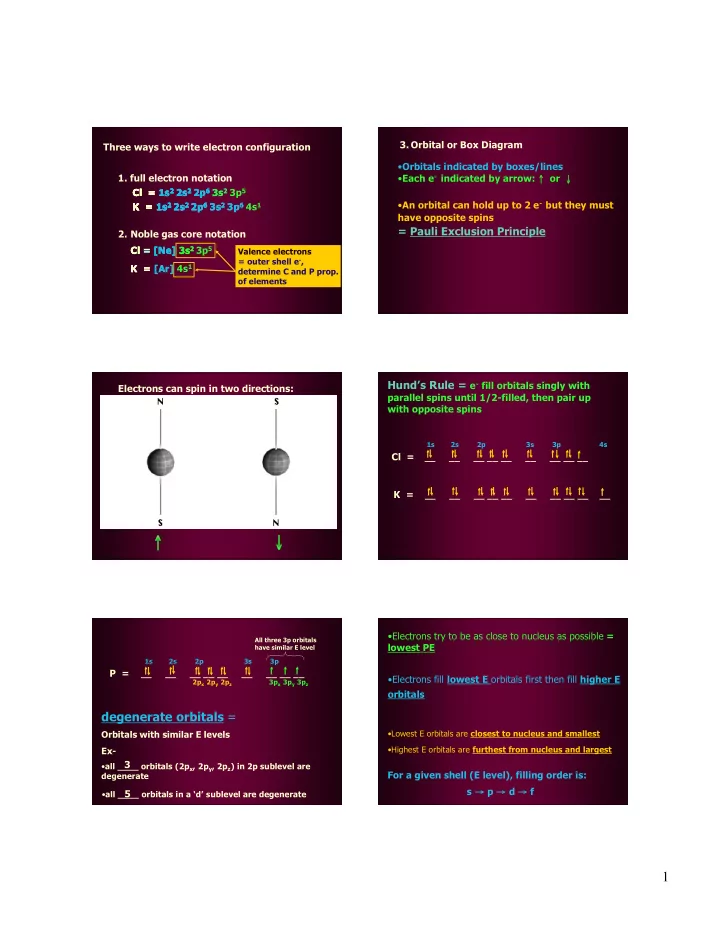
Three ways to write electron configuration
- 1. full electron notation
- 2. Noble gas core notation
K = Cl = 1s2 Cl = 1s2 2s2 Cl = 1s2 2s2 2p6 Cl = 1s2 2s2 2p6 3s2 Cl = 1s2 2s2 2p6 3s2 3p5 K = 1s2 K = 1s2 2s2 K = 1s2 2s2 2p6 K = 1s2 2s2 2p6 3s2 K = 1s2 2s2 2p6 3s2 3p6 K = 1s2 2s2 2p6 3s2 3p6 4s1 Cl = K = Cl = [Ne] Cl = [Ne] 3s2 Cl = [Ne] 3s2 3p5 K = [Ar] K = [Ar] 4s1
Valence electrons = outer shell e-, determine C and P prop.
- f elements
- Orbitals indicated by boxes/lines
- Each e- indicated by arrow: ↑ or ↓
- An orbital can hold up to 2 e- but they must
have opposite spins
= Pauli Exclusion Principle
- 3. Orbital or Box Diagram
Electrons can spin in two directions:
↑ ↓
Hund’s Rule = e- fill orbitals singly with
parallel spins until 1/2-filled, then pair up with opposite spins
1s 2s 2p 3s 3p 4s
__ __ __ __ __ __ __ __ __ Cl = K = __ __ __ __ __ __ __ __ __ __
1s 2s 2p 3s 3p All three 3p orbitals have similar E level 3px 3py 3pz 2px 2py 2pz
degenerate orbitals =
Orbitals with similar E levels Ex-
- all ____ orbitals (2px, 2py, 2pz) in 2p sublevel are
degenerate
3 5
- all ____ orbitals in a ‘d’ sublevel are degenerate
P = __ __ __ __ __ __ __ __ __
- Electrons try to be as close to nucleus as possible =
lowest PE
- Electrons fill lowest E orbitals first then fill higher E
- rbitals
- Lowest E orbitals are closest to nucleus and smallest
- Highest E orbitals are furthest from nucleus and largest