Radiation Where does Radiation Come from? Material Atom Nucleus - - PowerPoint PPT Presentation

radiation where does radiation come from
SMART_READER_LITE
LIVE PREVIEW

Radiation Where does Radiation Come from? Material Atom Nucleus - - PowerPoint PPT Presentation

Radiation Where does Radiation Come from? Material Atom Nucleus Protons Neutrons particles Example of disintegration Two protons Two neutrons Transformation Nucleus Nucleus Nucleus Radium226 Radon222 Nucleus


slide-1
SLIDE 1

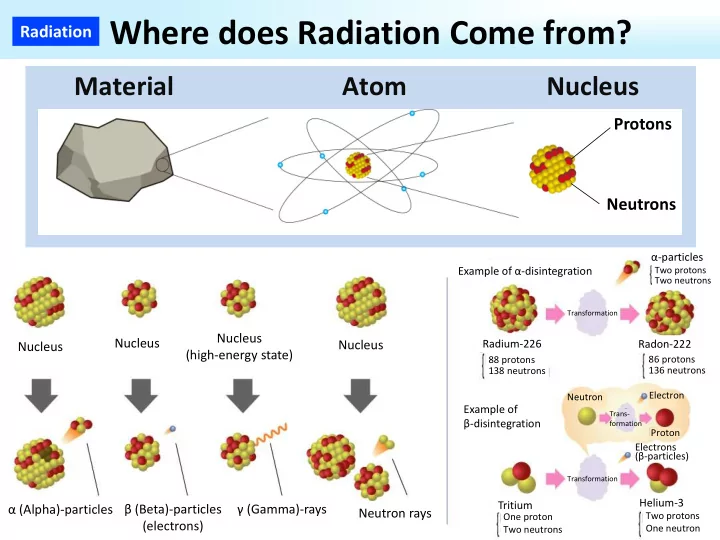
Radiation Where does Radiation Come from?

Material Atom Nucleus

Protons Neutrons

Nucleus Nucleus Nucleus (high‐energy state) Nucleus

Example of α‐disintegration

α (Alpha)‐particles β (Beta)‐particles (electrons) γ (Gamma)‐rays Neutron rays

Radium‐226

88 protons 138 neutrons

Transformation

Two protons Two neutrons

α‐particles Radon‐222

86 protons 136 neutrons

Trans‐ formation

Neutron Electron Proton Electrons (β‐particles)

Transformation

Example of β‐disintegration Tritium

One proton Two neutrons

Helium‐3

Two protons One neutron

slide-2
SLIDE 2

While radiation includes ionizing radiation and nonionizing radiation, radiation usually means ionizing radiation.

Radiation Types of Radiation

Ionizing radiation Particle beams Charged‐particle beams (directly ionizing radiation) α‐particles (helium nuclei ejected from a nucleus) β‐particles (electrons ejected from a nucleus) Proton beams, deuteron beams, triton beams, heavy‐ion beams Charged meson beams Fission fragments, etc. Uncharged particle beams (indirectly ionizing radiation) Uncharged meson beams Neutrino Neutron beams, etc. (produced in nuclear reactors, accelerators, etc.) Electromagnetic waves (indirectly ionizing radiation) X‐rays (generated outside a nucleus) γ‐rays (emitted from a nucleus) Nonionizing radiation Electric waves, microwaves, infrared rays, visible rays, ultraviolet rays, etc. Partially revised "Ionizing Radiation" in the Encyclopedia for Public Acceptance

  • f Atomic Energy Accessible on the Internet, ATOMICA
slide-3
SLIDE 3

Radiation Types of Ionizing Radiation

Ionizing radiation

Radiation that causes ionization Radiation that causes ionization

Particle beams

Protons Neutrons Electrons

Electromagnetic waves

Electrons (β‐particles) α‐particles (helium nuclei ejected from a nucleus) β‐particles (electrons ejected from a nucleus) Neutron beams(produced in nuclear reactors, accelerators, etc.) Proton beams(produced in accelerators, etc.) X‐rays (generated outside a nucleus)

* X‐rays generated when electrons within an atom are caused to travel between orbits by incident electrons are called characteristic X‐rays.

γ‐rays (emitted from a nucleus)

slide-4
SLIDE 4

Radiation X‐rays for Medical Use and Generators

Braking X‐rays

Electrons (β‐particles) Braking X‐rays Structural drawing of an X‐ray generator

Voltage V (several to hundreds of thousands V) Thermal electrons Cathode Anode (Anticathode) Characteristic X‐rays Braking X‐rays

Characteristic X‐rays

Electrons

Characteristic X‐rays

Electron

  • rbits
slide-5
SLIDE 5

1010 108 106 104 102 1 10-2 10-4 10-6 10-8 10-10 10-12 (eV) X‐rays, γ‐rays (Generally, γ‐rays come from within a nucleus, and X‐rays come from outside a nucleus.) Infrared rays Microwaves

Short waves

Medium waves

Long waves 10-16 10-14 10-12 10-10 10-8 10-6 10-4 10-2 1 102 104 106 (m) 1pm 1nm 1μm 1mm 1m 1km

Radiation Types of Electromagnetic Waves

Visible light Energy Ultraviolet rays Electric waves

Ultrashort waves

  • Light has particle properties in

addition to wave properties.

  • Electromagnetic waves are called

"photons" when they are considered as particles.

The values indicated above show photons' energy (eV) and those indicated below show their wavelengths (m) as wave motions. pm: picometers μm: micrometers nm: nanometers eV: electron volts

Direction of the electric field Direction of the magnetic field Direction of propagation of electromagnetic waves Wavelength

slide-6
SLIDE 6

Radiation Ionization of Radiation ‐ Property of Ionizing

Radiation

Electrons Radiation

Separation into positive ions and negative electrons

Ionization

α‐particles γ‐rays

Ejected electrons Atoms turned into positive ions

slide-7
SLIDE 7

+ + - +

Radiation Types of Radiation and Biological Effects

  • α‐particles

‐ Two protons plus two neutrons ‐ Helium (He) nuclei ‐ Charged particles (2+)

High ionization density

  • β‐particles

‐ Electrons (or positrons) ‐ Charged particles (‐ or +)

Low ionization density

  • γ‐rays and X‐rays

‐ Electromagnetic waves (photons)

Low ionization density/high penetrating power

  • Neutron beams

‐ Neutrons ‐ Uncharged particles

High ionization density When the ionization number is the same, the higher the ionization density is, the larger the biological effects are.

slide-8
SLIDE 8

Radiation Penetrating Power of Radiation

Radiation can be blocked by various substances.

Block α‐particles Block β‐particles Weaken γ‐rays and X‐rays α‐particles β‐particles γ‐rays and X‐rays Paper Thin sheet of metal such as aluminum Thick sheet of lead or iron Neutron beams Substance containing hydrogen Such as water or concrete Weaken neutron beams

slide-9
SLIDE 9

Radiation Penetrating Power of Radiation within the Body

Distance traveling in the air 1 to 10 cm Several meters

(depending on the amount

  • f energy)

Several tens of meters

(depending on the amount of energy)

α‐particles

Particles (Helium nucleus)

(One‐trillionth of a centimeter)

β‐particles

Particles (electrons)

γ‐rays X‐rays

Upon collision with the body

Several to several tens of micro meters Several millimeters Several centimeters ‐

(depending on the amount of energy)

slide-10
SLIDE 10

Radiation Penetrating Power and Range of Effects on the

Human Body

When radioactive materials are located outside the body When radioactive materials are located within the body Outside the body Within the body Affected part Organs, etc.

α‐particles β‐particles γ‐rays

Within the body Outside the body

α‐particles β‐particles γ‐rays

Radioactive materials in the tissues Peripheral tissues