
SLIDE 1
Signals and the frequency domain
ENGR 40M lecture notes — July 31, 2017 Chuan-Zheng Lee, Stanford University A signal is a function, in the mathematical sense, normally a function of time. We often refer to functions as signals to convey that the function represents some sort of phenomenon—for example, an audio signal, the electromagnetic signal broadcast in FM radio, a currency exchange rate, or the voltage somewhere in a circuit. One of the great advances of the 19th century was courtesy of a French mathematician called Joseph Fourier, who showed in his work about heat flow that representing a signal as a sum of sinusoids opens the door to more powerful analytical tools. This idea gave rise to what is now known as the frequency domain, where we think of signals as a function of frequency, as opposed to a function of time. Our goal today is to define, in some sense, what that means.
Preliminaries
Periodic signals. At least to begin, we’ll mainly be concerned with signals that are periodic. Informally, a periodic signal is one that repeats, over and over, forever. To be more precise: A signal x(t) is said to be periodic if there exists some number T such that, for all t, x(t) = x(t+T). The number T is known as the period of the signal. The smallest T satisfying x(t) = x(t + T) is known as the fundamental period.
- Sinusoids. Precisely what do we mean by a sinusoid? The term “sinusoid” means a sine wave, but we don’t
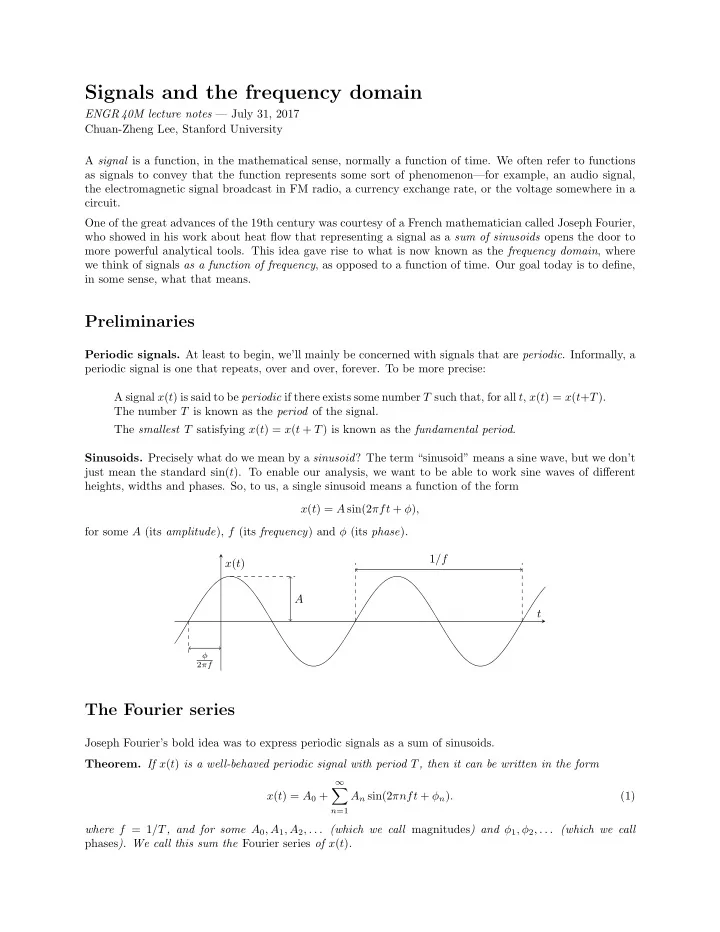
just mean the standard sin(t). To enable our analysis, we want to be able to work sine waves of different heights, widths and phases. So, to us, a single sinusoid means a function of the form x(t) = A sin(2πft + φ), for some A (its amplitude), f (its frequency) and φ (its phase). A 1/f
φ 2πf
t x(t)
The Fourier series
Joseph Fourier’s bold idea was to express periodic signals as a sum of sinusoids.
- Theorem. If x(t) is a well-behaved periodic signal with period T, then it can be written in the form
x(t) = A0 +
∞
- n=1