SLIDE 1 CPSC-313: Introduction to Computer Systems Asynchronous Events: Signals 1
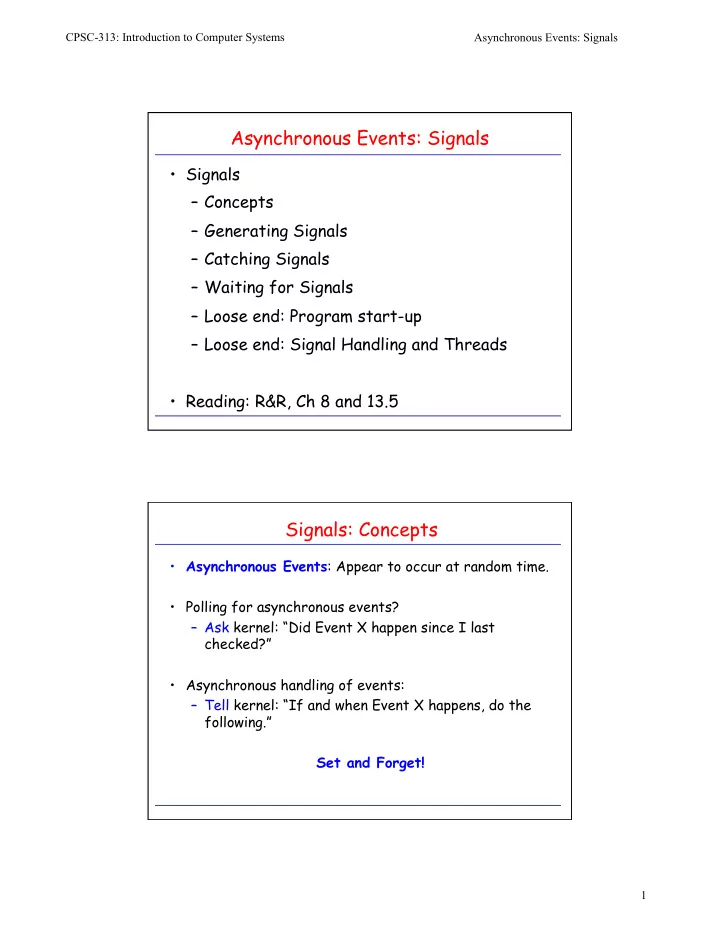
Asynchronous Events: Signals
–Concepts –Generating Signals –Catching Signals –Waiting for Signals –Loose end: Program start-up –Loose end: Signal Handling and Threads
- Reading: R&R, Ch 8 and 13.5
Signals: Concepts
- Asynchronous Events: Appear to occur at random time.
- Polling for asynchronous events?
– Ask kernel: “Did Event X happen since I last checked?”
- Asynchronous handling of events:
– Tell kernel: “If and when Event X happens, do the following.” Set and Forget!
SLIDE 2
CPSC-313: Introduction to Computer Systems Asynchronous Events: Signals 2
Conditions that Generate Signals
Terminal-generated signals: triggered when user presses certain key on terminal. (e.g. SIGINT and ^C) Hardware-exception generated signals: Hardware detects condition and notifies kernel. (e.g. SIGFPE divide by 0, SIGSEGV invalid memory reference) kill(2) function: Sends any signal to another process. kill(1) command: The command-line interface to kill (2). Software-condition generated signals: Triggered by software event (e.g. SIGURG by out-of-band data on network connection, SIGPIPE by broken pipe, SIGALRM by timer)
“Disposition” of the Signal
Tell the kernel what to do with a signal: 1.Ignore the signal. Works for most signals. Does not work for SIGKILL and SIGSTOP. Unwise to ignore hardware exception signals. 2.Catch the signal. Tell the kernel to invoke a given function whenever signal occurs. Example: Write signal handler for SIGTERM to clean up after program when it is terminated. 3.Default action. All signals have a default action.
SLIDE 3 CPSC-313: Introduction to Computer Systems Asynchronous Events: Signals 3
Signals and their Default Actions (Mac OS X)
No Name Default Action Description 1 SIGHUP terminate process terminal line hangup 2 SIGINT terminate process interrupt program 3 SIGQUIT create core image quit program 4 SIGILL create core image illegal instruction 5 SIGTRAP create core image trace trap 6 SIGABRT create core image abort program (formerly SIGIOT) 7 SIGEMT create core image emulate instruction executed 8 SIGFPE create core image floating-point exception 9 SIGKILL terminate process kill program 10 SIGBUS create core image bus error 11 SIGSEGV create core image segmentation violation 12 SIGSYS create core image non-existent system call invoked 13 SIGPIPE terminate process write on a pipe with no reader 14 SIGALRM terminate process real-time timer expired 15 SIGTERM terminate process software termination signal 16 SIGURG discard signal urgent condition present on socket No Name Default Action Description 17 SIGSTOP stop process stop (cannot be caught
18 SIGTSTP stop process stop signal generated from keyboard 19 SIGCONT discard signal continue after stop 20 SIGCHLD discard signal child status has changed 21 SIGTTIN stop process background read attempted from control terminal 22 SIGTTOU stop process background write attempted to control terminal 23 SIGIO discard signal I/O is possible on a descriptor (see fcntl(2)) 24 SIGXCPU terminate process cpu time limit exceeded (see setrlimit(2)) 25 SIGXFSZ terminate process file size limit exceeded (see setrlimit(2)) 26 SIGVTALRM terminate process virtual time alarm (see setitimer(2)) 27 SIGPROF terminate process profiling timer alarm (see setitimer(2)) 28 SIGWINCH discard signal Window size change 29 SIGINFO discard signal status request from keyboard 30 SIGUSR1 terminate process User defined signal 1 31 SIGUSR2 terminate process User defined signal 2
/* example: send signal SIGUSR1 to process 1234 */ if (kill(1234, SIGUSR1) == -1) perror(“Failed to send SIGUSR1 signal”); /* example: kill parent process */ if (kill(getppid(), SIGTERM) == -1) perror(“Failed to kill parent”);
Generating Signals: kill(2) and raise(3)
#include <signal.h> int kill(pid_t pid, int sig); /* send signal ‘sig’ to process ‘pid’ */ #include <signal.h> int raise(int sig); /* Sends signal ‘sig’ to itself. Part of C library! */
SLIDE 4
CPSC-313: Introduction to Computer Systems Asynchronous Events: Signals 4
The prototype can be simplified through the use of a typedef as follows: typedef void Sigfunc(int); Sigfunc * signal(int, Sigfunc*); In English: “The function signal takes two arguments: an integer and a pointer to a function that takes an integer and returns nothing. The function signal itself returns a pointer to a function that takes an integer as argument and returns nothing.”
“Catching” Signals: Signal Handlers
#include <signal.h> void (*signal(int signo, void (*func)(int)))(int); #define SIG_ERR (void(*)())-1 #define SIG_DFL (void(*)())0 #define SIG_IGN (void(*)())+1 defining signal handlers the old-fashioned way…
Simple Signal Handling: Example
static void sig_usr(int); /* one handler for two signals */ int main (void) { if (signal(SIGUSR1, sig_usr) == SIG_ERR) perror(“cannot catch signal SIGUSR1”); if (signal(SIGUSR2, sig_usr) == SIG_ERR) perror(“cannot catch signal SIGUSR2”); for(;;) pause(); } static void sig_usr(int signo) { /*argument is signal number*/ if (signo == SIGUSR1) printf(“received SIGUSR1\n”); else if (signo == SIGUSR2) printf(“received SIGUSR2\n”); else error_dump(“received signal %d\n”, signo); return; }
SLIDE 5 CPSC-313: Introduction to Computer Systems Asynchronous Events: Signals 5
Modern Signal Handling: sigaction()
#include <signal.h> int sigaction (int signo, const struct sigaction * act, struct sigaction * oact); /* install new signal handler from ‘act’, return old signal handler in ‘oact’. */ struct sigaction { void (*sa_handler)(int); /* SIG_DFL, SIG_IGN
sigset_t sa_mask; /* signals to block */ int sa_flags; /* flags and options */ void (*sa_sigaction)(int, siginfo_t *, void *); } /* real-time handler */ struct sigaction new_act; /* set sighandler for SIGINT */ new_act.sa_handler = mysighandler; /* set new handler */ new_act.sa_flags = 0; /* no special options */ if ((sigemptyset(&new_act.sa_mask) == 1) /* clear mask */ ||(sigaction(SIGINT, &new_act, NULL) == -1)) perror(“Failed to install SIGINT signal handler.”);
“real-time” Signals: Handling Memory Errors
/* -- SET FAULT HANDLER */ struct sigaction act; act.sa_sigaction = SIGSEGV_handler; sigemptyset(&act.sa_mask); act.sa_flags = SA_SIGINFO; if (sigaction(SIGSEGV, &act, &oact) < 0) perror("sigaction"); /* -- SEGMENTATION FAULT HANDLER */ static void SIGSEGV_handler(int sig, siginfo_t * info, void * d) { if (info->si_signo == SIGSEGV) printf("SIGSEGV\n"); else printf("*** other ***\n"); printf("signal code "); if (info->si_code == SEGV_ACCERR) printf("SEGV_ACCERR\n"); else printf("**** other *****\n"); printf("address %u\n", (unsigned long)(info->si_addr)); do_something(info->si_addr); }
SLIDE 6 CPSC-313: Introduction to Computer Systems Asynchronous Events: Signals 6
Need more Details?!! : ucontext
/* -- SEGMENTATION FAULT HANDLER */ static void SIGSEGV_handler(int sig, siginfo_t * info, ucontext_t * uc){ [. . . ] /* -- IDENTIFY INSTRUCTION THAT CAUSED FAULT */ unsigned long pc, *pcptr, instruction; #if defined(SOLARIS) pc = (unsigned long) uc->uc_mcontext.gregs[1]; pcptr = (unsigned long *) pc; instruction = *pcptr; #endif /* -- READ OR WRITE OPERATION? */ read_fault = LOAD_INSTRUCTION(instruction); write_fault = STORE_INSTRUCTION(instruction); [ . . . ] }
Signals: Terminology
- A signal is generated for a process when event that causes the signal
- ccurs. (Hardware exception, software condition, etc.)
- A signal is delivered when action for a signal is taken.
- During the time between generation and delivery, signal is pending.
- A process has the option of blocking the delivery of a signal.
– Signal remains blocked until process either (a) unblocks the signal, or (b) changes the action to ignore the signal.
- The system determines what to do with a blocked signal when the signal
is delivered, not when it is generated.
- What happens when blocked signal is generated more than once? (If
system delivers the signal more than once, the signal is queued. -- not done in most UNIX systems)
- What happens when more than one signal is ready to be delivered to a
process? (POSIX does not specify order, but Rationale suggests that signals related to current state be delivered first)
- signal mask to control set of signals that are blocked from delivery.
SLIDE 7 CPSC-313: Introduction to Computer Systems Asynchronous Events: Signals 7
Blocking Signals
blocking signals vs. ignoring signals
#include <signal.h> /* manipulate sets of signals */ int sigaddset(sigset_t *set, int signo); int sigdelset(sigset_t *set, int signo); int sigemptyset(sigset_t *set); int sigfillset(sigset_t *set); int sigismember (const sigset_t *set, int signo); #include <signal.h> /* modify signal mask */ int sigprocmask( int how, const sigset_t * set, sigset_t * oset);
/* the “how” parameter: SIG_BLOCK : add collection of signals to those already blocked. SIG_UNBLOCK : delete a collection of signals from those currently blocked. SIG_SETMASK : set the collection of blocked signals to given set. */
Waiting for Signals
- Typically, signal interrupts process execution to handle
asynchronous event.
- What if process has nothing else to do?!
#include <signal.h> /* wait for signal */ int pause(void);
SLIDE 8 CPSC-313: Introduction to Computer Systems Asynchronous Events: Signals 8
How do we wait for particular Signal?
/* Approach 1, using a global variable (buggy!) */ /* Have the signal handler set quitflag to 1. */ static volatile sig_atomic_t quitflag = 0; while (quitflag == 0) pause(); /* ?! */ /* Approach 2, using global variable (also buggy!) */ /* Have the sighandler set quitflag to 1. */ static volatile sig_atomic_t quitflag = 0; int signum; sigset_t sigset; sigemptyset(&sigset); sigaddset(&sigset, signum); sigprocmask(SIG_BLOCK, &sigset, NULL); while (quitflag == 0) pause(); /* ?! */
Waiting for specific Signal(s)
- 1. The signal mask of process is set to sigmask.
- 2. Process is suspended until a signal is caught or until a signal occurs
that terminates process.
- 3. If signal is caught and if signal handler returns, then
- 1. sigsuspend returns
- 2. signal mask of process is set to value before the call to
sigsuspend. #include <signal.h> int sigsuspend(const sigset_t * sigmask);
SLIDE 9
CPSC-313: Introduction to Computer Systems Asynchronous Events: Signals 9
How do we wait for Particular Signal? (2)
/* Correct approach */ static volatile sig_atomic_t quitflag = 0; signal(SIGINT, sig_int); signal(SIGQUIT, sig_int); sigemptyset(&zeromask); sigemptyset(&newmask); sigaddset(&newmask, SIGQUIT); /* block SIGQUIT and save current signal mask */ sigprocmask(SIG_BLOCK, &newmask, &oldmask); while (quitflag == 0) sigsuspend(&zeromask); /* SIGQUIT has been caught and is now blocked; do whatever */ quitflag = 0; /* reset signal mask, which unblocks SIGQUIT */ sigprocmask(SIG_SETMASK, &oldmask, NULL) void sig_int(int signo) {/* signal handler */ if (signo == SIGINT) printf(“\ninterrupt\n”); else if (signo == SIGQUIT) quitflag = 1; return; }
Example: Protect Crit. Section from particular Signal
sigset_t newmask, oldmask, zeromask; signal(SIGINT, sig_int); sigemptyset(&zeromask); sigemptyset(&newmask); sigaddset (&newmask, SIGINT); /* block SIGINT and save current signal mask */ sigprocmask(SIG_BLOCK, &newmask, &oldmask); critical_section(); /* allow all signals and pause */ sigsuspend(&zeromask); /* reset signal mask, which unblocks SIGINT */ sigprocmask(SIG_SETMASK, &oldmask, NULL); /* … and continue processing */
SLIDE 10 CPSC-313: Introduction to Computer Systems Asynchronous Events: Signals 10
Signal Disposition on Program Start-up
- When program starts (“is execed”) the status of all
signals is either default or ignore.
- If process calling exec is ignoring signal, child ignores
it as well.
- Example: Interactive shell and background processes.
cc main.c &
- Process Creation (fork())
– Child inherits parent’s disposition. – Also inherits the parent’s signal handlers.
Signal Handling and Threads
- All threads in process share signal handlers.
- Signal delivery:
– synchronous: delivered to thread that caused it. – asynchronous: delivered to some thread that has it unblocked. – directed: delivered to specific thread.
- Directed signal delivery:
#include <signal.h> #include <pthread.h> int pthread_kill(pthread_t thread, int sig); if (pthread_kill(pthread_self(), SIGKILL)) cerr << “Failed to commit suicide\n”);
SLIDE 11 CPSC-313: Introduction to Computer Systems Asynchronous Events: Signals 11
Signal Handling and Threads (II)
- Masking signals for threads.
– Rule of thumb: use sigprocmask in main thread, and then use pthread_sigmask().
- General approach to signal handling in multithreaded
programs: – Dedicate particular threads to signal handling
- Simpler to localize
- Simpler to control the priority and scheduling of
signals.