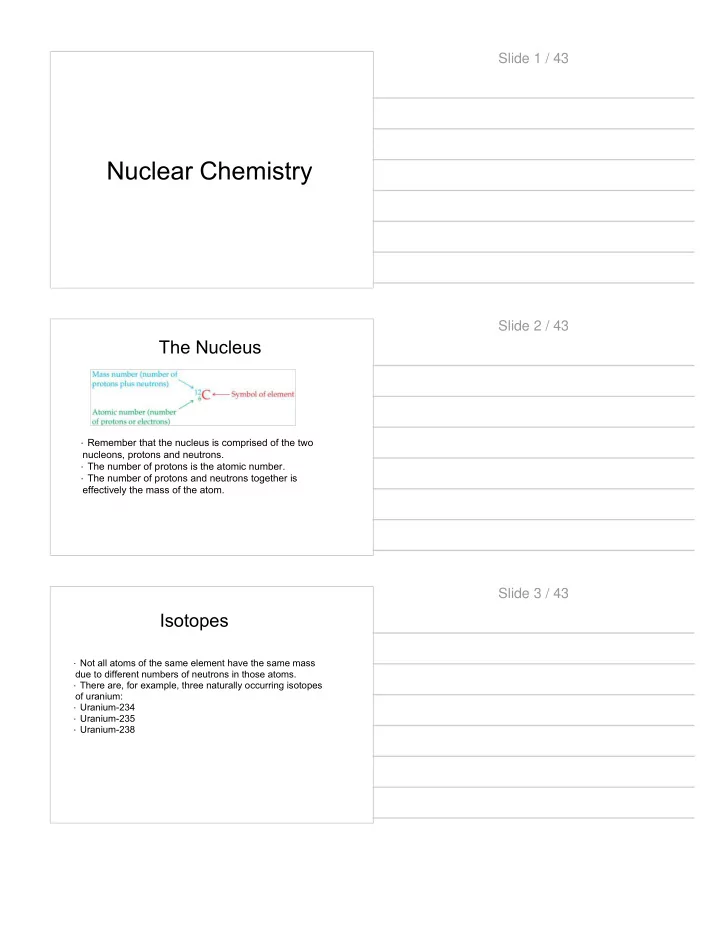
Nuclear Chemistry Slide 2 / 43 The Nucleus Remember that the - - PDF document

nuclear chemistry
SMART_READER_LITE
LIVE PREVIEW

Nuclear Chemistry Slide 2 / 43 The Nucleus Remember that the - - PDF document

Slide 1 / 43 Nuclear Chemistry Slide 2 / 43 The Nucleus Remember that the nucleus is comprised of the two nucleons, protons and neutrons. The number of protons is the atomic number. The number of protons and neutrons together is


slide-1
SLIDE 1

Nuclear Chemistry

Slide 1 / 43

The Nucleus

· Remember that the nucleus is comprised of the two nucleons, protons and neutrons. · The number of protons is the atomic number. · The number of protons and neutrons together is effectively the mass of the atom.

Slide 2 / 43

Isotopes

· Not all atoms of the same element have the same mass due to different numbers of neutrons in those atoms. · There are, for example, three naturally occurring isotopes

  • f uranium:

· Uranium-234 · Uranium-235 · Uranium-238

Slide 3 / 43

slide-2
SLIDE 2

Radioactivity

· It is not uncommon for some nuclides of an element to be unstable, or radioactive. · We refer to these as radionuclides. · There are several ways radionuclides can decay into a different nuclide.

Slide 4 / 43

Types of Radioactive Decay

Slide 5 / 43

Alpha Decay

Alpha decay is the loss of an α-particle (a helium

nucleus).

He

4 2

U ➝ U + He

238 92 234 90 4 2

Slide 6 / 43

slide-3
SLIDE 3

Beta Decay

Beta decay is the loss of a β-particle (a high energy electron).

e β

  • 1
  • r 0
  • 1

I ➝ Xe + e

131 53 131 54

  • 1

Slide 7 / 43

Positron Emission

Some nuclei decay by emitting a positron, a particle that has the same mass as but an opposite charge to that of an electron.

C ➝ B + e

11 6 131 54 1 1e

Slide 8 / 43

Gamma Emission

This is the loss of a g-ray, which is high-energy radiation that almost always accompanies the loss of a nuclear particle.

#

Slide 9 / 43

slide-4
SLIDE 4

Electron Capture (K-Capture)

Addition of an electron to a proton in the nucleus is known

as electron capture or K-capture. · The result of this process is that a proton is transformed into a neutron.

p + e ➝ n

1 1 1

  • 1

1 Slide 10 / 43

Neutron-Proton Ratios

· Any element with more than

  • ne proton (i.e., anything but

hydrogen) will have repulsions between the protons in the nucleus. · A strong nuclear force helps keep the nucleus from flying apart.

Slide 11 / 43

Neutron-Proton Ratios

· Neutrons play a key role stabilizing the nucleus. · Therefore, the ratio of neutrons to protons is an important factor.

Slide 12 / 43

slide-5
SLIDE 5

Neutron-Proton Ratios

For smaller nuclei (Z £

20) stable nuclei have a neutron-to-proton ratio close to 1:1.

Slide 13 / 43

Neutron-Proton Ratios

As nuclei get larger, it takes a greater number of neutrons to stabilize the nucleus.

Slide 14 / 43 Slide 15 / 43

slide-6
SLIDE 6

Stable Nuclei

The shaded region in the

figure, the so-called belt of stability, shows what nuclides would be stable.

Slide 16 / 43

Stable Nuclei

· Nuclei above this belt have too many neutrons. · They tend to decay by emitting beta particles.

Slide 17 / 43

Stable Nuclei

· Nuclei below the belt have too many protons. · They tend to become more stable by positron emission or electron capture.

Slide 18 / 43

slide-7
SLIDE 7

Stable Nuclei

· There are no stable nuclei with an atomic number greater than 83. · Nuclei with such large atomic numbers tend to decay by alpha emission.

Slide 19 / 43

Radioactive Series

· Large radioactive nuclei cannot stabilize by undergoing only one nuclear transformation. · They undergo a series of decays until they form a stable nuclide (often a nuclide

  • f lead).

Slide 20 / 43

Some Trends

Nuclei with 2, 8, 20, 28,

50, or 82 protons or 2, 8, 20, 28, 50, 82, or 126 neutrons tend to be more stable than nuclides with a different number of nucleons.

Slide 21 / 43

slide-8
SLIDE 8

Some Trends

Nuclei with an even number of protons and neutrons tend to be more stable than nuclides that have odd numbers of these nucleons.

Slide 22 / 43

Nuclear Transformations

Nuclear transformations can be induced by accelerating a particle and colliding it with the nuclide.

Slide 23 / 43

Particle Accelerators

These particle accelerators are enormous, having circular

tracks with radii that are miles long.

Slide 24 / 43

slide-9
SLIDE 9

Kinetics of Radioactive Decay

· Nuclear transmutation is a first-order process. · The kinetics of such a process, you will recall, obey this equation:

ln = -kt N t Slide 25 / 43

Kinetics of Radioactive Decay

· The half-life of such a process is: Comparing the amount of a radioactive nuclide present at a given point in time with the amount normally present, one can find the age of an object.

= t1/2 0.693 k Slide 26 / 43

Measuring Radioactivity

· One can use a device like this Geiger counter to measure the amount of activity present in a radioactive sample. · The ionizing radiation creates ions, which conduct a current that is detected by the instrument.

Slide 27 / 43

slide-10
SLIDE 10

Kinetics of Radioactive Decay

A wooden object from an archeological site is subjected to radiocarbon dating. The activity of the sample that is due to 14C is measured to be 11.6 disintegrations per second. The activity of a carbon sample of equal mass from fresh wood is 15.2 disintegrations per second. The half-life of 14C is 5715 yr. What is the age of the archeological sample?

Slide 28 / 43

Kinetics of Radioactive Decay

First we need to determine the rate constant, k, for the process.

= t1/2 0.693 k = 5715 yr 0.693 k = k 0.693 5715 1.21x10⁴ yr-1 = k Slide 29 / 43

Kinetics of Radioactive Decay

Now we can determine t: ln = -kt Nt N0 ln = -1.21x10⁴ 11.6 15.2 ln 0.763 = -1.21x10⁴ 6310 yr = t

Slide 30 / 43

slide-11
SLIDE 11

Energy in Nuclear Reactions

· There is a tremendous amount of energy stored in nuclei. · Einstein’s famous equation, E = mc2, relates directly to the calculation of this energy.

Slide 31 / 43

Energy in Nuclear Reactions

· In the types of chemical reactions we have encountered previously, the amount of mass converted to energy has been minimal. · · However, these energies are many thousands of times greater in nuclear reactions.

Slide 32 / 43

Energy in Nuclear Reactions

For example, the mass change for the decay of 1 mol of uranium-238 is −0.0046 g. The change in energy, ΔE, is then ΔE = (Δm) c2 ΔE = (−4.6 x 10⁻⁶ kg)(3.00 x 10⁸ m/s)2 ΔE = −4.1 x 10¹¹ J

Slide 33 / 43

slide-12
SLIDE 12

Nuclear Fission

· How does one tap all that energy? · Nuclear fission is the type of reaction carried out in nuclear reactors.

Slide 34 / 43

Nuclear Fission

· Bombardment of the radioactive nuclide with a neutron starts the process. · Neutrons released in the transmutation strike other nuclei, causing their decay and the production of more neutrons.

Slide 35 / 43

Nuclear Fission

This process continues in what we call a nuclear

chain reaction.

Slide 36 / 43

slide-13
SLIDE 13

Nuclear Fission

If there are not enough radioactive nuclides in the path of the ejected neutrons, the chain reaction will die out.

Slide 37 / 43

Nuclear Fission

Therefore, there must be a certain minimum amount of fissionable material present for the chain reaction to be sustained: critical mass.

Slide 38 / 43

Nuclear Reactors

In nuclear reactors the heat generated by the reaction is

used to produce steam that turns a turbine connected to a generator.

Slide 39 / 43

slide-14
SLIDE 14

Nuclear Reactors

· The reaction is kept in check by the use of control rods. · These block the paths of some neutrons, keeping the system from reaching a dangerous supercritical mass.

Slide 40 / 43

Nuclear Fusion

· Fusion would be a superior method

  • f generating power.

· The good news is that the products

  • f the reaction are not radioactive.

· The bad news is that in order to achieve fusion, the material must be in the plasma state at several million kelvins.

Slide 41 / 43

Nuclear Fusion

· Tokamak apparati like the one shown at the right show promise for carrying out these reactions. · They use magnetic fields to heat the material.

Slide 42 / 43

slide-15
SLIDE 15

Slide 43 / 43