SLIDE 2 ATI TEAS SCIENCE – CHEMISTRY
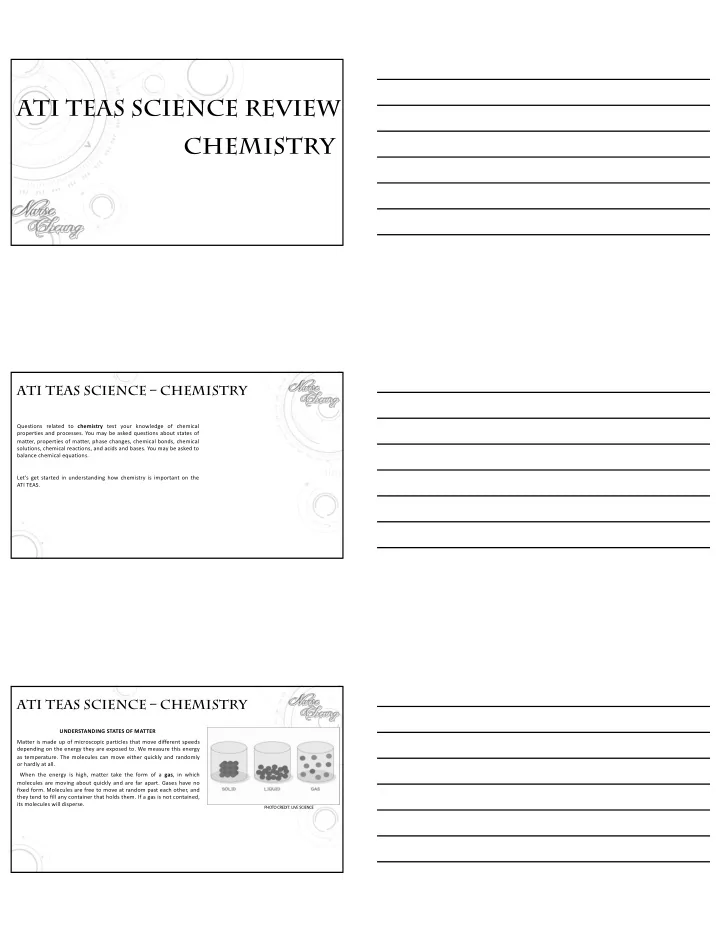
UNDERSTANDING STATES OF MATTER Lower temperatures result in a liquid, in which molecules cohere but are fluid. Coherence means that the molecules remain close together, but they can change position by sliding over one another. In liquids, molecules move less freely than in a gaseous state, sliding past one
- another. They have a fixed volume but will flow freely unless they fill a
portion of a container. When the temperature is low, matter takes the form of a solid, in which molecules are packed closely together and retain their positions. Solid matter is rigid, and molecules retain a uniform spacing. A solid has a defined form, which is brittle. It can be broken into pieces but tends to stay together. A somewhat unusual state of matter is plasma, which is like a gas in many of its properties but carries an electric charge. The TEAS focus on solids, liquids, and gases.
PHOTO CREDIT: LIVE SCIENCE
ATI TEAS SCIENCE – CHEMISTRY
UNDERSTANDING CHANGES IN STATE OF MATTER The state of matter depends on temperature and pressure. Higher temperatures cause molecules to energize and move farther apart. Increasing pressure forces molecules closer together. Melting is the phase change from solid to liquid and boiling is the phase change from liquid to gas. There is also a direct change from solid to gas known as
- sublimation. The phase change from gas to liquid is condensation and
the change from liquid to solid is freezing. A direct change from gas to solid is deposition.
PHOTO CREDIT: VECTORSTOCK
ATI TEAS SCIENCE – CHEMISTRY
UNDERSTANDING PROPERTIES OF MATTER All types of matter can be described in terms of the physical and chemical properties each substance has. Physical properties are observable and there is an extensive list of physical properties that one could observe about a substance. A few examples are density, the temperatures at which the substance undergoes phase changes, malleability, conductivity, specific heat capacity, mass, volume, color, and many other properties. Physical properties are further divided into intensive and extensive properties. An intensive property does not depend on the size or amount of matter in the
- bject, while an extensive property does depend on the
amount of matter in the object. For example, mass is extensive because the measurement would change the size of the sample. Boiling point is intensive because the temperature at which the object boils is not dependent on its volume.
PHOTO CREDIT: THOUGHTCO